SUBSCRIBE TO OUR FREE NEWSLETTER
Daily news & progressive opinion—funded by the people, not the corporations—delivered straight to your inbox.
5
#000000
#FFFFFF
To donate by check, phone, or other method, see our More Ways to Give page.
Daily news & progressive opinion—funded by the people, not the corporations—delivered straight to your inbox.
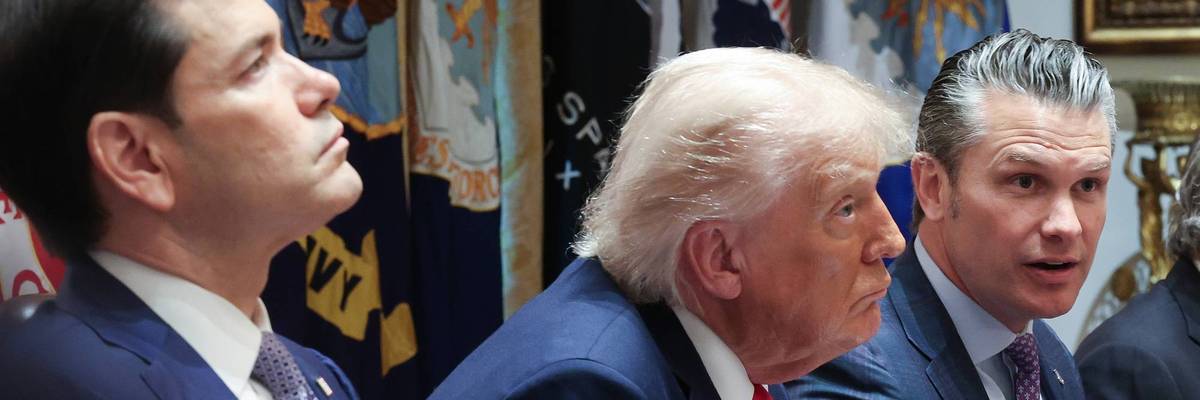
US Secretary of State Marco Rubio, President Donald Trump, and Pentagon chief Pete Hegseth attend a Cabinet meeting at the White House on May 27, 2026 in Washington, DC.
The US attack came as Secretary of State Marco Rubio announced a trilateral agreement with Israel and Lebanon, which Israeli forces have bombed and occupied throughout the Iran War.
US President Donald Trump resumed bombing Iran on Friday, a day after an Iranian attack on a cargo ship in the Strait of Hormuz, elevating concerns about the future of a ceasefire agreement just as Israel and Lebanon signed a related deal.
The Trump administration—which partnered with Israel to launch an illegal war on Iran in late February—and the Iranian government agreed on a memorandum of understanding (MOU) earlier this month. On Thursday, Iran attacked the Singapore-flagged commercial vessel, the Ever Lovely, in the strait, a key trade waterway.
"The Islamic Republic of Iran shot at least four One Way Attack Drones at Ships transversing the Strait of Hormuz," Trump wrote on his Truth Social platform Friday morning. "One of the Drones solidly hit the upper deck of a large and very expensive Cargo Carrying Ship. Damage was done, but the Ship was able to proceed on its way. We knocked down three other Drones. Obviously, this is a foolish violation of our Ceasefire Agreement."
Responding on the social media network X, Ebrahim Azizi, who heads the Iranian Parliament's Commission on National Security and Foreign Policy, said: "The reality in the Persian Gulf has changed. The Strait of Hormuz is governed by Iran, so: Respect the rules. Use secure routes. Do not mistake control for escalation. If you do not learn the rules, the Iranian armed forces will teach them to you. This is not a violation of the ceasefire; it is ceasefire management."
Later Friday, US Central Command (CENTCOM) announced that "as a powerful response to yesterday's attack on a commercial ship that was transiting the Strait of Hormuz," American aircraft "struck Iranian missile and drone storage locations and coastal radar sites."
"The unwarranted aggression against commercial shipping by Iranian forces clearly violated the ceasefire," CENTCOM said. "Furthermore, Iran's dangerous behavior undermined freedom of navigation as commerce increasingly flows through the vital international trade corridor."
"CENTCOM forces continue to provide safe passage coordination and support to commercial vessels transiting the strait," Central Command added. "The US military remains present and vigilant to ensure all aspects of the agreement with Iran are adhered to, obeyed, and in full force and effect."
Flagging CENTCOM's announcement, the National Iranian American Council (NIAC) pointed out that "this marks the first publicly acknowledged US military action against Iran since the recent ceasefire agreement, potentially representing the most serious test yet of the fragile understanding between Tehran and Washington."
"Notably, the alleged violation of the MOU resulted in military retaliation," NIAC added, "contra coordination via the executive mechanism that was supposed to be established to monitor implementation of the deal."
Al Jazeera reported late Friday that Iran's Islamic Revolutionary Guard Corps (IRGC) released a statement saying it has responded with fire:
The IRGC said its Navy targeted locations in the region where US forces are deployed, without specifying where or providing additional details.
It condemned the US strikes on Iran, saying Washington, "as always, violated its commitments and launched an airstrike” on the Iranian coast.
"According to Article 5 of the memorandum of understanding, Islamabad has arrangements for controlling traffic in the Strait of Hormuz with the Islamic Republic of Iran," the IRGC said.
"However, the US, by inciting various parties, sought to violate this commitment, which was met with the necessary response," the statement continued. "If the aggression is repeated, our response will be more extensive."
As for the administration's supposedly diplomatic efforts, US Secretary of State Marco Rubio announced that the United States, Israel, and Lebanon—which Israeli forces have been bombing throughout the Iran War—had signed a trilateral framework that he claimed "builds a realistic path out of endless conflict."
"This agreement establishes a clear and structured process to restore Lebanon’s sovereignty, disarm Hezbollah, and dismantle its terrorist infrastructure, and enable Israel to return to its borders once that threat to its citizens is removed," Rubio said. "It also creates a trilateral Military Coordination Group for Lebanon (MCG4L), facilitated by the United States, allowing the two sides to implement this framework. For Lebanon, this framework provides a genuine pathway out of a long crisis. For Israel, it creates a verifiable path to removing the persistent threat on its northern border."
The framework was met with protests in the Lebanese capital. Lebanon's National News Agency reported that Hezbollah supporters gathered on motorcycles in Beirut to oppose the deal.
Dear Common Dreams reader, It’s been nearly 30 years since I co-founded Common Dreams with my late wife, Lina Newhouser. We had the radical notion that journalism should serve the public good, not corporate profits. It was clear to us from the outset what it would take to build such a project. No paid advertisements. No corporate sponsors. No millionaire publisher telling us what to think or do. Many people said we wouldn't last a year, but we proved those doubters wrong. Together with a tremendous team of journalists and dedicated staff, we built an independent media outlet free from the constraints of profits and corporate control. Our mission has always been simple: To inform. To inspire. To ignite change for the common good. Building Common Dreams was not easy. Our survival was never guaranteed. When you take on the most powerful forces—Wall Street greed, fossil fuel industry destruction, Big Tech lobbyists, and uber-rich oligarchs who have spent billions upon billions rigging the economy and democracy in their favor—the only bulwark you have is supporters who believe in your work. But here’s the urgent message from me today. It's never been this bad out there. And it's never been this hard to keep us going. At the very moment Common Dreams is most needed, the threats we face are intensifying. We need your support now more than ever. We don't accept corporate advertising and never will. We don't have a paywall because we don't think people should be blocked from critical news based on their ability to pay. Everything we do is funded by the donations of readers like you. When everyone does the little they can afford, we are strong. But if that support retreats or dries up, so do we. Will you donate now to make sure Common Dreams not only survives but thrives? —Craig Brown, Co-founder |
US President Donald Trump resumed bombing Iran on Friday, a day after an Iranian attack on a cargo ship in the Strait of Hormuz, elevating concerns about the future of a ceasefire agreement just as Israel and Lebanon signed a related deal.
The Trump administration—which partnered with Israel to launch an illegal war on Iran in late February—and the Iranian government agreed on a memorandum of understanding (MOU) earlier this month. On Thursday, Iran attacked the Singapore-flagged commercial vessel, the Ever Lovely, in the strait, a key trade waterway.
"The Islamic Republic of Iran shot at least four One Way Attack Drones at Ships transversing the Strait of Hormuz," Trump wrote on his Truth Social platform Friday morning. "One of the Drones solidly hit the upper deck of a large and very expensive Cargo Carrying Ship. Damage was done, but the Ship was able to proceed on its way. We knocked down three other Drones. Obviously, this is a foolish violation of our Ceasefire Agreement."
Responding on the social media network X, Ebrahim Azizi, who heads the Iranian Parliament's Commission on National Security and Foreign Policy, said: "The reality in the Persian Gulf has changed. The Strait of Hormuz is governed by Iran, so: Respect the rules. Use secure routes. Do not mistake control for escalation. If you do not learn the rules, the Iranian armed forces will teach them to you. This is not a violation of the ceasefire; it is ceasefire management."
Later Friday, US Central Command (CENTCOM) announced that "as a powerful response to yesterday's attack on a commercial ship that was transiting the Strait of Hormuz," American aircraft "struck Iranian missile and drone storage locations and coastal radar sites."
"The unwarranted aggression against commercial shipping by Iranian forces clearly violated the ceasefire," CENTCOM said. "Furthermore, Iran's dangerous behavior undermined freedom of navigation as commerce increasingly flows through the vital international trade corridor."
"CENTCOM forces continue to provide safe passage coordination and support to commercial vessels transiting the strait," Central Command added. "The US military remains present and vigilant to ensure all aspects of the agreement with Iran are adhered to, obeyed, and in full force and effect."
Flagging CENTCOM's announcement, the National Iranian American Council (NIAC) pointed out that "this marks the first publicly acknowledged US military action against Iran since the recent ceasefire agreement, potentially representing the most serious test yet of the fragile understanding between Tehran and Washington."
"Notably, the alleged violation of the MOU resulted in military retaliation," NIAC added, "contra coordination via the executive mechanism that was supposed to be established to monitor implementation of the deal."
Al Jazeera reported late Friday that Iran's Islamic Revolutionary Guard Corps (IRGC) released a statement saying it has responded with fire:
The IRGC said its Navy targeted locations in the region where US forces are deployed, without specifying where or providing additional details.
It condemned the US strikes on Iran, saying Washington, "as always, violated its commitments and launched an airstrike” on the Iranian coast.
"According to Article 5 of the memorandum of understanding, Islamabad has arrangements for controlling traffic in the Strait of Hormuz with the Islamic Republic of Iran," the IRGC said.
"However, the US, by inciting various parties, sought to violate this commitment, which was met with the necessary response," the statement continued. "If the aggression is repeated, our response will be more extensive."
As for the administration's supposedly diplomatic efforts, US Secretary of State Marco Rubio announced that the United States, Israel, and Lebanon—which Israeli forces have been bombing throughout the Iran War—had signed a trilateral framework that he claimed "builds a realistic path out of endless conflict."
"This agreement establishes a clear and structured process to restore Lebanon’s sovereignty, disarm Hezbollah, and dismantle its terrorist infrastructure, and enable Israel to return to its borders once that threat to its citizens is removed," Rubio said. "It also creates a trilateral Military Coordination Group for Lebanon (MCG4L), facilitated by the United States, allowing the two sides to implement this framework. For Lebanon, this framework provides a genuine pathway out of a long crisis. For Israel, it creates a verifiable path to removing the persistent threat on its northern border."
The framework was met with protests in the Lebanese capital. Lebanon's National News Agency reported that Hezbollah supporters gathered on motorcycles in Beirut to oppose the deal.
US President Donald Trump resumed bombing Iran on Friday, a day after an Iranian attack on a cargo ship in the Strait of Hormuz, elevating concerns about the future of a ceasefire agreement just as Israel and Lebanon signed a related deal.
The Trump administration—which partnered with Israel to launch an illegal war on Iran in late February—and the Iranian government agreed on a memorandum of understanding (MOU) earlier this month. On Thursday, Iran attacked the Singapore-flagged commercial vessel, the Ever Lovely, in the strait, a key trade waterway.
"The Islamic Republic of Iran shot at least four One Way Attack Drones at Ships transversing the Strait of Hormuz," Trump wrote on his Truth Social platform Friday morning. "One of the Drones solidly hit the upper deck of a large and very expensive Cargo Carrying Ship. Damage was done, but the Ship was able to proceed on its way. We knocked down three other Drones. Obviously, this is a foolish violation of our Ceasefire Agreement."
Responding on the social media network X, Ebrahim Azizi, who heads the Iranian Parliament's Commission on National Security and Foreign Policy, said: "The reality in the Persian Gulf has changed. The Strait of Hormuz is governed by Iran, so: Respect the rules. Use secure routes. Do not mistake control for escalation. If you do not learn the rules, the Iranian armed forces will teach them to you. This is not a violation of the ceasefire; it is ceasefire management."
Later Friday, US Central Command (CENTCOM) announced that "as a powerful response to yesterday's attack on a commercial ship that was transiting the Strait of Hormuz," American aircraft "struck Iranian missile and drone storage locations and coastal radar sites."
"The unwarranted aggression against commercial shipping by Iranian forces clearly violated the ceasefire," CENTCOM said. "Furthermore, Iran's dangerous behavior undermined freedom of navigation as commerce increasingly flows through the vital international trade corridor."
"CENTCOM forces continue to provide safe passage coordination and support to commercial vessels transiting the strait," Central Command added. "The US military remains present and vigilant to ensure all aspects of the agreement with Iran are adhered to, obeyed, and in full force and effect."
Flagging CENTCOM's announcement, the National Iranian American Council (NIAC) pointed out that "this marks the first publicly acknowledged US military action against Iran since the recent ceasefire agreement, potentially representing the most serious test yet of the fragile understanding between Tehran and Washington."
"Notably, the alleged violation of the MOU resulted in military retaliation," NIAC added, "contra coordination via the executive mechanism that was supposed to be established to monitor implementation of the deal."
Al Jazeera reported late Friday that Iran's Islamic Revolutionary Guard Corps (IRGC) released a statement saying it has responded with fire:
The IRGC said its Navy targeted locations in the region where US forces are deployed, without specifying where or providing additional details.
It condemned the US strikes on Iran, saying Washington, "as always, violated its commitments and launched an airstrike” on the Iranian coast.
"According to Article 5 of the memorandum of understanding, Islamabad has arrangements for controlling traffic in the Strait of Hormuz with the Islamic Republic of Iran," the IRGC said.
"However, the US, by inciting various parties, sought to violate this commitment, which was met with the necessary response," the statement continued. "If the aggression is repeated, our response will be more extensive."
As for the administration's supposedly diplomatic efforts, US Secretary of State Marco Rubio announced that the United States, Israel, and Lebanon—which Israeli forces have been bombing throughout the Iran War—had signed a trilateral framework that he claimed "builds a realistic path out of endless conflict."
"This agreement establishes a clear and structured process to restore Lebanon’s sovereignty, disarm Hezbollah, and dismantle its terrorist infrastructure, and enable Israel to return to its borders once that threat to its citizens is removed," Rubio said. "It also creates a trilateral Military Coordination Group for Lebanon (MCG4L), facilitated by the United States, allowing the two sides to implement this framework. For Lebanon, this framework provides a genuine pathway out of a long crisis. For Israel, it creates a verifiable path to removing the persistent threat on its northern border."
The framework was met with protests in the Lebanese capital. Lebanon's National News Agency reported that Hezbollah supporters gathered on motorcycles in Beirut to oppose the deal.