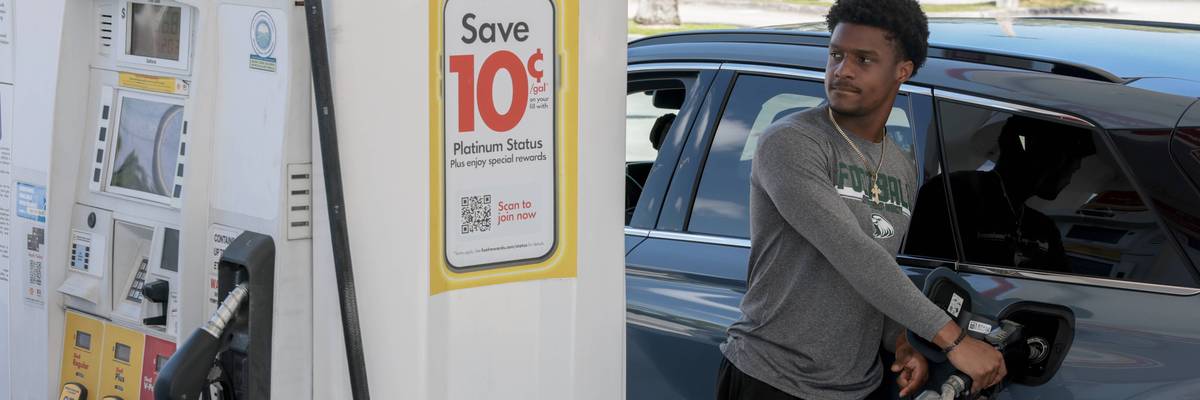
Kyndal Royal fills his vehicle with fuel at a gas station on April 13, 2026 in Miami, Florida.
77% of Americans Blame Trump for Soaring Gas Prices as GOP Lacks Iran War Exit Plan
"Gas prices are skyrocketing because of Trump's war," said the Democratic House whip. "If just a few Republicans are willing to choose the American people over Trump, we can stop this reckless war today."
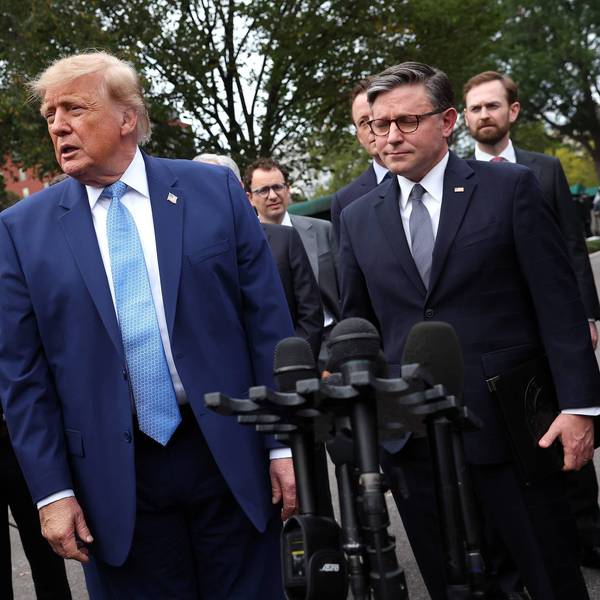
With the national average price for a gallon of gasoline sitting at $4.059 on Friday, a Reuters/Ipsos poll showed that fuel costs "are a very big concern" for 78% of Americans, and 77% blame President Donald Trump for the recent price spikes.
Fossil fuel prices worldwide have soared since Trump and Israel launched an illegal war on Iran in February, and the Iranian government responded by restricting traffic through the Strait of Hormuz, a key trade route, particularly for oil and liquefied natural gas.
Among the 3,577 registered voters polled by Reuters/Ipsos last week and early this week, 82% of Democrats, 79% of Independents, and 73% of Republicans said fuel prices are a major concern. Although there's some disagreement when it comes to blame, clear majorities—95% of Democrats, 82% of Independents, and 55% of Republicans—point the finger at the president.
An overall majority, 58%, also said they would be "less likely" to vote for a candidate who supports Trump's approach to the Iran war in the November midterm elections—in which Democrats hope to seize control of the US Senate and House of Representatives. That included 90% of Democrats, 68% of Independents, and 19% of Republicans.
According to Reuters, Sarah Chamberlain, a strategist and president of the Republican Main Street Partnership, which advocates for conservative lawmakers, acknowledged that the war is turning into a liability for the party.
"Right now, it's bad. People are upset," Chamberlain said. "Republicans are obviously very concerned about maintaining the House, but if we can get through the Iran situation by summertime and gas prices drop back down, or at least go down maybe not to quite the level they were prior to the war, then I think we have a really good shot."
As AAA explained Thursday: "Drivers are getting a bit of relief at the pump as the national average went down by 6 cents since last week to $4.03. Crude oil prices have come down below $100/barrel, helping drive down the cost of gasoline for consumers. But how long the downward trend will last is uncertain with continued instability along the Strait of Hormuz."
After Trump announced earlier this month that he'd agreed to a ceasefire with Iran, which has since been extended, the international climate group 350.org warned that "'fossilflation'—or inflation caused by volatile and rising prices of oil and gas—is still likely to continue," due to the fragility of the deal and extensively damaged infrastructure in the waterway.
Trump has repeatedly dismissed consumer concerns about fuel costs—but also suggested that his own energy secretary, former fracking executive Chris Wright, was wrong that gas prices may not drop below $3 per gallon until next year. He's also continued a blockade of Iranian ports during the ceasefire and claimed Thursday that the United States has "total control over the Strait of Hormuz. No ship can enter or leave without the approval of the United States Navy. It is 'Sealed up Tight.'"
However, that claim notably came after Iran seized two container ships in the strait on Wednesday, and The Washington Post reported that during a classified briefing for members of the House Armed Services Committee on Tuesday, a Pentagon official said that it could take six months to fully clear the waterway of the Iranian military's mines.
"Gas prices are skyrocketing because of Trump's war," House Minority Whip Katherine Clark (D-Mass.) said on social media Thursday. "After weeks of lies and broken promises, the GOP still has no exit plan or strategy. If just a few Republicans are willing to choose the American people over Trump, we can stop this reckless war today."
There have been three failed votes on war powers resolutions aimed at ending Trump's Iran war in the House, and five in the Senate. Three Congressional Progressive Caucus members—Reps. Pramila Jayapal (D-Wash.), Jared Huffman (D-Calif.), and Ro Khanna (D-Calif.)—separately introduced more resolutions this week. Khanna explained that he introduced the bill in coordination with the CPC "just so that we can continue to have options to have votes."
We are at a crossroads
This country and this world are at a monumental crossroads. In a few short weeks, US voters will have an opportunity to beat back the forces of fascism and confront the billionaires who are rigging the economy, our media system, and our democracy, making it increasingly impossible for ordinary people to get by. We’re not just talking about the election. We’re talking about what must be done once these fascist elements are vanquished from power. We need a bolder set of solutions than what either major party has so far been willing to offer and a working-class movement ready to fight like hell for it. Trump didn't emerge from nowhere. The conditions that fueled MAGA authoritarianism were created by decades of radical neoliberal economic policies and a corrupt political system dominated by corporate interests. They slashed taxes on the super-rich, promising that the benefits would trickle down. They said giveaways to the corporate titans would make life more affordable for the rest of us. It was all bullshit. And when a bitter, betrayed populace searches for someone to blame, right-wing demagogues have little trouble finding scapegoats. People know when they're being lied to, but you won't hear any of this from the corporate media. Only independent journalism—powered and funded by people who believe in building a better world—can deliver truly trustworthy daily news. Our Fall Campaign is underway, and we need your help. To power our newsroom through the rest of the year, we need to raise $125,000 by midnight on October 31. So if you share our vision, please contribute whatever you can to sustain our work. |
With the national average price for a gallon of gasoline sitting at $4.059 on Friday, a Reuters/Ipsos poll showed that fuel costs "are a very big concern" for 78% of Americans, and 77% blame President Donald Trump for the recent price spikes.
Fossil fuel prices worldwide have soared since Trump and Israel launched an illegal war on Iran in February, and the Iranian government responded by restricting traffic through the Strait of Hormuz, a key trade route, particularly for oil and liquefied natural gas.
Among the 3,577 registered voters polled by Reuters/Ipsos last week and early this week, 82% of Democrats, 79% of Independents, and 73% of Republicans said fuel prices are a major concern. Although there's some disagreement when it comes to blame, clear majorities—95% of Democrats, 82% of Independents, and 55% of Republicans—point the finger at the president.
An overall majority, 58%, also said they would be "less likely" to vote for a candidate who supports Trump's approach to the Iran war in the November midterm elections—in which Democrats hope to seize control of the US Senate and House of Representatives. That included 90% of Democrats, 68% of Independents, and 19% of Republicans.
According to Reuters, Sarah Chamberlain, a strategist and president of the Republican Main Street Partnership, which advocates for conservative lawmakers, acknowledged that the war is turning into a liability for the party.
"Right now, it's bad. People are upset," Chamberlain said. "Republicans are obviously very concerned about maintaining the House, but if we can get through the Iran situation by summertime and gas prices drop back down, or at least go down maybe not to quite the level they were prior to the war, then I think we have a really good shot."
As AAA explained Thursday: "Drivers are getting a bit of relief at the pump as the national average went down by 6 cents since last week to $4.03. Crude oil prices have come down below $100/barrel, helping drive down the cost of gasoline for consumers. But how long the downward trend will last is uncertain with continued instability along the Strait of Hormuz."
After Trump announced earlier this month that he'd agreed to a ceasefire with Iran, which has since been extended, the international climate group 350.org warned that "'fossilflation'—or inflation caused by volatile and rising prices of oil and gas—is still likely to continue," due to the fragility of the deal and extensively damaged infrastructure in the waterway.
Trump has repeatedly dismissed consumer concerns about fuel costs—but also suggested that his own energy secretary, former fracking executive Chris Wright, was wrong that gas prices may not drop below $3 per gallon until next year. He's also continued a blockade of Iranian ports during the ceasefire and claimed Thursday that the United States has "total control over the Strait of Hormuz. No ship can enter or leave without the approval of the United States Navy. It is 'Sealed up Tight.'"
However, that claim notably came after Iran seized two container ships in the strait on Wednesday, and The Washington Post reported that during a classified briefing for members of the House Armed Services Committee on Tuesday, a Pentagon official said that it could take six months to fully clear the waterway of the Iranian military's mines.
"Gas prices are skyrocketing because of Trump's war," House Minority Whip Katherine Clark (D-Mass.) said on social media Thursday. "After weeks of lies and broken promises, the GOP still has no exit plan or strategy. If just a few Republicans are willing to choose the American people over Trump, we can stop this reckless war today."
There have been three failed votes on war powers resolutions aimed at ending Trump's Iran war in the House, and five in the Senate. Three Congressional Progressive Caucus members—Reps. Pramila Jayapal (D-Wash.), Jared Huffman (D-Calif.), and Ro Khanna (D-Calif.)—separately introduced more resolutions this week. Khanna explained that he introduced the bill in coordination with the CPC "just so that we can continue to have options to have votes."
- Trump Claims His Own Energy Secretary Is 'Totally Wrong' About When Gas Will Go Back Below $3 - News & Opinion - The Commons ›
- As Americans Struggle With Soaring Prices, Trump Says $4 Gas Is ‘Not Very High' - News & Opinion - The Commons ›
- Americans to Pay $1,096 Extra at Gas Pump Due to Trump-Israel War on Iran: Markey ›
- 'Absolutely Massive' Price Shocks Coming as Trump's Iran War Drives Up Gas, Diesel Prices ›
- Trump Invokes Wartime Law to Fulfill 'Wish List for Oil, Gas, and Coal Industries' ›
- As Trump Drives Up Gas Prices and Trashes Economy, US Auto Debt Hits Record High | Common Dreams ›
- Trump's Iran War Has Already Cost Americans Over $40 Billion Extra on Gas and Diesel | Common Dreams ›
- US Gas Prices Set Mid-August Record After Trump Vows to 'Never Apologize' for Prolonged Iran War | Common Dreams ›
With the national average price for a gallon of gasoline sitting at $4.059 on Friday, a Reuters/Ipsos poll showed that fuel costs "are a very big concern" for 78% of Americans, and 77% blame President Donald Trump for the recent price spikes.
Fossil fuel prices worldwide have soared since Trump and Israel launched an illegal war on Iran in February, and the Iranian government responded by restricting traffic through the Strait of Hormuz, a key trade route, particularly for oil and liquefied natural gas.
Among the 3,577 registered voters polled by Reuters/Ipsos last week and early this week, 82% of Democrats, 79% of Independents, and 73% of Republicans said fuel prices are a major concern. Although there's some disagreement when it comes to blame, clear majorities—95% of Democrats, 82% of Independents, and 55% of Republicans—point the finger at the president.
An overall majority, 58%, also said they would be "less likely" to vote for a candidate who supports Trump's approach to the Iran war in the November midterm elections—in which Democrats hope to seize control of the US Senate and House of Representatives. That included 90% of Democrats, 68% of Independents, and 19% of Republicans.
According to Reuters, Sarah Chamberlain, a strategist and president of the Republican Main Street Partnership, which advocates for conservative lawmakers, acknowledged that the war is turning into a liability for the party.
"Right now, it's bad. People are upset," Chamberlain said. "Republicans are obviously very concerned about maintaining the House, but if we can get through the Iran situation by summertime and gas prices drop back down, or at least go down maybe not to quite the level they were prior to the war, then I think we have a really good shot."
As AAA explained Thursday: "Drivers are getting a bit of relief at the pump as the national average went down by 6 cents since last week to $4.03. Crude oil prices have come down below $100/barrel, helping drive down the cost of gasoline for consumers. But how long the downward trend will last is uncertain with continued instability along the Strait of Hormuz."
After Trump announced earlier this month that he'd agreed to a ceasefire with Iran, which has since been extended, the international climate group 350.org warned that "'fossilflation'—or inflation caused by volatile and rising prices of oil and gas—is still likely to continue," due to the fragility of the deal and extensively damaged infrastructure in the waterway.
Trump has repeatedly dismissed consumer concerns about fuel costs—but also suggested that his own energy secretary, former fracking executive Chris Wright, was wrong that gas prices may not drop below $3 per gallon until next year. He's also continued a blockade of Iranian ports during the ceasefire and claimed Thursday that the United States has "total control over the Strait of Hormuz. No ship can enter or leave without the approval of the United States Navy. It is 'Sealed up Tight.'"
However, that claim notably came after Iran seized two container ships in the strait on Wednesday, and The Washington Post reported that during a classified briefing for members of the House Armed Services Committee on Tuesday, a Pentagon official said that it could take six months to fully clear the waterway of the Iranian military's mines.
"Gas prices are skyrocketing because of Trump's war," House Minority Whip Katherine Clark (D-Mass.) said on social media Thursday. "After weeks of lies and broken promises, the GOP still has no exit plan or strategy. If just a few Republicans are willing to choose the American people over Trump, we can stop this reckless war today."
There have been three failed votes on war powers resolutions aimed at ending Trump's Iran war in the House, and five in the Senate. Three Congressional Progressive Caucus members—Reps. Pramila Jayapal (D-Wash.), Jared Huffman (D-Calif.), and Ro Khanna (D-Calif.)—separately introduced more resolutions this week. Khanna explained that he introduced the bill in coordination with the CPC "just so that we can continue to have options to have votes."
- Trump Claims His Own Energy Secretary Is 'Totally Wrong' About When Gas Will Go Back Below $3 - News & Opinion - The Commons ›
- As Americans Struggle With Soaring Prices, Trump Says $4 Gas Is ‘Not Very High' - News & Opinion - The Commons ›
- Americans to Pay $1,096 Extra at Gas Pump Due to Trump-Israel War on Iran: Markey ›
- 'Absolutely Massive' Price Shocks Coming as Trump's Iran War Drives Up Gas, Diesel Prices ›
- Trump Invokes Wartime Law to Fulfill 'Wish List for Oil, Gas, and Coal Industries' ›
- As Trump Drives Up Gas Prices and Trashes Economy, US Auto Debt Hits Record High | Common Dreams ›
- Trump's Iran War Has Already Cost Americans Over $40 Billion Extra on Gas and Diesel | Common Dreams ›
- US Gas Prices Set Mid-August Record After Trump Vows to 'Never Apologize' for Prolonged Iran War | Common Dreams ›