SUBSCRIBE TO OUR FREE NEWSLETTER
Daily news & progressive opinion—funded by the people, not the corporations—delivered straight to your inbox.
5
#000000
#FFFFFF
To donate by check, phone, or other method, see our More Ways to Give page.
Daily news & progressive opinion—funded by the people, not the corporations—delivered straight to your inbox.
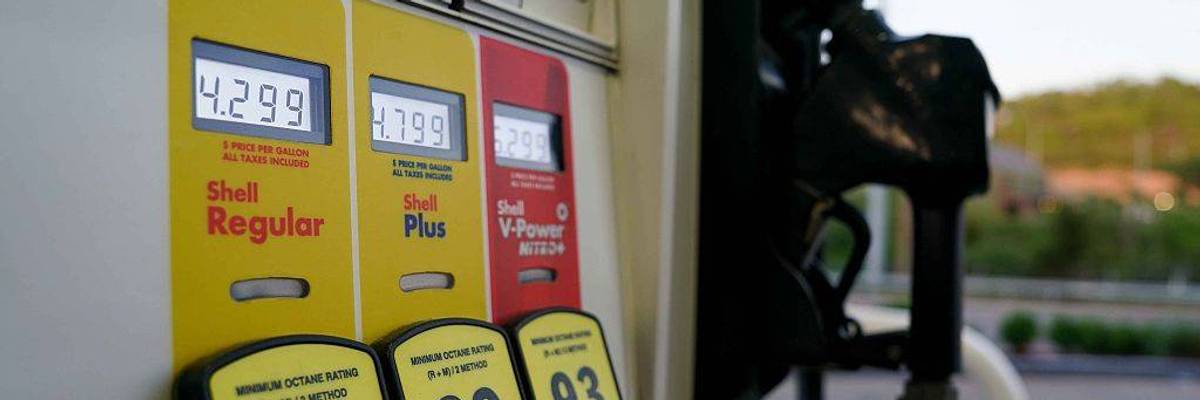
Fuel prices are displayed on a gas station sign in Brentwood, Tennessee, on April 19, 2026.
US Energy Secretary Chris Wright told CNN on Sunday that gas prices might not drop below $3 until next year.
US President Donald Trump on Monday said his own energy secretary, former fracking executive Chris Wright, was incorrect when he said gas prices may not get below $3 per gallon until next year.
In a Sunday interview with CNN's Jake Tapper, Wright was asked when Americans could expect to see gas prices fall significantly after they spiked to over $4 per gallon on average nationwide because of Trump's illegal war of choice with Iran.
"I don't know," Wright responded. "That could happen later this year. That might not happen until next year."
In an interview with The Hill on Monday, Trump said Wright was "totally wrong" about the projection, and insisted that gas prices would plummet "as soon as [the war with Iran] ends."
Despite Trump's claims that gas prices will come down rapidly after the end of the war, The New York Times reported on Monday that the negative effects of Iran's closure of the Strait of Hormuz, which has choked off roughly 20% of global petroleum shipments, is just starting to be felt.
The impact of the strait's closure is being felt most acutely in East Asia, where oil supply shortages are having a ripple effect that is likely to spread throughout the world if the strait remains closed for much longer.
"Even if there is a peace deal soon," the Times reported, "the future... will likely include months of canceled flights, surging food prices, factory pauses, delayed shipments and empty shelves for products long considered quick and easy to buy worldwide: plastic bags, instant noodles, vaccines, syringes, lipstick, microchips and sportswear."
The Times added that "even if the Strait of Hormuz stabilizes tomorrow, it could take years for oil and gas output and shipping to reach fat prewar levels."
Bob McNally, founder and president of the consulting firm Rapidan Energy Group, echoed the Times' analysis in an interview with Newsweek published on Monday.
"It is likely we will feel the effects of energy disruptions through the end of the year," McNally explained. "Even if the conflict and disruptions were to end today, the ripple effects would be felt for many months. Just restarting Gulf production and flows would take three to four months. Repairing damage to facilities could take longer."
Mark Zandi, chief economist at Moody's Analytics, also projected more financial pain for US consumers in the months ahead.
"It doesn’t look like gasoline prices will return to pre-war levels anytime soon," Zandi wrote in a Sunday social media post. "That’s even if the war ends soon, which looks iffy, to say the least. And this abstracts from what Americans will need to shell out for higher prices on everything from groceries to airfares in the coming weeks and months. The financial pain caused by the war and its fallout on consumer spending and the economy is set to intensify."
Dear Common Dreams reader, It’s been nearly 30 years since I co-founded Common Dreams with my late wife, Lina Newhouser. We had the radical notion that journalism should serve the public good, not corporate profits. It was clear to us from the outset what it would take to build such a project. No paid advertisements. No corporate sponsors. No millionaire publisher telling us what to think or do. Many people said we wouldn't last a year, but we proved those doubters wrong. Together with a tremendous team of journalists and dedicated staff, we built an independent media outlet free from the constraints of profits and corporate control. Our mission has always been simple: To inform. To inspire. To ignite change for the common good. Building Common Dreams was not easy. Our survival was never guaranteed. When you take on the most powerful forces—Wall Street greed, fossil fuel industry destruction, Big Tech lobbyists, and uber-rich oligarchs who have spent billions upon billions rigging the economy and democracy in their favor—the only bulwark you have is supporters who believe in your work. But here’s the urgent message from me today. It's never been this bad out there. And it's never been this hard to keep us going. At the very moment Common Dreams is most needed, the threats we face are intensifying. We need your support now more than ever. We don't accept corporate advertising and never will. We don't have a paywall because we don't think people should be blocked from critical news based on their ability to pay. Everything we do is funded by the donations of readers like you. When everyone does the little they can afford, we are strong. But if that support retreats or dries up, so do we. Will you donate now to make sure Common Dreams not only survives but thrives? —Craig Brown, Co-founder |
US President Donald Trump on Monday said his own energy secretary, former fracking executive Chris Wright, was incorrect when he said gas prices may not get below $3 per gallon until next year.
In a Sunday interview with CNN's Jake Tapper, Wright was asked when Americans could expect to see gas prices fall significantly after they spiked to over $4 per gallon on average nationwide because of Trump's illegal war of choice with Iran.
"I don't know," Wright responded. "That could happen later this year. That might not happen until next year."
In an interview with The Hill on Monday, Trump said Wright was "totally wrong" about the projection, and insisted that gas prices would plummet "as soon as [the war with Iran] ends."
Despite Trump's claims that gas prices will come down rapidly after the end of the war, The New York Times reported on Monday that the negative effects of Iran's closure of the Strait of Hormuz, which has choked off roughly 20% of global petroleum shipments, is just starting to be felt.
The impact of the strait's closure is being felt most acutely in East Asia, where oil supply shortages are having a ripple effect that is likely to spread throughout the world if the strait remains closed for much longer.
"Even if there is a peace deal soon," the Times reported, "the future... will likely include months of canceled flights, surging food prices, factory pauses, delayed shipments and empty shelves for products long considered quick and easy to buy worldwide: plastic bags, instant noodles, vaccines, syringes, lipstick, microchips and sportswear."
The Times added that "even if the Strait of Hormuz stabilizes tomorrow, it could take years for oil and gas output and shipping to reach fat prewar levels."
Bob McNally, founder and president of the consulting firm Rapidan Energy Group, echoed the Times' analysis in an interview with Newsweek published on Monday.
"It is likely we will feel the effects of energy disruptions through the end of the year," McNally explained. "Even if the conflict and disruptions were to end today, the ripple effects would be felt for many months. Just restarting Gulf production and flows would take three to four months. Repairing damage to facilities could take longer."
Mark Zandi, chief economist at Moody's Analytics, also projected more financial pain for US consumers in the months ahead.
"It doesn’t look like gasoline prices will return to pre-war levels anytime soon," Zandi wrote in a Sunday social media post. "That’s even if the war ends soon, which looks iffy, to say the least. And this abstracts from what Americans will need to shell out for higher prices on everything from groceries to airfares in the coming weeks and months. The financial pain caused by the war and its fallout on consumer spending and the economy is set to intensify."
US President Donald Trump on Monday said his own energy secretary, former fracking executive Chris Wright, was incorrect when he said gas prices may not get below $3 per gallon until next year.
In a Sunday interview with CNN's Jake Tapper, Wright was asked when Americans could expect to see gas prices fall significantly after they spiked to over $4 per gallon on average nationwide because of Trump's illegal war of choice with Iran.
"I don't know," Wright responded. "That could happen later this year. That might not happen until next year."
In an interview with The Hill on Monday, Trump said Wright was "totally wrong" about the projection, and insisted that gas prices would plummet "as soon as [the war with Iran] ends."
Despite Trump's claims that gas prices will come down rapidly after the end of the war, The New York Times reported on Monday that the negative effects of Iran's closure of the Strait of Hormuz, which has choked off roughly 20% of global petroleum shipments, is just starting to be felt.
The impact of the strait's closure is being felt most acutely in East Asia, where oil supply shortages are having a ripple effect that is likely to spread throughout the world if the strait remains closed for much longer.
"Even if there is a peace deal soon," the Times reported, "the future... will likely include months of canceled flights, surging food prices, factory pauses, delayed shipments and empty shelves for products long considered quick and easy to buy worldwide: plastic bags, instant noodles, vaccines, syringes, lipstick, microchips and sportswear."
The Times added that "even if the Strait of Hormuz stabilizes tomorrow, it could take years for oil and gas output and shipping to reach fat prewar levels."
Bob McNally, founder and president of the consulting firm Rapidan Energy Group, echoed the Times' analysis in an interview with Newsweek published on Monday.
"It is likely we will feel the effects of energy disruptions through the end of the year," McNally explained. "Even if the conflict and disruptions were to end today, the ripple effects would be felt for many months. Just restarting Gulf production and flows would take three to four months. Repairing damage to facilities could take longer."
Mark Zandi, chief economist at Moody's Analytics, also projected more financial pain for US consumers in the months ahead.
"It doesn’t look like gasoline prices will return to pre-war levels anytime soon," Zandi wrote in a Sunday social media post. "That’s even if the war ends soon, which looks iffy, to say the least. And this abstracts from what Americans will need to shell out for higher prices on everything from groceries to airfares in the coming weeks and months. The financial pain caused by the war and its fallout on consumer spending and the economy is set to intensify."