5
#000000
#FFFFFF
To donate by check, phone, or other method, see our More Ways to Give page.
Daily news & progressive opinion—funded by the people, not the corporations—delivered straight to your inbox.

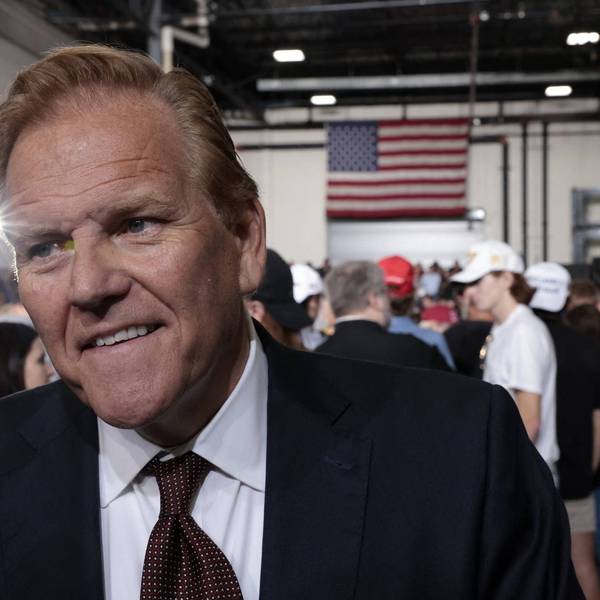
A new ad features Rogers saying, "You can’t have your privacy violated if you don’t know your privacy is violated," and bragging about his role in creating the PATRIOT Act.
As Flock cameras and the data firm Palantir dominate headlines, Michigan’s Democratic US Senate nominee Abdul El-Sayed is spending the final weeks of the race hammering his Republican opponent, former Rep. Mike Rogers, for his role in expanding the surveillance state.
On Tuesday, El-Sayed's campaign unveiled a new campaign ad with the tagline "Mike Rogers is watching you."
The ad, first reported by WIRED, features clips of Rogers, who chaired the House Intelligence Committee from 2011-15, boasting of his role in passing the infamous PATRIOT Act, which dramatically expanded government spying powers in the wake of the 9/11 terrorist attacks, including the mass gathering of Americans' telephone records.
The video repeatedly shows a clip of Rogers from a 2013 intelligence committee hearing, where he downplayed explosive revelations about the National Security Agency's (NSA) warrantless spying powers.
"You can’t have your privacy violated if you don’t know your privacy is violated, right?" Rogers said.
Another clip shows Rogers, during a 2016 Heritage Foundation speech, saying, "We would love to get one-tenth of what Google has on you." The comment was made as Rogers lamented that aggressive intelligence gathering on US citizens had been curtailed somewhat in the wake of what he said was a "completely undeserv[ed]" backlash against intelligence agencies.
The new ad campaign comes amid broad public unease about government surveillance. A YouGov poll earlier this year found that 76% of Americans were concerned about technology's impact on state spying capabilities, while a separate survey from the Center for Democracy and Technology found 74% were concerned about the security of personal information held by government agencies.
The rapid adoption of Flock's artificial intelligence-powered license plate readers by police departments around the country has sparked bipartisan concern: 62% of voters say they are concerned by the use of Flock cameras, including majorities of Democrats, Republicans, and independents, according to a Navigator survey in September—many expressed fears that the technology was being used to collect information on innocent people without their consent.
A spokesperson for Rogers has said he “vehemently opposes unchecked use of Flock cameras to track law-abiding citizens” and emphasized that he departed from Congress before the company was founded in 2017.
Since he won the Democratic primary in August, El-Sayed has sought to lay voters' spying fears at the feet of Rogers, joking in August that the Republican had spent his career courting the "peeping Tom vote."
In addition to digital ads and billboards, El-Sayed's campaign also published a website titled "MikeIsWatching.com," which examines Rogers' record during his 14 years in Congress.
It notes Rogers' self-described role in helping to "author" the PATRIOT Act and its renewals, as well as his support for other legislation that expanded the government's reach into Americans' private lives:
In Ohio, former Democratic Sen. Sherrod Brown has attacked Republican Sen. John Husted for promoting AI data centers, while Democratic Texas state Rep. James Talarico (D-50) has done the same to his opponent, Republican Attorney General Ken Paxton.
But others have leaned harder on the issue of mass surveillance. Also in Texas, Democratic state Rep. Gina Hinojosa (D-49) is trying to take down Republican Gov. Greg Abbott by hammering on a $28.5 million state contract with Flock, which now has over 13,000 cameras in the state, according to the group DeFlock.
This country and this world are at a monumental crossroads. US voters have an opportunity to beat back the forces of fascism and confront the billionaires who are rigging the economy, our media system, and our democracy, making it increasingly impossible for ordinary people to get by. We’re not just talking about the election. We’re talking about what must be done once these fascist elements are vanquished from power. We need a bolder set of solutions than what either major party has so far been willing to offer and a working-class movement ready to fight like hell for it. Trump didn't emerge from nowhere. The conditions that fueled MAGA authoritarianism were created by decades of radical neoliberal economic policies and a corrupt political system dominated by corporate interests. They slashed taxes on the super-rich, promising that the benefits would trickle down. They said giveaways to the corporate titans would make life more affordable for the rest of us. It was all bullshit. And when a bitter, betrayed populace searches for someone to blame, right-wing demagogues have little trouble finding scapegoats. People know when they're being lied to, but you won't hear any of this from the corporate media. Only independent journalism—powered and funded by people who believe in building a better world—can deliver truly trustworthy daily news. If you share our vision, please contribute whatever you can to sustain our work. |
As Flock cameras and the data firm Palantir dominate headlines, Michigan’s Democratic US Senate nominee Abdul El-Sayed is spending the final weeks of the race hammering his Republican opponent, former Rep. Mike Rogers, for his role in expanding the surveillance state.
On Tuesday, El-Sayed's campaign unveiled a new campaign ad with the tagline "Mike Rogers is watching you."
The ad, first reported by WIRED, features clips of Rogers, who chaired the House Intelligence Committee from 2011-15, boasting of his role in passing the infamous PATRIOT Act, which dramatically expanded government spying powers in the wake of the 9/11 terrorist attacks, including the mass gathering of Americans' telephone records.
The video repeatedly shows a clip of Rogers from a 2013 intelligence committee hearing, where he downplayed explosive revelations about the National Security Agency's (NSA) warrantless spying powers.
"You can’t have your privacy violated if you don’t know your privacy is violated, right?" Rogers said.
Another clip shows Rogers, during a 2016 Heritage Foundation speech, saying, "We would love to get one-tenth of what Google has on you." The comment was made as Rogers lamented that aggressive intelligence gathering on US citizens had been curtailed somewhat in the wake of what he said was a "completely undeserv[ed]" backlash against intelligence agencies.
The new ad campaign comes amid broad public unease about government surveillance. A YouGov poll earlier this year found that 76% of Americans were concerned about technology's impact on state spying capabilities, while a separate survey from the Center for Democracy and Technology found 74% were concerned about the security of personal information held by government agencies.
The rapid adoption of Flock's artificial intelligence-powered license plate readers by police departments around the country has sparked bipartisan concern: 62% of voters say they are concerned by the use of Flock cameras, including majorities of Democrats, Republicans, and independents, according to a Navigator survey in September—many expressed fears that the technology was being used to collect information on innocent people without their consent.
A spokesperson for Rogers has said he “vehemently opposes unchecked use of Flock cameras to track law-abiding citizens” and emphasized that he departed from Congress before the company was founded in 2017.
Since he won the Democratic primary in August, El-Sayed has sought to lay voters' spying fears at the feet of Rogers, joking in August that the Republican had spent his career courting the "peeping Tom vote."
In addition to digital ads and billboards, El-Sayed's campaign also published a website titled "MikeIsWatching.com," which examines Rogers' record during his 14 years in Congress.
It notes Rogers' self-described role in helping to "author" the PATRIOT Act and its renewals, as well as his support for other legislation that expanded the government's reach into Americans' private lives:
In Ohio, former Democratic Sen. Sherrod Brown has attacked Republican Sen. John Husted for promoting AI data centers, while Democratic Texas state Rep. James Talarico (D-50) has done the same to his opponent, Republican Attorney General Ken Paxton.
But others have leaned harder on the issue of mass surveillance. Also in Texas, Democratic state Rep. Gina Hinojosa (D-49) is trying to take down Republican Gov. Greg Abbott by hammering on a $28.5 million state contract with Flock, which now has over 13,000 cameras in the state, according to the group DeFlock.