SUBSCRIBE TO OUR FREE NEWSLETTER
Daily news & progressive opinion—funded by the people, not the corporations—delivered straight to your inbox.
5
#000000
#FFFFFF
To donate by check, phone, or other method, see our More Ways to Give page.
Daily news & progressive opinion—funded by the people, not the corporations—delivered straight to your inbox.
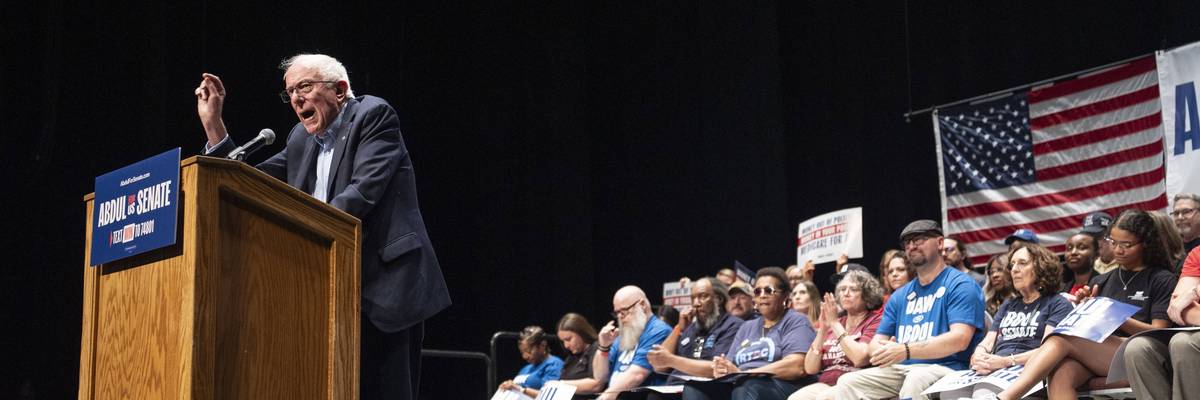
US Sen. Bernie Sanders (I-Vt.) speaks at a rally on July 18, 2026 in Detroit, Michigan.
"I would hope that we can all agree that Republican special interests should not play a role in determining the outcome of Democratic primaries. The time to act is now."
US Sen. Bernie Sanders on Monday urged national Democratic leaders to impose a total ban on super PAC spending in primary contests, a change that the progressive senator said is necessary to prevent corporate interests from heavily influencing the party's electoral outcomes.
In a letter addressed to Senate Minority Leader Chuck Schumer (D-NY), House Minority Leader Hakeem Jeffries (D-NY), and Democratic National Committee Chair Ken Martin, Sanders (I-Vt.) wrote that "what is particularly obscene is not only the outrageous amount of money coming into Democratic primaries from billionaire-funded super PACs, but the reality that these special interests have no particular desire to see Democrats win."
Sanders, who caucuses with the Democratic Party, cited as a telling example the American Israel Public Affairs Committee's $30 million intervention in the Democratic primary for a critical US Senate seat in Michigan. The organization, known as AIPAC, spent heavily to boost Rep. Haley Stevens (D-Mich.) and attempt to tear down her progressive opponent, Abdul El-Sayed—who went on to win the race despite being massively outspent.
AIPAC is now reportedly planning to spend big in support of El-Sayed's Republican general election opponent, Mike Rogers.
"It is absurd that they spend tens of millions of dollars to try to determine who the Democratic nominee is and, if they fail, then proceed to support the Republican candidate in the general election," Sandres wrote. "That is not democracy. That is not what Democratic voters want."
Sanders emphasized his support for passage of a constitutional amendment to repeal the US Supreme Court's 2010 Citizens United decision, which paved the way for the establishment and proliferation of super PACs—entities that can raise and spend unlimited sums supporting or opposing political campaigns.
"BUT WE DO NOT HAVE TO WAIT," Sanders wrote in all caps. "Right now, the Democratic Party has the power to prohibit super PACs from participating in its primaries. That can be done. That must be done. I urge you to take action and make clear that the Democratic Party will no longer maintain this corrupt system."
"While there are ideological differences of opinion within the big tent of the party, I would hope that we can all agree that Republican special interests should not play a role in determining the outcome of Democratic primaries," the senator continued. "The time to act is now."
The DNC has repeatedly faced calls in recent years to curb or eliminate the influence of super PACs in Democratic primaries—but has yet to take concrete action.
Earlier this year, the DNC Rules Committee rejected a proposed resolution that condemned the "growing influence" of AIPAC and other organizations pumping huge sums into Democratic primaries. The rules panel instead advanced a resolution broadly condemning dark money and expressing the DNC's "commitment to campaign finance practices that align with the party’s core values."
Nearly a third of all corporate political spending on elections since the Supreme Court's Citizens United ruling has come during the 2026 election cycle, according to a June report by Public Citizen.
"Cryptocurrency, artificial intelligence, Big Tech, and online betting corporations have collectively spent $294 million to influence federal elections in the 2026 midterm cycle, reflecting a strategic move to spend directly on political action committees to influence federal elections," the report found. "These corporate super PAC political contributions make up 57% of the $517 million that corporations have reported spending on the 2026 midterms so far."
Dear Common Dreams reader, It’s been nearly 30 years since I co-founded Common Dreams with my late wife, Lina Newhouser. We had the radical notion that journalism should serve the public good, not corporate profits. It was clear to us from the outset what it would take to build such a project. No paid advertisements. No corporate sponsors. No millionaire publisher telling us what to think or do. Many people said we wouldn't last a year, but we proved those doubters wrong. Together with a tremendous team of journalists and dedicated staff, we built an independent media outlet free from the constraints of profits and corporate control. Our mission has always been simple: To inform. To inspire. To ignite change for the common good. Building Common Dreams was not easy. Our survival was never guaranteed. When you take on the most powerful forces—Wall Street greed, fossil fuel industry destruction, Big Tech lobbyists, and uber-rich oligarchs who have spent billions upon billions rigging the economy and democracy in their favor—the only bulwark you have is supporters who believe in your work. But here’s the urgent message from me today. It's never been this bad out there. And it's never been this hard to keep us going. At the very moment Common Dreams is most needed, the threats we face are intensifying. We need your support now more than ever. We don't accept corporate advertising and never will. We don't have a paywall because we don't think people should be blocked from critical news based on their ability to pay. Everything we do is funded by the donations of readers like you. When everyone does the little they can afford, we are strong. But if that support retreats or dries up, so do we. Will you donate now to make sure Common Dreams not only survives but thrives? —Craig Brown, Co-founder |
US Sen. Bernie Sanders on Monday urged national Democratic leaders to impose a total ban on super PAC spending in primary contests, a change that the progressive senator said is necessary to prevent corporate interests from heavily influencing the party's electoral outcomes.
In a letter addressed to Senate Minority Leader Chuck Schumer (D-NY), House Minority Leader Hakeem Jeffries (D-NY), and Democratic National Committee Chair Ken Martin, Sanders (I-Vt.) wrote that "what is particularly obscene is not only the outrageous amount of money coming into Democratic primaries from billionaire-funded super PACs, but the reality that these special interests have no particular desire to see Democrats win."
Sanders, who caucuses with the Democratic Party, cited as a telling example the American Israel Public Affairs Committee's $30 million intervention in the Democratic primary for a critical US Senate seat in Michigan. The organization, known as AIPAC, spent heavily to boost Rep. Haley Stevens (D-Mich.) and attempt to tear down her progressive opponent, Abdul El-Sayed—who went on to win the race despite being massively outspent.
AIPAC is now reportedly planning to spend big in support of El-Sayed's Republican general election opponent, Mike Rogers.
"It is absurd that they spend tens of millions of dollars to try to determine who the Democratic nominee is and, if they fail, then proceed to support the Republican candidate in the general election," Sandres wrote. "That is not democracy. That is not what Democratic voters want."
Sanders emphasized his support for passage of a constitutional amendment to repeal the US Supreme Court's 2010 Citizens United decision, which paved the way for the establishment and proliferation of super PACs—entities that can raise and spend unlimited sums supporting or opposing political campaigns.
"BUT WE DO NOT HAVE TO WAIT," Sanders wrote in all caps. "Right now, the Democratic Party has the power to prohibit super PACs from participating in its primaries. That can be done. That must be done. I urge you to take action and make clear that the Democratic Party will no longer maintain this corrupt system."
"While there are ideological differences of opinion within the big tent of the party, I would hope that we can all agree that Republican special interests should not play a role in determining the outcome of Democratic primaries," the senator continued. "The time to act is now."
The DNC has repeatedly faced calls in recent years to curb or eliminate the influence of super PACs in Democratic primaries—but has yet to take concrete action.
Earlier this year, the DNC Rules Committee rejected a proposed resolution that condemned the "growing influence" of AIPAC and other organizations pumping huge sums into Democratic primaries. The rules panel instead advanced a resolution broadly condemning dark money and expressing the DNC's "commitment to campaign finance practices that align with the party’s core values."
Nearly a third of all corporate political spending on elections since the Supreme Court's Citizens United ruling has come during the 2026 election cycle, according to a June report by Public Citizen.
"Cryptocurrency, artificial intelligence, Big Tech, and online betting corporations have collectively spent $294 million to influence federal elections in the 2026 midterm cycle, reflecting a strategic move to spend directly on political action committees to influence federal elections," the report found. "These corporate super PAC political contributions make up 57% of the $517 million that corporations have reported spending on the 2026 midterms so far."
US Sen. Bernie Sanders on Monday urged national Democratic leaders to impose a total ban on super PAC spending in primary contests, a change that the progressive senator said is necessary to prevent corporate interests from heavily influencing the party's electoral outcomes.
In a letter addressed to Senate Minority Leader Chuck Schumer (D-NY), House Minority Leader Hakeem Jeffries (D-NY), and Democratic National Committee Chair Ken Martin, Sanders (I-Vt.) wrote that "what is particularly obscene is not only the outrageous amount of money coming into Democratic primaries from billionaire-funded super PACs, but the reality that these special interests have no particular desire to see Democrats win."
Sanders, who caucuses with the Democratic Party, cited as a telling example the American Israel Public Affairs Committee's $30 million intervention in the Democratic primary for a critical US Senate seat in Michigan. The organization, known as AIPAC, spent heavily to boost Rep. Haley Stevens (D-Mich.) and attempt to tear down her progressive opponent, Abdul El-Sayed—who went on to win the race despite being massively outspent.
AIPAC is now reportedly planning to spend big in support of El-Sayed's Republican general election opponent, Mike Rogers.
"It is absurd that they spend tens of millions of dollars to try to determine who the Democratic nominee is and, if they fail, then proceed to support the Republican candidate in the general election," Sandres wrote. "That is not democracy. That is not what Democratic voters want."
Sanders emphasized his support for passage of a constitutional amendment to repeal the US Supreme Court's 2010 Citizens United decision, which paved the way for the establishment and proliferation of super PACs—entities that can raise and spend unlimited sums supporting or opposing political campaigns.
"BUT WE DO NOT HAVE TO WAIT," Sanders wrote in all caps. "Right now, the Democratic Party has the power to prohibit super PACs from participating in its primaries. That can be done. That must be done. I urge you to take action and make clear that the Democratic Party will no longer maintain this corrupt system."
"While there are ideological differences of opinion within the big tent of the party, I would hope that we can all agree that Republican special interests should not play a role in determining the outcome of Democratic primaries," the senator continued. "The time to act is now."
The DNC has repeatedly faced calls in recent years to curb or eliminate the influence of super PACs in Democratic primaries—but has yet to take concrete action.
Earlier this year, the DNC Rules Committee rejected a proposed resolution that condemned the "growing influence" of AIPAC and other organizations pumping huge sums into Democratic primaries. The rules panel instead advanced a resolution broadly condemning dark money and expressing the DNC's "commitment to campaign finance practices that align with the party’s core values."
Nearly a third of all corporate political spending on elections since the Supreme Court's Citizens United ruling has come during the 2026 election cycle, according to a June report by Public Citizen.
"Cryptocurrency, artificial intelligence, Big Tech, and online betting corporations have collectively spent $294 million to influence federal elections in the 2026 midterm cycle, reflecting a strategic move to spend directly on political action committees to influence federal elections," the report found. "These corporate super PAC political contributions make up 57% of the $517 million that corporations have reported spending on the 2026 midterms so far."