5
#000000
#FFFFFF
To donate by check, phone, or other method, see our More Ways to Give page.
Daily news & progressive opinion—funded by the people, not the corporations—delivered straight to your inbox.
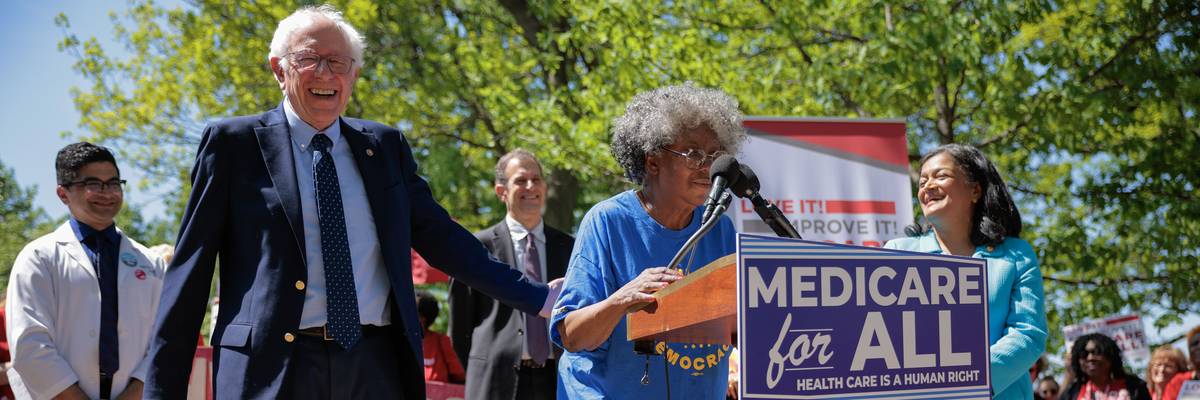
US Sen. Bernie Sanders (I-Vt.) shares a laugh with 80-year-old Frankie Clark of North Carolina as she addresses a rally to reintroduce the Medicare for All Act on April 29, 2025 in Washington, DC.
"Do not tell me we cannot afford Medicare for All," said Sen. Bernie Sanders. "What we cannot afford is a broken healthcare system based on greed."
Previous research has shown that shifting the United States to a Medicare for All system could save roughly 68,000 lives and $650 billion per year, but a new study by experts at Yale University suggests the savings would likely be even greater on both fronts.
In a Tuesday statement, Sen. Bernie Sanders (I-Vt.), lead sponsor of the Medicare for All Act in the Senate, highlighted the findings, published recently on medRxiv, a server for preprints, or research that hasn't yet been peer reviewed.
"The US spends more on healthcare than any other nation, yet tens of millions of Americans are uninsured or underinsured, and coverage retractions enacted in 2025 are widening these gaps," the five experts wrote.
Upward of 15 million Americans could lose health insurance coverage over the next decade because of Medicaid cuts in President Donald Trump's so-called One Big Beautiful Bill Act and the Republican-led Congress' failure to extend Affordable Care Act subsidies that expired at the end of last year.
"The misalignment between the for-profit insurance architecture and optimal patient care, together with the inefficiencies of a fragmented system, contributes to both unnecessary costs and preventable mortality," according to the Yale researchers. "We update our previous analyses with the most recent data to project the economic benefits and the number of lives saved that would be achieved by single-payer universal coverage, as proposed in the Medicare for All Act."
"We estimate that such a system would reduce national health expenditure by $1,041 billion annually," they explained. "Sources of savings include reductions in administrative overhead, pharmaceutical prices, fraudulent billing, and avoidable emergency care. Combined with the reversal of recent retractions, universal coverage would save over 114,000 lives annually."
Specifically, as Sanders' office detailed in a statement, Americans would save:
Welcoming the findings, the senator declared that "this study confirms what we have known for years: Medicare for All saves lives and saves money. In fact, guaranteeing healthcare as a human right through a Medicare for All, single-payer system would cost $1 trillion less than our current dysfunctional system."
"It would save working families thousands of dollars a year. And it would prevent over 100,000 Americans from dying unnecessarily each and every year because they cannot make it to a doctor in time," he stressed. "At a time when 15 million Americans are being thrown off the healthcare they have and 20 million Americans have already seen their premiums double, on average, as a result of Trump's so-called 'Big Beautiful Bill,' we need Medicare for All now more than ever."
"The time is now to end the greed of the big insurance and drug companies and pass Medicare for All," he added.
The research comes as Americans face high prices for not only healthcare but also food, gasoline, housing, and more under President Donald Trump and the GOP-led Congress. It also comes amid a renewed push by hundreds of advocacy groups that support Medicare for All and a wave of victories by progressive candidates who support the policy.
Among them is former Detroit health official Abdul El-Sayed, who won the Democratic primary for US Senate in Michigan last week having campaigned on a promise to prioritize "money out of politics, money in your pocket, and Medicare for All." His victory followed those of various other candidates, from Colorado to New York and Pennsylvania.
However, it's not just elected Republicans standing the way of a transition to universal healthcare in the United States. As a Monday analysis from the investigative outlet Sludge shows, the health insurance industry is pouring money into Third Way, a think tank reportedly preparing to spend $15 million combating the rise of candidates who support progressive policies including Medicare for All.
Dear Common Dreams reader, It’s been nearly 30 years since I co-founded Common Dreams with my late wife, Lina Newhouser. We had the radical notion that journalism should serve the public good, not corporate profits. It was clear to us from the outset what it would take to build such a project. No paid advertisements. No corporate sponsors. No millionaire publisher telling us what to think or do. Many people said we wouldn't last a year, but we proved those doubters wrong. Together with a tremendous team of journalists and dedicated staff, we built an independent media outlet free from the constraints of profits and corporate control. Our mission has always been simple: To inform. To inspire. To ignite change for the common good. Building Common Dreams was not easy. Our survival was never guaranteed. When you take on the most powerful forces—Wall Street greed, fossil fuel industry destruction, Big Tech lobbyists, and uber-rich oligarchs who have spent billions upon billions rigging the economy and democracy in their favor—the only bulwark you have is supporters who believe in your work. But here’s the urgent message from me today. It's never been this bad out there. And it's never been this hard to keep us going. At the very moment Common Dreams is most needed, the threats we face are intensifying. We need your support now more than ever. We don't accept corporate advertising and never will. We don't have a paywall because we don't think people should be blocked from critical news based on their ability to pay. Everything we do is funded by the donations of readers like you. When everyone does the little they can afford, we are strong. But if that support retreats or dries up, so do we. Will you donate now to make sure Common Dreams not only survives but thrives? —Craig Brown, Co-founder |
Previous research has shown that shifting the United States to a Medicare for All system could save roughly 68,000 lives and $650 billion per year, but a new study by experts at Yale University suggests the savings would likely be even greater on both fronts.
In a Tuesday statement, Sen. Bernie Sanders (I-Vt.), lead sponsor of the Medicare for All Act in the Senate, highlighted the findings, published recently on medRxiv, a server for preprints, or research that hasn't yet been peer reviewed.
"The US spends more on healthcare than any other nation, yet tens of millions of Americans are uninsured or underinsured, and coverage retractions enacted in 2025 are widening these gaps," the five experts wrote.
Upward of 15 million Americans could lose health insurance coverage over the next decade because of Medicaid cuts in President Donald Trump's so-called One Big Beautiful Bill Act and the Republican-led Congress' failure to extend Affordable Care Act subsidies that expired at the end of last year.
"The misalignment between the for-profit insurance architecture and optimal patient care, together with the inefficiencies of a fragmented system, contributes to both unnecessary costs and preventable mortality," according to the Yale researchers. "We update our previous analyses with the most recent data to project the economic benefits and the number of lives saved that would be achieved by single-payer universal coverage, as proposed in the Medicare for All Act."
"We estimate that such a system would reduce national health expenditure by $1,041 billion annually," they explained. "Sources of savings include reductions in administrative overhead, pharmaceutical prices, fraudulent billing, and avoidable emergency care. Combined with the reversal of recent retractions, universal coverage would save over 114,000 lives annually."
Specifically, as Sanders' office detailed in a statement, Americans would save:
Welcoming the findings, the senator declared that "this study confirms what we have known for years: Medicare for All saves lives and saves money. In fact, guaranteeing healthcare as a human right through a Medicare for All, single-payer system would cost $1 trillion less than our current dysfunctional system."
"It would save working families thousands of dollars a year. And it would prevent over 100,000 Americans from dying unnecessarily each and every year because they cannot make it to a doctor in time," he stressed. "At a time when 15 million Americans are being thrown off the healthcare they have and 20 million Americans have already seen their premiums double, on average, as a result of Trump's so-called 'Big Beautiful Bill,' we need Medicare for All now more than ever."
"The time is now to end the greed of the big insurance and drug companies and pass Medicare for All," he added.
The research comes as Americans face high prices for not only healthcare but also food, gasoline, housing, and more under President Donald Trump and the GOP-led Congress. It also comes amid a renewed push by hundreds of advocacy groups that support Medicare for All and a wave of victories by progressive candidates who support the policy.
Among them is former Detroit health official Abdul El-Sayed, who won the Democratic primary for US Senate in Michigan last week having campaigned on a promise to prioritize "money out of politics, money in your pocket, and Medicare for All." His victory followed those of various other candidates, from Colorado to New York and Pennsylvania.
However, it's not just elected Republicans standing the way of a transition to universal healthcare in the United States. As a Monday analysis from the investigative outlet Sludge shows, the health insurance industry is pouring money into Third Way, a think tank reportedly preparing to spend $15 million combating the rise of candidates who support progressive policies including Medicare for All.
Previous research has shown that shifting the United States to a Medicare for All system could save roughly 68,000 lives and $650 billion per year, but a new study by experts at Yale University suggests the savings would likely be even greater on both fronts.
In a Tuesday statement, Sen. Bernie Sanders (I-Vt.), lead sponsor of the Medicare for All Act in the Senate, highlighted the findings, published recently on medRxiv, a server for preprints, or research that hasn't yet been peer reviewed.
"The US spends more on healthcare than any other nation, yet tens of millions of Americans are uninsured or underinsured, and coverage retractions enacted in 2025 are widening these gaps," the five experts wrote.
Upward of 15 million Americans could lose health insurance coverage over the next decade because of Medicaid cuts in President Donald Trump's so-called One Big Beautiful Bill Act and the Republican-led Congress' failure to extend Affordable Care Act subsidies that expired at the end of last year.
"The misalignment between the for-profit insurance architecture and optimal patient care, together with the inefficiencies of a fragmented system, contributes to both unnecessary costs and preventable mortality," according to the Yale researchers. "We update our previous analyses with the most recent data to project the economic benefits and the number of lives saved that would be achieved by single-payer universal coverage, as proposed in the Medicare for All Act."
"We estimate that such a system would reduce national health expenditure by $1,041 billion annually," they explained. "Sources of savings include reductions in administrative overhead, pharmaceutical prices, fraudulent billing, and avoidable emergency care. Combined with the reversal of recent retractions, universal coverage would save over 114,000 lives annually."
Specifically, as Sanders' office detailed in a statement, Americans would save:
Welcoming the findings, the senator declared that "this study confirms what we have known for years: Medicare for All saves lives and saves money. In fact, guaranteeing healthcare as a human right through a Medicare for All, single-payer system would cost $1 trillion less than our current dysfunctional system."
"It would save working families thousands of dollars a year. And it would prevent over 100,000 Americans from dying unnecessarily each and every year because they cannot make it to a doctor in time," he stressed. "At a time when 15 million Americans are being thrown off the healthcare they have and 20 million Americans have already seen their premiums double, on average, as a result of Trump's so-called 'Big Beautiful Bill,' we need Medicare for All now more than ever."
"The time is now to end the greed of the big insurance and drug companies and pass Medicare for All," he added.
The research comes as Americans face high prices for not only healthcare but also food, gasoline, housing, and more under President Donald Trump and the GOP-led Congress. It also comes amid a renewed push by hundreds of advocacy groups that support Medicare for All and a wave of victories by progressive candidates who support the policy.
Among them is former Detroit health official Abdul El-Sayed, who won the Democratic primary for US Senate in Michigan last week having campaigned on a promise to prioritize "money out of politics, money in your pocket, and Medicare for All." His victory followed those of various other candidates, from Colorado to New York and Pennsylvania.
However, it's not just elected Republicans standing the way of a transition to universal healthcare in the United States. As a Monday analysis from the investigative outlet Sludge shows, the health insurance industry is pouring money into Third Way, a think tank reportedly preparing to spend $15 million combating the rise of candidates who support progressive policies including Medicare for All.