SUBSCRIBE TO OUR FREE NEWSLETTER
Daily news & progressive opinion—funded by the people, not the corporations—delivered straight to your inbox.
5
#000000
#FFFFFF
To donate by check, phone, or other method, see our More Ways to Give page.
Daily news & progressive opinion—funded by the people, not the corporations—delivered straight to your inbox.
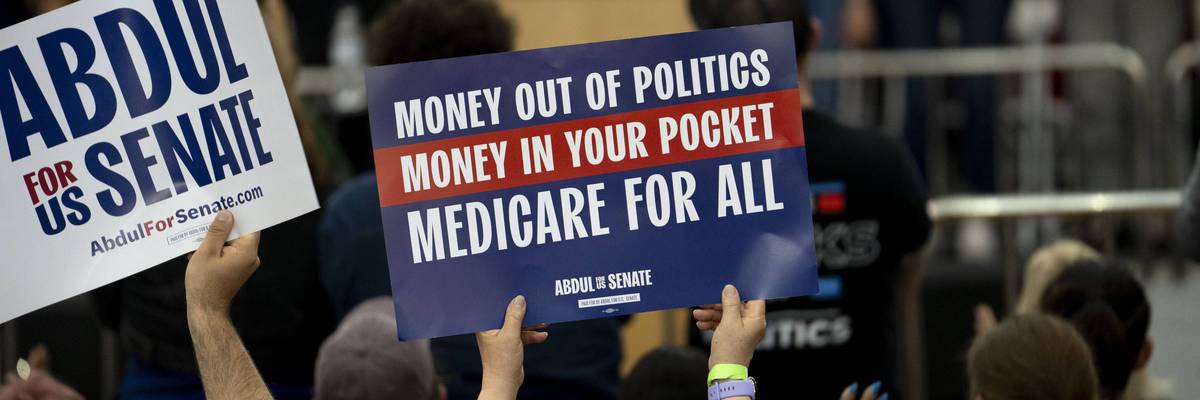
The audience cheers for a speaker before US Sen. Bernie Sanders (I-Vt.) takes the stage at Mumford High School on May 3, 2026 in Detroit, Michigan.
"Instead of going to war against the left, why not attract votes by going to war against insurance companies gouging patients, against employers busting unions, or against polluters?" said one critic.
Abdul El-Sayed's victory in the Democratic US Senate primary in Michigan this week was just the latest example of an insurgent progressive challenger defeating candidates backed by the Democratic establishment.
The establishment, however, is vowing to not go down without a fight.
In an interview with The New York Times published Thursday, Jonathan Cowan, the president of the corporate-funded group Third Way, revealed plans for a $15 million campaign to counter the influence of organizations such as the Democratic Socialists of America (DSA), which he described as a "mortal danger" to the Democratic Party.
"We are preparing for the next war that is coming," said Cowan, who added that "it is deeply troubling to see radical, far-left candidates winning in places that are potentially presidential swing states."
The Times report noted, however, that big moneyed interests, most notably the American Israel Public Affairs Committee (AIPAC), spent tens of millions of dollars attacking El-Sayed, who nonetheless emerged triumphant in the race.
Some critics fired back at Third Way, noting that the group only appeared interested in attacking progressives rather than promoting a positive agenda to improve people's lives.
Maurice Mitchell, the director of the Working Families Party, told the Times that groups such as Third Way are "missing a point of view" and are not seeing the "populist insurgency taking place in this country."
Mitchell was far from alone in criticizing the group's plans.
Jon Favreau, co-host of Pod Save America, remarked in a social media post that Third Way's $15 million investment would be better spent "building a movement and coming up with a vision that actually excites voters."
Favreau's comments were echoed by journalist Nathan Newman.
"Have moderates thought about presenting compelling policies more appealing to voters?" Newman asked. "Instead of going to war against the left, why not attract votes by going to war against insurance companies gouging patients, against employers busting unions, or against polluters?"
Even some critics more in line with Third Way's politics expressed skepticism of its proposed campaign.
Derek Thompson, co-author of Abundance, a book that critiqued progressive governance, argued that Third Way's efforts would only reinforce progressives' narratives about big moneyed interests trying to squash a grassroots rebellion against the status quo.
"People should do what they want with their money but moderate Democrats' deficits relate to candidates, messaging, organizing, and enthusiasm... not money," said Thompson. "Plus, I hope people see the risk in a headline about moderates raising millions of dollars to attack a popular left insurgency that attracts support in part... by representing themselves as a bulwark against moneyed interests."
New York University School of Law professor Chris Sprigman was similarly dismissive of the Third Way campaign, predicting that "centrists [are] likely to be no more effective against their own democratic left than they’ve been against the authoritarian right."
Lindsay Owens, executive director of the Groundwork Collaborative, argued that Third Way and other neoliberal organizations needed to look in the mirror when it comes to placing blame for the current state of US politics.
"The reason we are in this mess is because the biggest risk we face is market fundamentalism," Owens wrote. "That's what broke the country and voters know it. That's why they are turning against Third Way corporate Dem-style candidates. That’s the thing to fix."
Dear Common Dreams reader, It’s been nearly 30 years since I co-founded Common Dreams with my late wife, Lina Newhouser. We had the radical notion that journalism should serve the public good, not corporate profits. It was clear to us from the outset what it would take to build such a project. No paid advertisements. No corporate sponsors. No millionaire publisher telling us what to think or do. Many people said we wouldn't last a year, but we proved those doubters wrong. Together with a tremendous team of journalists and dedicated staff, we built an independent media outlet free from the constraints of profits and corporate control. Our mission has always been simple: To inform. To inspire. To ignite change for the common good. Building Common Dreams was not easy. Our survival was never guaranteed. When you take on the most powerful forces—Wall Street greed, fossil fuel industry destruction, Big Tech lobbyists, and uber-rich oligarchs who have spent billions upon billions rigging the economy and democracy in their favor—the only bulwark you have is supporters who believe in your work. But here’s the urgent message from me today. It's never been this bad out there. And it's never been this hard to keep us going. At the very moment Common Dreams is most needed, the threats we face are intensifying. We need your support now more than ever. We don't accept corporate advertising and never will. We don't have a paywall because we don't think people should be blocked from critical news based on their ability to pay. Everything we do is funded by the donations of readers like you. When everyone does the little they can afford, we are strong. But if that support retreats or dries up, so do we. Will you donate now to make sure Common Dreams not only survives but thrives? —Craig Brown, Co-founder |
Abdul El-Sayed's victory in the Democratic US Senate primary in Michigan this week was just the latest example of an insurgent progressive challenger defeating candidates backed by the Democratic establishment.
The establishment, however, is vowing to not go down without a fight.
In an interview with The New York Times published Thursday, Jonathan Cowan, the president of the corporate-funded group Third Way, revealed plans for a $15 million campaign to counter the influence of organizations such as the Democratic Socialists of America (DSA), which he described as a "mortal danger" to the Democratic Party.
"We are preparing for the next war that is coming," said Cowan, who added that "it is deeply troubling to see radical, far-left candidates winning in places that are potentially presidential swing states."
The Times report noted, however, that big moneyed interests, most notably the American Israel Public Affairs Committee (AIPAC), spent tens of millions of dollars attacking El-Sayed, who nonetheless emerged triumphant in the race.
Some critics fired back at Third Way, noting that the group only appeared interested in attacking progressives rather than promoting a positive agenda to improve people's lives.
Maurice Mitchell, the director of the Working Families Party, told the Times that groups such as Third Way are "missing a point of view" and are not seeing the "populist insurgency taking place in this country."
Mitchell was far from alone in criticizing the group's plans.
Jon Favreau, co-host of Pod Save America, remarked in a social media post that Third Way's $15 million investment would be better spent "building a movement and coming up with a vision that actually excites voters."
Favreau's comments were echoed by journalist Nathan Newman.
"Have moderates thought about presenting compelling policies more appealing to voters?" Newman asked. "Instead of going to war against the left, why not attract votes by going to war against insurance companies gouging patients, against employers busting unions, or against polluters?"
Even some critics more in line with Third Way's politics expressed skepticism of its proposed campaign.
Derek Thompson, co-author of Abundance, a book that critiqued progressive governance, argued that Third Way's efforts would only reinforce progressives' narratives about big moneyed interests trying to squash a grassroots rebellion against the status quo.
"People should do what they want with their money but moderate Democrats' deficits relate to candidates, messaging, organizing, and enthusiasm... not money," said Thompson. "Plus, I hope people see the risk in a headline about moderates raising millions of dollars to attack a popular left insurgency that attracts support in part... by representing themselves as a bulwark against moneyed interests."
New York University School of Law professor Chris Sprigman was similarly dismissive of the Third Way campaign, predicting that "centrists [are] likely to be no more effective against their own democratic left than they’ve been against the authoritarian right."
Lindsay Owens, executive director of the Groundwork Collaborative, argued that Third Way and other neoliberal organizations needed to look in the mirror when it comes to placing blame for the current state of US politics.
"The reason we are in this mess is because the biggest risk we face is market fundamentalism," Owens wrote. "That's what broke the country and voters know it. That's why they are turning against Third Way corporate Dem-style candidates. That’s the thing to fix."
Abdul El-Sayed's victory in the Democratic US Senate primary in Michigan this week was just the latest example of an insurgent progressive challenger defeating candidates backed by the Democratic establishment.
The establishment, however, is vowing to not go down without a fight.
In an interview with The New York Times published Thursday, Jonathan Cowan, the president of the corporate-funded group Third Way, revealed plans for a $15 million campaign to counter the influence of organizations such as the Democratic Socialists of America (DSA), which he described as a "mortal danger" to the Democratic Party.
"We are preparing for the next war that is coming," said Cowan, who added that "it is deeply troubling to see radical, far-left candidates winning in places that are potentially presidential swing states."
The Times report noted, however, that big moneyed interests, most notably the American Israel Public Affairs Committee (AIPAC), spent tens of millions of dollars attacking El-Sayed, who nonetheless emerged triumphant in the race.
Some critics fired back at Third Way, noting that the group only appeared interested in attacking progressives rather than promoting a positive agenda to improve people's lives.
Maurice Mitchell, the director of the Working Families Party, told the Times that groups such as Third Way are "missing a point of view" and are not seeing the "populist insurgency taking place in this country."
Mitchell was far from alone in criticizing the group's plans.
Jon Favreau, co-host of Pod Save America, remarked in a social media post that Third Way's $15 million investment would be better spent "building a movement and coming up with a vision that actually excites voters."
Favreau's comments were echoed by journalist Nathan Newman.
"Have moderates thought about presenting compelling policies more appealing to voters?" Newman asked. "Instead of going to war against the left, why not attract votes by going to war against insurance companies gouging patients, against employers busting unions, or against polluters?"
Even some critics more in line with Third Way's politics expressed skepticism of its proposed campaign.
Derek Thompson, co-author of Abundance, a book that critiqued progressive governance, argued that Third Way's efforts would only reinforce progressives' narratives about big moneyed interests trying to squash a grassroots rebellion against the status quo.
"People should do what they want with their money but moderate Democrats' deficits relate to candidates, messaging, organizing, and enthusiasm... not money," said Thompson. "Plus, I hope people see the risk in a headline about moderates raising millions of dollars to attack a popular left insurgency that attracts support in part... by representing themselves as a bulwark against moneyed interests."
New York University School of Law professor Chris Sprigman was similarly dismissive of the Third Way campaign, predicting that "centrists [are] likely to be no more effective against their own democratic left than they’ve been against the authoritarian right."
Lindsay Owens, executive director of the Groundwork Collaborative, argued that Third Way and other neoliberal organizations needed to look in the mirror when it comes to placing blame for the current state of US politics.
"The reason we are in this mess is because the biggest risk we face is market fundamentalism," Owens wrote. "That's what broke the country and voters know it. That's why they are turning against Third Way corporate Dem-style candidates. That’s the thing to fix."