SUBSCRIBE TO OUR FREE NEWSLETTER
Daily news & progressive opinion—funded by the people, not the corporations—delivered straight to your inbox.
5
#000000
#FFFFFF
To donate by check, phone, or other method, see our More Ways to Give page.
Daily news & progressive opinion—funded by the people, not the corporations—delivered straight to your inbox.
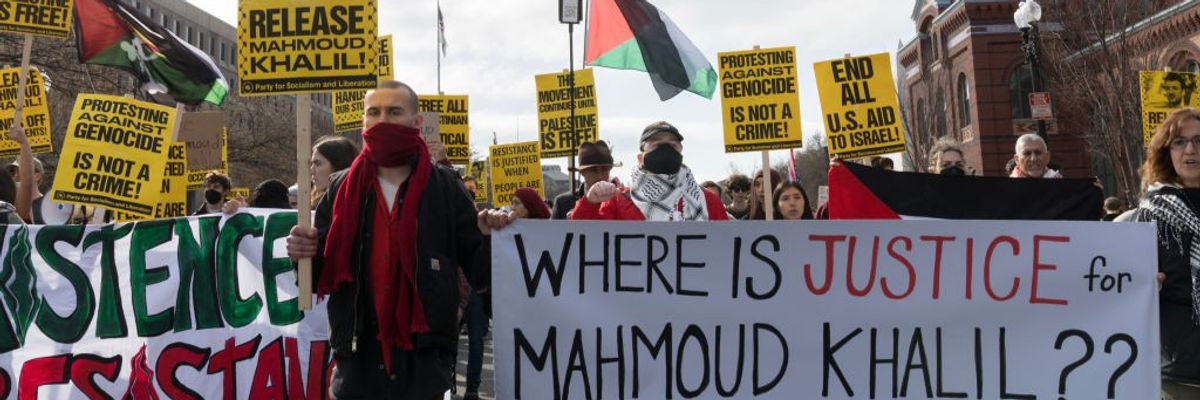
Demonstrators rally outside U.S. Immigration and Customs Enforcement headquarters in Washington, D.C. on March 15, 2025 to demand the release of pro-Palestine activist and green card holder Mahmoud Khalil.
"This is a first step, but we need to continue to demand justice for Mahmoud," said Khalil's wife. "His unlawful and unjust detention cannot stand."
A federal judge on Wednesday ruled that the case of Mahmoud Khalil, a permanent U.S. resident arrested earlier this month and slated for deportation by immigration authorities over his pro-Palestine activism, should be heard in New Jersey—not Louisiana as sought by the Trump administration—and reaffirmed an order blocking his expulsion from the country pending the outcome of his legal challenge.
Judge Jesse Furman of the U.S. District Court for the Southern District of New York found that since Khalil was detained by the Department of Homeland Security (DHS) in New Jersey when he lodged a legal challenge to his detention, his case should be transferred to the Garden State. Last week, Furman—an appointee of former President Barack Obama—issued and then
extended an order temporarily barring Khalil's deportation.
"This is a first step, but we need to continue to demand justice for Mahmoud," Khalil's wife, Noor Abdalla, who is eight months pregnant, said in response to Wednesday's ruling. "His unlawful and unjust detention cannot stand. We will not stop fighting until he is home with me."
Khalil, an Algerian citizen of Palestinian descent, last year finished his graduate studies at Columbia University, where he helped lead campus protests against Israel's annihilation of Gaza. He was arrested at his New York home by plainclothes DHS officers on March 8 before being transferred to New Jersey and then Louisiana.
Accused of no crime and widely considered a political prisoner, Khalil was targeted following U.S. President Donald Trump's issuance of an executive order authorizing the deportation of noncitizen students and others who take part in pro-Palestine demonstrations. The Trump administration has also invoked the Immigration and Nationality Act of 1952, which empowers the secretary of state to expel noncitizens whose presence in the United States is deemed detrimental to U.S. foreign policy interests.
Samah Sisay, a staff attorney at the Center for Constitutional Rights and a member of Khalil's legal team, said Wednesday that "the government transferred Mr. Khalil to a remote private prison in Louisiana hours after his arrest and the filing of his original habeas petition—an intentional and retaliatory attempt to silence his speech in support of Palestinian rights and interfere with the jurisdiction of the New York and New Jersey courts."
"Mr. Khalil should be free and home with his wife awaiting the birth of their first child, and we will continue to do everything possible to make that happen," Sisay added.
ACLU senior staff attorney Brett Max Kaufman, who also represents Khalil, said that "this is just the beginning, but it is a moment to celebrate."
"The court's ruling sends a critical message to courts across the country, who are sure to face similar unprecedented challenges to their authority in the days that come, that the judiciary must not shy from its constitutional role," he continued. "And no judicial role is more important than acting as a check on executive abuses the Trump administration has made the defining feature of its first 60 days."
"After this first step, we will eagerly and aggressively seek to get Mahmoud out, bring him home, and then defend his and others' right to speak freely about Palestine or any other issue without fear of detention and deportation," Kaufman added.
Another lawyer for Khalil, Amy Greer, said: "We are ready to fight just as hard for Mr. Khalil in the district of New Jersey. He was taken by plainclothes federal agents, transferred in the middle of the night across state lines, and has been detained for over a week now, all because of his advocacy for Palestinian freedom. We will not stop working until Mr. Khalil is home with his wife."
Democracy defenders have warned that Khalil's arrest—which sparked protests across the nation—is a blatant violation of constitutionally protected free speech rights and a sign of advancing authoritarianism. Trump vowed last week that Khalil was "the first arrest of many to come."
On Tuesday, Khalil released a
letter calling himself a "political prisoner." He called his arrest and detention "a direct consequence of exercising my right to free speech as I advocated for a free Palestine and an end to the genocide in Gaza," and "part of a broader strategy to suppress dissent" from which no one is immune.
Dear Common Dreams reader, It’s been nearly 30 years since I co-founded Common Dreams with my late wife, Lina Newhouser. We had the radical notion that journalism should serve the public good, not corporate profits. It was clear to us from the outset what it would take to build such a project. No paid advertisements. No corporate sponsors. No millionaire publisher telling us what to think or do. Many people said we wouldn't last a year, but we proved those doubters wrong. Together with a tremendous team of journalists and dedicated staff, we built an independent media outlet free from the constraints of profits and corporate control. Our mission has always been simple: To inform. To inspire. To ignite change for the common good. Building Common Dreams was not easy. Our survival was never guaranteed. When you take on the most powerful forces—Wall Street greed, fossil fuel industry destruction, Big Tech lobbyists, and uber-rich oligarchs who have spent billions upon billions rigging the economy and democracy in their favor—the only bulwark you have is supporters who believe in your work. But here’s the urgent message from me today. It's never been this bad out there. And it's never been this hard to keep us going. At the very moment Common Dreams is most needed, the threats we face are intensifying. We need your support now more than ever. We don't accept corporate advertising and never will. We don't have a paywall because we don't think people should be blocked from critical news based on their ability to pay. Everything we do is funded by the donations of readers like you. When everyone does the little they can afford, we are strong. But if that support retreats or dries up, so do we. Will you donate now to make sure Common Dreams not only survives but thrives? —Craig Brown, Co-founder |
A federal judge on Wednesday ruled that the case of Mahmoud Khalil, a permanent U.S. resident arrested earlier this month and slated for deportation by immigration authorities over his pro-Palestine activism, should be heard in New Jersey—not Louisiana as sought by the Trump administration—and reaffirmed an order blocking his expulsion from the country pending the outcome of his legal challenge.
Judge Jesse Furman of the U.S. District Court for the Southern District of New York found that since Khalil was detained by the Department of Homeland Security (DHS) in New Jersey when he lodged a legal challenge to his detention, his case should be transferred to the Garden State. Last week, Furman—an appointee of former President Barack Obama—issued and then
extended an order temporarily barring Khalil's deportation.
"This is a first step, but we need to continue to demand justice for Mahmoud," Khalil's wife, Noor Abdalla, who is eight months pregnant, said in response to Wednesday's ruling. "His unlawful and unjust detention cannot stand. We will not stop fighting until he is home with me."
Khalil, an Algerian citizen of Palestinian descent, last year finished his graduate studies at Columbia University, where he helped lead campus protests against Israel's annihilation of Gaza. He was arrested at his New York home by plainclothes DHS officers on March 8 before being transferred to New Jersey and then Louisiana.
Accused of no crime and widely considered a political prisoner, Khalil was targeted following U.S. President Donald Trump's issuance of an executive order authorizing the deportation of noncitizen students and others who take part in pro-Palestine demonstrations. The Trump administration has also invoked the Immigration and Nationality Act of 1952, which empowers the secretary of state to expel noncitizens whose presence in the United States is deemed detrimental to U.S. foreign policy interests.
Samah Sisay, a staff attorney at the Center for Constitutional Rights and a member of Khalil's legal team, said Wednesday that "the government transferred Mr. Khalil to a remote private prison in Louisiana hours after his arrest and the filing of his original habeas petition—an intentional and retaliatory attempt to silence his speech in support of Palestinian rights and interfere with the jurisdiction of the New York and New Jersey courts."
"Mr. Khalil should be free and home with his wife awaiting the birth of their first child, and we will continue to do everything possible to make that happen," Sisay added.
ACLU senior staff attorney Brett Max Kaufman, who also represents Khalil, said that "this is just the beginning, but it is a moment to celebrate."
"The court's ruling sends a critical message to courts across the country, who are sure to face similar unprecedented challenges to their authority in the days that come, that the judiciary must not shy from its constitutional role," he continued. "And no judicial role is more important than acting as a check on executive abuses the Trump administration has made the defining feature of its first 60 days."
"After this first step, we will eagerly and aggressively seek to get Mahmoud out, bring him home, and then defend his and others' right to speak freely about Palestine or any other issue without fear of detention and deportation," Kaufman added.
Another lawyer for Khalil, Amy Greer, said: "We are ready to fight just as hard for Mr. Khalil in the district of New Jersey. He was taken by plainclothes federal agents, transferred in the middle of the night across state lines, and has been detained for over a week now, all because of his advocacy for Palestinian freedom. We will not stop working until Mr. Khalil is home with his wife."
Democracy defenders have warned that Khalil's arrest—which sparked protests across the nation—is a blatant violation of constitutionally protected free speech rights and a sign of advancing authoritarianism. Trump vowed last week that Khalil was "the first arrest of many to come."
On Tuesday, Khalil released a
letter calling himself a "political prisoner." He called his arrest and detention "a direct consequence of exercising my right to free speech as I advocated for a free Palestine and an end to the genocide in Gaza," and "part of a broader strategy to suppress dissent" from which no one is immune.
A federal judge on Wednesday ruled that the case of Mahmoud Khalil, a permanent U.S. resident arrested earlier this month and slated for deportation by immigration authorities over his pro-Palestine activism, should be heard in New Jersey—not Louisiana as sought by the Trump administration—and reaffirmed an order blocking his expulsion from the country pending the outcome of his legal challenge.
Judge Jesse Furman of the U.S. District Court for the Southern District of New York found that since Khalil was detained by the Department of Homeland Security (DHS) in New Jersey when he lodged a legal challenge to his detention, his case should be transferred to the Garden State. Last week, Furman—an appointee of former President Barack Obama—issued and then
extended an order temporarily barring Khalil's deportation.
"This is a first step, but we need to continue to demand justice for Mahmoud," Khalil's wife, Noor Abdalla, who is eight months pregnant, said in response to Wednesday's ruling. "His unlawful and unjust detention cannot stand. We will not stop fighting until he is home with me."
Khalil, an Algerian citizen of Palestinian descent, last year finished his graduate studies at Columbia University, where he helped lead campus protests against Israel's annihilation of Gaza. He was arrested at his New York home by plainclothes DHS officers on March 8 before being transferred to New Jersey and then Louisiana.
Accused of no crime and widely considered a political prisoner, Khalil was targeted following U.S. President Donald Trump's issuance of an executive order authorizing the deportation of noncitizen students and others who take part in pro-Palestine demonstrations. The Trump administration has also invoked the Immigration and Nationality Act of 1952, which empowers the secretary of state to expel noncitizens whose presence in the United States is deemed detrimental to U.S. foreign policy interests.
Samah Sisay, a staff attorney at the Center for Constitutional Rights and a member of Khalil's legal team, said Wednesday that "the government transferred Mr. Khalil to a remote private prison in Louisiana hours after his arrest and the filing of his original habeas petition—an intentional and retaliatory attempt to silence his speech in support of Palestinian rights and interfere with the jurisdiction of the New York and New Jersey courts."
"Mr. Khalil should be free and home with his wife awaiting the birth of their first child, and we will continue to do everything possible to make that happen," Sisay added.
ACLU senior staff attorney Brett Max Kaufman, who also represents Khalil, said that "this is just the beginning, but it is a moment to celebrate."
"The court's ruling sends a critical message to courts across the country, who are sure to face similar unprecedented challenges to their authority in the days that come, that the judiciary must not shy from its constitutional role," he continued. "And no judicial role is more important than acting as a check on executive abuses the Trump administration has made the defining feature of its first 60 days."
"After this first step, we will eagerly and aggressively seek to get Mahmoud out, bring him home, and then defend his and others' right to speak freely about Palestine or any other issue without fear of detention and deportation," Kaufman added.
Another lawyer for Khalil, Amy Greer, said: "We are ready to fight just as hard for Mr. Khalil in the district of New Jersey. He was taken by plainclothes federal agents, transferred in the middle of the night across state lines, and has been detained for over a week now, all because of his advocacy for Palestinian freedom. We will not stop working until Mr. Khalil is home with his wife."
Democracy defenders have warned that Khalil's arrest—which sparked protests across the nation—is a blatant violation of constitutionally protected free speech rights and a sign of advancing authoritarianism. Trump vowed last week that Khalil was "the first arrest of many to come."
On Tuesday, Khalil released a
letter calling himself a "political prisoner." He called his arrest and detention "a direct consequence of exercising my right to free speech as I advocated for a free Palestine and an end to the genocide in Gaza," and "part of a broader strategy to suppress dissent" from which no one is immune.