SUBSCRIBE TO OUR FREE NEWSLETTER
Daily news & progressive opinion—funded by the people, not the corporations—delivered straight to your inbox.
5
#000000
#FFFFFF
To donate by check, phone, or other method, see our More Ways to Give page.
Daily news & progressive opinion—funded by the people, not the corporations—delivered straight to your inbox.
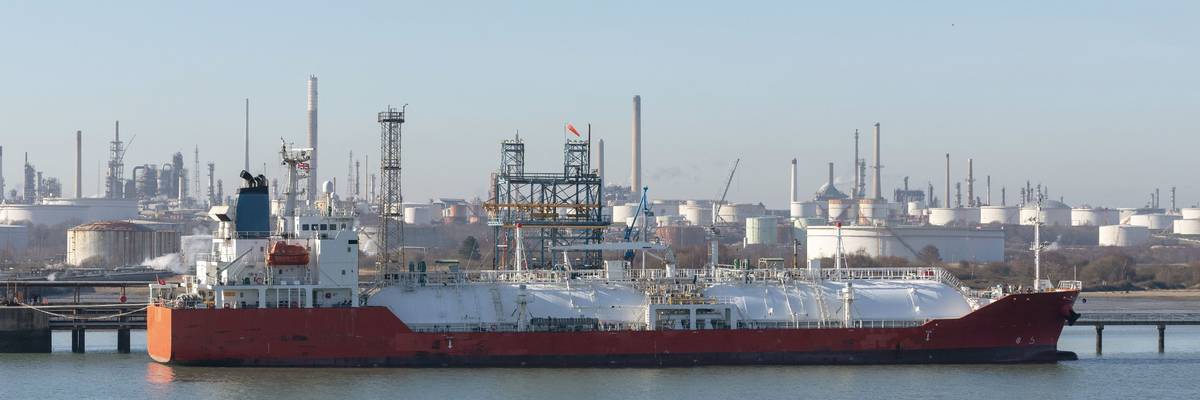
A liquid petroleum tanker vessel is seen on a refinery berth.
A Ukrainian drone attack on Russia's largest oil refinery highlights the inherent vulnerability of fossil fuel infrastructure, especially when compared with renewable alternatives.
I visited Omsk once, or at least its airport; we were en route from Moscow to Ulan Ade on the Mongolian border, and the Aeroflot flight landed there to refuel. (It was a memorable journey; this was still the Soviet Union, and on boarding for the full-day flight, the stewardess handed each passenger a baggie with a scrawny chicken drumstick). All of which is to say, I’m equipped to pronounce, with the gravitas proper to a pundit, that Omsk is long ways from anywhere else.
Including the Ukrainian border, which makes it remarkable that Ukraine's President Volodymyr Zelenskyy’s drone specialists managed to fly a whole squadron of their craft more than 2,500 kilometers from home and bomb the heck out of Russian President Vladimir Putin’s largest oil refinery. It was the high point of an ongoing campaign designed to highlight what may be Russia’s greatest weakness: that it, like a number of other countries, is heavily dependent on oil.
Just as US President Donald Trump has proposed building American prosperity on the back of “energy dominance" via “liquid gold,” oil was supposed to be Russia’s strength, the source of its greatest riches. (John McCain memorably called it a “gas station with nukes.”) And indeed in the early days of the war, Russia flexed its hydrocarbon muscle, threatening to cut off Europe’s gas supply. Throughout its invasion of its neighbor, Russia has relied on the often-covert export of oil via its fleet of “shadow tankers” to keep revenue flowing. Trump of course made this easier and more profitable for his buddy by temporarily lifting sanctions in the wake of our own ill-advised attack on Iran.
But if our attack on Iran has made other nations demonstrably more nervous about relying on the import of hydrocarbons, Ukraine’s attacks on Russia’s petroleum network should make them nervous about depending on the stuff even if they don’t have to bring it in from afar. It turns out that in the drone age it’s a very risky business, because it relies on colossal pieces of infrastructure that can’t be easily defended.
Once you can run cars and heat pumps and cooktops off the power those panels and turbines generate, then you’re far more protected against attack.
One of those is the supertanker—there was one on fire Tuesday in the Gulf, apparently hit by an Iranian missile because it strayed from the Tehran-approved shipping lane. Ukrainian drones attacked another Monday in the Sea of Azov, crippling the vessel. There’s essentially no defense for these slow-moving giant ships if an adversary with a few drones wants to take one out—they are, after all, a floating pool of flammable liquid.
Another vulnerability is the terminal where you load and unload the crude—Ukraine got one of those Monday too, in occupied Crimea:
The facility serves as a major logistics hub for petroleum products on the occupied peninsula, handling the receipt, storage, and transfer of oil between rail infrastructure, storage tanks, and tankers
And a third—and perhaps most exposed—is the refinery. An oil refinery is one of the most specialized pieces of equipment humans have ever built; anyone who’s ever driven by one on the highway will recognize that the tangle of pipes and tanks that makes each so complicated. It’s an industry truism that no two are alike.
That means that they’re highly vulnerable. If you aim your drone well, maybe it will smash, say, the ELOU-AVT-11 Unit, which at Omsk is what they call the thing that does the initial distillation and desalination of the crude. Without it, the secondary units that produce, say, gasoline and jet fuel have nothing to work with. And this is highly complicated equipment not easy to replace—given Western sanctions, the current guess is six months to a year. And it’s not as if Ukraine has hit just that refinery—in fact, it was one of the last squares on a drone pilot’s bingo card. As Illia Kabachynskyi reports:
It's also worth remembering that Ukraine has already hit all 10 of Russia's largest refineries, some of them more than once. That means it's no longer a single plant waiting for repairs—it's effectively all of them at once, which piles additional pressure on repair crews and on the supply of replacement parts that are hard to source under sanctions.
Russia started this energy war, of course—over the years of the conflict it has targeted heating plants and the like, trying to freeze the fighting spirit out of the Ukrainians during their long winters. It’s been effective at producing cold, but not at winning the war; along with the attacks on schools, hospitals, and other civilian targets it seems to have helped reinforce the Ukrainian will to resist.
Now—with far more attention to avoiding civilian casualties—the Ukrainians are striking back, at defense plants, and especially at refineries. As Zelensky said Tuesday morning:
The very idea of Russia having a strategic rear is gone. For a long time, Russia believed it had territorial advantage no one else possessed, a deep rear, where it could safely keep everything its war depends on, believing no one could reach them. We have reached them.
But of course what’s at stake here is not just the oil that the Russian war machine runs on. In Russia, as in America, almost everything runs on oil. I remember that the one and only time that I sat down with former President Barack Obama, the first thing he told me was that “the price of gasoline is the most salient fact in American politics.” If that’s even close to the case in Russia, Putin better watch out: in occupied Crimea, gas prices are going above $10 a gallon. The government is desperately trying to import gasoline from as far away as India. As Pjotr Sauer reported Tuesday morning, police are having to draw guns to quell disturbances at gas stations where lines can stretch for kilometers, “fuel tourists” are crossing the borders with China and Kazakhstan to fill their tanks, and as a result:
“Mass fatigue with the war is turning into mass irritation,” said Andrei Kolesnikov, a Moscow-based political analyst. Even so, he said the shortages were unlikely to trigger widespread protests in Russia’s tightly controlled political system. “There is certainly shock, but the lack of any real means of influencing the situation—and the risks associated with trying to do so—make protests unlikely.”
This seems likely to get worse. Here’s a social media post from an Omsk resident watching the drone strikes: "Don't waste any time right now. Anyone with a car who's watching me—head to the gas station! The lines are about to get crazy."
And here’s an account of how Russian horse breeders are reporting a surge in sales because a steed is now cheaper to maintain than a car; check out the video of the equestrian cantering past the endless line at the gas station.
Ukraine has stood up to Russia’s attacks on its energy infrastructure mostly by starting to diversify: as Paul Hockenos reported last winter, the country is undergoing a rapid renewables revolution:
According to estimates from the Solar Energy Association of Ukraine, the nation installed at least 1.5 gigawatts of new solar generation in 2025—enough to power roughly 1.1 million homes—and grid operators intend to almost double the country’s renewable energy production over the next four years.
“Ukraine’s energy transition is not a slogan,” says Ievgeniia Kopytsia, a Ukrainian energy analyst at the Institute for Climate Protection, Energy, and Mobility. “Since the full-scale invasion, Ukraine has added over 3 gigawatts of new renewable energy capacity. It’s a security-driven transformation, unfolding under extreme constraints, that prioritizes decentralization, flexibility, and speed of recovery.”
In the most basic terms, a single missile can take out a gas-fired power plant. But as Jeff Oatham of DTEK, Ukraine’s largest energy company and its largest private energy investor, explains:
“You would need around 40 missiles to do the equivalent amount of capacity damage at a wind farm.”
Solar, too, makes an unattractive target. “Attacking decentralized solar power installations is not economically rational,” says Ukrainian energy expert Olena Kondratiuk. “Missiles and drones are expensive, and significantly disrupting such systems would require a large number of strikes, while the overall impact on the energy system would remain limited.” Both solar and wind parks can function even when parts of them are out of operation.
That’s because sun and wind and batteries are not like oil—they are small, interchangeable pieces of infrastructure, easily subbed in. There aren’t choke points like refineries and tankers and terminals; there’s no cascading failure. My roof is covered with solar panels, and I suppose a saboteur could put a ladder against the wall and climb up there with a hammer and do some damage. But it wouldn’t shut down the electric grid across New England; it would be a problem, not a crisis. Which in turn is why no rational saboteur would ever bother.
And once you can run cars and heat pumps and cooktops off the power those panels and turbines generate, then you’re far more protected against attack. If Vladimir Putin had an electrified Russia he would worry far less about Ukrainian drones. Of course, if the world ran on electricity Russia would never have built up the treasury required to act like a bellicose beast.
Look, world leaders should be moving quickly to clean energy because it’s the one scaleable weapon in the war against climate change. But I’ll take any motivation—and I’ll count it as a real bonus if a cleaner world is also one where it’s harder to attack your neighbors because they don’t have vulnerable infrastructure. The peace dividend from sun and wind could be very real.
Dear Common Dreams reader, It’s been nearly 30 years since I co-founded Common Dreams with my late wife, Lina Newhouser. We had the radical notion that journalism should serve the public good, not corporate profits. It was clear to us from the outset what it would take to build such a project. No paid advertisements. No corporate sponsors. No millionaire publisher telling us what to think or do. Many people said we wouldn't last a year, but we proved those doubters wrong. Together with a tremendous team of journalists and dedicated staff, we built an independent media outlet free from the constraints of profits and corporate control. Our mission has always been simple: To inform. To inspire. To ignite change for the common good. Building Common Dreams was not easy. Our survival was never guaranteed. When you take on the most powerful forces—Wall Street greed, fossil fuel industry destruction, Big Tech lobbyists, and uber-rich oligarchs who have spent billions upon billions rigging the economy and democracy in their favor—the only bulwark you have is supporters who believe in your work. But here’s the urgent message from me today. It's never been this bad out there. And it's never been this hard to keep us going. At the very moment Common Dreams is most needed, the threats we face are intensifying. We need your support now more than ever. We don't accept corporate advertising and never will. We don't have a paywall because we don't think people should be blocked from critical news based on their ability to pay. Everything we do is funded by the donations of readers like you. When everyone does the little they can afford, we are strong. But if that support retreats or dries up, so do we. Will you donate now to make sure Common Dreams not only survives but thrives? —Craig Brown, Co-founder |
I visited Omsk once, or at least its airport; we were en route from Moscow to Ulan Ade on the Mongolian border, and the Aeroflot flight landed there to refuel. (It was a memorable journey; this was still the Soviet Union, and on boarding for the full-day flight, the stewardess handed each passenger a baggie with a scrawny chicken drumstick). All of which is to say, I’m equipped to pronounce, with the gravitas proper to a pundit, that Omsk is long ways from anywhere else.
Including the Ukrainian border, which makes it remarkable that Ukraine's President Volodymyr Zelenskyy’s drone specialists managed to fly a whole squadron of their craft more than 2,500 kilometers from home and bomb the heck out of Russian President Vladimir Putin’s largest oil refinery. It was the high point of an ongoing campaign designed to highlight what may be Russia’s greatest weakness: that it, like a number of other countries, is heavily dependent on oil.
Just as US President Donald Trump has proposed building American prosperity on the back of “energy dominance" via “liquid gold,” oil was supposed to be Russia’s strength, the source of its greatest riches. (John McCain memorably called it a “gas station with nukes.”) And indeed in the early days of the war, Russia flexed its hydrocarbon muscle, threatening to cut off Europe’s gas supply. Throughout its invasion of its neighbor, Russia has relied on the often-covert export of oil via its fleet of “shadow tankers” to keep revenue flowing. Trump of course made this easier and more profitable for his buddy by temporarily lifting sanctions in the wake of our own ill-advised attack on Iran.
But if our attack on Iran has made other nations demonstrably more nervous about relying on the import of hydrocarbons, Ukraine’s attacks on Russia’s petroleum network should make them nervous about depending on the stuff even if they don’t have to bring it in from afar. It turns out that in the drone age it’s a very risky business, because it relies on colossal pieces of infrastructure that can’t be easily defended.
Once you can run cars and heat pumps and cooktops off the power those panels and turbines generate, then you’re far more protected against attack.
One of those is the supertanker—there was one on fire Tuesday in the Gulf, apparently hit by an Iranian missile because it strayed from the Tehran-approved shipping lane. Ukrainian drones attacked another Monday in the Sea of Azov, crippling the vessel. There’s essentially no defense for these slow-moving giant ships if an adversary with a few drones wants to take one out—they are, after all, a floating pool of flammable liquid.
Another vulnerability is the terminal where you load and unload the crude—Ukraine got one of those Monday too, in occupied Crimea:
The facility serves as a major logistics hub for petroleum products on the occupied peninsula, handling the receipt, storage, and transfer of oil between rail infrastructure, storage tanks, and tankers
And a third—and perhaps most exposed—is the refinery. An oil refinery is one of the most specialized pieces of equipment humans have ever built; anyone who’s ever driven by one on the highway will recognize that the tangle of pipes and tanks that makes each so complicated. It’s an industry truism that no two are alike.
That means that they’re highly vulnerable. If you aim your drone well, maybe it will smash, say, the ELOU-AVT-11 Unit, which at Omsk is what they call the thing that does the initial distillation and desalination of the crude. Without it, the secondary units that produce, say, gasoline and jet fuel have nothing to work with. And this is highly complicated equipment not easy to replace—given Western sanctions, the current guess is six months to a year. And it’s not as if Ukraine has hit just that refinery—in fact, it was one of the last squares on a drone pilot’s bingo card. As Illia Kabachynskyi reports:
It's also worth remembering that Ukraine has already hit all 10 of Russia's largest refineries, some of them more than once. That means it's no longer a single plant waiting for repairs—it's effectively all of them at once, which piles additional pressure on repair crews and on the supply of replacement parts that are hard to source under sanctions.
Russia started this energy war, of course—over the years of the conflict it has targeted heating plants and the like, trying to freeze the fighting spirit out of the Ukrainians during their long winters. It’s been effective at producing cold, but not at winning the war; along with the attacks on schools, hospitals, and other civilian targets it seems to have helped reinforce the Ukrainian will to resist.
Now—with far more attention to avoiding civilian casualties—the Ukrainians are striking back, at defense plants, and especially at refineries. As Zelensky said Tuesday morning:
The very idea of Russia having a strategic rear is gone. For a long time, Russia believed it had territorial advantage no one else possessed, a deep rear, where it could safely keep everything its war depends on, believing no one could reach them. We have reached them.
But of course what’s at stake here is not just the oil that the Russian war machine runs on. In Russia, as in America, almost everything runs on oil. I remember that the one and only time that I sat down with former President Barack Obama, the first thing he told me was that “the price of gasoline is the most salient fact in American politics.” If that’s even close to the case in Russia, Putin better watch out: in occupied Crimea, gas prices are going above $10 a gallon. The government is desperately trying to import gasoline from as far away as India. As Pjotr Sauer reported Tuesday morning, police are having to draw guns to quell disturbances at gas stations where lines can stretch for kilometers, “fuel tourists” are crossing the borders with China and Kazakhstan to fill their tanks, and as a result:
“Mass fatigue with the war is turning into mass irritation,” said Andrei Kolesnikov, a Moscow-based political analyst. Even so, he said the shortages were unlikely to trigger widespread protests in Russia’s tightly controlled political system. “There is certainly shock, but the lack of any real means of influencing the situation—and the risks associated with trying to do so—make protests unlikely.”
This seems likely to get worse. Here’s a social media post from an Omsk resident watching the drone strikes: "Don't waste any time right now. Anyone with a car who's watching me—head to the gas station! The lines are about to get crazy."
And here’s an account of how Russian horse breeders are reporting a surge in sales because a steed is now cheaper to maintain than a car; check out the video of the equestrian cantering past the endless line at the gas station.
Ukraine has stood up to Russia’s attacks on its energy infrastructure mostly by starting to diversify: as Paul Hockenos reported last winter, the country is undergoing a rapid renewables revolution:
According to estimates from the Solar Energy Association of Ukraine, the nation installed at least 1.5 gigawatts of new solar generation in 2025—enough to power roughly 1.1 million homes—and grid operators intend to almost double the country’s renewable energy production over the next four years.
“Ukraine’s energy transition is not a slogan,” says Ievgeniia Kopytsia, a Ukrainian energy analyst at the Institute for Climate Protection, Energy, and Mobility. “Since the full-scale invasion, Ukraine has added over 3 gigawatts of new renewable energy capacity. It’s a security-driven transformation, unfolding under extreme constraints, that prioritizes decentralization, flexibility, and speed of recovery.”
In the most basic terms, a single missile can take out a gas-fired power plant. But as Jeff Oatham of DTEK, Ukraine’s largest energy company and its largest private energy investor, explains:
“You would need around 40 missiles to do the equivalent amount of capacity damage at a wind farm.”
Solar, too, makes an unattractive target. “Attacking decentralized solar power installations is not economically rational,” says Ukrainian energy expert Olena Kondratiuk. “Missiles and drones are expensive, and significantly disrupting such systems would require a large number of strikes, while the overall impact on the energy system would remain limited.” Both solar and wind parks can function even when parts of them are out of operation.
That’s because sun and wind and batteries are not like oil—they are small, interchangeable pieces of infrastructure, easily subbed in. There aren’t choke points like refineries and tankers and terminals; there’s no cascading failure. My roof is covered with solar panels, and I suppose a saboteur could put a ladder against the wall and climb up there with a hammer and do some damage. But it wouldn’t shut down the electric grid across New England; it would be a problem, not a crisis. Which in turn is why no rational saboteur would ever bother.
And once you can run cars and heat pumps and cooktops off the power those panels and turbines generate, then you’re far more protected against attack. If Vladimir Putin had an electrified Russia he would worry far less about Ukrainian drones. Of course, if the world ran on electricity Russia would never have built up the treasury required to act like a bellicose beast.
Look, world leaders should be moving quickly to clean energy because it’s the one scaleable weapon in the war against climate change. But I’ll take any motivation—and I’ll count it as a real bonus if a cleaner world is also one where it’s harder to attack your neighbors because they don’t have vulnerable infrastructure. The peace dividend from sun and wind could be very real.
I visited Omsk once, or at least its airport; we were en route from Moscow to Ulan Ade on the Mongolian border, and the Aeroflot flight landed there to refuel. (It was a memorable journey; this was still the Soviet Union, and on boarding for the full-day flight, the stewardess handed each passenger a baggie with a scrawny chicken drumstick). All of which is to say, I’m equipped to pronounce, with the gravitas proper to a pundit, that Omsk is long ways from anywhere else.
Including the Ukrainian border, which makes it remarkable that Ukraine's President Volodymyr Zelenskyy’s drone specialists managed to fly a whole squadron of their craft more than 2,500 kilometers from home and bomb the heck out of Russian President Vladimir Putin’s largest oil refinery. It was the high point of an ongoing campaign designed to highlight what may be Russia’s greatest weakness: that it, like a number of other countries, is heavily dependent on oil.
Just as US President Donald Trump has proposed building American prosperity on the back of “energy dominance" via “liquid gold,” oil was supposed to be Russia’s strength, the source of its greatest riches. (John McCain memorably called it a “gas station with nukes.”) And indeed in the early days of the war, Russia flexed its hydrocarbon muscle, threatening to cut off Europe’s gas supply. Throughout its invasion of its neighbor, Russia has relied on the often-covert export of oil via its fleet of “shadow tankers” to keep revenue flowing. Trump of course made this easier and more profitable for his buddy by temporarily lifting sanctions in the wake of our own ill-advised attack on Iran.
But if our attack on Iran has made other nations demonstrably more nervous about relying on the import of hydrocarbons, Ukraine’s attacks on Russia’s petroleum network should make them nervous about depending on the stuff even if they don’t have to bring it in from afar. It turns out that in the drone age it’s a very risky business, because it relies on colossal pieces of infrastructure that can’t be easily defended.
Once you can run cars and heat pumps and cooktops off the power those panels and turbines generate, then you’re far more protected against attack.
One of those is the supertanker—there was one on fire Tuesday in the Gulf, apparently hit by an Iranian missile because it strayed from the Tehran-approved shipping lane. Ukrainian drones attacked another Monday in the Sea of Azov, crippling the vessel. There’s essentially no defense for these slow-moving giant ships if an adversary with a few drones wants to take one out—they are, after all, a floating pool of flammable liquid.
Another vulnerability is the terminal where you load and unload the crude—Ukraine got one of those Monday too, in occupied Crimea:
The facility serves as a major logistics hub for petroleum products on the occupied peninsula, handling the receipt, storage, and transfer of oil between rail infrastructure, storage tanks, and tankers
And a third—and perhaps most exposed—is the refinery. An oil refinery is one of the most specialized pieces of equipment humans have ever built; anyone who’s ever driven by one on the highway will recognize that the tangle of pipes and tanks that makes each so complicated. It’s an industry truism that no two are alike.
That means that they’re highly vulnerable. If you aim your drone well, maybe it will smash, say, the ELOU-AVT-11 Unit, which at Omsk is what they call the thing that does the initial distillation and desalination of the crude. Without it, the secondary units that produce, say, gasoline and jet fuel have nothing to work with. And this is highly complicated equipment not easy to replace—given Western sanctions, the current guess is six months to a year. And it’s not as if Ukraine has hit just that refinery—in fact, it was one of the last squares on a drone pilot’s bingo card. As Illia Kabachynskyi reports:
It's also worth remembering that Ukraine has already hit all 10 of Russia's largest refineries, some of them more than once. That means it's no longer a single plant waiting for repairs—it's effectively all of them at once, which piles additional pressure on repair crews and on the supply of replacement parts that are hard to source under sanctions.
Russia started this energy war, of course—over the years of the conflict it has targeted heating plants and the like, trying to freeze the fighting spirit out of the Ukrainians during their long winters. It’s been effective at producing cold, but not at winning the war; along with the attacks on schools, hospitals, and other civilian targets it seems to have helped reinforce the Ukrainian will to resist.
Now—with far more attention to avoiding civilian casualties—the Ukrainians are striking back, at defense plants, and especially at refineries. As Zelensky said Tuesday morning:
The very idea of Russia having a strategic rear is gone. For a long time, Russia believed it had territorial advantage no one else possessed, a deep rear, where it could safely keep everything its war depends on, believing no one could reach them. We have reached them.
But of course what’s at stake here is not just the oil that the Russian war machine runs on. In Russia, as in America, almost everything runs on oil. I remember that the one and only time that I sat down with former President Barack Obama, the first thing he told me was that “the price of gasoline is the most salient fact in American politics.” If that’s even close to the case in Russia, Putin better watch out: in occupied Crimea, gas prices are going above $10 a gallon. The government is desperately trying to import gasoline from as far away as India. As Pjotr Sauer reported Tuesday morning, police are having to draw guns to quell disturbances at gas stations where lines can stretch for kilometers, “fuel tourists” are crossing the borders with China and Kazakhstan to fill their tanks, and as a result:
“Mass fatigue with the war is turning into mass irritation,” said Andrei Kolesnikov, a Moscow-based political analyst. Even so, he said the shortages were unlikely to trigger widespread protests in Russia’s tightly controlled political system. “There is certainly shock, but the lack of any real means of influencing the situation—and the risks associated with trying to do so—make protests unlikely.”
This seems likely to get worse. Here’s a social media post from an Omsk resident watching the drone strikes: "Don't waste any time right now. Anyone with a car who's watching me—head to the gas station! The lines are about to get crazy."
And here’s an account of how Russian horse breeders are reporting a surge in sales because a steed is now cheaper to maintain than a car; check out the video of the equestrian cantering past the endless line at the gas station.
Ukraine has stood up to Russia’s attacks on its energy infrastructure mostly by starting to diversify: as Paul Hockenos reported last winter, the country is undergoing a rapid renewables revolution:
According to estimates from the Solar Energy Association of Ukraine, the nation installed at least 1.5 gigawatts of new solar generation in 2025—enough to power roughly 1.1 million homes—and grid operators intend to almost double the country’s renewable energy production over the next four years.
“Ukraine’s energy transition is not a slogan,” says Ievgeniia Kopytsia, a Ukrainian energy analyst at the Institute for Climate Protection, Energy, and Mobility. “Since the full-scale invasion, Ukraine has added over 3 gigawatts of new renewable energy capacity. It’s a security-driven transformation, unfolding under extreme constraints, that prioritizes decentralization, flexibility, and speed of recovery.”
In the most basic terms, a single missile can take out a gas-fired power plant. But as Jeff Oatham of DTEK, Ukraine’s largest energy company and its largest private energy investor, explains:
“You would need around 40 missiles to do the equivalent amount of capacity damage at a wind farm.”
Solar, too, makes an unattractive target. “Attacking decentralized solar power installations is not economically rational,” says Ukrainian energy expert Olena Kondratiuk. “Missiles and drones are expensive, and significantly disrupting such systems would require a large number of strikes, while the overall impact on the energy system would remain limited.” Both solar and wind parks can function even when parts of them are out of operation.
That’s because sun and wind and batteries are not like oil—they are small, interchangeable pieces of infrastructure, easily subbed in. There aren’t choke points like refineries and tankers and terminals; there’s no cascading failure. My roof is covered with solar panels, and I suppose a saboteur could put a ladder against the wall and climb up there with a hammer and do some damage. But it wouldn’t shut down the electric grid across New England; it would be a problem, not a crisis. Which in turn is why no rational saboteur would ever bother.
And once you can run cars and heat pumps and cooktops off the power those panels and turbines generate, then you’re far more protected against attack. If Vladimir Putin had an electrified Russia he would worry far less about Ukrainian drones. Of course, if the world ran on electricity Russia would never have built up the treasury required to act like a bellicose beast.
Look, world leaders should be moving quickly to clean energy because it’s the one scaleable weapon in the war against climate change. But I’ll take any motivation—and I’ll count it as a real bonus if a cleaner world is also one where it’s harder to attack your neighbors because they don’t have vulnerable infrastructure. The peace dividend from sun and wind could be very real.