SUBSCRIBE TO OUR FREE NEWSLETTER
Daily news & progressive opinion—funded by the people, not the corporations—delivered straight to your inbox.
5
#000000
#FFFFFF
To donate by check, phone, or other method, see our More Ways to Give page.
Daily news & progressive opinion—funded by the people, not the corporations—delivered straight to your inbox.
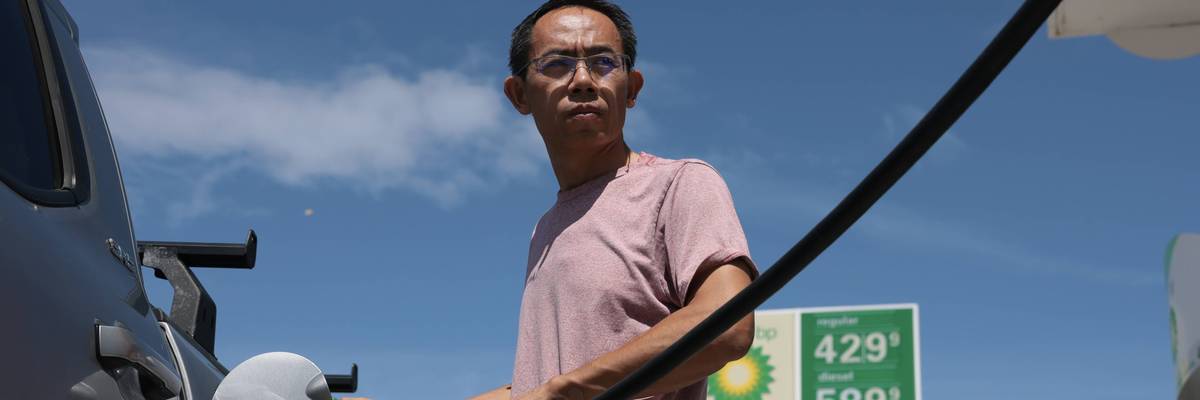
A man puts fuel in his vehicle at a gas station on April 6, 2026 in Miami, Florida.
The US and Iran exchanged military strikes on Wednesday as American oil inventories dropped to the lowest level in more than two decades.
US President Donald Trump on Wednesday tried to project optimism about reaching a deal to end the illegal war he started against Iran, even while acknowledging the crisis could last for several more months.
In an interview with The New York Post, Trump was asked whether the current blockade of Iran would last until Labor Day.
"I don't know," Trump said. "I mean, I think it could be, but I think it's unlikely... I think this will resolve itself fairly quickly."
Q: Do you think the blockade will still be in place by Labor Day?
Trump: It could be, but I think it's unlikely. I think this will resolve itself fairly quickly. pic.twitter.com/Ispq2tnPJZ
— Clash Report (@clashreport) June 3, 2026
The president for the last several months has managed to keep oil prices from spiking to disastrous levels by dropping hints that his illegal war will soon be over, even though it has continued with no end in sight.
And while the Trump administration has insisted that its ceasefire deal is still in effect, CNN reported on Wednesday that Iran launched attacks against US military bases in Kuwait and Bahrain after US forces fired a Hellfire missile at a Botswana-flagged oil tanker that was heading toward an Iranian port.
Iran also launched drone and missile strikes at Kuwait's international airport, killing one person and leaving dozens injured, according to Al Jazeera.
Oil industry expert Patrick De Haan on Tuesday warned that the price of oil will soon shoot back up if the Strait of Hormuz remains closed because US petroleum supplies, which have been drained at a rapid pace since the start of the war, are about to hit their lowest level in over two decades.
"US distillate inventories will likely fall under 100 million barrels for the first time in over 20 years, exacerbated by high exports due to the closure of the Strait of Hormuz," De Hann wrote in a social media post. "This is a powder keg waiting to go off if a deal to reopen the strait doesn't happen soon."
In an analysis published Wednesday, The American Prospect's Ryan Cooper similarly warned that the tricks used by nations around the world to keep a lid on oil prices, such as releasing petroleum reserves, would soon be ineffective thanks to hard supply constraints.
"As storages dwindle and run out, the only way to match demand to supply will be for the price to rise high enough to destroy something like 10 to 20% of global oil consumption," Cooper wrote. "And because a great deal of oil demand is obligatory and therefore not very price-sensitive, that price will likely be north of $150 per barrel."
This would lead not just to an explosion in gasoline and diesel fuel prices, Cooper continued, but a "corresponding price hike for anything that needs to be transported, or involved in plastic in some way, which is to say basically everything."
Dear Common Dreams reader, It’s been nearly 30 years since I co-founded Common Dreams with my late wife, Lina Newhouser. We had the radical notion that journalism should serve the public good, not corporate profits. It was clear to us from the outset what it would take to build such a project. No paid advertisements. No corporate sponsors. No millionaire publisher telling us what to think or do. Many people said we wouldn't last a year, but we proved those doubters wrong. Together with a tremendous team of journalists and dedicated staff, we built an independent media outlet free from the constraints of profits and corporate control. Our mission has always been simple: To inform. To inspire. To ignite change for the common good. Building Common Dreams was not easy. Our survival was never guaranteed. When you take on the most powerful forces—Wall Street greed, fossil fuel industry destruction, Big Tech lobbyists, and uber-rich oligarchs who have spent billions upon billions rigging the economy and democracy in their favor—the only bulwark you have is supporters who believe in your work. But here’s the urgent message from me today. It's never been this bad out there. And it's never been this hard to keep us going. At the very moment Common Dreams is most needed, the threats we face are intensifying. We need your support now more than ever. We don't accept corporate advertising and never will. We don't have a paywall because we don't think people should be blocked from critical news based on their ability to pay. Everything we do is funded by the donations of readers like you. When everyone does the little they can afford, we are strong. But if that support retreats or dries up, so do we. Will you donate now to make sure Common Dreams not only survives but thrives? —Craig Brown, Co-founder |
US President Donald Trump on Wednesday tried to project optimism about reaching a deal to end the illegal war he started against Iran, even while acknowledging the crisis could last for several more months.
In an interview with The New York Post, Trump was asked whether the current blockade of Iran would last until Labor Day.
"I don't know," Trump said. "I mean, I think it could be, but I think it's unlikely... I think this will resolve itself fairly quickly."
Q: Do you think the blockade will still be in place by Labor Day?
Trump: It could be, but I think it's unlikely. I think this will resolve itself fairly quickly. pic.twitter.com/Ispq2tnPJZ
— Clash Report (@clashreport) June 3, 2026
The president for the last several months has managed to keep oil prices from spiking to disastrous levels by dropping hints that his illegal war will soon be over, even though it has continued with no end in sight.
And while the Trump administration has insisted that its ceasefire deal is still in effect, CNN reported on Wednesday that Iran launched attacks against US military bases in Kuwait and Bahrain after US forces fired a Hellfire missile at a Botswana-flagged oil tanker that was heading toward an Iranian port.
Iran also launched drone and missile strikes at Kuwait's international airport, killing one person and leaving dozens injured, according to Al Jazeera.
Oil industry expert Patrick De Haan on Tuesday warned that the price of oil will soon shoot back up if the Strait of Hormuz remains closed because US petroleum supplies, which have been drained at a rapid pace since the start of the war, are about to hit their lowest level in over two decades.
"US distillate inventories will likely fall under 100 million barrels for the first time in over 20 years, exacerbated by high exports due to the closure of the Strait of Hormuz," De Hann wrote in a social media post. "This is a powder keg waiting to go off if a deal to reopen the strait doesn't happen soon."
In an analysis published Wednesday, The American Prospect's Ryan Cooper similarly warned that the tricks used by nations around the world to keep a lid on oil prices, such as releasing petroleum reserves, would soon be ineffective thanks to hard supply constraints.
"As storages dwindle and run out, the only way to match demand to supply will be for the price to rise high enough to destroy something like 10 to 20% of global oil consumption," Cooper wrote. "And because a great deal of oil demand is obligatory and therefore not very price-sensitive, that price will likely be north of $150 per barrel."
This would lead not just to an explosion in gasoline and diesel fuel prices, Cooper continued, but a "corresponding price hike for anything that needs to be transported, or involved in plastic in some way, which is to say basically everything."
US President Donald Trump on Wednesday tried to project optimism about reaching a deal to end the illegal war he started against Iran, even while acknowledging the crisis could last for several more months.
In an interview with The New York Post, Trump was asked whether the current blockade of Iran would last until Labor Day.
"I don't know," Trump said. "I mean, I think it could be, but I think it's unlikely... I think this will resolve itself fairly quickly."
Q: Do you think the blockade will still be in place by Labor Day?
Trump: It could be, but I think it's unlikely. I think this will resolve itself fairly quickly. pic.twitter.com/Ispq2tnPJZ
— Clash Report (@clashreport) June 3, 2026
The president for the last several months has managed to keep oil prices from spiking to disastrous levels by dropping hints that his illegal war will soon be over, even though it has continued with no end in sight.
And while the Trump administration has insisted that its ceasefire deal is still in effect, CNN reported on Wednesday that Iran launched attacks against US military bases in Kuwait and Bahrain after US forces fired a Hellfire missile at a Botswana-flagged oil tanker that was heading toward an Iranian port.
Iran also launched drone and missile strikes at Kuwait's international airport, killing one person and leaving dozens injured, according to Al Jazeera.
Oil industry expert Patrick De Haan on Tuesday warned that the price of oil will soon shoot back up if the Strait of Hormuz remains closed because US petroleum supplies, which have been drained at a rapid pace since the start of the war, are about to hit their lowest level in over two decades.
"US distillate inventories will likely fall under 100 million barrels for the first time in over 20 years, exacerbated by high exports due to the closure of the Strait of Hormuz," De Hann wrote in a social media post. "This is a powder keg waiting to go off if a deal to reopen the strait doesn't happen soon."
In an analysis published Wednesday, The American Prospect's Ryan Cooper similarly warned that the tricks used by nations around the world to keep a lid on oil prices, such as releasing petroleum reserves, would soon be ineffective thanks to hard supply constraints.
"As storages dwindle and run out, the only way to match demand to supply will be for the price to rise high enough to destroy something like 10 to 20% of global oil consumption," Cooper wrote. "And because a great deal of oil demand is obligatory and therefore not very price-sensitive, that price will likely be north of $150 per barrel."
This would lead not just to an explosion in gasoline and diesel fuel prices, Cooper continued, but a "corresponding price hike for anything that needs to be transported, or involved in plastic in some way, which is to say basically everything."