
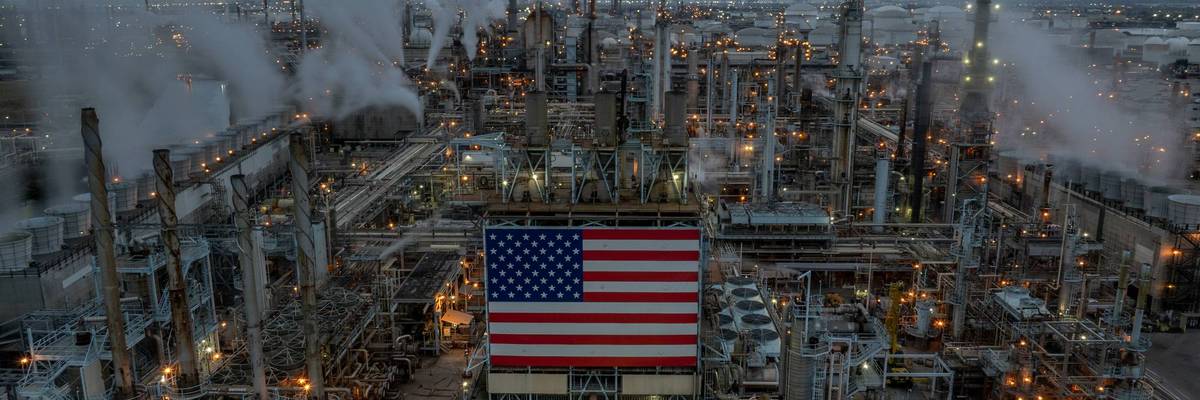
In an aerial view, Marathon Petroleum Corp's Los Angeles Refinery, one of the largest oil refineries in the North America, operates as gas prices rocket upward due to worldwide oil supply disruptions caused by the US and Israeli attack on Iran, on March 10, 2026 in Carson, California.
Without a US-Iran Peace Deal, the World Is Headed for an Energy Crisis Apocalypse
Global reserves of petroleum could fall so low by September, if the crisis is not resolved, that they will reach what analysts call “an operational floor.”
The International Energy Agency has made its May report free to download, and the news is not good for the second and third quarters of this year, i.e. April-September. The IEA hopes things will look up in the fourth quarter, but premises that expectation on an early end to the US conflict with Iran and a reopening of the Strait of Hormuz.
At the moment (June 5, 2026), there does not seem much movement on that front, and in fact the US and Iran are not only skirmishing with one another but Iran is making good its threat to hurt US allies like Bahrain and Kuwait every time the US hurts Iran.
One was killed and dozens injured in Kuwait on Wednesday by Iranian Shahed drone barrages that also damaged the airport. Kuwait Airlines shut down briefly but is now flying from a different terminal; it is the only carrier flying from Kuwait. Iran also targeted the HQ of the US Fifth Fleet in Bahrain but CENTCOM says the missiles were intercepted. Iran says the attacks were in reaction to US strikes on Qeshm Island, which is a base for Iranian missiles and a radar installation.
Iranian Foreign Minister Abbas Araghchi said Friday Iran time that no progress has been made in talks with the US, though contacts are ongoing.
Last week alone, US petroleum reserves fell by 10.6 million barrels, to the lowest level seen since 2004.
In the meantime, the IEA says that in Q2, ending June 30, world demand for petroleum will be down by 2.45 million barrels a day. This reduction is what economists call demand destruction, and it is a very bad sign. People are just using less petroleum because it is more expensive than it was before the US and Israel attacked Iran on February 28. In the US, gasoline is up by 35% to 50%. In Europe, diesel, which runs trucks, was the equivalent of $6.78 a gallon in February, and is now $8.02 per gallon (€1.82 per liter). If you are running a fleet of trucks over thousands of miles, that is a huge loss, and you might consolidate and cut out less remunerative routes.
Likewise, airlines have cancelled tens of thousands of flights and ticket prices have risen, so some passengers are cancelling or postponing trips. Trucks deliver goods to retail stores, so prices of commodities have gone up, and some customers have put off buying things they don’t desperately need right now. If the retailer doesn’t sell a product, it doesn’t order more, so the trucks don’t roll as often. And if the goods aren’t selling, the factories scale back production, so they use less petroleum, too.
The IEA statistics suggest that the pain is greater for the poorer countries, which makes sense. The wealthy countries’ consumers are paying more and cutting back a bit. Those in the developing world are just going without, as I pointed out on Monday.
The IEA expected the world to produce 106.1 million barrels a day in 2026. It won’t. That projection has been revised down to 102.2 million barrels a day, a reduction of 3.9 million barrels a day. That is severe. But here is the catch. That is the reduction if “flows through the Strait gradually resume from June.” As Qasim al-Ali points out, that is an iffy bet as things now stand. So the shortfall in production will be bigger. Which will slow the world economy even more.
The agency observes, “With Hormuz tanker traffic still restricted, cumulative supply losses from Gulf producers already exceed 1 billion barrels with more than 14 mb/d of oil now shut in, an unprecedented supply shock.”
The shock hasn’t been as bad as it could have been so far, for several reasons. We just saw that there is enormous demand destruction, with the economic slowdown it implies. Also, there was a glut in the oil market going into the crisis, which takes some of the pressure off. The US, Europe, and China are drawing down their Strategic Petroleum Reserves (SPRs) at an alarming rate. That move eases the pain in the short term. But low reserves imply a limited ability to deal with further supply shocks that may occur next year. Israeli Prime Minister Benjamin Netanyahu has signaled that he’d like to attack Iran again. So the big crisis may be next year this time, when there won’t be any SPR cushion.
Also, Strategic Petroleum Reserves are not infinite. China has enough for six months. At some point governments will become reluctant to draw them down any more, and then the interruption in supplies from the Gulf will hit all that much harder. The reserves held at oil hubs can’t go to zero, moreover. The inventory at Cushing, Oklahoma has fallen from 33 to 24.5 million barrels. But it can’t go lower than 20 million barrels without gumming up the pipelines and refineries.
Last week alone, US petroleum reserves fell by 10.6 million barrels, to the lowest level seen since 2004.
Global reserves of petroleum could fall so low by September, if the crisis is not resolved, that they will reach what analysts call “an operational floor.”
And when that happens, the shortages won’t be able to be finessed anymore, not by demand destruction and not by release of reserves.
And when we cross that threshold, oil shoots suddenly to $200 a barrel, which is an energy crisis apocalypse and spells deep gloom for the global and the US economy.
We are at a crossroads
This country and this world are at a monumental crossroads. In a few short weeks, US voters will have an opportunity to beat back the forces of fascism and confront the billionaires who are rigging the economy, our media system, and our democracy, making it increasingly impossible for ordinary people to get by. We’re not just talking about the election. We’re talking about what must be done once these fascist elements are vanquished from power. We need a bolder set of solutions than what either major party has so far been willing to offer and a working-class movement ready to fight like hell for it. Trump didn't emerge from nowhere. The conditions that fueled MAGA authoritarianism were created by decades of radical neoliberal economic policies and a corrupt political system dominated by corporate interests. They slashed taxes on the super-rich, promising that the benefits would trickle down. They said giveaways to the corporate titans would make life more affordable for the rest of us. It was all bullshit. And when a bitter, betrayed populace searches for someone to blame, right-wing demagogues have little trouble finding scapegoats. People know when they're being lied to, but you won't hear any of this from the corporate media. Only independent journalism—powered and funded by people who believe in building a better world—can deliver truly trustworthy daily news. Our Fall Campaign is underway, and we need your help. To power our newsroom through the rest of the year, we need to raise $125,000 by midnight on October 31. So if you share our vision, please contribute whatever you can to sustain our work. |
The International Energy Agency has made its May report free to download, and the news is not good for the second and third quarters of this year, i.e. April-September. The IEA hopes things will look up in the fourth quarter, but premises that expectation on an early end to the US conflict with Iran and a reopening of the Strait of Hormuz.
At the moment (June 5, 2026), there does not seem much movement on that front, and in fact the US and Iran are not only skirmishing with one another but Iran is making good its threat to hurt US allies like Bahrain and Kuwait every time the US hurts Iran.
One was killed and dozens injured in Kuwait on Wednesday by Iranian Shahed drone barrages that also damaged the airport. Kuwait Airlines shut down briefly but is now flying from a different terminal; it is the only carrier flying from Kuwait. Iran also targeted the HQ of the US Fifth Fleet in Bahrain but CENTCOM says the missiles were intercepted. Iran says the attacks were in reaction to US strikes on Qeshm Island, which is a base for Iranian missiles and a radar installation.
Iranian Foreign Minister Abbas Araghchi said Friday Iran time that no progress has been made in talks with the US, though contacts are ongoing.
Last week alone, US petroleum reserves fell by 10.6 million barrels, to the lowest level seen since 2004.
In the meantime, the IEA says that in Q2, ending June 30, world demand for petroleum will be down by 2.45 million barrels a day. This reduction is what economists call demand destruction, and it is a very bad sign. People are just using less petroleum because it is more expensive than it was before the US and Israel attacked Iran on February 28. In the US, gasoline is up by 35% to 50%. In Europe, diesel, which runs trucks, was the equivalent of $6.78 a gallon in February, and is now $8.02 per gallon (€1.82 per liter). If you are running a fleet of trucks over thousands of miles, that is a huge loss, and you might consolidate and cut out less remunerative routes.
Likewise, airlines have cancelled tens of thousands of flights and ticket prices have risen, so some passengers are cancelling or postponing trips. Trucks deliver goods to retail stores, so prices of commodities have gone up, and some customers have put off buying things they don’t desperately need right now. If the retailer doesn’t sell a product, it doesn’t order more, so the trucks don’t roll as often. And if the goods aren’t selling, the factories scale back production, so they use less petroleum, too.
The IEA statistics suggest that the pain is greater for the poorer countries, which makes sense. The wealthy countries’ consumers are paying more and cutting back a bit. Those in the developing world are just going without, as I pointed out on Monday.
The IEA expected the world to produce 106.1 million barrels a day in 2026. It won’t. That projection has been revised down to 102.2 million barrels a day, a reduction of 3.9 million barrels a day. That is severe. But here is the catch. That is the reduction if “flows through the Strait gradually resume from June.” As Qasim al-Ali points out, that is an iffy bet as things now stand. So the shortfall in production will be bigger. Which will slow the world economy even more.
The agency observes, “With Hormuz tanker traffic still restricted, cumulative supply losses from Gulf producers already exceed 1 billion barrels with more than 14 mb/d of oil now shut in, an unprecedented supply shock.”
The shock hasn’t been as bad as it could have been so far, for several reasons. We just saw that there is enormous demand destruction, with the economic slowdown it implies. Also, there was a glut in the oil market going into the crisis, which takes some of the pressure off. The US, Europe, and China are drawing down their Strategic Petroleum Reserves (SPRs) at an alarming rate. That move eases the pain in the short term. But low reserves imply a limited ability to deal with further supply shocks that may occur next year. Israeli Prime Minister Benjamin Netanyahu has signaled that he’d like to attack Iran again. So the big crisis may be next year this time, when there won’t be any SPR cushion.
Also, Strategic Petroleum Reserves are not infinite. China has enough for six months. At some point governments will become reluctant to draw them down any more, and then the interruption in supplies from the Gulf will hit all that much harder. The reserves held at oil hubs can’t go to zero, moreover. The inventory at Cushing, Oklahoma has fallen from 33 to 24.5 million barrels. But it can’t go lower than 20 million barrels without gumming up the pipelines and refineries.
Last week alone, US petroleum reserves fell by 10.6 million barrels, to the lowest level seen since 2004.
Global reserves of petroleum could fall so low by September, if the crisis is not resolved, that they will reach what analysts call “an operational floor.”
And when that happens, the shortages won’t be able to be finessed anymore, not by demand destruction and not by release of reserves.
And when we cross that threshold, oil shoots suddenly to $200 a barrel, which is an energy crisis apocalypse and spells deep gloom for the global and the US economy.
- 'The Situation Is Scary': Global Economic Chaos as Trump’s Iran War Sends Markets Diving ›
- Thanks to Trump's Iran War, Big Oil Raking in $30 Million Per Hour in Windfall Profits ›
- Thanks to Trump's Iran War, Over $100 Billion Has Been 'Siphoned From Ordinary People' to Big Oil ›
- Trump Says Iran Blockade Could Last All Summer Amid Fears of Oil Supply 'Powder Keg' ›
- IEA Chief Warns Only 'Weeks' of Oil Inventories Left Thanks to Trump's Iran War ›
- World ‘Burning Through Oil Safety Net’ as Trump Weighs Plans to Restart Iran Assault ›
The International Energy Agency has made its May report free to download, and the news is not good for the second and third quarters of this year, i.e. April-September. The IEA hopes things will look up in the fourth quarter, but premises that expectation on an early end to the US conflict with Iran and a reopening of the Strait of Hormuz.
At the moment (June 5, 2026), there does not seem much movement on that front, and in fact the US and Iran are not only skirmishing with one another but Iran is making good its threat to hurt US allies like Bahrain and Kuwait every time the US hurts Iran.
One was killed and dozens injured in Kuwait on Wednesday by Iranian Shahed drone barrages that also damaged the airport. Kuwait Airlines shut down briefly but is now flying from a different terminal; it is the only carrier flying from Kuwait. Iran also targeted the HQ of the US Fifth Fleet in Bahrain but CENTCOM says the missiles were intercepted. Iran says the attacks were in reaction to US strikes on Qeshm Island, which is a base for Iranian missiles and a radar installation.
Iranian Foreign Minister Abbas Araghchi said Friday Iran time that no progress has been made in talks with the US, though contacts are ongoing.
Last week alone, US petroleum reserves fell by 10.6 million barrels, to the lowest level seen since 2004.
In the meantime, the IEA says that in Q2, ending June 30, world demand for petroleum will be down by 2.45 million barrels a day. This reduction is what economists call demand destruction, and it is a very bad sign. People are just using less petroleum because it is more expensive than it was before the US and Israel attacked Iran on February 28. In the US, gasoline is up by 35% to 50%. In Europe, diesel, which runs trucks, was the equivalent of $6.78 a gallon in February, and is now $8.02 per gallon (€1.82 per liter). If you are running a fleet of trucks over thousands of miles, that is a huge loss, and you might consolidate and cut out less remunerative routes.
Likewise, airlines have cancelled tens of thousands of flights and ticket prices have risen, so some passengers are cancelling or postponing trips. Trucks deliver goods to retail stores, so prices of commodities have gone up, and some customers have put off buying things they don’t desperately need right now. If the retailer doesn’t sell a product, it doesn’t order more, so the trucks don’t roll as often. And if the goods aren’t selling, the factories scale back production, so they use less petroleum, too.
The IEA statistics suggest that the pain is greater for the poorer countries, which makes sense. The wealthy countries’ consumers are paying more and cutting back a bit. Those in the developing world are just going without, as I pointed out on Monday.
The IEA expected the world to produce 106.1 million barrels a day in 2026. It won’t. That projection has been revised down to 102.2 million barrels a day, a reduction of 3.9 million barrels a day. That is severe. But here is the catch. That is the reduction if “flows through the Strait gradually resume from June.” As Qasim al-Ali points out, that is an iffy bet as things now stand. So the shortfall in production will be bigger. Which will slow the world economy even more.
The agency observes, “With Hormuz tanker traffic still restricted, cumulative supply losses from Gulf producers already exceed 1 billion barrels with more than 14 mb/d of oil now shut in, an unprecedented supply shock.”
The shock hasn’t been as bad as it could have been so far, for several reasons. We just saw that there is enormous demand destruction, with the economic slowdown it implies. Also, there was a glut in the oil market going into the crisis, which takes some of the pressure off. The US, Europe, and China are drawing down their Strategic Petroleum Reserves (SPRs) at an alarming rate. That move eases the pain in the short term. But low reserves imply a limited ability to deal with further supply shocks that may occur next year. Israeli Prime Minister Benjamin Netanyahu has signaled that he’d like to attack Iran again. So the big crisis may be next year this time, when there won’t be any SPR cushion.
Also, Strategic Petroleum Reserves are not infinite. China has enough for six months. At some point governments will become reluctant to draw them down any more, and then the interruption in supplies from the Gulf will hit all that much harder. The reserves held at oil hubs can’t go to zero, moreover. The inventory at Cushing, Oklahoma has fallen from 33 to 24.5 million barrels. But it can’t go lower than 20 million barrels without gumming up the pipelines and refineries.
Last week alone, US petroleum reserves fell by 10.6 million barrels, to the lowest level seen since 2004.
Global reserves of petroleum could fall so low by September, if the crisis is not resolved, that they will reach what analysts call “an operational floor.”
And when that happens, the shortages won’t be able to be finessed anymore, not by demand destruction and not by release of reserves.
And when we cross that threshold, oil shoots suddenly to $200 a barrel, which is an energy crisis apocalypse and spells deep gloom for the global and the US economy.
- 'The Situation Is Scary': Global Economic Chaos as Trump’s Iran War Sends Markets Diving ›
- Thanks to Trump's Iran War, Big Oil Raking in $30 Million Per Hour in Windfall Profits ›
- Thanks to Trump's Iran War, Over $100 Billion Has Been 'Siphoned From Ordinary People' to Big Oil ›
- Trump Says Iran Blockade Could Last All Summer Amid Fears of Oil Supply 'Powder Keg' ›
- IEA Chief Warns Only 'Weeks' of Oil Inventories Left Thanks to Trump's Iran War ›
- World ‘Burning Through Oil Safety Net’ as Trump Weighs Plans to Restart Iran Assault ›