SUBSCRIBE TO OUR FREE NEWSLETTER
Daily news & progressive opinion—funded by the people, not the corporations—delivered straight to your inbox.
5
#000000
#FFFFFF
To donate by check, phone, or other method, see our More Ways to Give page.
Daily news & progressive opinion—funded by the people, not the corporations—delivered straight to your inbox.
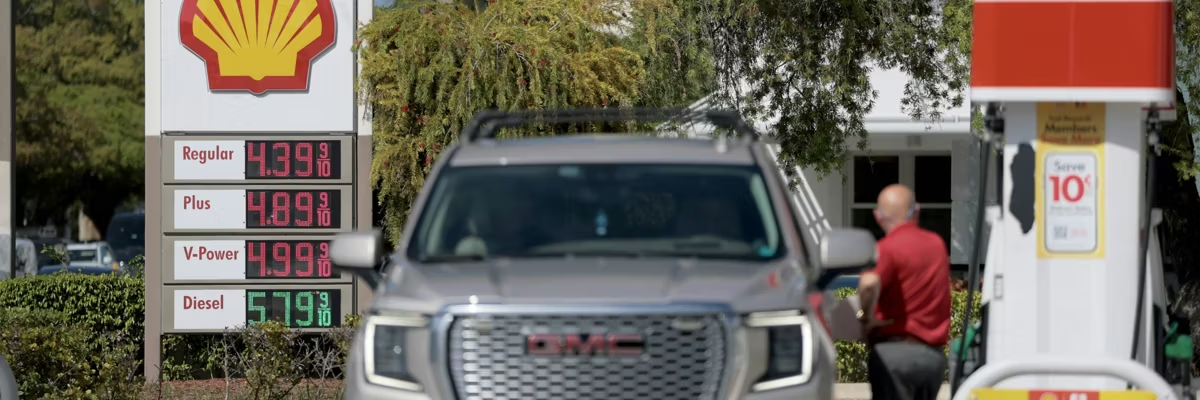
Fuel prices are displayed on a sign as a customer fills their vehicle at a gas station on April 13, 2026 in Miami, Florida.
“You can only decrease consumption so much, and when inventories run out, they are going to run out,” said one energy industry expert.
The global energy crisis caused by President Donald Trump's illegal war with Iran is set to worsen in the coming months, as The Wall Street Journal reported on Friday that the world is "burning through its oil safety net."
Even though oil prices surged at the start of the war, which led Iran to close the Strait of Hormuz to commercial ships, that increase was temporarily mitigated by crude surpluses that allowed countries to add more petroleum to the market.
However, the Journal reported that those reserve stocks are being depleted at an unprecedented pace, with inventories declining by nearly 250 million barrels in just the first two months of the conflict.
This rapid drawdown has led oil executives and analysts to warn that "a harsh reckoning is set to upend the relative calm in energy markets" as "acute shortages of key fuels and soaring prices could emerge within weeks if the Strait of Hormuz remains shut," according to the Journal.
The Journal cited a report from consulting firm Eurasia Group estimating that, at the current rate of depletion, US diesel reserves are set to fall below 100 million barrels for the first time in 23 years by the end of this month.
Ellen Wald, senior fellow at the Atlantic Council’s Global Energy Center, told the Journal that while the increased price of oil would be partially offset by a decrease in consumption, the sheer scale of the coming supply crunch is so big that prices will continue to spiral upward.
“You can only decrease consumption so much, and when inventories run out, they are going to run out,” Wald explained. “At some point the market is going to collide and prices are going to shoot up.”
This problem could be exacerbated further if Trump decides to renew attacks on Iran, which could lead to devastating Iranian counterstrikes on oil production facilities throughout the region.
Zeteo reported on Thursday that "preparations for an imminent new phase of Trump’s Iran war have accelerated," as the president "has grown increasingly frustrated by the state of peace talks."
According to Zeteo's sources, the US military campaign is set to ramp up shortly after Trump returns from his visit to China, with options that include "a potential massive new bombing campaign against the Iranians."
The US military bombed Iranian military targets and civilian infrastructure throughout the early weeks of the conflict, but the country has still refused to reopen the Strait of Hormuz.
With peace talks stalled and the prospect of renewed hostilities on the table, the price of Brent crude futures surged on Friday, topping more than $108 per barrel.
Average gas prices in the US remained above $4.50 on Friday, and petroleum industry analyst Patrick De Haan estimated on Thursday that prices could soon jump to over $5 per gallon if the Strait of Hormuz isn't opened soon.
This country and this world are at a monumental crossroads. US voters have an opportunity to beat back the forces of fascism and confront the billionaires who are rigging the economy, our media system, and our democracy, making it increasingly impossible for ordinary people to get by. We’re not just talking about the election. We’re talking about what must be done once these fascist elements are vanquished from power. We need a bolder set of solutions than what either major party has so far been willing to offer and a working-class movement ready to fight like hell for it. Trump didn't emerge from nowhere. The conditions that fueled MAGA authoritarianism were created by decades of radical neoliberal economic policies and a corrupt political system dominated by corporate interests. They slashed taxes on the super-rich, promising that the benefits would trickle down. They said giveaways to the corporate titans would make life more affordable for the rest of us. It was all bullshit. And when a bitter, betrayed populace searches for someone to blame, right-wing demagogues have little trouble finding scapegoats. People know when they're being lied to, but you won't hear any of this from the corporate media. Only independent journalism—powered and funded by people who believe in building a better world—can deliver truly trustworthy daily news. If you share our vision, please contribute whatever you can to sustain our work. |
The global energy crisis caused by President Donald Trump's illegal war with Iran is set to worsen in the coming months, as The Wall Street Journal reported on Friday that the world is "burning through its oil safety net."
Even though oil prices surged at the start of the war, which led Iran to close the Strait of Hormuz to commercial ships, that increase was temporarily mitigated by crude surpluses that allowed countries to add more petroleum to the market.
However, the Journal reported that those reserve stocks are being depleted at an unprecedented pace, with inventories declining by nearly 250 million barrels in just the first two months of the conflict.
This rapid drawdown has led oil executives and analysts to warn that "a harsh reckoning is set to upend the relative calm in energy markets" as "acute shortages of key fuels and soaring prices could emerge within weeks if the Strait of Hormuz remains shut," according to the Journal.
The Journal cited a report from consulting firm Eurasia Group estimating that, at the current rate of depletion, US diesel reserves are set to fall below 100 million barrels for the first time in 23 years by the end of this month.
Ellen Wald, senior fellow at the Atlantic Council’s Global Energy Center, told the Journal that while the increased price of oil would be partially offset by a decrease in consumption, the sheer scale of the coming supply crunch is so big that prices will continue to spiral upward.
“You can only decrease consumption so much, and when inventories run out, they are going to run out,” Wald explained. “At some point the market is going to collide and prices are going to shoot up.”
This problem could be exacerbated further if Trump decides to renew attacks on Iran, which could lead to devastating Iranian counterstrikes on oil production facilities throughout the region.
Zeteo reported on Thursday that "preparations for an imminent new phase of Trump’s Iran war have accelerated," as the president "has grown increasingly frustrated by the state of peace talks."
According to Zeteo's sources, the US military campaign is set to ramp up shortly after Trump returns from his visit to China, with options that include "a potential massive new bombing campaign against the Iranians."
The US military bombed Iranian military targets and civilian infrastructure throughout the early weeks of the conflict, but the country has still refused to reopen the Strait of Hormuz.
With peace talks stalled and the prospect of renewed hostilities on the table, the price of Brent crude futures surged on Friday, topping more than $108 per barrel.
Average gas prices in the US remained above $4.50 on Friday, and petroleum industry analyst Patrick De Haan estimated on Thursday that prices could soon jump to over $5 per gallon if the Strait of Hormuz isn't opened soon.