5
#000000
#FFFFFF
To donate by check, phone, or other method, see our More Ways to Give page.
Daily news & progressive opinion—funded by the people, not the corporations—delivered straight to your inbox.
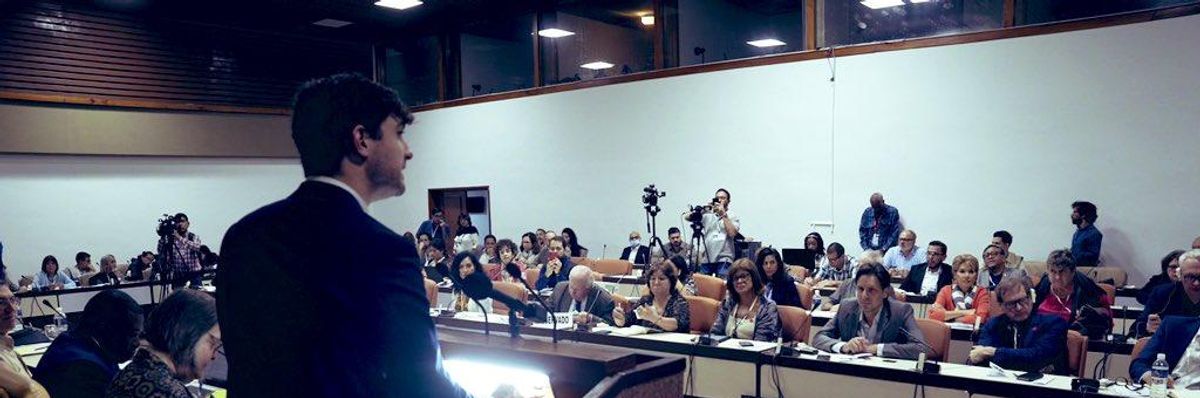
Progressive International general coordinator David Adler speaks at the Havana Congress on the New International Economic Order in Cuba on January 27, 2023.
"What is the common vision to guide the Global South out of this crisis?" asked the Progressive International. "What is the plan to win it?"
Delegates to the Havana Congress on the New International Economic Order—a gathering organized by the Progressive International and attended by more than 50 scholars and policymakers from 26 countries across all six inhabited continents—agreed over the weekend on a declaration that outlines a "common vision" for building an egalitarian and sustainable society out of the wreckage of five decades of neoliberal capitalism.
"The crisis of the existing world system can either entrench inequalities," the declaration asserts, or it can "embolden" popular movements throughout the Global South to "reclaim" their role as protagonists "in the construction of a new world order based on justice, equity, and peace."
Delegates resolved to focus their initial efforts on strengthening the development and dissemination of lifesaving technologies in low-income nations.
"Delegates agreed that a key priority must be to secure science and technology sovereignty."
This decision comes one year after Cuban officials announced, at a press conference convened by the Progressive International (PI), their plan to deliver 200 million homegrown Covid-19 vaccine doses to impoverished countries abandoned by their wealthy counterparts and Big Pharma—along with tools to enable domestic production and expert support to improve distribution.
It also comes as Cuba assumes the presidency of the Group of 77 (G77), a bloc of 134 developing countries in Africa, Asia, and Latin America where "the combined crises of food, energy, and environment" are escalating, PI noted.
"What is the common vision to guide the Global South out of this crisis?" the coalition asked. "What is the plan to win it? What is the New International Economic Order for the 21st century?"
"After two days of detailed discussions about how to transform our shared world, delegates agreed that a key priority must be to secure science and technology sovereignty," PI general coordinator David Adler said Sunday at the conclusion of the Havana Congress. "From pharmaceuticals to green tech, from digital currencies to microchips, too much of humanity is locked out of both benefiting from scientific advances and contributing to new ones. We will, as today's declaration calls for, work to build 'a planetary bloc led by the South and reinforced by the solidarities of the North' to liberate knowledge and peoples."
Speaking at the January 12 ceremony during which Cuba ascended to the G77 presidency, Cuban Foreign Minister Bruno Rodríguez Parrilla emphasized the need for coordinated action across the Global South on science and tech, arguing that "scientific-technical development is today monopolized by a club of countries that monopolize most of the patents, technologies, research centers, and promote the drain of talent from our countries."
The G77 Summit on Science, Technology, and Innovation, scheduled for September in Havana, seeks to "unite, complement each other, integrate our national capacities so as not to be relegated to future pandemics," said Parrilla.
During his speech on the first day of the Havana Congress, meanwhile, former Greek Finance Minister Yanis Varoufakis called for a new non-aligned movement to "end the legalized robbery of people and Earth fueling climate catastrophe."
Read the full Havana Declaration on the New International Economic Order:
The Havana Congress,
Recalling the role of the Cuban Revolution in the struggle to unite the Southern nations of the world, and the spirit of the 1966 Havana Tricontinental Conference that convened peoples from Asia, Africa, and Latin America to chart a path to collective liberation in the face of severe global crises and sustained imperial subjugation;
Hearing the echoes of that history today, as crises of hunger, disease, and war once again overwhelm the world, compounded by a rapidly changing climate and the droughts, floods, and hurricanes that not only threaten to inflame conflicts between peoples, but also risk the extinction of humanity at large;
Celebrating the legacy of the anti-colonial struggle, and the victories won by combining a program of sovereign development at home, solidarity for national liberation abroad, and a strong Southern bloc to force concessions to its interests, culminating in the adoption of the U.N. Declaration on the Establishment of a New International Economic Order (NIEO);
Acknowledging that the project of decolonization remains incomplete, disrupted by concerted attacks on the unity of the South in the form of wars, coups, sanctions, structural adjustment, and the false promise that sovereign development might be won through integration into a hierarchical world system;
Emphasizing that the result has been the sustained divergence between North and South, characterized by the same dynamics that defined the international economic order five decades prior: the extraction of natural resources, the enclosure of 'intellectual property,' the plunder of structural adjustment, and the exclusion of the multilateral system;
Recognizing that despite these setbacks, the flame of Southern resistance did not die; that the pursuit of sovereign development has yielded unprecedented achievements—from mass literacy and universal healthcare to poverty alleviation and medical innovation—that enable a renewed campaign of Southern cooperation today;
Stressing that this potential for Southern unity is perceived as a threat to Northern powers, which seek once again to preserve their position in the hierarchy of the world system through mechanisms of economic exclusion, political coercion, and military aggression;
Seizing the opportunity of the present historical juncture, when the crisis of the existing world system can either entrench inequalities or embolden the call to reclaim Southern protagonism in the construction of a new world order based on justice, equity, and peace;
The Havana Congress calls to:
This country and this world are at a monumental crossroads. US voters have an opportunity to beat back the forces of fascism and confront the billionaires who are rigging the economy, our media system, and our democracy, making it increasingly impossible for ordinary people to get by. We’re not just talking about the election. We’re talking about what must be done once these fascist elements are vanquished from power. We need a bolder set of solutions than what either major party has so far been willing to offer and a working-class movement ready to fight like hell for it. Trump didn't emerge from nowhere. The conditions that fueled MAGA authoritarianism were created by decades of radical neoliberal economic policies and a corrupt political system dominated by corporate interests. They slashed taxes on the super-rich, promising that the benefits would trickle down. They said giveaways to the corporate titans would make life more affordable for the rest of us. It was all bullshit. And when a bitter, betrayed populace searches for someone to blame, right-wing demagogues have little trouble finding scapegoats. People know when they're being lied to, but you won't hear any of this from the corporate media. Only independent journalism—powered and funded by people who believe in building a better world—can deliver truly trustworthy daily news. If you share our vision, please contribute whatever you can to sustain our work. |
Delegates to the Havana Congress on the New International Economic Order—a gathering organized by the Progressive International and attended by more than 50 scholars and policymakers from 26 countries across all six inhabited continents—agreed over the weekend on a declaration that outlines a "common vision" for building an egalitarian and sustainable society out of the wreckage of five decades of neoliberal capitalism.
"The crisis of the existing world system can either entrench inequalities," the declaration asserts, or it can "embolden" popular movements throughout the Global South to "reclaim" their role as protagonists "in the construction of a new world order based on justice, equity, and peace."
Delegates resolved to focus their initial efforts on strengthening the development and dissemination of lifesaving technologies in low-income nations.
"Delegates agreed that a key priority must be to secure science and technology sovereignty."
This decision comes one year after Cuban officials announced, at a press conference convened by the Progressive International (PI), their plan to deliver 200 million homegrown Covid-19 vaccine doses to impoverished countries abandoned by their wealthy counterparts and Big Pharma—along with tools to enable domestic production and expert support to improve distribution.
It also comes as Cuba assumes the presidency of the Group of 77 (G77), a bloc of 134 developing countries in Africa, Asia, and Latin America where "the combined crises of food, energy, and environment" are escalating, PI noted.
"What is the common vision to guide the Global South out of this crisis?" the coalition asked. "What is the plan to win it? What is the New International Economic Order for the 21st century?"
"After two days of detailed discussions about how to transform our shared world, delegates agreed that a key priority must be to secure science and technology sovereignty," PI general coordinator David Adler said Sunday at the conclusion of the Havana Congress. "From pharmaceuticals to green tech, from digital currencies to microchips, too much of humanity is locked out of both benefiting from scientific advances and contributing to new ones. We will, as today's declaration calls for, work to build 'a planetary bloc led by the South and reinforced by the solidarities of the North' to liberate knowledge and peoples."
Speaking at the January 12 ceremony during which Cuba ascended to the G77 presidency, Cuban Foreign Minister Bruno Rodríguez Parrilla emphasized the need for coordinated action across the Global South on science and tech, arguing that "scientific-technical development is today monopolized by a club of countries that monopolize most of the patents, technologies, research centers, and promote the drain of talent from our countries."
The G77 Summit on Science, Technology, and Innovation, scheduled for September in Havana, seeks to "unite, complement each other, integrate our national capacities so as not to be relegated to future pandemics," said Parrilla.
During his speech on the first day of the Havana Congress, meanwhile, former Greek Finance Minister Yanis Varoufakis called for a new non-aligned movement to "end the legalized robbery of people and Earth fueling climate catastrophe."
Read the full Havana Declaration on the New International Economic Order:
The Havana Congress,
Recalling the role of the Cuban Revolution in the struggle to unite the Southern nations of the world, and the spirit of the 1966 Havana Tricontinental Conference that convened peoples from Asia, Africa, and Latin America to chart a path to collective liberation in the face of severe global crises and sustained imperial subjugation;
Hearing the echoes of that history today, as crises of hunger, disease, and war once again overwhelm the world, compounded by a rapidly changing climate and the droughts, floods, and hurricanes that not only threaten to inflame conflicts between peoples, but also risk the extinction of humanity at large;
Celebrating the legacy of the anti-colonial struggle, and the victories won by combining a program of sovereign development at home, solidarity for national liberation abroad, and a strong Southern bloc to force concessions to its interests, culminating in the adoption of the U.N. Declaration on the Establishment of a New International Economic Order (NIEO);
Acknowledging that the project of decolonization remains incomplete, disrupted by concerted attacks on the unity of the South in the form of wars, coups, sanctions, structural adjustment, and the false promise that sovereign development might be won through integration into a hierarchical world system;
Emphasizing that the result has been the sustained divergence between North and South, characterized by the same dynamics that defined the international economic order five decades prior: the extraction of natural resources, the enclosure of 'intellectual property,' the plunder of structural adjustment, and the exclusion of the multilateral system;
Recognizing that despite these setbacks, the flame of Southern resistance did not die; that the pursuit of sovereign development has yielded unprecedented achievements—from mass literacy and universal healthcare to poverty alleviation and medical innovation—that enable a renewed campaign of Southern cooperation today;
Stressing that this potential for Southern unity is perceived as a threat to Northern powers, which seek once again to preserve their position in the hierarchy of the world system through mechanisms of economic exclusion, political coercion, and military aggression;
Seizing the opportunity of the present historical juncture, when the crisis of the existing world system can either entrench inequalities or embolden the call to reclaim Southern protagonism in the construction of a new world order based on justice, equity, and peace;
The Havana Congress calls to: