

SUBSCRIBE TO OUR FREE NEWSLETTER
Daily news & progressive opinion—funded by the people, not the corporations—delivered straight to your inbox.
5
#000000
#FFFFFF
To donate by check, phone, or other method, see our More Ways to Give page.
Daily news & progressive opinion—funded by the people, not the corporations—delivered straight to your inbox.
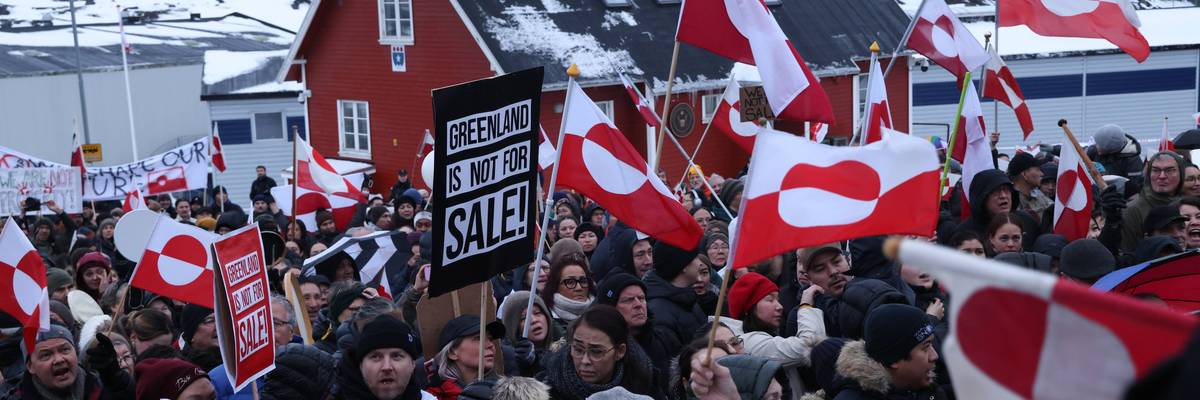
People hold Greenlandic flags as they gather in front of the US consulate to protest against President Donald Trump's attempts to acquire Greenland on January 17, 2026 in the island's capital, Nuuk.
"Trump's energy and climate policies, including his heedless preoccupation with exploiting Greenland and the rest of the Arctic for oil and gas resources, risk a far more rapid meltdown of the Arctic."
As warnings about the dangers of President Donald Trump's Greenland threats mount, experts are sounding the alarm over what his takeover of the self-governing Danish territory that straddles the Arctic Circle would mean for a world that is already heating up due to humanity's continued reliance on fossil fuels.
Since returning to office last January—in part thanks to campaign cash from fossil fuel giants—Trump has called climate change "the greatest con job ever perpetrated on the world" in a UN speech and constantly prioritized big polluters over working people and the planet, including by ditching dozens of international organizations and treaties, such as the Paris Agreement. The president's first year back in power was also among the hottest on record, according to his own government and various scientific institutions.
"His fixation on Greenland is an admission that climate change is real," John Conger, a former Pentagon official in the Obama administration who is now an adviser to the Center for Climate and Security, a research institute, told the New York Times earlier this month.
The Arctic is warming 2-4 times faster than most of the Earth. As reflective sea ice melts and is replaced by darker land or water, more heat from the sun is absorbed, causing a temperature increase that further accelerates melting. Atlantic Council distinguished fellow Sherri Goodman recently told the Washington Post that "it's partly the melting of sea ice making it more attractive for the economic development that he'd pursue in Greenland."
"It's partly the melting of sea ice making it more attractive for the economic development that he'd pursue in Greenland."
Regional warming is opening up potential shipping routes and access to natural resources, from minerals needed for renewable energy technologies to oil. While the Trump administration is now engaged in talks with Greenland and Denmark, the president has said he wants the island—whose people don't want to join the United States—because of "national security" concerns, claiming that if he doesn't take it over, China or Russia will.
"Climate change is a significant national security risk," said Goodman, who was deputy undersecretary of defense for environmental security during the Clinton administration. "The openings of sea lanes, the changing ice conditions, are contributing to the intense geopolitical situations we're experiencing."
Fears eased a bit last week, when Trump backed off threats to impose tariffs on European countries opposed to his Greenland takeover and potentially use US military force to seize the territory. While in Switzerland for the Davos summit, he also announced the "framework of a future deal with respect to Greenland and, in fact, the entire Arctic Region."
Danish Foreign Minister Lars Løkke Rasmussen told reporters in Brussels on Thursday that negotiations between his country, Greenland, and the United States the previous day had a "very constructive atmosphere and tone, and new meetings are planned," according to CNBC.
"It's not that things are solved, but it is good because now we are back to what we agreed in Washington exactly two weeks and a day ago. After that, there was a major detour. Things were escalating, but now we are back on track," Rasmussen said. "It's not that we can conclude anything, but I am slightly more optimistic today than a week ago."
Even so, Trump has made clear that the plans to deliver on his campaign pledge to "drill, baby, drill," and as Politico detailed:According to an assessment by the US Geological Survey, Greenland "contains approximately 31,400 million barrels oil equivalent (MMBOE) of oil" and other fuel products, including around 148 trillion cubic feet of natural gas.
"That's the kind of reserves that if they were discovered in Saudi Arabia or Qatar, businesses would be jumping for joy," said Ajay Parmar, a senior crude markets analyst with commodities intelligence firm ICIS.
"Of course, given it's in Greenland, there would be technical challenges putting in place the piping to extract it and get it around the world," he said. "But there's still a major commercial opportunity there, even if it would require a lot of time and effort to make it work."
However, in 2021, Greenland introduced a moratorium on oil and gas exploitation after the socialist, pro-independence Inuit Ataqatigiit party took power, vowing to "take the climate crisis seriously."
It's unclear whether that ban will survive current negotiations, or if Trump will return to threats of taking Greenland by force.
Paul Bledsoe a lecturer at American University’s Center for Environmental Policy who held various roles in the Clinton administration, wrote in a Thursday opinion piece for the Hill that "Trump's energy and climate policies, including his heedless preoccupation with exploiting Greenland and the rest of the Arctic for oil and gas resources, risk a far more rapid meltdown of the Arctic, with disastrous consequences for nations and people around the world."
"More than half of the Arctic's reflective ice has melted in the last 50 years, and a recent study in the journal Nature found that the Arctic will be free of sea ice entirely for at least a day before 2030," he noted. "Should Arctic sea ice be allowed to melt, which may happen within just two decades or even sooner, absorption of the sun's heat by the newly open northern ocean will add the equivalent of 25 years of worldwide carbon dioxide emissions, pushing already dangerous global temperatures of 2.7°F above preindustrial levels toward climatic instability."
"This loss of Arctic sea ice is just one of more than a dozen temperature-sensitive tipping points scientists have now identified, including in ocean currents and the Amazon rainforest, that risk unleashing super-heating around the globe," Bledsoe continued. He also highlighted that "huge new shipping traffic in the Arctic and industrial development of oil and gas in the region will greatly increase the amount of climate pollution, including from carbon dioxide, methane, and especially black carbon soot, which is already washing out onto Arctic ice and increasing melting rates tremendously."
"Huge new shipping traffic in the Arctic and industrial development of oil and gas in the region will greatly increase the amount of climate pollution, including from carbon dioxide, methane, and especially black carbon soot."
US planet-heating emissions "are now rising again under Trump," thanks to him abandoning key climate agreements and imposing policies on close coal-fired power plants, methane regulations, carbon dioxide standards, and more, the expert added. Given that the president's "anti-climate policies have already been damaging to the Arctic and global climate protection," Bledsoe warned against letting his quest for Greenland "increase the chances of disastrous, runaway climate change."
Bledsoe's warning coincided with a Thursday letter from over 120 civil society groups—including Friends of the Earth, Greenpeace International, Oil Change International, Public Citizen, and Zero Hour—urging European Union leaders to resist Trump's "fossil-fueled imperialism" in solidarity with Latin America and Greenland.
The coalition called on the bloc's leaders to introduce a United Nations motion condemning Trump's violations of international law, cancel the US-EU trade deal, renew the European Green Deal, end contracts for importing or financing US liquefied natural gas, create a roadmap to phase out gas, defend EU methane rules, and support for the First International Conference on the Just Transition Away from Fossil Fuels.
"As long as the EU accedes to Trump's demands," the coalition wrote, "it will be switching one dangerous dependency for another, giving up its sovereignty bit by bit, losing the competitiveness battle, deepening the climate crisis which will be putting its own people's lives at even higher risk from extreme weather, and jeopardizing its ambitions to be seen as a global climate leader."
Dear Common Dreams reader, It’s been nearly 30 years since I co-founded Common Dreams with my late wife, Lina Newhouser. We had the radical notion that journalism should serve the public good, not corporate profits. It was clear to us from the outset what it would take to build such a project. No paid advertisements. No corporate sponsors. No millionaire publisher telling us what to think or do. Many people said we wouldn't last a year, but we proved those doubters wrong. Together with a tremendous team of journalists and dedicated staff, we built an independent media outlet free from the constraints of profits and corporate control. Our mission has always been simple: To inform. To inspire. To ignite change for the common good. Building Common Dreams was not easy. Our survival was never guaranteed. When you take on the most powerful forces—Wall Street greed, fossil fuel industry destruction, Big Tech lobbyists, and uber-rich oligarchs who have spent billions upon billions rigging the economy and democracy in their favor—the only bulwark you have is supporters who believe in your work. But here’s the urgent message from me today. It's never been this bad out there. And it's never been this hard to keep us going. At the very moment Common Dreams is most needed, the threats we face are intensifying. We need your support now more than ever. We don't accept corporate advertising and never will. We don't have a paywall because we don't think people should be blocked from critical news based on their ability to pay. Everything we do is funded by the donations of readers like you. When everyone does the little they can afford, we are strong. But if that support retreats or dries up, so do we. Will you donate now to make sure Common Dreams not only survives but thrives? —Craig Brown, Co-founder |
As warnings about the dangers of President Donald Trump's Greenland threats mount, experts are sounding the alarm over what his takeover of the self-governing Danish territory that straddles the Arctic Circle would mean for a world that is already heating up due to humanity's continued reliance on fossil fuels.
Since returning to office last January—in part thanks to campaign cash from fossil fuel giants—Trump has called climate change "the greatest con job ever perpetrated on the world" in a UN speech and constantly prioritized big polluters over working people and the planet, including by ditching dozens of international organizations and treaties, such as the Paris Agreement. The president's first year back in power was also among the hottest on record, according to his own government and various scientific institutions.
"His fixation on Greenland is an admission that climate change is real," John Conger, a former Pentagon official in the Obama administration who is now an adviser to the Center for Climate and Security, a research institute, told the New York Times earlier this month.
The Arctic is warming 2-4 times faster than most of the Earth. As reflective sea ice melts and is replaced by darker land or water, more heat from the sun is absorbed, causing a temperature increase that further accelerates melting. Atlantic Council distinguished fellow Sherri Goodman recently told the Washington Post that "it's partly the melting of sea ice making it more attractive for the economic development that he'd pursue in Greenland."
"It's partly the melting of sea ice making it more attractive for the economic development that he'd pursue in Greenland."
Regional warming is opening up potential shipping routes and access to natural resources, from minerals needed for renewable energy technologies to oil. While the Trump administration is now engaged in talks with Greenland and Denmark, the president has said he wants the island—whose people don't want to join the United States—because of "national security" concerns, claiming that if he doesn't take it over, China or Russia will.
"Climate change is a significant national security risk," said Goodman, who was deputy undersecretary of defense for environmental security during the Clinton administration. "The openings of sea lanes, the changing ice conditions, are contributing to the intense geopolitical situations we're experiencing."
Fears eased a bit last week, when Trump backed off threats to impose tariffs on European countries opposed to his Greenland takeover and potentially use US military force to seize the territory. While in Switzerland for the Davos summit, he also announced the "framework of a future deal with respect to Greenland and, in fact, the entire Arctic Region."
Danish Foreign Minister Lars Løkke Rasmussen told reporters in Brussels on Thursday that negotiations between his country, Greenland, and the United States the previous day had a "very constructive atmosphere and tone, and new meetings are planned," according to CNBC.
"It's not that things are solved, but it is good because now we are back to what we agreed in Washington exactly two weeks and a day ago. After that, there was a major detour. Things were escalating, but now we are back on track," Rasmussen said. "It's not that we can conclude anything, but I am slightly more optimistic today than a week ago."
Even so, Trump has made clear that the plans to deliver on his campaign pledge to "drill, baby, drill," and as Politico detailed:According to an assessment by the US Geological Survey, Greenland "contains approximately 31,400 million barrels oil equivalent (MMBOE) of oil" and other fuel products, including around 148 trillion cubic feet of natural gas.
"That's the kind of reserves that if they were discovered in Saudi Arabia or Qatar, businesses would be jumping for joy," said Ajay Parmar, a senior crude markets analyst with commodities intelligence firm ICIS.
"Of course, given it's in Greenland, there would be technical challenges putting in place the piping to extract it and get it around the world," he said. "But there's still a major commercial opportunity there, even if it would require a lot of time and effort to make it work."
However, in 2021, Greenland introduced a moratorium on oil and gas exploitation after the socialist, pro-independence Inuit Ataqatigiit party took power, vowing to "take the climate crisis seriously."
It's unclear whether that ban will survive current negotiations, or if Trump will return to threats of taking Greenland by force.
Paul Bledsoe a lecturer at American University’s Center for Environmental Policy who held various roles in the Clinton administration, wrote in a Thursday opinion piece for the Hill that "Trump's energy and climate policies, including his heedless preoccupation with exploiting Greenland and the rest of the Arctic for oil and gas resources, risk a far more rapid meltdown of the Arctic, with disastrous consequences for nations and people around the world."
"More than half of the Arctic's reflective ice has melted in the last 50 years, and a recent study in the journal Nature found that the Arctic will be free of sea ice entirely for at least a day before 2030," he noted. "Should Arctic sea ice be allowed to melt, which may happen within just two decades or even sooner, absorption of the sun's heat by the newly open northern ocean will add the equivalent of 25 years of worldwide carbon dioxide emissions, pushing already dangerous global temperatures of 2.7°F above preindustrial levels toward climatic instability."
"This loss of Arctic sea ice is just one of more than a dozen temperature-sensitive tipping points scientists have now identified, including in ocean currents and the Amazon rainforest, that risk unleashing super-heating around the globe," Bledsoe continued. He also highlighted that "huge new shipping traffic in the Arctic and industrial development of oil and gas in the region will greatly increase the amount of climate pollution, including from carbon dioxide, methane, and especially black carbon soot, which is already washing out onto Arctic ice and increasing melting rates tremendously."
"Huge new shipping traffic in the Arctic and industrial development of oil and gas in the region will greatly increase the amount of climate pollution, including from carbon dioxide, methane, and especially black carbon soot."
US planet-heating emissions "are now rising again under Trump," thanks to him abandoning key climate agreements and imposing policies on close coal-fired power plants, methane regulations, carbon dioxide standards, and more, the expert added. Given that the president's "anti-climate policies have already been damaging to the Arctic and global climate protection," Bledsoe warned against letting his quest for Greenland "increase the chances of disastrous, runaway climate change."
Bledsoe's warning coincided with a Thursday letter from over 120 civil society groups—including Friends of the Earth, Greenpeace International, Oil Change International, Public Citizen, and Zero Hour—urging European Union leaders to resist Trump's "fossil-fueled imperialism" in solidarity with Latin America and Greenland.
The coalition called on the bloc's leaders to introduce a United Nations motion condemning Trump's violations of international law, cancel the US-EU trade deal, renew the European Green Deal, end contracts for importing or financing US liquefied natural gas, create a roadmap to phase out gas, defend EU methane rules, and support for the First International Conference on the Just Transition Away from Fossil Fuels.
"As long as the EU accedes to Trump's demands," the coalition wrote, "it will be switching one dangerous dependency for another, giving up its sovereignty bit by bit, losing the competitiveness battle, deepening the climate crisis which will be putting its own people's lives at even higher risk from extreme weather, and jeopardizing its ambitions to be seen as a global climate leader."
As warnings about the dangers of President Donald Trump's Greenland threats mount, experts are sounding the alarm over what his takeover of the self-governing Danish territory that straddles the Arctic Circle would mean for a world that is already heating up due to humanity's continued reliance on fossil fuels.
Since returning to office last January—in part thanks to campaign cash from fossil fuel giants—Trump has called climate change "the greatest con job ever perpetrated on the world" in a UN speech and constantly prioritized big polluters over working people and the planet, including by ditching dozens of international organizations and treaties, such as the Paris Agreement. The president's first year back in power was also among the hottest on record, according to his own government and various scientific institutions.
"His fixation on Greenland is an admission that climate change is real," John Conger, a former Pentagon official in the Obama administration who is now an adviser to the Center for Climate and Security, a research institute, told the New York Times earlier this month.
The Arctic is warming 2-4 times faster than most of the Earth. As reflective sea ice melts and is replaced by darker land or water, more heat from the sun is absorbed, causing a temperature increase that further accelerates melting. Atlantic Council distinguished fellow Sherri Goodman recently told the Washington Post that "it's partly the melting of sea ice making it more attractive for the economic development that he'd pursue in Greenland."
"It's partly the melting of sea ice making it more attractive for the economic development that he'd pursue in Greenland."
Regional warming is opening up potential shipping routes and access to natural resources, from minerals needed for renewable energy technologies to oil. While the Trump administration is now engaged in talks with Greenland and Denmark, the president has said he wants the island—whose people don't want to join the United States—because of "national security" concerns, claiming that if he doesn't take it over, China or Russia will.
"Climate change is a significant national security risk," said Goodman, who was deputy undersecretary of defense for environmental security during the Clinton administration. "The openings of sea lanes, the changing ice conditions, are contributing to the intense geopolitical situations we're experiencing."
Fears eased a bit last week, when Trump backed off threats to impose tariffs on European countries opposed to his Greenland takeover and potentially use US military force to seize the territory. While in Switzerland for the Davos summit, he also announced the "framework of a future deal with respect to Greenland and, in fact, the entire Arctic Region."
Danish Foreign Minister Lars Løkke Rasmussen told reporters in Brussels on Thursday that negotiations between his country, Greenland, and the United States the previous day had a "very constructive atmosphere and tone, and new meetings are planned," according to CNBC.
"It's not that things are solved, but it is good because now we are back to what we agreed in Washington exactly two weeks and a day ago. After that, there was a major detour. Things were escalating, but now we are back on track," Rasmussen said. "It's not that we can conclude anything, but I am slightly more optimistic today than a week ago."
Even so, Trump has made clear that the plans to deliver on his campaign pledge to "drill, baby, drill," and as Politico detailed:According to an assessment by the US Geological Survey, Greenland "contains approximately 31,400 million barrels oil equivalent (MMBOE) of oil" and other fuel products, including around 148 trillion cubic feet of natural gas.
"That's the kind of reserves that if they were discovered in Saudi Arabia or Qatar, businesses would be jumping for joy," said Ajay Parmar, a senior crude markets analyst with commodities intelligence firm ICIS.
"Of course, given it's in Greenland, there would be technical challenges putting in place the piping to extract it and get it around the world," he said. "But there's still a major commercial opportunity there, even if it would require a lot of time and effort to make it work."
However, in 2021, Greenland introduced a moratorium on oil and gas exploitation after the socialist, pro-independence Inuit Ataqatigiit party took power, vowing to "take the climate crisis seriously."
It's unclear whether that ban will survive current negotiations, or if Trump will return to threats of taking Greenland by force.
Paul Bledsoe a lecturer at American University’s Center for Environmental Policy who held various roles in the Clinton administration, wrote in a Thursday opinion piece for the Hill that "Trump's energy and climate policies, including his heedless preoccupation with exploiting Greenland and the rest of the Arctic for oil and gas resources, risk a far more rapid meltdown of the Arctic, with disastrous consequences for nations and people around the world."
"More than half of the Arctic's reflective ice has melted in the last 50 years, and a recent study in the journal Nature found that the Arctic will be free of sea ice entirely for at least a day before 2030," he noted. "Should Arctic sea ice be allowed to melt, which may happen within just two decades or even sooner, absorption of the sun's heat by the newly open northern ocean will add the equivalent of 25 years of worldwide carbon dioxide emissions, pushing already dangerous global temperatures of 2.7°F above preindustrial levels toward climatic instability."
"This loss of Arctic sea ice is just one of more than a dozen temperature-sensitive tipping points scientists have now identified, including in ocean currents and the Amazon rainforest, that risk unleashing super-heating around the globe," Bledsoe continued. He also highlighted that "huge new shipping traffic in the Arctic and industrial development of oil and gas in the region will greatly increase the amount of climate pollution, including from carbon dioxide, methane, and especially black carbon soot, which is already washing out onto Arctic ice and increasing melting rates tremendously."
"Huge new shipping traffic in the Arctic and industrial development of oil and gas in the region will greatly increase the amount of climate pollution, including from carbon dioxide, methane, and especially black carbon soot."
US planet-heating emissions "are now rising again under Trump," thanks to him abandoning key climate agreements and imposing policies on close coal-fired power plants, methane regulations, carbon dioxide standards, and more, the expert added. Given that the president's "anti-climate policies have already been damaging to the Arctic and global climate protection," Bledsoe warned against letting his quest for Greenland "increase the chances of disastrous, runaway climate change."
Bledsoe's warning coincided with a Thursday letter from over 120 civil society groups—including Friends of the Earth, Greenpeace International, Oil Change International, Public Citizen, and Zero Hour—urging European Union leaders to resist Trump's "fossil-fueled imperialism" in solidarity with Latin America and Greenland.
The coalition called on the bloc's leaders to introduce a United Nations motion condemning Trump's violations of international law, cancel the US-EU trade deal, renew the European Green Deal, end contracts for importing or financing US liquefied natural gas, create a roadmap to phase out gas, defend EU methane rules, and support for the First International Conference on the Just Transition Away from Fossil Fuels.
"As long as the EU accedes to Trump's demands," the coalition wrote, "it will be switching one dangerous dependency for another, giving up its sovereignty bit by bit, losing the competitiveness battle, deepening the climate crisis which will be putting its own people's lives at even higher risk from extreme weather, and jeopardizing its ambitions to be seen as a global climate leader."

