SUBSCRIBE TO OUR FREE NEWSLETTER
Daily news & progressive opinion—funded by the people, not the corporations—delivered straight to your inbox.
5
#000000
#FFFFFF
To donate by check, phone, or other method, see our More Ways to Give page.
Daily news & progressive opinion—funded by the people, not the corporations—delivered straight to your inbox.
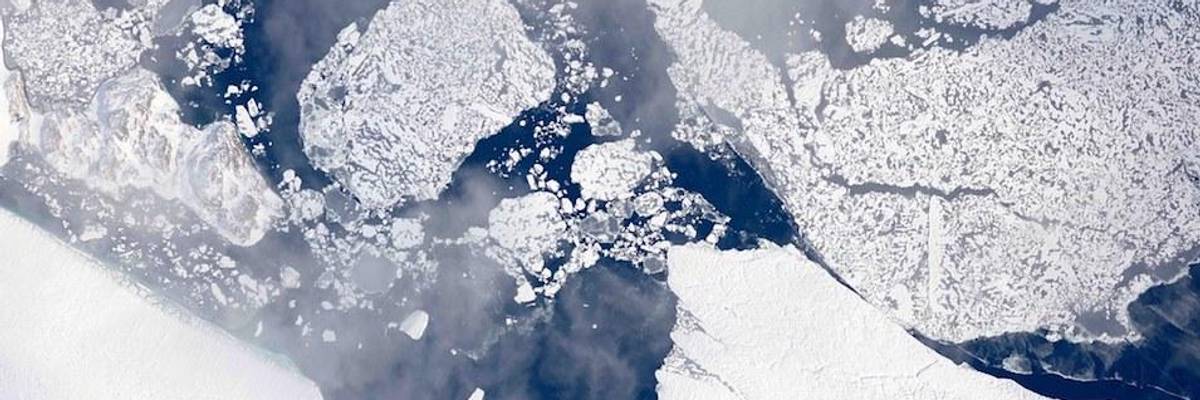
The Greenland ice sheet may melt at a pace that could break records set in 2012 this year as a heatwave from Europe turns north. (Photo: NASA/Flickr)
Last week's European heatwave is moving north toward the Arctic, where temperatures could trigger record melting in Greenland and affect sea levels worldwide for millennia.
That's according to meteorologist Eric Holthaus, who said on Twitter Monday that the melting event from the heat could result in the loss of 40 billion tons of ice.
"This single heat wave will create a permanent change in our oceans that will linger for millennia," said Holthaus. "We are in a climate emergency."
The heat is an indicator of the climate crisis that can't be ignored, Rep. Alexandria Ocasio-Cortez (D-N.Y.) tweeted Monday. The congresswoman said the crisis makes the case that her Green New Deal legislation needs to be passed as soon as possible, no matter the concerns about it being "too much, too soon."
"Setting climate goals for 2030 isn't due to some arbitrary political rationale--it's there due to scientific consensus," said Ocasio-Cortez. "Simply put, we must draw down carbon by 2030 to stave off climate disaster on levels yet unseen."
The current spate of Arctic melting may break the record for the region set in 2012. As BuzzFeed News reported on July 26, Arctic ice is disappearing at a rate higher than ever recorded--and in 2012, the rate was exacerbated by storms that broke up sea ice in the summer leading to more melting.
This time, it's heat.
On Monday, CNN talked to Ruth Mottram, a climate scientist with the the Danish Meteorological Institute, who said the 2019 melt is particularly dangerous.
This year's melt is different to the one in 2012 as it is happening persistently every day rather than in extreme bursts, Mottram noted.
She said that Greenland's ice loss has added an estimated 180 gigatons (billion tons) of water to the oceans since the 1 July. This contributes to a global sea level rise of around half a millimeter.
"Summer is coming to the Greenland ice sheet," tweeted climatologist Xavier Fettweis, "resulting to the one of largest melt event (a priori the 2nd one) in the ice sheet history."
On Tuesday, Democracy Now! host Amy Goodman laid out the risk to the planet if the Greenland ice sheet melts and noted the connection of climate change to the rapidly disappearing glaciers on the island.
"If the ice sheet melts entirely, it would raise global sea levels by almost 23 feet," said Goodman. "Last month was the hottest June ever recorded on Earth, while July is on track to be the hottest month ever."
Dear Common Dreams reader, It’s been nearly 30 years since I co-founded Common Dreams with my late wife, Lina Newhouser. We had the radical notion that journalism should serve the public good, not corporate profits. It was clear to us from the outset what it would take to build such a project. No paid advertisements. No corporate sponsors. No millionaire publisher telling us what to think or do. Many people said we wouldn't last a year, but we proved those doubters wrong. Together with a tremendous team of journalists and dedicated staff, we built an independent media outlet free from the constraints of profits and corporate control. Our mission has always been simple: To inform. To inspire. To ignite change for the common good. Building Common Dreams was not easy. Our survival was never guaranteed. When you take on the most powerful forces—Wall Street greed, fossil fuel industry destruction, Big Tech lobbyists, and uber-rich oligarchs who have spent billions upon billions rigging the economy and democracy in their favor—the only bulwark you have is supporters who believe in your work. But here’s the urgent message from me today. It's never been this bad out there. And it's never been this hard to keep us going. At the very moment Common Dreams is most needed, the threats we face are intensifying. We need your support now more than ever. We don't accept corporate advertising and never will. We don't have a paywall because we don't think people should be blocked from critical news based on their ability to pay. Everything we do is funded by the donations of readers like you. When everyone does the little they can afford, we are strong. But if that support retreats or dries up, so do we. Will you donate now to make sure Common Dreams not only survives but thrives? —Craig Brown, Co-founder |
Last week's European heatwave is moving north toward the Arctic, where temperatures could trigger record melting in Greenland and affect sea levels worldwide for millennia.
That's according to meteorologist Eric Holthaus, who said on Twitter Monday that the melting event from the heat could result in the loss of 40 billion tons of ice.
"This single heat wave will create a permanent change in our oceans that will linger for millennia," said Holthaus. "We are in a climate emergency."
The heat is an indicator of the climate crisis that can't be ignored, Rep. Alexandria Ocasio-Cortez (D-N.Y.) tweeted Monday. The congresswoman said the crisis makes the case that her Green New Deal legislation needs to be passed as soon as possible, no matter the concerns about it being "too much, too soon."
"Setting climate goals for 2030 isn't due to some arbitrary political rationale--it's there due to scientific consensus," said Ocasio-Cortez. "Simply put, we must draw down carbon by 2030 to stave off climate disaster on levels yet unseen."
The current spate of Arctic melting may break the record for the region set in 2012. As BuzzFeed News reported on July 26, Arctic ice is disappearing at a rate higher than ever recorded--and in 2012, the rate was exacerbated by storms that broke up sea ice in the summer leading to more melting.
This time, it's heat.
On Monday, CNN talked to Ruth Mottram, a climate scientist with the the Danish Meteorological Institute, who said the 2019 melt is particularly dangerous.
This year's melt is different to the one in 2012 as it is happening persistently every day rather than in extreme bursts, Mottram noted.
She said that Greenland's ice loss has added an estimated 180 gigatons (billion tons) of water to the oceans since the 1 July. This contributes to a global sea level rise of around half a millimeter.
"Summer is coming to the Greenland ice sheet," tweeted climatologist Xavier Fettweis, "resulting to the one of largest melt event (a priori the 2nd one) in the ice sheet history."
On Tuesday, Democracy Now! host Amy Goodman laid out the risk to the planet if the Greenland ice sheet melts and noted the connection of climate change to the rapidly disappearing glaciers on the island.
"If the ice sheet melts entirely, it would raise global sea levels by almost 23 feet," said Goodman. "Last month was the hottest June ever recorded on Earth, while July is on track to be the hottest month ever."
Last week's European heatwave is moving north toward the Arctic, where temperatures could trigger record melting in Greenland and affect sea levels worldwide for millennia.
That's according to meteorologist Eric Holthaus, who said on Twitter Monday that the melting event from the heat could result in the loss of 40 billion tons of ice.
"This single heat wave will create a permanent change in our oceans that will linger for millennia," said Holthaus. "We are in a climate emergency."
The heat is an indicator of the climate crisis that can't be ignored, Rep. Alexandria Ocasio-Cortez (D-N.Y.) tweeted Monday. The congresswoman said the crisis makes the case that her Green New Deal legislation needs to be passed as soon as possible, no matter the concerns about it being "too much, too soon."
"Setting climate goals for 2030 isn't due to some arbitrary political rationale--it's there due to scientific consensus," said Ocasio-Cortez. "Simply put, we must draw down carbon by 2030 to stave off climate disaster on levels yet unseen."
The current spate of Arctic melting may break the record for the region set in 2012. As BuzzFeed News reported on July 26, Arctic ice is disappearing at a rate higher than ever recorded--and in 2012, the rate was exacerbated by storms that broke up sea ice in the summer leading to more melting.
This time, it's heat.
On Monday, CNN talked to Ruth Mottram, a climate scientist with the the Danish Meteorological Institute, who said the 2019 melt is particularly dangerous.
This year's melt is different to the one in 2012 as it is happening persistently every day rather than in extreme bursts, Mottram noted.
She said that Greenland's ice loss has added an estimated 180 gigatons (billion tons) of water to the oceans since the 1 July. This contributes to a global sea level rise of around half a millimeter.
"Summer is coming to the Greenland ice sheet," tweeted climatologist Xavier Fettweis, "resulting to the one of largest melt event (a priori the 2nd one) in the ice sheet history."
On Tuesday, Democracy Now! host Amy Goodman laid out the risk to the planet if the Greenland ice sheet melts and noted the connection of climate change to the rapidly disappearing glaciers on the island.
"If the ice sheet melts entirely, it would raise global sea levels by almost 23 feet," said Goodman. "Last month was the hottest June ever recorded on Earth, while July is on track to be the hottest month ever."