5
#000000
#FFFFFF
To donate by check, phone, or other method, see our More Ways to Give page.
Daily news & progressive opinion—funded by the people, not the corporations—delivered straight to your inbox.
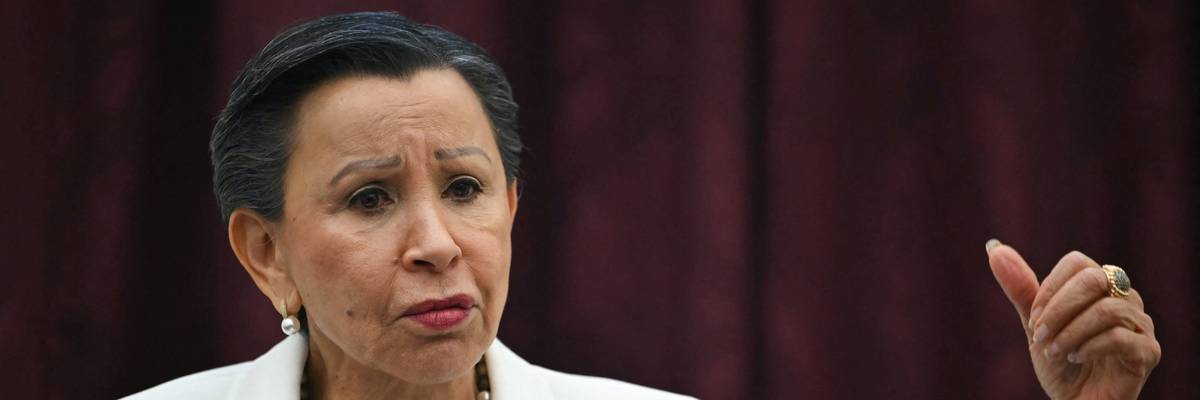
US Rep. Nydia Velázquez (D-NY) speaks during a press conference to introduce the New Good Neighbor Act in Washington, DC, on February 10, 2026.
"We need to finally leave the Monroe Doctrine behind and pursue a foreign policy grounded in mutual respect and shared prosperity," said Rep. Nydia Velázquez, introducing the New Good Neighbor Act with Rep. Delia Ramirez.
With the death toll from President Donald Trump's boat bombings of alleged drug traffickers now at 130 after a Monday strike, a pair of progressive congresswomen on Tuesday called for ending the Monroe Doctrine and establishing a "New Good Neighbor" policy toward Latin America and the Caribbean.
In 1823, then-President James Monroe "declared the Western Hemisphere off limits to powerful countries in Europe," NPR noted last month. "Fast forward, and President Trump is reviving the Monroe Doctrine to justify intervening in places like Venezuela, and threatening further action in other parts of Latin America and Greenland."
Trump's version of the policy has been dubbed the "Donroe Doctrine." After US forces boarded the Aquila II, a Venezuela-linked oil tanker, in the Indian Ocean, David Adler, co-general coordinator of Progressive International, said Monday that "the Donroe Doctrine is not simply a vision for the hemisphere. It is a doctrine of global domination."
In response to the president's recent actions—from his boat bombings and pardon of convicted drug trafficker and former Honduran President Juan Orlando Hernández, to his oil blockade of Venezuela and raid that overthrew the South American country's president, Nicolás Maduro—US Reps. Nydia Velázquez (D-NY) and Rep. Delia Ramirez (D-Ill.) introduced the New Good Neighbor Act.
"This administration's aggressive stance toward Latin America makes this resolution critical," said Velázquez in a statement. "Their 'Donroe Doctrine' is simply a more grotesque version of the interventionist policies that have failed us for two centuries."
"The United States and Latin America face shared challenges in drug trafficking, migration, and climate change," she continued. "We can only solve these through real partnership, not coercion. We need to finally leave the Monroe Doctrine behind and pursue a foreign policy grounded in mutual respect and shared prosperity."
Ramirez similarly said that "for more than 200 years, the United States has used the Monroe Doctrine to justify a paternalistic, damaging approach to relations with Latin America and the Caribbean. As a result, the legacy of our nation's foreign policy in those regions is political instability, deep poverty, extreme migration, and colonialism. It is well past time we change our approach."
"We must recognize our interconnectedness and admit that the Monroe Doctrine undermines the partnership needed to confront the complex challenges of this century," she argued. "We must become better neighbors. That is why I am proud to join Congresswoman Nydia Velázquez to develop an approach to foreign policy that advances our collective interests and builds a stronger coalition throughout the Americas and the rest of the world."
The original Good Neighbor Policy was adopted by former President Franklin D. Roosevelt in the 1930s, in an attempt at reverse US imperialism in Latin America. The aim was to curb military interventions, center respect for national sovereignty, and prioritize diplomacy and trade.
As the sponsors' offices summarized, the new resolution calls for:
The measure isn't likely to advance in a Republican-controlled Congress that has failed to pass various war powers resolutions that would rein in Trump's boat strikes and aggression toward Venezuela, but it offers Democrats an opportunity to make their foreign policy positions clear going into the midterms—in which Velázquez, who is 72, has decided not to seek reelection.
So far, it is backed by Democratic Reps. Greg Casar (Texas), Yvette Clarke (NY), Jesús "Chuy" García (Ill.), Sylvia García (Texas), Adelita Grijalva (Ariz.), Eleanor Holmes Norton (DC), Jonathan Jackson (Ill.), Pramila Jayapal (Wash.), Hank Johnson (Ga.), Summer Lee (Pa.), Alexandria Ocasio-Cortez (D-NY), Ilhan Omar (Minn.), Mark Pocan (Wis.), Jan Schakowsky (Ill.), Lateefah Simon (Calif.), and Rashida Tlaib (Mich.). Like Velázquez, Chuy García and Schakowsky are also retiring after this term.
Leaders from organizations including the Center for Economic and Policy Research (CEPR), the United Methodist Church's board, and We Are CASA also backed the bill and commended the sponsors for, as Cavan Kharrazian of Demand Progress, put it "advancing a new framework for US engagement in the region grounded in mutual respect, sovereignty, and cooperation rather than coercion or threats."
Alex Main, CEPR's director of international policy, stressed that "Trump is waging a new offensive against Latin America and the Caribbean—conducting illegal and unprovoked military attacks and extrajudicial killings and brazenly intervening in other countries' domestic affairs in an undisguised effort to exert control over the region's resources and politics."
"But while Trump’s actions are especially egregious, they are just the latest chapter of a centuries-old story of US military political and economic interference that has subverted democracy and fueled instability and human rights crimes across the hemisphere," Main continued. "It is in the interest of the US to reject this doctrine of unilateral domination and chart a new course for US-Latin American relations—to treat our Latin American siblings as vecinos, not vassals."
Sharing yet another brief black-and-white video on social media, US Southern Command on Monday announced a "lethal kinetic strike on a vessel" allegedly "transiting along known narco-trafficking routes in the Eastern Pacific." SOUTHCOM added that "two narco-terrorists were killed and one survived the strike," which prompted a search for the survivor.
Legal experts and various members of Congress have described the killings as murder on the high seas. Reiterating that position in response to the latest bombing disclosure, Amnesty International USA urged Americans to pressure lawmakers to act.
"US military helpfully publishes evidence of its mass murder of civilians at sea," said Ben Saul, a professor at Australia's University of Sydney and the United Nations special rapporteur on the promotion and protection of human rights and fundamental freedoms while countering terrorism. "Over to you, US Department of Justice, to do your job and bring murder suspects to justice."
Dear Common Dreams reader, It’s been nearly 30 years since I co-founded Common Dreams with my late wife, Lina Newhouser. We had the radical notion that journalism should serve the public good, not corporate profits. It was clear to us from the outset what it would take to build such a project. No paid advertisements. No corporate sponsors. No millionaire publisher telling us what to think or do. Many people said we wouldn't last a year, but we proved those doubters wrong. Together with a tremendous team of journalists and dedicated staff, we built an independent media outlet free from the constraints of profits and corporate control. Our mission has always been simple: To inform. To inspire. To ignite change for the common good. Building Common Dreams was not easy. Our survival was never guaranteed. When you take on the most powerful forces—Wall Street greed, fossil fuel industry destruction, Big Tech lobbyists, and uber-rich oligarchs who have spent billions upon billions rigging the economy and democracy in their favor—the only bulwark you have is supporters who believe in your work. But here’s the urgent message from me today. It's never been this bad out there. And it's never been this hard to keep us going. At the very moment Common Dreams is most needed, the threats we face are intensifying. We need your support now more than ever. We don't accept corporate advertising and never will. We don't have a paywall because we don't think people should be blocked from critical news based on their ability to pay. Everything we do is funded by the donations of readers like you. When everyone does the little they can afford, we are strong. But if that support retreats or dries up, so do we. Will you donate now to make sure Common Dreams not only survives but thrives? —Craig Brown, Co-founder |
With the death toll from President Donald Trump's boat bombings of alleged drug traffickers now at 130 after a Monday strike, a pair of progressive congresswomen on Tuesday called for ending the Monroe Doctrine and establishing a "New Good Neighbor" policy toward Latin America and the Caribbean.
In 1823, then-President James Monroe "declared the Western Hemisphere off limits to powerful countries in Europe," NPR noted last month. "Fast forward, and President Trump is reviving the Monroe Doctrine to justify intervening in places like Venezuela, and threatening further action in other parts of Latin America and Greenland."
Trump's version of the policy has been dubbed the "Donroe Doctrine." After US forces boarded the Aquila II, a Venezuela-linked oil tanker, in the Indian Ocean, David Adler, co-general coordinator of Progressive International, said Monday that "the Donroe Doctrine is not simply a vision for the hemisphere. It is a doctrine of global domination."
In response to the president's recent actions—from his boat bombings and pardon of convicted drug trafficker and former Honduran President Juan Orlando Hernández, to his oil blockade of Venezuela and raid that overthrew the South American country's president, Nicolás Maduro—US Reps. Nydia Velázquez (D-NY) and Rep. Delia Ramirez (D-Ill.) introduced the New Good Neighbor Act.
"This administration's aggressive stance toward Latin America makes this resolution critical," said Velázquez in a statement. "Their 'Donroe Doctrine' is simply a more grotesque version of the interventionist policies that have failed us for two centuries."
"The United States and Latin America face shared challenges in drug trafficking, migration, and climate change," she continued. "We can only solve these through real partnership, not coercion. We need to finally leave the Monroe Doctrine behind and pursue a foreign policy grounded in mutual respect and shared prosperity."
Ramirez similarly said that "for more than 200 years, the United States has used the Monroe Doctrine to justify a paternalistic, damaging approach to relations with Latin America and the Caribbean. As a result, the legacy of our nation's foreign policy in those regions is political instability, deep poverty, extreme migration, and colonialism. It is well past time we change our approach."
"We must recognize our interconnectedness and admit that the Monroe Doctrine undermines the partnership needed to confront the complex challenges of this century," she argued. "We must become better neighbors. That is why I am proud to join Congresswoman Nydia Velázquez to develop an approach to foreign policy that advances our collective interests and builds a stronger coalition throughout the Americas and the rest of the world."
The original Good Neighbor Policy was adopted by former President Franklin D. Roosevelt in the 1930s, in an attempt at reverse US imperialism in Latin America. The aim was to curb military interventions, center respect for national sovereignty, and prioritize diplomacy and trade.
As the sponsors' offices summarized, the new resolution calls for:
The measure isn't likely to advance in a Republican-controlled Congress that has failed to pass various war powers resolutions that would rein in Trump's boat strikes and aggression toward Venezuela, but it offers Democrats an opportunity to make their foreign policy positions clear going into the midterms—in which Velázquez, who is 72, has decided not to seek reelection.
So far, it is backed by Democratic Reps. Greg Casar (Texas), Yvette Clarke (NY), Jesús "Chuy" García (Ill.), Sylvia García (Texas), Adelita Grijalva (Ariz.), Eleanor Holmes Norton (DC), Jonathan Jackson (Ill.), Pramila Jayapal (Wash.), Hank Johnson (Ga.), Summer Lee (Pa.), Alexandria Ocasio-Cortez (D-NY), Ilhan Omar (Minn.), Mark Pocan (Wis.), Jan Schakowsky (Ill.), Lateefah Simon (Calif.), and Rashida Tlaib (Mich.). Like Velázquez, Chuy García and Schakowsky are also retiring after this term.
Leaders from organizations including the Center for Economic and Policy Research (CEPR), the United Methodist Church's board, and We Are CASA also backed the bill and commended the sponsors for, as Cavan Kharrazian of Demand Progress, put it "advancing a new framework for US engagement in the region grounded in mutual respect, sovereignty, and cooperation rather than coercion or threats."
Alex Main, CEPR's director of international policy, stressed that "Trump is waging a new offensive against Latin America and the Caribbean—conducting illegal and unprovoked military attacks and extrajudicial killings and brazenly intervening in other countries' domestic affairs in an undisguised effort to exert control over the region's resources and politics."
"But while Trump’s actions are especially egregious, they are just the latest chapter of a centuries-old story of US military political and economic interference that has subverted democracy and fueled instability and human rights crimes across the hemisphere," Main continued. "It is in the interest of the US to reject this doctrine of unilateral domination and chart a new course for US-Latin American relations—to treat our Latin American siblings as vecinos, not vassals."
Sharing yet another brief black-and-white video on social media, US Southern Command on Monday announced a "lethal kinetic strike on a vessel" allegedly "transiting along known narco-trafficking routes in the Eastern Pacific." SOUTHCOM added that "two narco-terrorists were killed and one survived the strike," which prompted a search for the survivor.
Legal experts and various members of Congress have described the killings as murder on the high seas. Reiterating that position in response to the latest bombing disclosure, Amnesty International USA urged Americans to pressure lawmakers to act.
"US military helpfully publishes evidence of its mass murder of civilians at sea," said Ben Saul, a professor at Australia's University of Sydney and the United Nations special rapporteur on the promotion and protection of human rights and fundamental freedoms while countering terrorism. "Over to you, US Department of Justice, to do your job and bring murder suspects to justice."
With the death toll from President Donald Trump's boat bombings of alleged drug traffickers now at 130 after a Monday strike, a pair of progressive congresswomen on Tuesday called for ending the Monroe Doctrine and establishing a "New Good Neighbor" policy toward Latin America and the Caribbean.
In 1823, then-President James Monroe "declared the Western Hemisphere off limits to powerful countries in Europe," NPR noted last month. "Fast forward, and President Trump is reviving the Monroe Doctrine to justify intervening in places like Venezuela, and threatening further action in other parts of Latin America and Greenland."
Trump's version of the policy has been dubbed the "Donroe Doctrine." After US forces boarded the Aquila II, a Venezuela-linked oil tanker, in the Indian Ocean, David Adler, co-general coordinator of Progressive International, said Monday that "the Donroe Doctrine is not simply a vision for the hemisphere. It is a doctrine of global domination."
In response to the president's recent actions—from his boat bombings and pardon of convicted drug trafficker and former Honduran President Juan Orlando Hernández, to his oil blockade of Venezuela and raid that overthrew the South American country's president, Nicolás Maduro—US Reps. Nydia Velázquez (D-NY) and Rep. Delia Ramirez (D-Ill.) introduced the New Good Neighbor Act.
"This administration's aggressive stance toward Latin America makes this resolution critical," said Velázquez in a statement. "Their 'Donroe Doctrine' is simply a more grotesque version of the interventionist policies that have failed us for two centuries."
"The United States and Latin America face shared challenges in drug trafficking, migration, and climate change," she continued. "We can only solve these through real partnership, not coercion. We need to finally leave the Monroe Doctrine behind and pursue a foreign policy grounded in mutual respect and shared prosperity."
Ramirez similarly said that "for more than 200 years, the United States has used the Monroe Doctrine to justify a paternalistic, damaging approach to relations with Latin America and the Caribbean. As a result, the legacy of our nation's foreign policy in those regions is political instability, deep poverty, extreme migration, and colonialism. It is well past time we change our approach."
"We must recognize our interconnectedness and admit that the Monroe Doctrine undermines the partnership needed to confront the complex challenges of this century," she argued. "We must become better neighbors. That is why I am proud to join Congresswoman Nydia Velázquez to develop an approach to foreign policy that advances our collective interests and builds a stronger coalition throughout the Americas and the rest of the world."
The original Good Neighbor Policy was adopted by former President Franklin D. Roosevelt in the 1930s, in an attempt at reverse US imperialism in Latin America. The aim was to curb military interventions, center respect for national sovereignty, and prioritize diplomacy and trade.
As the sponsors' offices summarized, the new resolution calls for:
The measure isn't likely to advance in a Republican-controlled Congress that has failed to pass various war powers resolutions that would rein in Trump's boat strikes and aggression toward Venezuela, but it offers Democrats an opportunity to make their foreign policy positions clear going into the midterms—in which Velázquez, who is 72, has decided not to seek reelection.
So far, it is backed by Democratic Reps. Greg Casar (Texas), Yvette Clarke (NY), Jesús "Chuy" García (Ill.), Sylvia García (Texas), Adelita Grijalva (Ariz.), Eleanor Holmes Norton (DC), Jonathan Jackson (Ill.), Pramila Jayapal (Wash.), Hank Johnson (Ga.), Summer Lee (Pa.), Alexandria Ocasio-Cortez (D-NY), Ilhan Omar (Minn.), Mark Pocan (Wis.), Jan Schakowsky (Ill.), Lateefah Simon (Calif.), and Rashida Tlaib (Mich.). Like Velázquez, Chuy García and Schakowsky are also retiring after this term.
Leaders from organizations including the Center for Economic and Policy Research (CEPR), the United Methodist Church's board, and We Are CASA also backed the bill and commended the sponsors for, as Cavan Kharrazian of Demand Progress, put it "advancing a new framework for US engagement in the region grounded in mutual respect, sovereignty, and cooperation rather than coercion or threats."
Alex Main, CEPR's director of international policy, stressed that "Trump is waging a new offensive against Latin America and the Caribbean—conducting illegal and unprovoked military attacks and extrajudicial killings and brazenly intervening in other countries' domestic affairs in an undisguised effort to exert control over the region's resources and politics."
"But while Trump’s actions are especially egregious, they are just the latest chapter of a centuries-old story of US military political and economic interference that has subverted democracy and fueled instability and human rights crimes across the hemisphere," Main continued. "It is in the interest of the US to reject this doctrine of unilateral domination and chart a new course for US-Latin American relations—to treat our Latin American siblings as vecinos, not vassals."
Sharing yet another brief black-and-white video on social media, US Southern Command on Monday announced a "lethal kinetic strike on a vessel" allegedly "transiting along known narco-trafficking routes in the Eastern Pacific." SOUTHCOM added that "two narco-terrorists were killed and one survived the strike," which prompted a search for the survivor.
Legal experts and various members of Congress have described the killings as murder on the high seas. Reiterating that position in response to the latest bombing disclosure, Amnesty International USA urged Americans to pressure lawmakers to act.
"US military helpfully publishes evidence of its mass murder of civilians at sea," said Ben Saul, a professor at Australia's University of Sydney and the United Nations special rapporteur on the promotion and protection of human rights and fundamental freedoms while countering terrorism. "Over to you, US Department of Justice, to do your job and bring murder suspects to justice."