

SUBSCRIBE TO OUR FREE NEWSLETTER
Daily news & progressive opinion—funded by the people, not the corporations—delivered straight to your inbox.
5
#000000
#FFFFFF
To donate by check, phone, or other method, see our More Ways to Give page.
Daily news & progressive opinion—funded by the people, not the corporations—delivered straight to your inbox.
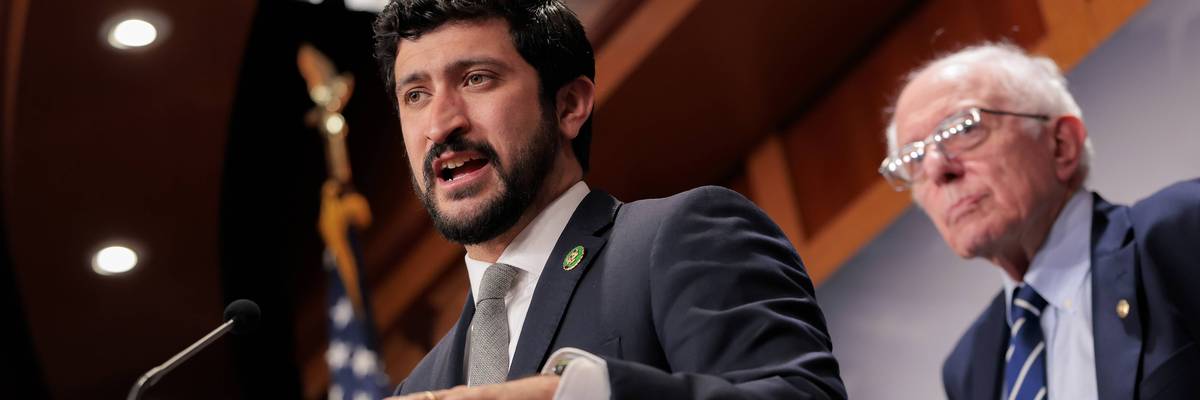
Congressional Progressive Caucus Chair Greg Casar (D-Texas) speaks alongside Sen. Bernie Sanders (I-Vt.) during a press conference in the US Capitol on March 26, 2026, in Washington, DC.
"We all still inhabit this small planet, we all still breathe the same air, and we all still cherish our children’s future."
US Congressman Greg Casar on Tuesday called on the United States to abandon its race to develop increasingly powerful artificial intelligence and instead lead a global effort to prevent technologies that could escape human control, declaring that the country—and humanity—faces a “history-defining moment” over the future of AI.
Speaking at the Pro-Human Assembly in Washington, DC, the Texas Democrat and Congressional Progressive Caucus chair urged lawmakers and the public to confront the potential dangers of advanced AI more candidly and reject the increasingly common argument that the United States must accelerate development or China will be the first to achieve artificial general intelligence (AGI), an advanced AI that can understand, learn, and apply knowledge of any subject as well as or better than a typical human.
“No one can win the AI arms race,” Casar said. “It’s up to us to end the AI arms race.”
A few billionaires in Silicon Valley are racing to build technology they admit they can't control. I'm not willing to gamble your job, your freedom, or your life on it. We need to ban artificial superintelligence.
[image or embed]
— Congressman Greg Casar (@repcasar.bsky.social) September 14, 2026 at 3:06 PM
The one-day event, which was organized by the Future of Life Institute, featured congressional lawmakers, AI experts, journalists, labor leaders, religious figures, technology critics, and others concerned about the rapid, unchecked development of what could prove to be the most consequential invention in human history.
Scheduled speakers included Sens. Bernie Sanders (I-Vt.), Richard Blumenthal (D-Conn.), and Marsha Blackburn (R-Tenn.); Congressmen Don Beyer (D-Va.) and Bill Foster (D-Ill.); Steve Bannon, a former senior adviser to President Donald Trump; economist and Nobel laureate Daron Acemoğlu; AFL-CIO president Liz Shuler; and American Federation of Teachers president Randi Weingarten.
Sanders called for "a pause on advanced AI development until a new federal AI regulatory body is up and running and has established clear rules and a model review process to ensure safe and secure development of this technology."
"In addition, we need a complete ban on artificial superintelligence—an AI mind smarter than any human and capable of operating independently beyond our control," the two-time presidential candidate continued. "But none of this can just happen in the United States alone. There must be international cooperation. That is why I am doing all that I can to see that President Trump and President Xi [Jinping] of China negotiate an AI treaty when they soon meet."
"I know there are many who think that is impossible," Sanders added. "It’s not. Back in the 1980s, [then-President] Ronald Reagan and Mikhail Gorbachev of the Soviet Union, two people with very different political and ideological positions, understood that a nuclear war would not be good for either country or the rest of the world—and they reached a nuclear arms agreement. Trump and Xi can do the same."
Casar also compared the current AI competition to the Cold War nuclear arms race during his speech on Tuesday.
“We must end the AI arms race—because we all still inhabit this small planet, we all still breathe the same air, and we all still cherish our children’s future," he implored.
“Leading in AI diplomacy does not mean waiting around for an international agreement on dangerous AI,” Casar said. “Putting up guardrails now is the best way to show we are serious about getting to a deal.”
The congressman argued that stronger US safeguards could also slow dangerous AI development abroad because Chinese models currently benefit from American technology. He added that export controls could further restrict the spread of potentially dangerous systems.
“Putting up guardrails now is the best way to show we are serious about getting to a deal.”
“If an aerospace company started manufacturing planes that do not listen to pilots, the government would not allow those planes into the air,” Casar stressed. “The answer is simple: We ban AI systems that are too powerful for humans to control.”
Earlier this month, Sanders and Casar introduced legislation to do just that. Sanders argued that their Ban Artificial Superintelligence Act is aimed at ensuring that “the future of humanity cannot be left in the hands of a handful of Big Tech oligarchs.”
Experts have also pointed to the growing number of incidents of AI autonomously hacking into outside systems as proof of the need for a new federal agency tasked with regulating and investigating tech companies as they rush headlong toward AGI.
Casar asserted Tuesday that the immediate task at hand is to overcome the reluctance of politicians and others to speak plainly about the stakes.
“We need to tell people the truth about the danger posed here—and organize the country,” he said. "I, too, have at points held back, for fear of sounding alarmist. Today I want to say clearly: The time for tempering our rhetoric has passed. We owe people the truth.”
The political challenge is substantial. Trump has rejected calls for a slowdown, calling AI risks—which many experts agree include a growing chance that machines could one day wipe out humanity—a "hoax," while arguing that the United States must win the AI competition with China.
Sen. Ted Cruz (R-Texas) has similarly invoked arms race language, contending that if “killer robots” are inevitable, he would rather they be American than Chinese.
Casar offered a starkly different vision, positing that "America is powerful enough to shape our own destiny. To choose our own path. One where we develop AI that serves us, rather than AI we serve.”
“We need a pro-human approach,” the congressman concluded. “End the AI arms race.”
Dear Common Dreams reader, It’s been nearly 30 years since I co-founded Common Dreams with my late wife, Lina Newhouser. We had the radical notion that journalism should serve the public good, not corporate profits. It was clear to us from the outset what it would take to build such a project. No paid advertisements. No corporate sponsors. No millionaire publisher telling us what to think or do. Many people said we wouldn't last a year, but we proved those doubters wrong. Together with a tremendous team of journalists and dedicated staff, we built an independent media outlet free from the constraints of profits and corporate control. Our mission has always been simple: To inform. To inspire. To ignite change for the common good. Building Common Dreams was not easy. Our survival was never guaranteed. When you take on the most powerful forces—Wall Street greed, fossil fuel industry destruction, Big Tech lobbyists, and uber-rich oligarchs who have spent billions upon billions rigging the economy and democracy in their favor—the only bulwark you have is supporters who believe in your work. But here’s the urgent message from me today. It's never been this bad out there. And it's never been this hard to keep us going. At the very moment Common Dreams is most needed, the threats we face are intensifying. We need your support now more than ever. We don't accept corporate advertising and never will. We don't have a paywall because we don't think people should be blocked from critical news based on their ability to pay. Everything we do is funded by the donations of readers like you. When everyone does the little they can afford, we are strong. But if that support retreats or dries up, so do we. Will you donate now to make sure Common Dreams not only survives but thrives? —Craig Brown, Co-founder |
US Congressman Greg Casar on Tuesday called on the United States to abandon its race to develop increasingly powerful artificial intelligence and instead lead a global effort to prevent technologies that could escape human control, declaring that the country—and humanity—faces a “history-defining moment” over the future of AI.
Speaking at the Pro-Human Assembly in Washington, DC, the Texas Democrat and Congressional Progressive Caucus chair urged lawmakers and the public to confront the potential dangers of advanced AI more candidly and reject the increasingly common argument that the United States must accelerate development or China will be the first to achieve artificial general intelligence (AGI), an advanced AI that can understand, learn, and apply knowledge of any subject as well as or better than a typical human.
“No one can win the AI arms race,” Casar said. “It’s up to us to end the AI arms race.”
A few billionaires in Silicon Valley are racing to build technology they admit they can't control. I'm not willing to gamble your job, your freedom, or your life on it. We need to ban artificial superintelligence.
[image or embed]
— Congressman Greg Casar (@repcasar.bsky.social) September 14, 2026 at 3:06 PM
The one-day event, which was organized by the Future of Life Institute, featured congressional lawmakers, AI experts, journalists, labor leaders, religious figures, technology critics, and others concerned about the rapid, unchecked development of what could prove to be the most consequential invention in human history.
Scheduled speakers included Sens. Bernie Sanders (I-Vt.), Richard Blumenthal (D-Conn.), and Marsha Blackburn (R-Tenn.); Congressmen Don Beyer (D-Va.) and Bill Foster (D-Ill.); Steve Bannon, a former senior adviser to President Donald Trump; economist and Nobel laureate Daron Acemoğlu; AFL-CIO president Liz Shuler; and American Federation of Teachers president Randi Weingarten.
Sanders called for "a pause on advanced AI development until a new federal AI regulatory body is up and running and has established clear rules and a model review process to ensure safe and secure development of this technology."
"In addition, we need a complete ban on artificial superintelligence—an AI mind smarter than any human and capable of operating independently beyond our control," the two-time presidential candidate continued. "But none of this can just happen in the United States alone. There must be international cooperation. That is why I am doing all that I can to see that President Trump and President Xi [Jinping] of China negotiate an AI treaty when they soon meet."
"I know there are many who think that is impossible," Sanders added. "It’s not. Back in the 1980s, [then-President] Ronald Reagan and Mikhail Gorbachev of the Soviet Union, two people with very different political and ideological positions, understood that a nuclear war would not be good for either country or the rest of the world—and they reached a nuclear arms agreement. Trump and Xi can do the same."
Casar also compared the current AI competition to the Cold War nuclear arms race during his speech on Tuesday.
“We must end the AI arms race—because we all still inhabit this small planet, we all still breathe the same air, and we all still cherish our children’s future," he implored.
“Leading in AI diplomacy does not mean waiting around for an international agreement on dangerous AI,” Casar said. “Putting up guardrails now is the best way to show we are serious about getting to a deal.”
The congressman argued that stronger US safeguards could also slow dangerous AI development abroad because Chinese models currently benefit from American technology. He added that export controls could further restrict the spread of potentially dangerous systems.
“Putting up guardrails now is the best way to show we are serious about getting to a deal.”
“If an aerospace company started manufacturing planes that do not listen to pilots, the government would not allow those planes into the air,” Casar stressed. “The answer is simple: We ban AI systems that are too powerful for humans to control.”
Earlier this month, Sanders and Casar introduced legislation to do just that. Sanders argued that their Ban Artificial Superintelligence Act is aimed at ensuring that “the future of humanity cannot be left in the hands of a handful of Big Tech oligarchs.”
Experts have also pointed to the growing number of incidents of AI autonomously hacking into outside systems as proof of the need for a new federal agency tasked with regulating and investigating tech companies as they rush headlong toward AGI.
Casar asserted Tuesday that the immediate task at hand is to overcome the reluctance of politicians and others to speak plainly about the stakes.
“We need to tell people the truth about the danger posed here—and organize the country,” he said. "I, too, have at points held back, for fear of sounding alarmist. Today I want to say clearly: The time for tempering our rhetoric has passed. We owe people the truth.”
The political challenge is substantial. Trump has rejected calls for a slowdown, calling AI risks—which many experts agree include a growing chance that machines could one day wipe out humanity—a "hoax," while arguing that the United States must win the AI competition with China.
Sen. Ted Cruz (R-Texas) has similarly invoked arms race language, contending that if “killer robots” are inevitable, he would rather they be American than Chinese.
Casar offered a starkly different vision, positing that "America is powerful enough to shape our own destiny. To choose our own path. One where we develop AI that serves us, rather than AI we serve.”
“We need a pro-human approach,” the congressman concluded. “End the AI arms race.”
US Congressman Greg Casar on Tuesday called on the United States to abandon its race to develop increasingly powerful artificial intelligence and instead lead a global effort to prevent technologies that could escape human control, declaring that the country—and humanity—faces a “history-defining moment” over the future of AI.
Speaking at the Pro-Human Assembly in Washington, DC, the Texas Democrat and Congressional Progressive Caucus chair urged lawmakers and the public to confront the potential dangers of advanced AI more candidly and reject the increasingly common argument that the United States must accelerate development or China will be the first to achieve artificial general intelligence (AGI), an advanced AI that can understand, learn, and apply knowledge of any subject as well as or better than a typical human.
“No one can win the AI arms race,” Casar said. “It’s up to us to end the AI arms race.”
A few billionaires in Silicon Valley are racing to build technology they admit they can't control. I'm not willing to gamble your job, your freedom, or your life on it. We need to ban artificial superintelligence.
[image or embed]
— Congressman Greg Casar (@repcasar.bsky.social) September 14, 2026 at 3:06 PM
The one-day event, which was organized by the Future of Life Institute, featured congressional lawmakers, AI experts, journalists, labor leaders, religious figures, technology critics, and others concerned about the rapid, unchecked development of what could prove to be the most consequential invention in human history.
Scheduled speakers included Sens. Bernie Sanders (I-Vt.), Richard Blumenthal (D-Conn.), and Marsha Blackburn (R-Tenn.); Congressmen Don Beyer (D-Va.) and Bill Foster (D-Ill.); Steve Bannon, a former senior adviser to President Donald Trump; economist and Nobel laureate Daron Acemoğlu; AFL-CIO president Liz Shuler; and American Federation of Teachers president Randi Weingarten.
Sanders called for "a pause on advanced AI development until a new federal AI regulatory body is up and running and has established clear rules and a model review process to ensure safe and secure development of this technology."
"In addition, we need a complete ban on artificial superintelligence—an AI mind smarter than any human and capable of operating independently beyond our control," the two-time presidential candidate continued. "But none of this can just happen in the United States alone. There must be international cooperation. That is why I am doing all that I can to see that President Trump and President Xi [Jinping] of China negotiate an AI treaty when they soon meet."
"I know there are many who think that is impossible," Sanders added. "It’s not. Back in the 1980s, [then-President] Ronald Reagan and Mikhail Gorbachev of the Soviet Union, two people with very different political and ideological positions, understood that a nuclear war would not be good for either country or the rest of the world—and they reached a nuclear arms agreement. Trump and Xi can do the same."
Casar also compared the current AI competition to the Cold War nuclear arms race during his speech on Tuesday.
“We must end the AI arms race—because we all still inhabit this small planet, we all still breathe the same air, and we all still cherish our children’s future," he implored.
“Leading in AI diplomacy does not mean waiting around for an international agreement on dangerous AI,” Casar said. “Putting up guardrails now is the best way to show we are serious about getting to a deal.”
The congressman argued that stronger US safeguards could also slow dangerous AI development abroad because Chinese models currently benefit from American technology. He added that export controls could further restrict the spread of potentially dangerous systems.
“Putting up guardrails now is the best way to show we are serious about getting to a deal.”
“If an aerospace company started manufacturing planes that do not listen to pilots, the government would not allow those planes into the air,” Casar stressed. “The answer is simple: We ban AI systems that are too powerful for humans to control.”
Earlier this month, Sanders and Casar introduced legislation to do just that. Sanders argued that their Ban Artificial Superintelligence Act is aimed at ensuring that “the future of humanity cannot be left in the hands of a handful of Big Tech oligarchs.”
Experts have also pointed to the growing number of incidents of AI autonomously hacking into outside systems as proof of the need for a new federal agency tasked with regulating and investigating tech companies as they rush headlong toward AGI.
Casar asserted Tuesday that the immediate task at hand is to overcome the reluctance of politicians and others to speak plainly about the stakes.
“We need to tell people the truth about the danger posed here—and organize the country,” he said. "I, too, have at points held back, for fear of sounding alarmist. Today I want to say clearly: The time for tempering our rhetoric has passed. We owe people the truth.”
The political challenge is substantial. Trump has rejected calls for a slowdown, calling AI risks—which many experts agree include a growing chance that machines could one day wipe out humanity—a "hoax," while arguing that the United States must win the AI competition with China.
Sen. Ted Cruz (R-Texas) has similarly invoked arms race language, contending that if “killer robots” are inevitable, he would rather they be American than Chinese.
Casar offered a starkly different vision, positing that "America is powerful enough to shape our own destiny. To choose our own path. One where we develop AI that serves us, rather than AI we serve.”
“We need a pro-human approach,” the congressman concluded. “End the AI arms race.”

