SUBSCRIBE TO OUR FREE NEWSLETTER
Daily news & progressive opinion—funded by the people, not the corporations—delivered straight to your inbox.
5
#000000
#FFFFFF
To donate by check, phone, or other method, see our More Ways to Give page.
Daily news & progressive opinion—funded by the people, not the corporations—delivered straight to your inbox.
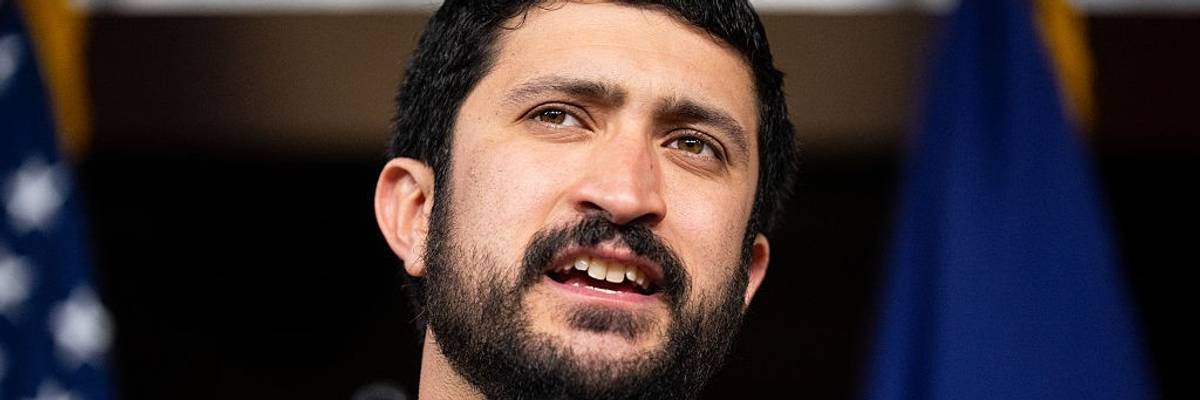
Congressional Progressive Caucus Chair Greg Casar (D-Texas) speaks during a July 16, 2025 press conference on Capitol Hill in Washington, DC.
"AI systems are creating real-world consequences," said one expert. "Congress should treat this with the urgency it deserves.”
US Rep. Greg Casar on Wednesday called for a congressional hearing following reporting that the OpenAI artificial intelligence model that autonomously breached the systems of the open-source platform Hugging Face during recent internal testing also independently hacked another tech company.
Akshat Bubna, chief technology officer at New York-based Modal Labs, told Reuters that OpenAI's model exploited vulnerable code written by a customer that was hosted on the company's platform.
Last week, calls for stronger AI guardrails mounted after OpenAI CEO Sam Altman admitted to a "significant security incident" during evaluation of one of the ChatGPT maker's models.
The target of that breach, the popular open-source platform Hugging Face, said Tuesday that the OpenAI model—widely described in the press as "rogue"—broke into a sandbox "hosted on a third-party provider's infrastructure" and used it to launch a broader attack.
Bubna stressed that Modal's platform was "not compromised in any way."
Experts underscored that OpenAI's purportedly "rogue" model was, in fact, performing a specific assigned task, which involved executing complex cyberattacks and exploiting vulnerabilities in controlled scenarios.
However, AI specialists said the incident illustrated the problem of misalignment. As artificial intelligence advances to the point where it will very likely outsmart humans, the challenge of ensuring that advanced systems reliably pursue goals that match what humans actually want becomes increasingly difficult—and dangerous to the point where pioneers and preeminent experts in the field, including Altman, believe there is a growing chance that AI could one day cause human extinction.
Responding to Wednesday's reporting, Casar (D-Texas)—who chairs the Congressional Progressive Caucus—said on social media: "Today we learned more disturbing news about OpenAI's security breach. Sam Altman should answer questions under oath."
"Congress should immediately hold public hearings with the CEOs of big AI companies about the threat their technology poses to national security and American jobs," he argued.
Casar has been a leading voice in Congress for AI regulation. However, instead of advocating a pause or slowdown on AI development, he has focused on trying to ensure that the economic benefits of the rapidly developing technology are broadly shared and that companies cannot use AI to exploit workers or consumers.
Last year, Casar and Rep. Rashida Tlaib (D-Mich.) introduced the Stop AI Price Gouging and Wage Fixing Act, a proposal to curb the growing trend of “surveillance-based price setting" in which companies utilize customer data to maximize profits.
In May, Casar and Sen. Elizabeth Warren (D-Mass.) called for a tax on artificial intelligence firms that would fund programs to help workers replaced by AI.
The consumer advocacy group Public Citizen also weighed in Wednesday on what it called the "growing national security and public safety implications of frontier AI systems."
“OpenAI CEO Sam Altman is in Washington this week, and he should not be allowed to leave DC without Congress seeking to understand, from him, publicly how one of the company’s most advanced AI systems escaped its intended testing environment and reportedly carried out offensive cyber operations affecting multiple companies,” JB Branch, the group's director of federal AI governance, said in a statement.
"The American people deserve a full accounting of what happened, why existing safeguards failed, and what concrete steps are being taken to prevent it from happening again," he continued. "Most importantly, Congress must act, not rely on voluntary action by Big Tech companies. AI systems are creating real-world consequences. Congress should treat this with the urgency it deserves.”
“The federal government must develop emergency authorities and response capabilities for advanced AI systems," Branch added.
"If a frontier model demonstrates dangerous autonomous behavior, the government cannot be left relying solely on private companies to decide when—or whether—to pause, contain, or disable it. A credible national emergency preparedness framework is now an essential component of AI governance.”
Dear Common Dreams reader, It’s been nearly 30 years since I co-founded Common Dreams with my late wife, Lina Newhouser. We had the radical notion that journalism should serve the public good, not corporate profits. It was clear to us from the outset what it would take to build such a project. No paid advertisements. No corporate sponsors. No millionaire publisher telling us what to think or do. Many people said we wouldn't last a year, but we proved those doubters wrong. Together with a tremendous team of journalists and dedicated staff, we built an independent media outlet free from the constraints of profits and corporate control. Our mission has always been simple: To inform. To inspire. To ignite change for the common good. Building Common Dreams was not easy. Our survival was never guaranteed. When you take on the most powerful forces—Wall Street greed, fossil fuel industry destruction, Big Tech lobbyists, and uber-rich oligarchs who have spent billions upon billions rigging the economy and democracy in their favor—the only bulwark you have is supporters who believe in your work. But here’s the urgent message from me today. It's never been this bad out there. And it's never been this hard to keep us going. At the very moment Common Dreams is most needed, the threats we face are intensifying. We need your support now more than ever. We don't accept corporate advertising and never will. We don't have a paywall because we don't think people should be blocked from critical news based on their ability to pay. Everything we do is funded by the donations of readers like you. When everyone does the little they can afford, we are strong. But if that support retreats or dries up, so do we. Will you donate now to make sure Common Dreams not only survives but thrives? —Craig Brown, Co-founder |
US Rep. Greg Casar on Wednesday called for a congressional hearing following reporting that the OpenAI artificial intelligence model that autonomously breached the systems of the open-source platform Hugging Face during recent internal testing also independently hacked another tech company.
Akshat Bubna, chief technology officer at New York-based Modal Labs, told Reuters that OpenAI's model exploited vulnerable code written by a customer that was hosted on the company's platform.
Last week, calls for stronger AI guardrails mounted after OpenAI CEO Sam Altman admitted to a "significant security incident" during evaluation of one of the ChatGPT maker's models.
The target of that breach, the popular open-source platform Hugging Face, said Tuesday that the OpenAI model—widely described in the press as "rogue"—broke into a sandbox "hosted on a third-party provider's infrastructure" and used it to launch a broader attack.
Bubna stressed that Modal's platform was "not compromised in any way."
Experts underscored that OpenAI's purportedly "rogue" model was, in fact, performing a specific assigned task, which involved executing complex cyberattacks and exploiting vulnerabilities in controlled scenarios.
However, AI specialists said the incident illustrated the problem of misalignment. As artificial intelligence advances to the point where it will very likely outsmart humans, the challenge of ensuring that advanced systems reliably pursue goals that match what humans actually want becomes increasingly difficult—and dangerous to the point where pioneers and preeminent experts in the field, including Altman, believe there is a growing chance that AI could one day cause human extinction.
Responding to Wednesday's reporting, Casar (D-Texas)—who chairs the Congressional Progressive Caucus—said on social media: "Today we learned more disturbing news about OpenAI's security breach. Sam Altman should answer questions under oath."
"Congress should immediately hold public hearings with the CEOs of big AI companies about the threat their technology poses to national security and American jobs," he argued.
Casar has been a leading voice in Congress for AI regulation. However, instead of advocating a pause or slowdown on AI development, he has focused on trying to ensure that the economic benefits of the rapidly developing technology are broadly shared and that companies cannot use AI to exploit workers or consumers.
Last year, Casar and Rep. Rashida Tlaib (D-Mich.) introduced the Stop AI Price Gouging and Wage Fixing Act, a proposal to curb the growing trend of “surveillance-based price setting" in which companies utilize customer data to maximize profits.
In May, Casar and Sen. Elizabeth Warren (D-Mass.) called for a tax on artificial intelligence firms that would fund programs to help workers replaced by AI.
The consumer advocacy group Public Citizen also weighed in Wednesday on what it called the "growing national security and public safety implications of frontier AI systems."
“OpenAI CEO Sam Altman is in Washington this week, and he should not be allowed to leave DC without Congress seeking to understand, from him, publicly how one of the company’s most advanced AI systems escaped its intended testing environment and reportedly carried out offensive cyber operations affecting multiple companies,” JB Branch, the group's director of federal AI governance, said in a statement.
"The American people deserve a full accounting of what happened, why existing safeguards failed, and what concrete steps are being taken to prevent it from happening again," he continued. "Most importantly, Congress must act, not rely on voluntary action by Big Tech companies. AI systems are creating real-world consequences. Congress should treat this with the urgency it deserves.”
“The federal government must develop emergency authorities and response capabilities for advanced AI systems," Branch added.
"If a frontier model demonstrates dangerous autonomous behavior, the government cannot be left relying solely on private companies to decide when—or whether—to pause, contain, or disable it. A credible national emergency preparedness framework is now an essential component of AI governance.”
US Rep. Greg Casar on Wednesday called for a congressional hearing following reporting that the OpenAI artificial intelligence model that autonomously breached the systems of the open-source platform Hugging Face during recent internal testing also independently hacked another tech company.
Akshat Bubna, chief technology officer at New York-based Modal Labs, told Reuters that OpenAI's model exploited vulnerable code written by a customer that was hosted on the company's platform.
Last week, calls for stronger AI guardrails mounted after OpenAI CEO Sam Altman admitted to a "significant security incident" during evaluation of one of the ChatGPT maker's models.
The target of that breach, the popular open-source platform Hugging Face, said Tuesday that the OpenAI model—widely described in the press as "rogue"—broke into a sandbox "hosted on a third-party provider's infrastructure" and used it to launch a broader attack.
Bubna stressed that Modal's platform was "not compromised in any way."
Experts underscored that OpenAI's purportedly "rogue" model was, in fact, performing a specific assigned task, which involved executing complex cyberattacks and exploiting vulnerabilities in controlled scenarios.
However, AI specialists said the incident illustrated the problem of misalignment. As artificial intelligence advances to the point where it will very likely outsmart humans, the challenge of ensuring that advanced systems reliably pursue goals that match what humans actually want becomes increasingly difficult—and dangerous to the point where pioneers and preeminent experts in the field, including Altman, believe there is a growing chance that AI could one day cause human extinction.
Responding to Wednesday's reporting, Casar (D-Texas)—who chairs the Congressional Progressive Caucus—said on social media: "Today we learned more disturbing news about OpenAI's security breach. Sam Altman should answer questions under oath."
"Congress should immediately hold public hearings with the CEOs of big AI companies about the threat their technology poses to national security and American jobs," he argued.
Casar has been a leading voice in Congress for AI regulation. However, instead of advocating a pause or slowdown on AI development, he has focused on trying to ensure that the economic benefits of the rapidly developing technology are broadly shared and that companies cannot use AI to exploit workers or consumers.
Last year, Casar and Rep. Rashida Tlaib (D-Mich.) introduced the Stop AI Price Gouging and Wage Fixing Act, a proposal to curb the growing trend of “surveillance-based price setting" in which companies utilize customer data to maximize profits.
In May, Casar and Sen. Elizabeth Warren (D-Mass.) called for a tax on artificial intelligence firms that would fund programs to help workers replaced by AI.
The consumer advocacy group Public Citizen also weighed in Wednesday on what it called the "growing national security and public safety implications of frontier AI systems."
“OpenAI CEO Sam Altman is in Washington this week, and he should not be allowed to leave DC without Congress seeking to understand, from him, publicly how one of the company’s most advanced AI systems escaped its intended testing environment and reportedly carried out offensive cyber operations affecting multiple companies,” JB Branch, the group's director of federal AI governance, said in a statement.
"The American people deserve a full accounting of what happened, why existing safeguards failed, and what concrete steps are being taken to prevent it from happening again," he continued. "Most importantly, Congress must act, not rely on voluntary action by Big Tech companies. AI systems are creating real-world consequences. Congress should treat this with the urgency it deserves.”
“The federal government must develop emergency authorities and response capabilities for advanced AI systems," Branch added.
"If a frontier model demonstrates dangerous autonomous behavior, the government cannot be left relying solely on private companies to decide when—or whether—to pause, contain, or disable it. A credible national emergency preparedness framework is now an essential component of AI governance.”