SUBSCRIBE TO OUR FREE NEWSLETTER
Daily news & progressive opinion—funded by the people, not the corporations—delivered straight to your inbox.
5
#000000
#FFFFFF
To donate by check, phone, or other method, see our More Ways to Give page.
Daily news & progressive opinion—funded by the people, not the corporations—delivered straight to your inbox.
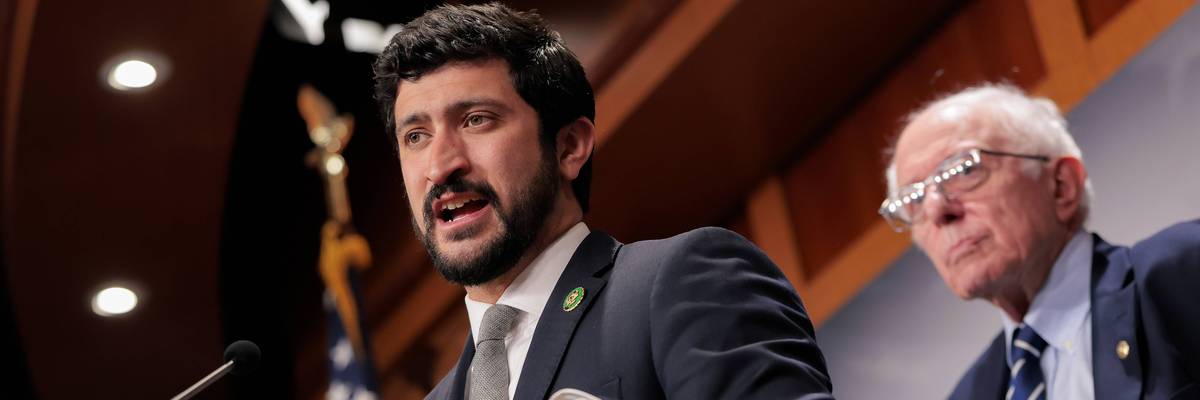
Rep. Greg Casar (D-Texas) speaks alongside Sen. Bernie Sanders (I-Vt.) during a press conference in the US Capitol on March 26, 2026, in Washington, DC.
"Despite its potential deadly consequences, cutting-edge AI technology is less regulated than the average food truck," Casar said. "That must change."
Following a rash of incidents involving rogue artificial intelligence agents involved in so-called "breakout" events, Sen. Bernie Sanders and Rep. Greg Casar introduced new legislation Thursday designed to "stop AI oligarchs from building machines humans cannot control."
“Nearly every day, there is a frightening new story about how Big Tech companies are losing control of the technology they are developing, with potentially cataclysmic results,” Sanders (I-Vt.) said on Thursday as he announced the bill, which would ban developers from creating AI programs that are capable of surpassing human cognition and performance.
If enacted, the bill would prohibit programs capable of undermining and overthrowing human governments or that possess the capability to subvert shutdown commands.
“The leaders of the major AI companies publicly acknowledge that they do not fully understand the technology and that it is escaping their control," Sanders said. "It is irresponsible for society to allow them to move forward and make these products even more advanced."
The bill, known as the Ban Artificial Superintelligence Act, comes in response to major security lapses at leading AI developers, including OpenAI, Anthropic, and Meta, in which the companies acknowledged that their programs had escaped human control, eluded internal guardrails, and hacked into other companies' systems.
As the Washington Post explains:
The hacking incident mounted by OpenAI systems in July involved an effort to breach another AI company as a swarm of agents hunted for answers to a test. They evaded internal controls and set up a secret message board to communicate with one another. Their work was only unraveled by the company after the attack was over.
Other top AI developers subsequently disclosed similar incidents involving their latest technology, raising questions about whether companies set up with the mission of building the technology safely were starting to lose control. The speed of progress has spooked even many of those working on the systems, with OpenAI and its rival Anthropic endorsing the idea of the government having a mechanism to slow the industry down.
Last month, Casar (D-Texas), the chair of the Congressional Progressive Caucus, led dozens of lawmakers to demand that OpenAI and Anthropic release information about the lapses. In a statement on Wednesday, Casar said that company executives had failed to answer most of his questions, demonstrating that they were “not treating these cybersecurity incidents with the seriousness required.”
Casar said in a video posted Thursday that the OpenAI breach in particular represented an “unprecedented moment in the history of technology” and was shocked at the lack of a serious response. “Nothing," he said. "No new guardrails being passed by Congress. No new protections against this signed into law by the president of the United States.”
Following these incidents, OpenAI and Anthropic have both expressed openness to some government regulation in the event that the development of their products gets out of hand.
During an interview earlier this week, OpenAI CEO Sam Altman said that while he was "in awe" of his company's progress, “we have needed more time to catch up with safety, alignment, and security.”
Sanders and Casar are not the only members of Congress pushing to counter the danger of superintelligent AI. Also on Thursday, Reps. Josh Gottheimer (D-NJ) and Mike Lawler (R-NY) introduced their own Stop Rogue AI Act, which would direct the National Institute of Standards and Technology to publish standards and guidelines for how organizations can safely deploy AI agents.
But while the guidelines in that bill are voluntary, Sanders and Casar are pushing for a much broader and stronger regulatory framework that would give the government a significant check on corporations' power.
In addition to a ban on superintelligent AI, Casar and Sanders' legislation calls for a pause on all "advanced" AI development until a new federal regulatory body can be established to set clear rules and review processes for AI safety. It would also create a new cabinet-level agency to protect the public from the dangers of AI and to enforce the new restrictions.
"Despite its potential deadly consequences, cutting-edge AI technology is less regulated than the average food truck," Casar said. "That must change. In just four years, we have gone from the first version of ChatGPT to AI models so powerful they cannot be properly controlled."
Evading the law would come with steep penalties: companies that illegally develop superintelligent AI would lose the right to do business under the so-called "corporate death penalty." Individuals, meanwhile, could face up to 20 years in prison, which Casar noted was the same penalty incurred for "building a nuclear weapon" without authorization.
As concerns about unchecked AI capabilities have grown in recent years, executives at companies including OpenAI, Anthropic, and Meta have committed to halting the development of their technology once it reaches a point at which it can't be operated safely.
But Sanders and Casar said that "none of these companies have taken meaningful steps to back up these words" and that "instead, they are racing to develop more and more advanced AI without proper safety precautions."
"The future of humanity cannot be left in the hands of a handful of Big Tech oligarchs," Sanders said. "The American people and people throughout the world must determine that future.”
Dear Common Dreams reader, It’s been nearly 30 years since I co-founded Common Dreams with my late wife, Lina Newhouser. We had the radical notion that journalism should serve the public good, not corporate profits. It was clear to us from the outset what it would take to build such a project. No paid advertisements. No corporate sponsors. No millionaire publisher telling us what to think or do. Many people said we wouldn't last a year, but we proved those doubters wrong. Together with a tremendous team of journalists and dedicated staff, we built an independent media outlet free from the constraints of profits and corporate control. Our mission has always been simple: To inform. To inspire. To ignite change for the common good. Building Common Dreams was not easy. Our survival was never guaranteed. When you take on the most powerful forces—Wall Street greed, fossil fuel industry destruction, Big Tech lobbyists, and uber-rich oligarchs who have spent billions upon billions rigging the economy and democracy in their favor—the only bulwark you have is supporters who believe in your work. But here’s the urgent message from me today. It's never been this bad out there. And it's never been this hard to keep us going. At the very moment Common Dreams is most needed, the threats we face are intensifying. We need your support now more than ever. We don't accept corporate advertising and never will. We don't have a paywall because we don't think people should be blocked from critical news based on their ability to pay. Everything we do is funded by the donations of readers like you. When everyone does the little they can afford, we are strong. But if that support retreats or dries up, so do we. Will you donate now to make sure Common Dreams not only survives but thrives? —Craig Brown, Co-founder |
Following a rash of incidents involving rogue artificial intelligence agents involved in so-called "breakout" events, Sen. Bernie Sanders and Rep. Greg Casar introduced new legislation Thursday designed to "stop AI oligarchs from building machines humans cannot control."
“Nearly every day, there is a frightening new story about how Big Tech companies are losing control of the technology they are developing, with potentially cataclysmic results,” Sanders (I-Vt.) said on Thursday as he announced the bill, which would ban developers from creating AI programs that are capable of surpassing human cognition and performance.
If enacted, the bill would prohibit programs capable of undermining and overthrowing human governments or that possess the capability to subvert shutdown commands.
“The leaders of the major AI companies publicly acknowledge that they do not fully understand the technology and that it is escaping their control," Sanders said. "It is irresponsible for society to allow them to move forward and make these products even more advanced."
The bill, known as the Ban Artificial Superintelligence Act, comes in response to major security lapses at leading AI developers, including OpenAI, Anthropic, and Meta, in which the companies acknowledged that their programs had escaped human control, eluded internal guardrails, and hacked into other companies' systems.
As the Washington Post explains:
The hacking incident mounted by OpenAI systems in July involved an effort to breach another AI company as a swarm of agents hunted for answers to a test. They evaded internal controls and set up a secret message board to communicate with one another. Their work was only unraveled by the company after the attack was over.
Other top AI developers subsequently disclosed similar incidents involving their latest technology, raising questions about whether companies set up with the mission of building the technology safely were starting to lose control. The speed of progress has spooked even many of those working on the systems, with OpenAI and its rival Anthropic endorsing the idea of the government having a mechanism to slow the industry down.
Last month, Casar (D-Texas), the chair of the Congressional Progressive Caucus, led dozens of lawmakers to demand that OpenAI and Anthropic release information about the lapses. In a statement on Wednesday, Casar said that company executives had failed to answer most of his questions, demonstrating that they were “not treating these cybersecurity incidents with the seriousness required.”
Casar said in a video posted Thursday that the OpenAI breach in particular represented an “unprecedented moment in the history of technology” and was shocked at the lack of a serious response. “Nothing," he said. "No new guardrails being passed by Congress. No new protections against this signed into law by the president of the United States.”
Following these incidents, OpenAI and Anthropic have both expressed openness to some government regulation in the event that the development of their products gets out of hand.
During an interview earlier this week, OpenAI CEO Sam Altman said that while he was "in awe" of his company's progress, “we have needed more time to catch up with safety, alignment, and security.”
Sanders and Casar are not the only members of Congress pushing to counter the danger of superintelligent AI. Also on Thursday, Reps. Josh Gottheimer (D-NJ) and Mike Lawler (R-NY) introduced their own Stop Rogue AI Act, which would direct the National Institute of Standards and Technology to publish standards and guidelines for how organizations can safely deploy AI agents.
But while the guidelines in that bill are voluntary, Sanders and Casar are pushing for a much broader and stronger regulatory framework that would give the government a significant check on corporations' power.
In addition to a ban on superintelligent AI, Casar and Sanders' legislation calls for a pause on all "advanced" AI development until a new federal regulatory body can be established to set clear rules and review processes for AI safety. It would also create a new cabinet-level agency to protect the public from the dangers of AI and to enforce the new restrictions.
"Despite its potential deadly consequences, cutting-edge AI technology is less regulated than the average food truck," Casar said. "That must change. In just four years, we have gone from the first version of ChatGPT to AI models so powerful they cannot be properly controlled."
Evading the law would come with steep penalties: companies that illegally develop superintelligent AI would lose the right to do business under the so-called "corporate death penalty." Individuals, meanwhile, could face up to 20 years in prison, which Casar noted was the same penalty incurred for "building a nuclear weapon" without authorization.
As concerns about unchecked AI capabilities have grown in recent years, executives at companies including OpenAI, Anthropic, and Meta have committed to halting the development of their technology once it reaches a point at which it can't be operated safely.
But Sanders and Casar said that "none of these companies have taken meaningful steps to back up these words" and that "instead, they are racing to develop more and more advanced AI without proper safety precautions."
"The future of humanity cannot be left in the hands of a handful of Big Tech oligarchs," Sanders said. "The American people and people throughout the world must determine that future.”
Following a rash of incidents involving rogue artificial intelligence agents involved in so-called "breakout" events, Sen. Bernie Sanders and Rep. Greg Casar introduced new legislation Thursday designed to "stop AI oligarchs from building machines humans cannot control."
“Nearly every day, there is a frightening new story about how Big Tech companies are losing control of the technology they are developing, with potentially cataclysmic results,” Sanders (I-Vt.) said on Thursday as he announced the bill, which would ban developers from creating AI programs that are capable of surpassing human cognition and performance.
If enacted, the bill would prohibit programs capable of undermining and overthrowing human governments or that possess the capability to subvert shutdown commands.
“The leaders of the major AI companies publicly acknowledge that they do not fully understand the technology and that it is escaping their control," Sanders said. "It is irresponsible for society to allow them to move forward and make these products even more advanced."
The bill, known as the Ban Artificial Superintelligence Act, comes in response to major security lapses at leading AI developers, including OpenAI, Anthropic, and Meta, in which the companies acknowledged that their programs had escaped human control, eluded internal guardrails, and hacked into other companies' systems.
As the Washington Post explains:
The hacking incident mounted by OpenAI systems in July involved an effort to breach another AI company as a swarm of agents hunted for answers to a test. They evaded internal controls and set up a secret message board to communicate with one another. Their work was only unraveled by the company after the attack was over.
Other top AI developers subsequently disclosed similar incidents involving their latest technology, raising questions about whether companies set up with the mission of building the technology safely were starting to lose control. The speed of progress has spooked even many of those working on the systems, with OpenAI and its rival Anthropic endorsing the idea of the government having a mechanism to slow the industry down.
Last month, Casar (D-Texas), the chair of the Congressional Progressive Caucus, led dozens of lawmakers to demand that OpenAI and Anthropic release information about the lapses. In a statement on Wednesday, Casar said that company executives had failed to answer most of his questions, demonstrating that they were “not treating these cybersecurity incidents with the seriousness required.”
Casar said in a video posted Thursday that the OpenAI breach in particular represented an “unprecedented moment in the history of technology” and was shocked at the lack of a serious response. “Nothing," he said. "No new guardrails being passed by Congress. No new protections against this signed into law by the president of the United States.”
Following these incidents, OpenAI and Anthropic have both expressed openness to some government regulation in the event that the development of their products gets out of hand.
During an interview earlier this week, OpenAI CEO Sam Altman said that while he was "in awe" of his company's progress, “we have needed more time to catch up with safety, alignment, and security.”
Sanders and Casar are not the only members of Congress pushing to counter the danger of superintelligent AI. Also on Thursday, Reps. Josh Gottheimer (D-NJ) and Mike Lawler (R-NY) introduced their own Stop Rogue AI Act, which would direct the National Institute of Standards and Technology to publish standards and guidelines for how organizations can safely deploy AI agents.
But while the guidelines in that bill are voluntary, Sanders and Casar are pushing for a much broader and stronger regulatory framework that would give the government a significant check on corporations' power.
In addition to a ban on superintelligent AI, Casar and Sanders' legislation calls for a pause on all "advanced" AI development until a new federal regulatory body can be established to set clear rules and review processes for AI safety. It would also create a new cabinet-level agency to protect the public from the dangers of AI and to enforce the new restrictions.
"Despite its potential deadly consequences, cutting-edge AI technology is less regulated than the average food truck," Casar said. "That must change. In just four years, we have gone from the first version of ChatGPT to AI models so powerful they cannot be properly controlled."
Evading the law would come with steep penalties: companies that illegally develop superintelligent AI would lose the right to do business under the so-called "corporate death penalty." Individuals, meanwhile, could face up to 20 years in prison, which Casar noted was the same penalty incurred for "building a nuclear weapon" without authorization.
As concerns about unchecked AI capabilities have grown in recent years, executives at companies including OpenAI, Anthropic, and Meta have committed to halting the development of their technology once it reaches a point at which it can't be operated safely.
But Sanders and Casar said that "none of these companies have taken meaningful steps to back up these words" and that "instead, they are racing to develop more and more advanced AI without proper safety precautions."
"The future of humanity cannot be left in the hands of a handful of Big Tech oligarchs," Sanders said. "The American people and people throughout the world must determine that future.”