5
#000000
#FFFFFF
To donate by check, phone, or other method, see our More Ways to Give page.
Daily news & progressive opinion—funded by the people, not the corporations—delivered straight to your inbox.
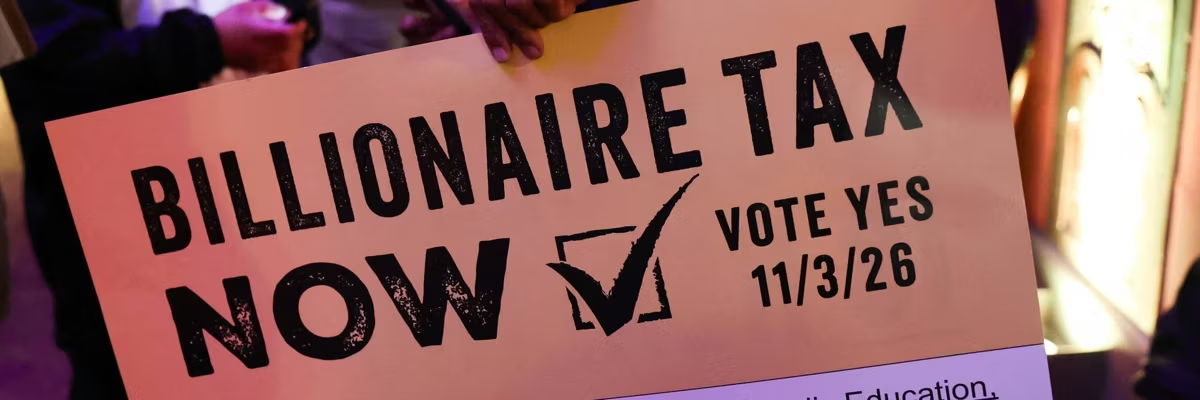
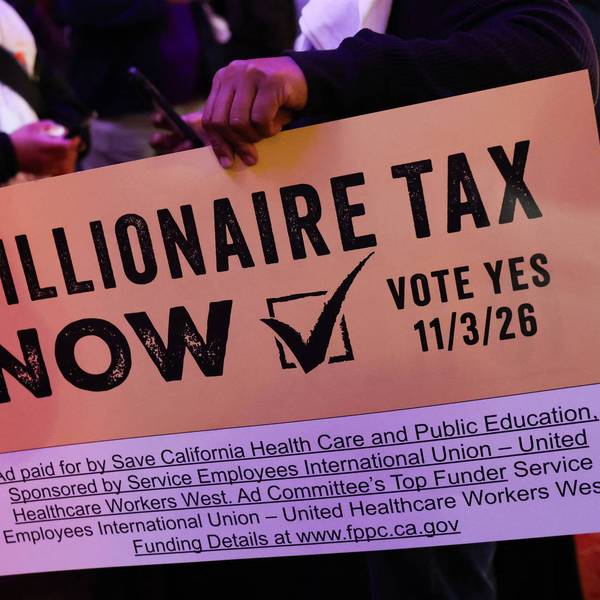
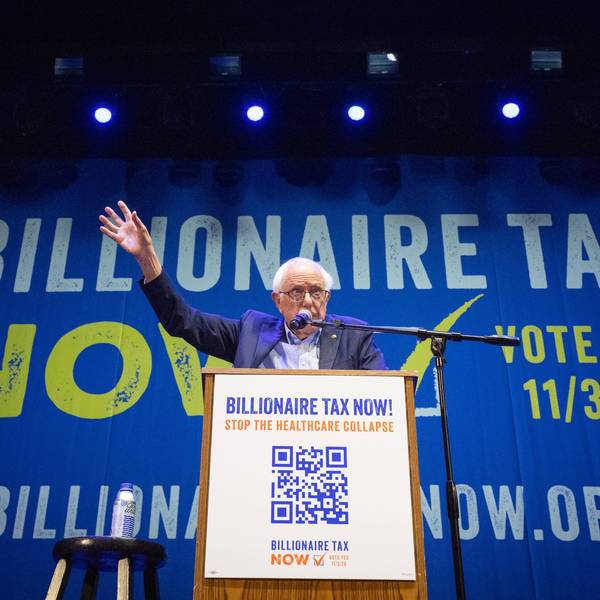
An attendee holds a sign before the start of a rally led by US Senator Bernie Sanders (I-Vt.) during the campaign kickoff for the California Billionaire Tax Act at the Wiltern in Los Angeles on February 18, 2026.
"I believe it's a patriotic duty to pay taxes, and I do so with pride. Our tax system favors wealthy people, and the least we can do is pay up rather than try to avoid it."
As some of California's richest residents pour tens of millions of dollars into defeating a proposed billionaire tax, one former venture capitalist is making a remarkably different argument: He is perfectly happy to pay it—and he's not alone.
John O'Farrell, a former partner at Andreessen Horowitz, explained Wednesday in a 12-post thread on the social media platform X why he supports the California Billionaire Tax Act, commonly known as Proposition 40, which is on the state's November midterm ballot.
O'Farrell's argument contradicts the chorus of Silicon Valley billionaires and their allies who warn that taxing billionaire wealth would drive the ultra-rich out of California.
"I know where I want to live," he wrote.
"I've been fortunate to benefit from tech wealth. I'm not even close to being a billionaire, but I could easily afford to pay the wealth tax—and any billionaire certainly can—without the slightest effect on my lifestyle," O'Farrell said. "I support a wealth tax at my wealth level also."
Introduced by the Service Employees International Union-United Healthcare Workers West, Prop 40 would impose a one-time 5% levy on people worth $1 billion or more, with an option to pay the tax in annual installments of 1% over five years.
The proposal would require the state to spend 90% of revenue from the tax on healthcare and the rest on food assistance and public education. Proponents say the tax would raise roughly $100 billion in revenue. Critics argue that it could drive wealthy residents and investment from California and stall economic growth.
"I find the knee-jerk opposition of some ultra-wealthy people to the idea of paying any new tax deeply disappointing," O'Farrell said in his thread. "To be honest, I can't understand it. They have so much money they couldn't spend it in multiple lifetimes."
Inequality.org, a project of the Institute for Policy Studies—a Washington, DC-based progressive think tank—exposed 22 California billionaires who have poured more than $150 million into defeating Prop 40, "with more rolling in every day," as Chuck Collins wrote for the group.
"These 22 include a prince, several private jet-flying chums of Jeffrey Epstein, and a bunch of crypto and tech bros designing the [artificial intelligence] future for the rest of us," Collins noted. "On January 1, 2025, these 22 billionaires had a combined wealth of $439.8 billion. By September 1, 2026, their wealth had grown to $722.1 billion. In a little under 20 months, their combined wealth increased $282.6 billion, a gain of over 64%."
O'Farrell's social media thread pointed out how "our tax system favors wealthy people."
"I believe it's a patriotic duty to pay taxes, and I do so with pride," he wrote, adding, "the least we can do is pay up rather than try to avoid it."
"Paying taxes is ultimately a matter of self-interest," he contended. "What kind of society do we want to live in? One that rewards achievement but also emphasizes fairness and opportunity for all—or one in which you have to cower in a bunker and live in fear of the pitchforks?"
"One enables the pursuit of happiness for all," he concluded. "The other, just the pursuit of endless wealth."
Prop 40 is backed by numerous progressive groups including the Teamsters union, California Democratic Socialists of America (DSA), and Our Revolution, as well as individual progressives such as Sen. Bernie Sanders (I-Vt.), Rep. Ro Khanna (D-Calif.), and Democratic congressional candidate Connie Chan, who is running to replace retiring longtime San Francisco congresswoman Nancy Pelosi.
Sanders, Khanna, and others—including Congresswoman Aisha Wahab (D-Calif.), Democratic congressional candidate Randy Villegas, and California insurance commissioner candidate Jane Kim—are set to speak at a series of rallies for Prop 40 starting Saturday in San Francisco.
O'Farrell isn't the only wealthy Californian who supports Prop 40. Nvidia CEO Jensen Huang, whose fortune has soared into the hundreds of billions of dollars, has said he is “perfectly fine” with the proposed tax, telling Bloomberg that he and his family “chose to live in Silicon Valley” and that whatever taxes California applies, “so be it.”
Dear Common Dreams reader, It’s been nearly 30 years since I co-founded Common Dreams with my late wife, Lina Newhouser. We had the radical notion that journalism should serve the public good, not corporate profits. It was clear to us from the outset what it would take to build such a project. No paid advertisements. No corporate sponsors. No millionaire publisher telling us what to think or do. Many people said we wouldn't last a year, but we proved those doubters wrong. Together with a tremendous team of journalists and dedicated staff, we built an independent media outlet free from the constraints of profits and corporate control. Our mission has always been simple: To inform. To inspire. To ignite change for the common good. Building Common Dreams was not easy. Our survival was never guaranteed. When you take on the most powerful forces—Wall Street greed, fossil fuel industry destruction, Big Tech lobbyists, and uber-rich oligarchs who have spent billions upon billions rigging the economy and democracy in their favor—the only bulwark you have is supporters who believe in your work. But here’s the urgent message from me today. It's never been this bad out there. And it's never been this hard to keep us going. At the very moment Common Dreams is most needed, the threats we face are intensifying. We need your support now more than ever. We don't accept corporate advertising and never will. We don't have a paywall because we don't think people should be blocked from critical news based on their ability to pay. Everything we do is funded by the donations of readers like you. When everyone does the little they can afford, we are strong. But if that support retreats or dries up, so do we. Will you donate now to make sure Common Dreams not only survives but thrives? —Craig Brown, Co-founder |
As some of California's richest residents pour tens of millions of dollars into defeating a proposed billionaire tax, one former venture capitalist is making a remarkably different argument: He is perfectly happy to pay it—and he's not alone.
John O'Farrell, a former partner at Andreessen Horowitz, explained Wednesday in a 12-post thread on the social media platform X why he supports the California Billionaire Tax Act, commonly known as Proposition 40, which is on the state's November midterm ballot.
O'Farrell's argument contradicts the chorus of Silicon Valley billionaires and their allies who warn that taxing billionaire wealth would drive the ultra-rich out of California.
"I know where I want to live," he wrote.
"I've been fortunate to benefit from tech wealth. I'm not even close to being a billionaire, but I could easily afford to pay the wealth tax—and any billionaire certainly can—without the slightest effect on my lifestyle," O'Farrell said. "I support a wealth tax at my wealth level also."
Introduced by the Service Employees International Union-United Healthcare Workers West, Prop 40 would impose a one-time 5% levy on people worth $1 billion or more, with an option to pay the tax in annual installments of 1% over five years.
The proposal would require the state to spend 90% of revenue from the tax on healthcare and the rest on food assistance and public education. Proponents say the tax would raise roughly $100 billion in revenue. Critics argue that it could drive wealthy residents and investment from California and stall economic growth.
"I find the knee-jerk opposition of some ultra-wealthy people to the idea of paying any new tax deeply disappointing," O'Farrell said in his thread. "To be honest, I can't understand it. They have so much money they couldn't spend it in multiple lifetimes."
Inequality.org, a project of the Institute for Policy Studies—a Washington, DC-based progressive think tank—exposed 22 California billionaires who have poured more than $150 million into defeating Prop 40, "with more rolling in every day," as Chuck Collins wrote for the group.
"These 22 include a prince, several private jet-flying chums of Jeffrey Epstein, and a bunch of crypto and tech bros designing the [artificial intelligence] future for the rest of us," Collins noted. "On January 1, 2025, these 22 billionaires had a combined wealth of $439.8 billion. By September 1, 2026, their wealth had grown to $722.1 billion. In a little under 20 months, their combined wealth increased $282.6 billion, a gain of over 64%."
O'Farrell's social media thread pointed out how "our tax system favors wealthy people."
"I believe it's a patriotic duty to pay taxes, and I do so with pride," he wrote, adding, "the least we can do is pay up rather than try to avoid it."
"Paying taxes is ultimately a matter of self-interest," he contended. "What kind of society do we want to live in? One that rewards achievement but also emphasizes fairness and opportunity for all—or one in which you have to cower in a bunker and live in fear of the pitchforks?"
"One enables the pursuit of happiness for all," he concluded. "The other, just the pursuit of endless wealth."
Prop 40 is backed by numerous progressive groups including the Teamsters union, California Democratic Socialists of America (DSA), and Our Revolution, as well as individual progressives such as Sen. Bernie Sanders (I-Vt.), Rep. Ro Khanna (D-Calif.), and Democratic congressional candidate Connie Chan, who is running to replace retiring longtime San Francisco congresswoman Nancy Pelosi.
Sanders, Khanna, and others—including Congresswoman Aisha Wahab (D-Calif.), Democratic congressional candidate Randy Villegas, and California insurance commissioner candidate Jane Kim—are set to speak at a series of rallies for Prop 40 starting Saturday in San Francisco.
O'Farrell isn't the only wealthy Californian who supports Prop 40. Nvidia CEO Jensen Huang, whose fortune has soared into the hundreds of billions of dollars, has said he is “perfectly fine” with the proposed tax, telling Bloomberg that he and his family “chose to live in Silicon Valley” and that whatever taxes California applies, “so be it.”
As some of California's richest residents pour tens of millions of dollars into defeating a proposed billionaire tax, one former venture capitalist is making a remarkably different argument: He is perfectly happy to pay it—and he's not alone.
John O'Farrell, a former partner at Andreessen Horowitz, explained Wednesday in a 12-post thread on the social media platform X why he supports the California Billionaire Tax Act, commonly known as Proposition 40, which is on the state's November midterm ballot.
O'Farrell's argument contradicts the chorus of Silicon Valley billionaires and their allies who warn that taxing billionaire wealth would drive the ultra-rich out of California.
"I know where I want to live," he wrote.
"I've been fortunate to benefit from tech wealth. I'm not even close to being a billionaire, but I could easily afford to pay the wealth tax—and any billionaire certainly can—without the slightest effect on my lifestyle," O'Farrell said. "I support a wealth tax at my wealth level also."
Introduced by the Service Employees International Union-United Healthcare Workers West, Prop 40 would impose a one-time 5% levy on people worth $1 billion or more, with an option to pay the tax in annual installments of 1% over five years.
The proposal would require the state to spend 90% of revenue from the tax on healthcare and the rest on food assistance and public education. Proponents say the tax would raise roughly $100 billion in revenue. Critics argue that it could drive wealthy residents and investment from California and stall economic growth.
"I find the knee-jerk opposition of some ultra-wealthy people to the idea of paying any new tax deeply disappointing," O'Farrell said in his thread. "To be honest, I can't understand it. They have so much money they couldn't spend it in multiple lifetimes."
Inequality.org, a project of the Institute for Policy Studies—a Washington, DC-based progressive think tank—exposed 22 California billionaires who have poured more than $150 million into defeating Prop 40, "with more rolling in every day," as Chuck Collins wrote for the group.
"These 22 include a prince, several private jet-flying chums of Jeffrey Epstein, and a bunch of crypto and tech bros designing the [artificial intelligence] future for the rest of us," Collins noted. "On January 1, 2025, these 22 billionaires had a combined wealth of $439.8 billion. By September 1, 2026, their wealth had grown to $722.1 billion. In a little under 20 months, their combined wealth increased $282.6 billion, a gain of over 64%."
O'Farrell's social media thread pointed out how "our tax system favors wealthy people."
"I believe it's a patriotic duty to pay taxes, and I do so with pride," he wrote, adding, "the least we can do is pay up rather than try to avoid it."
"Paying taxes is ultimately a matter of self-interest," he contended. "What kind of society do we want to live in? One that rewards achievement but also emphasizes fairness and opportunity for all—or one in which you have to cower in a bunker and live in fear of the pitchforks?"
"One enables the pursuit of happiness for all," he concluded. "The other, just the pursuit of endless wealth."
Prop 40 is backed by numerous progressive groups including the Teamsters union, California Democratic Socialists of America (DSA), and Our Revolution, as well as individual progressives such as Sen. Bernie Sanders (I-Vt.), Rep. Ro Khanna (D-Calif.), and Democratic congressional candidate Connie Chan, who is running to replace retiring longtime San Francisco congresswoman Nancy Pelosi.
Sanders, Khanna, and others—including Congresswoman Aisha Wahab (D-Calif.), Democratic congressional candidate Randy Villegas, and California insurance commissioner candidate Jane Kim—are set to speak at a series of rallies for Prop 40 starting Saturday in San Francisco.
O'Farrell isn't the only wealthy Californian who supports Prop 40. Nvidia CEO Jensen Huang, whose fortune has soared into the hundreds of billions of dollars, has said he is “perfectly fine” with the proposed tax, telling Bloomberg that he and his family “chose to live in Silicon Valley” and that whatever taxes California applies, “so be it.”