

SUBSCRIBE TO OUR FREE NEWSLETTER
Daily news & progressive opinion—funded by the people, not the corporations—delivered straight to your inbox.
5
#000000
#FFFFFF
To donate by check, phone, or other method, see our More Ways to Give page.
Daily news & progressive opinion—funded by the people, not the corporations—delivered straight to your inbox.
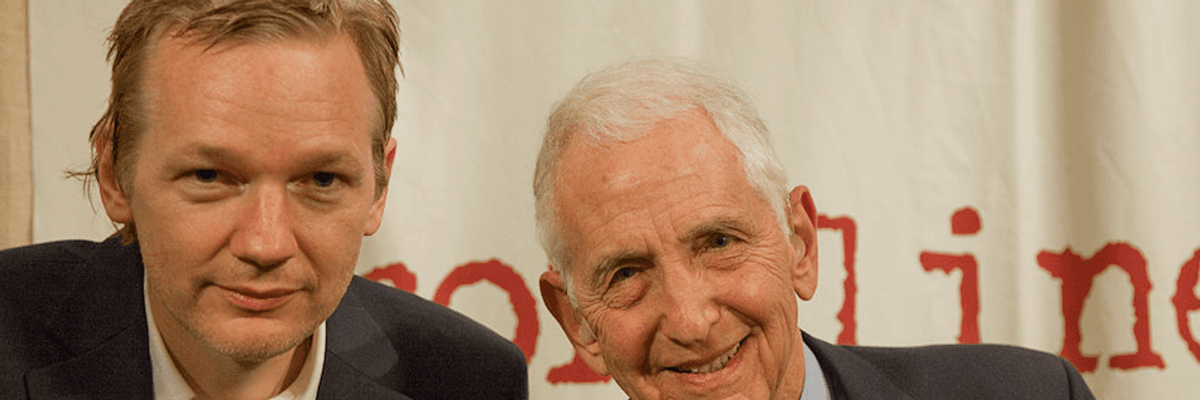
WikiLeaks founder Julian Assange (L) and Pentagon Papers Whistleblower Daniel Ellsberg meet at London's Frontline Club after the publication of the Iraq War Logs in 2010. (Photo: Robert Wallis/Corbis/Getty Images)
Daniel Ellsberg--who famously leaked the Pentagon Papers exposing U.S. lies and crimes in Southeast Asia--told a British court on Tuesday that the U.S. government is seeking both "revenge" against WikiLeaks founder Julian Assange and to "crush" future whistleblowers with its extradition attempt.
Ellsberg's eight-page written statement (pdf) to the London court considering a U.S. request to extradite Assange was an incisive statement of support for the 49-year-old Australian, who has been jailed in the U.K. since 2019 for avoiding a 2010 international arrest warrant from Sweden for alleged sex offenses.
"Very frequently the claim for 'national security' has been erected to obscure illegality and deceit, often on a major scale."
--Daniel Ellsberg
Assange's imprisonment followed a nearly seven-year period of political asylum granted by Ecuador--which agreed he could face political persecution if extradited to Sweden or the U.S.--spent entirely in the South American nation's London embassy.
Last year, Nils Melzer, the United Nations special rapporteur on torture, repeatedly called the cumulative effects of the U.S., Britain, and Sweden "ganging up" on Assange a form of "psychological torture."
The Trump administration last year formally requested Britain's extradition of Assange under the 1917 Espionage Act and the Computer Fraud and Abuse Act. U.S. authorities accuse him of conspiring to hack government computers and illegally disclosing classified and sensitive national defense information.
Critics from both sides of the mainstream political aisle have called Assange's actions "reckless."
At the height of WikiLeaks' revelations, some leading Republicans and Donald Trump called for his execution.
However, Ellsberg refuted claims that Assange acted in such a manner, asserting in the court statement that "his approach was the exact opposite of reckless," and that Assange would not "willfully expose others to harm."
Ellsberg also noted that "very frequently the claim for 'national security' has been erected to obscure illegality and deceit, often on a major scale," and argued that the "closest similarities" between his and Assange's cases include the manner in which "the exposure of illegality and criminal acts institutionally and by individuals was intended to be crushed by the administration carrying out those illegalities."
This, Ellsberg argued, is "in part in revenge" for revealing wrongdoing, as well as an attempt "to crush all such future exposure of the truth."
"I have closely observed the actions of the U.S. government, its military, and its intelligence agency the CIA, and that the actions in question were never intended to be revealed, including rendition and torture, the use of 'black sites,' and crimes against humanity," wrote Ellsberg.
Among the most important documents shared by WikiLeaks were the Afghanistan and Iraq War Logs, which revealed war crimes including mass killing of civilians, extrajudicial killing, torture, corruption, and other crimes and abuses committed by U.S. and coalition forces and the governments of Afghanistan and Iraq.
In 2010 WikiLeaks also released the infamous "Collateral Murder" video, which shows U.S. Army attack helicopter crews joking and laughing while massacring Iraqi civilians--including two journalists--and shooting children and first responders.
"I have also observed that those who have been party to exposing them have been and continue to be themselves threatened and criminalized," Ellsberg added, a likely reference to other whistleblowers targeted by the Bush, Obama, and Trump administrations, including Edward Snowden, Chelsea Manning, John Kiriakou, Jeffrey Sterling, and Reality Leigh Winner.
Ellsberg was a former RAND Corporation economist who in 1971 leaked the Pentagon Papers, a series of classified documents commissioned by Defense Secretary Robert McNamara during the height of the Vietnam War. The papers detailed the history of U.S. involvement in Vietnam and beyond from 1945 through 1967, including the secret escalation of the war into Laos and Cambodia, and that the Johnson administration "systematically lied, not only to the public but also to Congress."
Like Assange, Ellsberg was demonized in the U.S. after the New York Times published the Pentagon Papers in 1971. He was criminally charged with theft and conspiracy under the Espionage Act. However, all charges against him were dismissed in 1973 and today Ellsberg is widely viewed as an iconic figure in the history of the movement for government transparency and accountability.
A British judge will rule on whether Assange can be extradited to the United States. His lawyers claim he faces cruel and unusual punishment in the U.S., including a draconian 175-year sentence in notoriously harsh American prisons, where they say he risks being tortured.
Press freedom, legal, and human rights advocates around the world have all championed Assange's cause.
This is not the first time Ellsberg has defended Assange. Last May, he appeared on Democracy Now! and called the charges against Assange "unprecedented" and a "direct attack on the First Amendment."
"There hasn't actually been such a significant attack on the freedom of the press...since my case in 1971," the then-88-year-old said.
Dear Common Dreams reader, It’s been nearly 30 years since I co-founded Common Dreams with my late wife, Lina Newhouser. We had the radical notion that journalism should serve the public good, not corporate profits. It was clear to us from the outset what it would take to build such a project. No paid advertisements. No corporate sponsors. No millionaire publisher telling us what to think or do. Many people said we wouldn't last a year, but we proved those doubters wrong. Together with a tremendous team of journalists and dedicated staff, we built an independent media outlet free from the constraints of profits and corporate control. Our mission has always been simple: To inform. To inspire. To ignite change for the common good. Building Common Dreams was not easy. Our survival was never guaranteed. When you take on the most powerful forces—Wall Street greed, fossil fuel industry destruction, Big Tech lobbyists, and uber-rich oligarchs who have spent billions upon billions rigging the economy and democracy in their favor—the only bulwark you have is supporters who believe in your work. But here’s the urgent message from me today. It's never been this bad out there. And it's never been this hard to keep us going. At the very moment Common Dreams is most needed, the threats we face are intensifying. We need your support now more than ever. We don't accept corporate advertising and never will. We don't have a paywall because we don't think people should be blocked from critical news based on their ability to pay. Everything we do is funded by the donations of readers like you. When everyone does the little they can afford, we are strong. But if that support retreats or dries up, so do we. Will you donate now to make sure Common Dreams not only survives but thrives? —Craig Brown, Co-founder |
Daniel Ellsberg--who famously leaked the Pentagon Papers exposing U.S. lies and crimes in Southeast Asia--told a British court on Tuesday that the U.S. government is seeking both "revenge" against WikiLeaks founder Julian Assange and to "crush" future whistleblowers with its extradition attempt.
Ellsberg's eight-page written statement (pdf) to the London court considering a U.S. request to extradite Assange was an incisive statement of support for the 49-year-old Australian, who has been jailed in the U.K. since 2019 for avoiding a 2010 international arrest warrant from Sweden for alleged sex offenses.
"Very frequently the claim for 'national security' has been erected to obscure illegality and deceit, often on a major scale."
--Daniel Ellsberg
Assange's imprisonment followed a nearly seven-year period of political asylum granted by Ecuador--which agreed he could face political persecution if extradited to Sweden or the U.S.--spent entirely in the South American nation's London embassy.
Last year, Nils Melzer, the United Nations special rapporteur on torture, repeatedly called the cumulative effects of the U.S., Britain, and Sweden "ganging up" on Assange a form of "psychological torture."
The Trump administration last year formally requested Britain's extradition of Assange under the 1917 Espionage Act and the Computer Fraud and Abuse Act. U.S. authorities accuse him of conspiring to hack government computers and illegally disclosing classified and sensitive national defense information.
Critics from both sides of the mainstream political aisle have called Assange's actions "reckless."
At the height of WikiLeaks' revelations, some leading Republicans and Donald Trump called for his execution.
However, Ellsberg refuted claims that Assange acted in such a manner, asserting in the court statement that "his approach was the exact opposite of reckless," and that Assange would not "willfully expose others to harm."
Ellsberg also noted that "very frequently the claim for 'national security' has been erected to obscure illegality and deceit, often on a major scale," and argued that the "closest similarities" between his and Assange's cases include the manner in which "the exposure of illegality and criminal acts institutionally and by individuals was intended to be crushed by the administration carrying out those illegalities."
This, Ellsberg argued, is "in part in revenge" for revealing wrongdoing, as well as an attempt "to crush all such future exposure of the truth."
"I have closely observed the actions of the U.S. government, its military, and its intelligence agency the CIA, and that the actions in question were never intended to be revealed, including rendition and torture, the use of 'black sites,' and crimes against humanity," wrote Ellsberg.
Among the most important documents shared by WikiLeaks were the Afghanistan and Iraq War Logs, which revealed war crimes including mass killing of civilians, extrajudicial killing, torture, corruption, and other crimes and abuses committed by U.S. and coalition forces and the governments of Afghanistan and Iraq.
In 2010 WikiLeaks also released the infamous "Collateral Murder" video, which shows U.S. Army attack helicopter crews joking and laughing while massacring Iraqi civilians--including two journalists--and shooting children and first responders.
"I have also observed that those who have been party to exposing them have been and continue to be themselves threatened and criminalized," Ellsberg added, a likely reference to other whistleblowers targeted by the Bush, Obama, and Trump administrations, including Edward Snowden, Chelsea Manning, John Kiriakou, Jeffrey Sterling, and Reality Leigh Winner.
Ellsberg was a former RAND Corporation economist who in 1971 leaked the Pentagon Papers, a series of classified documents commissioned by Defense Secretary Robert McNamara during the height of the Vietnam War. The papers detailed the history of U.S. involvement in Vietnam and beyond from 1945 through 1967, including the secret escalation of the war into Laos and Cambodia, and that the Johnson administration "systematically lied, not only to the public but also to Congress."
Like Assange, Ellsberg was demonized in the U.S. after the New York Times published the Pentagon Papers in 1971. He was criminally charged with theft and conspiracy under the Espionage Act. However, all charges against him were dismissed in 1973 and today Ellsberg is widely viewed as an iconic figure in the history of the movement for government transparency and accountability.
A British judge will rule on whether Assange can be extradited to the United States. His lawyers claim he faces cruel and unusual punishment in the U.S., including a draconian 175-year sentence in notoriously harsh American prisons, where they say he risks being tortured.
Press freedom, legal, and human rights advocates around the world have all championed Assange's cause.
This is not the first time Ellsberg has defended Assange. Last May, he appeared on Democracy Now! and called the charges against Assange "unprecedented" and a "direct attack on the First Amendment."
"There hasn't actually been such a significant attack on the freedom of the press...since my case in 1971," the then-88-year-old said.
Daniel Ellsberg--who famously leaked the Pentagon Papers exposing U.S. lies and crimes in Southeast Asia--told a British court on Tuesday that the U.S. government is seeking both "revenge" against WikiLeaks founder Julian Assange and to "crush" future whistleblowers with its extradition attempt.
Ellsberg's eight-page written statement (pdf) to the London court considering a U.S. request to extradite Assange was an incisive statement of support for the 49-year-old Australian, who has been jailed in the U.K. since 2019 for avoiding a 2010 international arrest warrant from Sweden for alleged sex offenses.
"Very frequently the claim for 'national security' has been erected to obscure illegality and deceit, often on a major scale."
--Daniel Ellsberg
Assange's imprisonment followed a nearly seven-year period of political asylum granted by Ecuador--which agreed he could face political persecution if extradited to Sweden or the U.S.--spent entirely in the South American nation's London embassy.
Last year, Nils Melzer, the United Nations special rapporteur on torture, repeatedly called the cumulative effects of the U.S., Britain, and Sweden "ganging up" on Assange a form of "psychological torture."
The Trump administration last year formally requested Britain's extradition of Assange under the 1917 Espionage Act and the Computer Fraud and Abuse Act. U.S. authorities accuse him of conspiring to hack government computers and illegally disclosing classified and sensitive national defense information.
Critics from both sides of the mainstream political aisle have called Assange's actions "reckless."
At the height of WikiLeaks' revelations, some leading Republicans and Donald Trump called for his execution.
However, Ellsberg refuted claims that Assange acted in such a manner, asserting in the court statement that "his approach was the exact opposite of reckless," and that Assange would not "willfully expose others to harm."
Ellsberg also noted that "very frequently the claim for 'national security' has been erected to obscure illegality and deceit, often on a major scale," and argued that the "closest similarities" between his and Assange's cases include the manner in which "the exposure of illegality and criminal acts institutionally and by individuals was intended to be crushed by the administration carrying out those illegalities."
This, Ellsberg argued, is "in part in revenge" for revealing wrongdoing, as well as an attempt "to crush all such future exposure of the truth."
"I have closely observed the actions of the U.S. government, its military, and its intelligence agency the CIA, and that the actions in question were never intended to be revealed, including rendition and torture, the use of 'black sites,' and crimes against humanity," wrote Ellsberg.
Among the most important documents shared by WikiLeaks were the Afghanistan and Iraq War Logs, which revealed war crimes including mass killing of civilians, extrajudicial killing, torture, corruption, and other crimes and abuses committed by U.S. and coalition forces and the governments of Afghanistan and Iraq.
In 2010 WikiLeaks also released the infamous "Collateral Murder" video, which shows U.S. Army attack helicopter crews joking and laughing while massacring Iraqi civilians--including two journalists--and shooting children and first responders.
"I have also observed that those who have been party to exposing them have been and continue to be themselves threatened and criminalized," Ellsberg added, a likely reference to other whistleblowers targeted by the Bush, Obama, and Trump administrations, including Edward Snowden, Chelsea Manning, John Kiriakou, Jeffrey Sterling, and Reality Leigh Winner.
Ellsberg was a former RAND Corporation economist who in 1971 leaked the Pentagon Papers, a series of classified documents commissioned by Defense Secretary Robert McNamara during the height of the Vietnam War. The papers detailed the history of U.S. involvement in Vietnam and beyond from 1945 through 1967, including the secret escalation of the war into Laos and Cambodia, and that the Johnson administration "systematically lied, not only to the public but also to Congress."
Like Assange, Ellsberg was demonized in the U.S. after the New York Times published the Pentagon Papers in 1971. He was criminally charged with theft and conspiracy under the Espionage Act. However, all charges against him were dismissed in 1973 and today Ellsberg is widely viewed as an iconic figure in the history of the movement for government transparency and accountability.
A British judge will rule on whether Assange can be extradited to the United States. His lawyers claim he faces cruel and unusual punishment in the U.S., including a draconian 175-year sentence in notoriously harsh American prisons, where they say he risks being tortured.
Press freedom, legal, and human rights advocates around the world have all championed Assange's cause.
This is not the first time Ellsberg has defended Assange. Last May, he appeared on Democracy Now! and called the charges against Assange "unprecedented" and a "direct attack on the First Amendment."
"There hasn't actually been such a significant attack on the freedom of the press...since my case in 1971," the then-88-year-old said.

