

SUBSCRIBE TO OUR FREE NEWSLETTER
Daily news & progressive opinion—funded by the people, not the corporations—delivered straight to your inbox.
5
#000000
#FFFFFF
To donate by check, phone, or other method, see our More Ways to Give page.
Daily news & progressive opinion—funded by the people, not the corporations—delivered straight to your inbox.
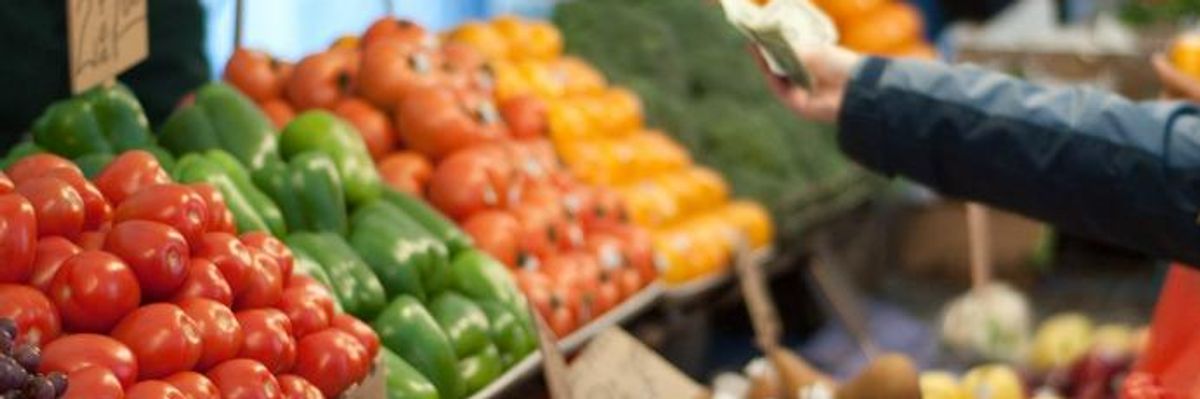
"In short, the Good Food Purchasing Program helps build the local, sustainable, thriving food culture that we know we need--for the sake of our planet and for the health of generations to come," said Corporate Accountability's Alexa Kaczmarski.(Photo: Yarian Gomez/flickr/cc)
Food justice advocates heaped praise on Boston Monday after the city's legislative body unanimously passed an ordinance that boosts the local economy and environment as well as workers, animal welfare, and healthful eating.
"With this passage, Boston has loosened the stranglehold that corporations have over our food system, especially in schools," said Alexa Kaczmarski, senior organizer at Corporate Accountability, following the vote on the Good Food Purchasing Program (GFPP).
"This will have ripple effects throughout the entire nation," she added.
The GFPP, sponsored by Boston City Councilor At-Large Michelle Wu, affects public food purchasers, the largest of which is the Boston Public Schools, which has a $18 million food budget.
As noted in (pdf) the ordinance, the purchasers will follow a set of standards in order to
The ordinance will also
Encourage prospective food vendors to invest in our disadvantaged and minority communities by including in procurement requests preferences for prospective vendors who demonstrate a track record of hiring and investing in local disadvantaged communities; provide living wages to all their employees, including frontline foodworkers; are local minority, disabled, and/or women-owned businesses; and are local producers and processors operating in low-income communities and employing non-toxic, environmentally sustainable methods
"In short," said Kaczmarski, "GFPP helps build the local, sustainable, thriving food culture that we know we need--for the sake of our planet and for the health of generations to come."
The ordinance--which now heads to the mayor's desk for likely approval before it can be implemented--was backed by a diverse coalition including Corporate Accountability, Farm to Institution New England, Food Chain Workers Alliance, Massachusetts Society for the Prevention of Cruelty to Animals (MSPCA), and the Northwest Atlantic Marine Alliance.
"Congratulations to the City of Boston for their leadership in the region," said Suzanne Adely of the Food Chain Workers Alliance.
"The Good Food Purchasing Policy is not only expected to redirect millions of dollars to local producers and improve nutrition, environmental sustainability, and animal welfare, but also to create the infrastructure to improve wages and working conditions for hundreds of thousands of food workers and their families. Boston Public Schools' adoption of the Good Food Purchasing Program is a huge leap forward in the quest of good food for all," she continued.
The Boston City Council's move follows similar food purchasing policies taken by Los Angeles, San Francisco, the Oakland Unified School District, and Chicago Public Schools. But according to food system transformation organization Real Food Media, the New England city took things a step further:
"The Boston ordinance looks to be one of the strongest yet, with explicit language around racial equity outcomes and transparency."
* This article has been edited to reflect that Adely represents the Food Chain Workers Alliance, not the ASPCA. We regret the error.
This country and this world are at a monumental crossroads. US voters have an opportunity to beat back the forces of fascism and confront the billionaires who are rigging the economy, our media system, and our democracy, making it increasingly impossible for ordinary people to get by. We’re not just talking about the election. We’re talking about what must be done once these fascist elements are vanquished from power. We need a bolder set of solutions than what either major party has so far been willing to offer and a working-class movement ready to fight like hell for it. Trump didn't emerge from nowhere. The conditions that fueled MAGA authoritarianism were created by decades of radical neoliberal economic policies and a corrupt political system dominated by corporate interests. They slashed taxes on the super-rich, promising that the benefits would trickle down. They said giveaways to the corporate titans would make life more affordable for the rest of us. It was all bullshit. And when a bitter, betrayed populace searches for someone to blame, right-wing demagogues have little trouble finding scapegoats. People know when they're being lied to, but you won't hear any of this from the corporate media. Only independent journalism—powered and funded by people who believe in building a better world—can deliver truly trustworthy daily news. If you share our vision, please contribute whatever you can to sustain our work. |
Food justice advocates heaped praise on Boston Monday after the city's legislative body unanimously passed an ordinance that boosts the local economy and environment as well as workers, animal welfare, and healthful eating.
"With this passage, Boston has loosened the stranglehold that corporations have over our food system, especially in schools," said Alexa Kaczmarski, senior organizer at Corporate Accountability, following the vote on the Good Food Purchasing Program (GFPP).
"This will have ripple effects throughout the entire nation," she added.
The GFPP, sponsored by Boston City Councilor At-Large Michelle Wu, affects public food purchasers, the largest of which is the Boston Public Schools, which has a $18 million food budget.
As noted in (pdf) the ordinance, the purchasers will follow a set of standards in order to
The ordinance will also
Encourage prospective food vendors to invest in our disadvantaged and minority communities by including in procurement requests preferences for prospective vendors who demonstrate a track record of hiring and investing in local disadvantaged communities; provide living wages to all their employees, including frontline foodworkers; are local minority, disabled, and/or women-owned businesses; and are local producers and processors operating in low-income communities and employing non-toxic, environmentally sustainable methods
"In short," said Kaczmarski, "GFPP helps build the local, sustainable, thriving food culture that we know we need--for the sake of our planet and for the health of generations to come."
The ordinance--which now heads to the mayor's desk for likely approval before it can be implemented--was backed by a diverse coalition including Corporate Accountability, Farm to Institution New England, Food Chain Workers Alliance, Massachusetts Society for the Prevention of Cruelty to Animals (MSPCA), and the Northwest Atlantic Marine Alliance.
"Congratulations to the City of Boston for their leadership in the region," said Suzanne Adely of the Food Chain Workers Alliance.
"The Good Food Purchasing Policy is not only expected to redirect millions of dollars to local producers and improve nutrition, environmental sustainability, and animal welfare, but also to create the infrastructure to improve wages and working conditions for hundreds of thousands of food workers and their families. Boston Public Schools' adoption of the Good Food Purchasing Program is a huge leap forward in the quest of good food for all," she continued.
The Boston City Council's move follows similar food purchasing policies taken by Los Angeles, San Francisco, the Oakland Unified School District, and Chicago Public Schools. But according to food system transformation organization Real Food Media, the New England city took things a step further:
"The Boston ordinance looks to be one of the strongest yet, with explicit language around racial equity outcomes and transparency."
* This article has been edited to reflect that Adely represents the Food Chain Workers Alliance, not the ASPCA. We regret the error.

