

SUBSCRIBE TO OUR FREE NEWSLETTER
Daily news & progressive opinion—funded by the people, not the corporations—delivered straight to your inbox.
5
#000000
#FFFFFF
To donate by check, phone, or other method, see our More Ways to Give page.
Daily news & progressive opinion—funded by the people, not the corporations—delivered straight to your inbox.
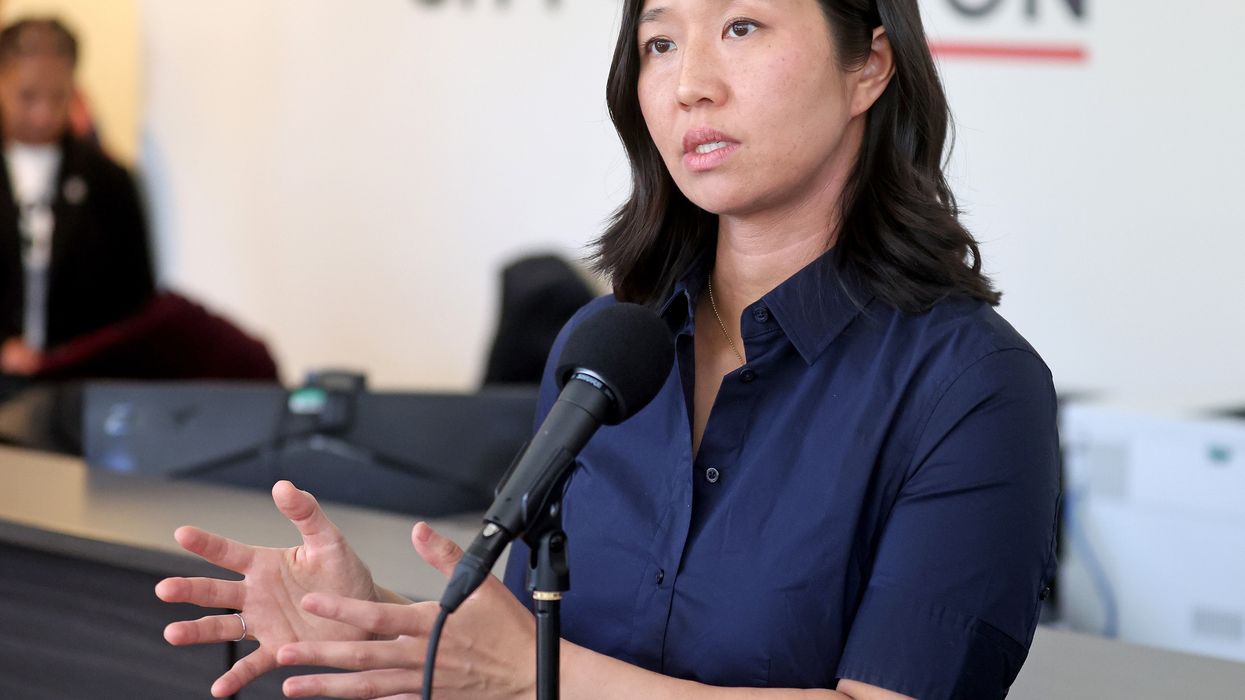
"The Trump administration seeks to divide, isolate, and intimidate our cities, and make Americans fearful of one another," wrote Wu.
Boston Mayor Michelle Wu on Tuesday came out swinging against US Attorney General Pam Bondi amid the Justice Department's threats to prosecute local officials for not helping the administration carry out its mass deportation program.
In a letter sent to Bondi, Wu defended Boston's right to not participate in federal deportation operations, and she cited court rulings in favor of the city's Boston Trust Act, which she noted has been upheld by courts as "valid exercises of local authority and fully consistent with federal law."
Wu took a hammer to the administration's attacks on American cities and its actions that she said have hurt Boston's economy.
"This federal administration's false and continuous attacks on American cities and millions of our residents are unprecedented," she wrote. "You have eliminated healthcare and food assistance for our families; unlawfully cancelled grants for our schools and roads; slashed funding for our universities, hospitals, and research institutions; and deployed military personnel to occupy our streets. These attacks all come back to a common aim: The Trump administration seeks to divide, isolate, and intimidate our cities, and make Americans fearful of one another."
Wu then linked the Trump administration's current actions to those of the British crown before the American Revolution, which she described as "the attempted coercion of Boston by an unaccountable and distant monarch."
However, Wu also emphasized that the Boston Police Department has cooperated with federal law enforcement officials where appropriate, and she cited the department last week arresting "thirteen people as the result of a joint human trafficking investigation with the FBI and Massachusetts State Police" as an example.
Wu closed her letter with a note of defiance against attempts by the Trump administration to take control of cities across the United States.
"On behalf of the people of Boston, and in solidarity with the cities and communities targeted by this federal administration for our refusal to bow down to unconstitutional threats and unlawful coercion, we affirm our support for each other and for our democracy," she wrote. "Boston will never back down from being a beacon of freedom, and a home for everyone."
Wu's letter comes at a time when Trump and several Republican governors have deployed National Guard forces to Washington, DC for the purported goal of reducing crime in the nation's capital. Trump has also threatened to deploy the National Guard to other cities, including Boston, New York, Chicago, Oakland, and Baltimore.
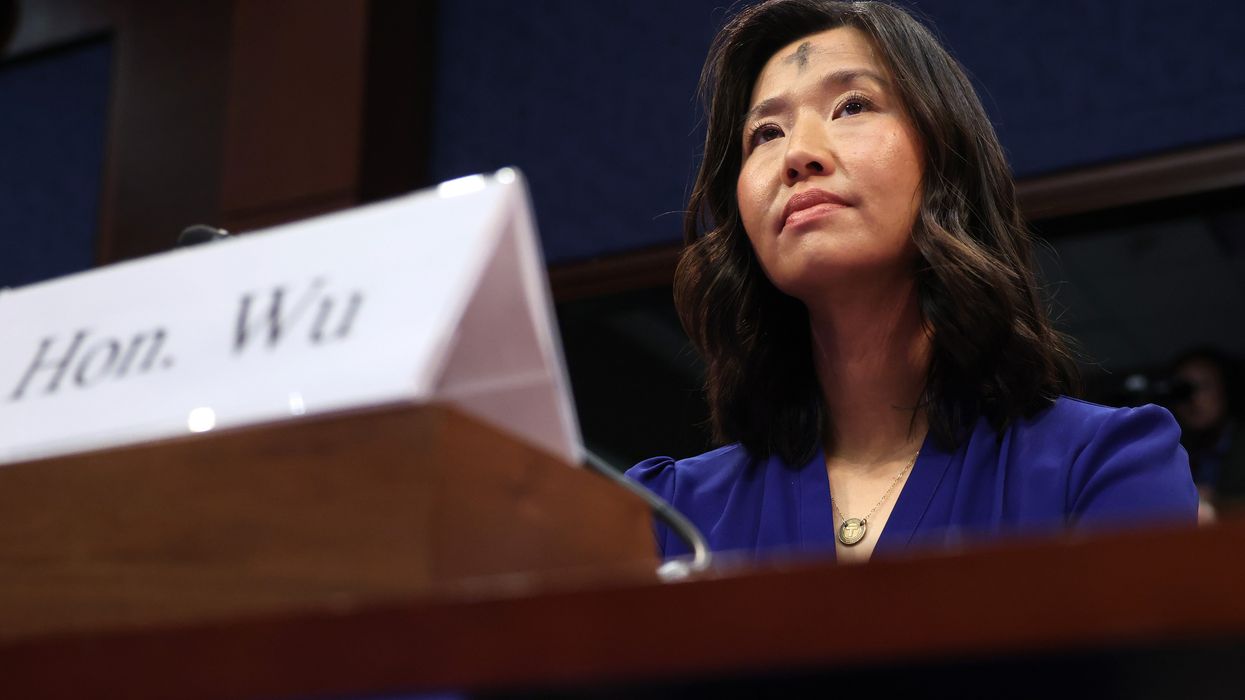
"If you wanted to make us safe, pass gun reforms. Stop cutting Medicaid," said Mayor Michelle Wu. "Stop cutting funds for veterans."
At an all-day hearing on sanctuary cities held by the U.S. House Oversight Committee, Republican lawmakers were intent on vilifying the Democratic mayors of Chicago, Boston, and other cities and accusing them of allowing undocumented immigrants to run rampant by refusing to authorize local police forces to work with the federal government on immigration enforcement.
But the narrative of dangerous immigrants and crime-ridden Democratic-led cities did not sit well with the local leaders who voluntarily testified before the committee, and Democratic Boston Mayor Michelle Wu appeared to welcome the opportunity to set the record straight regarding immigration reform and the broader GOP agenda.
Rep. Paul Gosar (R-Ariz.) accused Wu of acting unconstitutionally by setting immigration statutes in Boston that differ from federal policies under the Trump administration, which has launched a nationwide deportation operation led by border czar Thomas Homan and Immigration and Customs Enforcement (ICE).
As a sanctuary city, Boston does not fully cooperate with ICE to arrest undocumented immigrants, but Wu noted in the hearing that under a local law called the Trust Act, authorities work with the agency "every single day on criminal matters and hold people who are committing crimes accountable."
When Gosar demanded to know whether Wu defers to local, state, or federal laws when there is a distinction in immigration-related policies, the mayor pointed out that local leaders are not required to follow federal law "in conflict with local laws or state laws."
"The federal government has jurisdiction and supremacy over all immigration laws," replied Gosar. "We're the ones that define that. We just heard, 'We want comprehensive immigration policy.' How can you get a comprehensive immigration policy when you're defying it from the get-go?"
Wu answered that Congress could pass "bipartisan legislation, and that would be comprehensive immigration law."
"The false narrative is that immigrants in general are criminals or immigrants in general cause all sorts of danger and harm. That is actually what is undermining safety in our communities," she said, adding that Republicans could end their efforts to cut Medicaid and health research, and pass broadly popular gun control legislation.
"That is what would make our city safe," said Wu.
Wu further suggested she won't be pressured into changing her city's immigration policies to match President Donald Trump's when she said Boston has not historically been governed by "the word of presidents, or kings, or presidents who think they are kings."
The mayor fiercely defended her record as the city's leader and spoke out against characterizations of Boston and other large cities as crime-ridden, noting that officials recorded the lowest number of homicides in Boston last year since at least 1957.
She called on Homan to testify on Capitol Hill after Ranking Member Rep. Gerry Connolly (D-Va.) pointed to the border czar's comments from last month about Boston. Without citing specifics, Homan accused Massachusetts authorities of allowing "multiple" violent criminals who were unauthorized to be in the U.S. to walk free from jails.
"Shame on him for lying about my city, for having the nerve to insult our police commissioner who has overseen the safest Boston has been in anyone's lifetime," said Wu.
In Boston, city councilors and advocacy groups led local residents in a rally supporting Wu and the city's immigrant community. Attendees held signs that read, "Stay the hell out of Boston, Homan" and chanted, "Say it loud, say it clear, immigrants are welcome here!"
From Washington, Wu sent home a message via social media: "To every one of my neighbors back in Boston, know this: You belong here. This is your home. Boston es tu hogar. Boston se lakay ou... This is our city. We are the safest major city in the nation because we are safe for everyone."
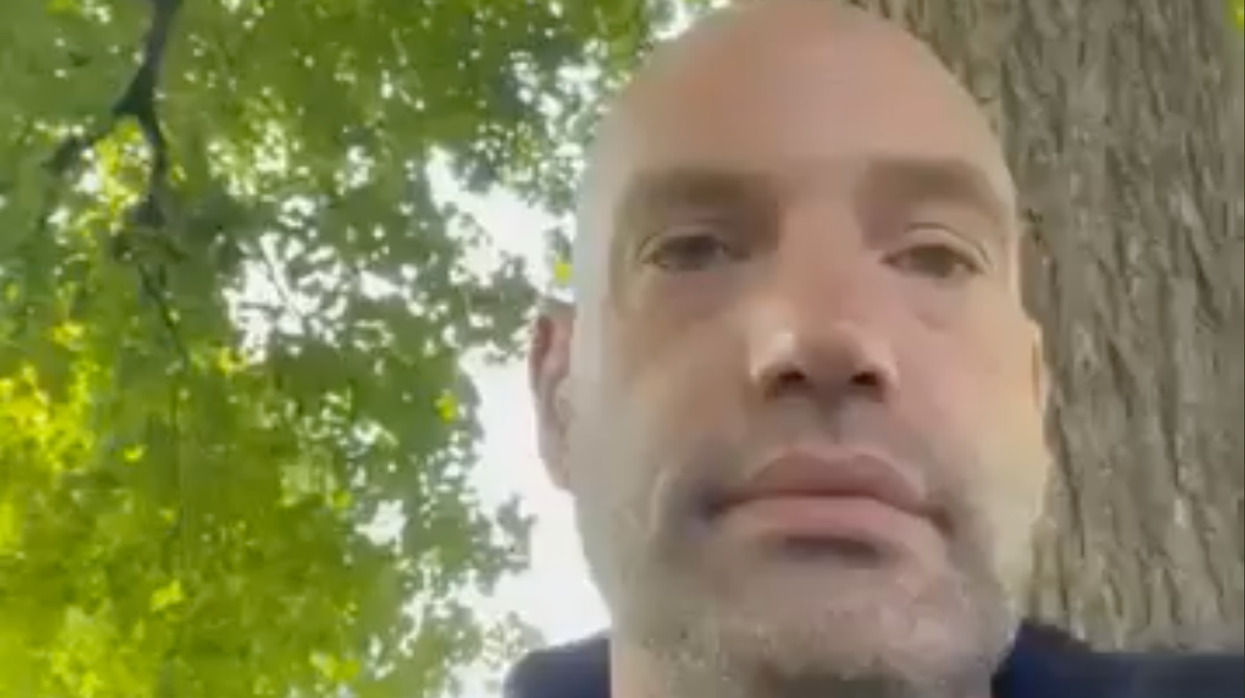
In a video, Nelson said he would set himself ablaze "to stop supplying Israel with the money and weapons it uses to imprison and murder innocent Palestinians" and "to pressure Israel to end the genocide in Gaza."
For the third time since Israel launched a war on Gaza for which it is currently on trial for genocide at the World Court, a person in the United States has set themself on fire to protest Israel's killing of more than 41,000 Palestinians and U.S. complicity in the slaughter.
In an incident all but completely ignored by the U.S. corporate media, a man identified as Matt Nelson set himself alight near the Israeli Consulate in Boston at around 8:15 pm local time on Wednesday, September 11.
"My name is Matt Nelson and I'm about to engage in an extreme act of protest," he said in a video first uploaded to YouTube on Wednesday. "We are all culpable in the ongoing genocide in Gaza."
"We are slaves to capitalism and the military-industrial complex. Most of us are too apathetic to care," Nelson continued. "The protest I'm about to engage in is a call to our government to stop supplying Israel with the money and weapons it uses to imprison and murder innocent Palestinians, to pressure Israel to end the genocide in Gaza, and to support the [International Criminal Court] indictment of [Israeli Prime Minister] Benjamin Netanyahu and other members of the Israeli government."
"A democracy is supposed to serve the will of the people, not the interests of the wealthy," he added. "Take the power back. Free Palestine."
According to NBC Boston, first responders confirmed a man suffered serious burn injuries. Nelson's current condition has not been reported.
NBC Boston and other local media took flak from critics on social media, who noted that the outlets chose to report the incident's location as "outside the Four Seasons Hotel" instead of by the Israeli Consulate.
Nelson is the third person known to have self-immolated in Gaza-related protests in the United States since October.
On December 1, a woman—whose identity remains unknown—carrying a Palestinian flag was hospitalized in critical condition after setting herself alight outside the Israeli consulate in Atlanta. Police called it an "act of extreme political protest." Israeli Consul-General Anat Sultan-Dadon called it an act of "hate and incitement toward Israel."
Then, in an incident that gained worldwide attention, Aaron Bushnell, a 25-year-old active-duty U.S. airman, doused himself in an unknown accelerant, donned his service cap, and set himself ablaze in front of the Israeli Embassy in Washington, D.C. on February 25.
Bushnell repeatedly screamed "Free Palestine" as he burned. Secret Service officers quickly rushed to the scene, with at least one of them drawing his pistol and pointing it at the burning man while ordering him to "get on the ground, you fucker."
As he screamed and writhed in agony, Bushnell managed one final, garbled, yet unmistakable "free Palestine" as his body was engulfed in flames. He died later that day.
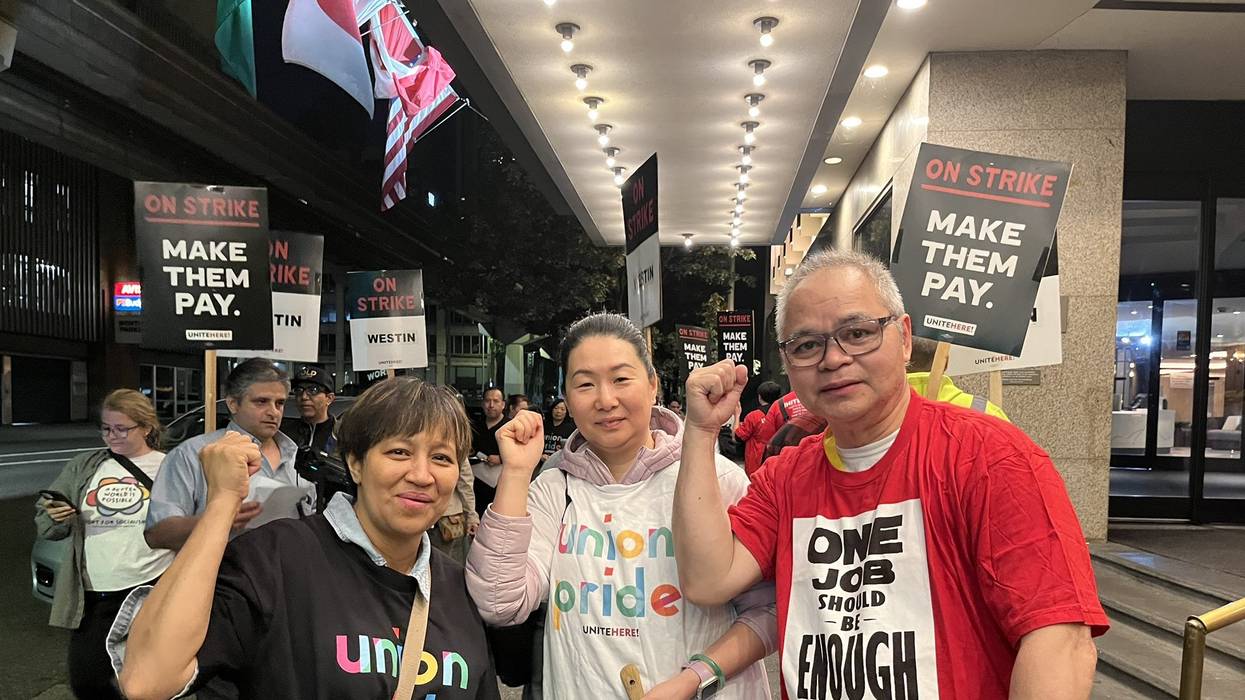
"We refuse to accept wages that can't support our families. It's insulting. And it ends now."
After approximately 10,000 hotel workers across the United States walked off the job over the weekend ahead of Labor Day, the strikes not only continued but grew on Monday, with employees of the Hilton Baltimore Inner Harbor taking to the streets.
In Maryland's biggest city, workers with UNITE HERE Local 7 carried signs that said, "Respect our work," "One job should be enough," and "Make them pay."
Sharing a video of the picket line on social media, the union said: "We refuse to accept wages that can't support our families. It's insulting. And it ends now."
The Baltimore workers joined staff from two dozen other hotels in Boston, Greenwich, Honolulu, Kauai, San Francisco, San Diego, San Jose, and Seattle who started their strikes on Sunday and plan to stay on the picket line through Tuesday.
"10,000 hotel workers across the U.S. are on strike because the hotel industry has gotten off track," UNITE HERE international president Gwen Mills said in a statement. "During Covid, everyone suffered, but now the hotel industry is making record profits while workers and guests are left behind. Too many hotels still haven't restored standard services that guests deserve, like automatic daily housekeeping and room service."
"Workers aren't making enough to support their families," she emphasized. "Many can no longer afford to live in the cities that they welcome guests to, and painful workloads are breaking their bodies. We won't accept a 'new normal' where hotel companies profit by cutting their offerings to guests and abandoning their commitments to workers."
Striking workers echoed the messages from Mills and their signs. Christian Carbajal, a market attendant who has worked for 15 years at the Hilton Bayfront in San Diego, said that "I'm on strike because I don't want hotels to become the next airline industry."
"I used to work in room service, but after Covid, they closed my department. Now I work in the grab-and-go market," Carbajal continued. "Guests complain to me that they can no longer get a steak delivered up to the room, and the tips aren't what they used to be. I'm making less than I used to, and now two families share my house because we can't afford the rent anymore. The hotels should respect our work and our guests."
Elena Duran, who has worked as a server at Marriott's Palace Hotel in San Francisco for 33 years, similarly said that "since Covid, they're expecting us to give five-star service with three-star staff."
"A couple weeks ago, we were at 98% occupancy, but they only put three servers when we used to be a team of four or five," Duran noted. "It's too much pressure on us to go faster and faster instead of calling in more people to work."
Mary Taboniar, who has been a housekeeper at the Hilton Hawaiian Village in Honolulu for six years, said that "I have to work a second job because my job at the hotel is not enough to support my kids as a single mom."
"I'm living on the edge where I'm not sure if I'll be able to pay our rent and groceries or provide my family with healthcare," Taboniar added. "It's so stressful. One job should be enough."
Daniela Campusano, who has been at Hilton's Hampton Inn & Homewood Suites in Boston's Seaport District for a dozen years, also said she is not making enough as a housekeeper.
"I'm on strike because I need higher wages. I currently have two jobs, and I work about 65 hours a week," Campusano said. "Everything is so expensive now—all my monthly bills have increased, and I need to earn more money so I can help my daughter pay for her university studies. One job should be enough."
Fellow housekeeper Rebeca Laroque, who has been at the Hyatt Regency Greenwich for the past 12 years, explained that "I'm on strike because I need more wages, I need the health insurance, and I need less rooms."
"I work so hard and come home exhausted at the end of the day, but I still don't make enough money to pay my bills," Laroque said. "Going on strike is a huge sacrifice, but it's something I have to do because I need a better life for me and my two kids."
Other groups and lawmakers expressed solidarity with the striking hotel workers, including the AFL-CIO, the Association of Flight Attendants-CWA, the National Employment Law Project, the United Auto Workers, and U.S. Reps. Pramila Jayapal (D-Wash.) and Ro Khanna (D-Calif.).
Along with corporate price gouging that is driving up prices, hotel workers have been impacted by practices including stock buybacks. An Institute for Policy Studies analysis released last week shows that Hilton and Marriott are among the 20 largest low-wage employers who have poured millions of dollars into share repurchases since 2019.
Meanwhile, Americans' support for organized labor has hit a seven-decade high, according to Gallup recent polling. Citing that survey, U.S. Sen. Bernie Sanders (I-Vt.) said Monday that "the working people of our country are increasingly aware of the unprecedented level of corporate greed and power we are now experiencing, and the outrageous level of income and wealth inequality that exists."
"They understand that never before in American history have so few had so much, while so many continue to struggle," he added. "And they are fighting back."

"Donald Trump and JD Vance are scabs and the audience knows it," said one observer.
A day after warmly welcoming Democratic vice presidential candidate Tim Walz, attendees of a firefighters' union convention in Boston on Thursday booed the Minnesota governor's GOP opponent, U.S. Sen. JD Vance—who claimed that he and his running mate, former President Donald Trump, are the "most pro-worker Republican ticket in history."
Vance, who represents Ohio, endured multiple rounds of boos, starting from the moment he thanked members of the International Association of Fire Fighters (IAFF) union just after taking the stage.
"Semper Fi, guys," Vance said in response to the boos, using the motto of the U.S. Marine Corps, in which he served. "Sounds like we got some fans and some haters. That's okay; let's listen to what I have to say here, and I'll make my pitch."
That pitch to the IAFF—which has yet to endorse a presidential candidate—included the claim that "President Trump and I are proud to be the most pro-worker Republican ticket in history, and I want to talk about why we are fighting for working people, why we are going to fight for unions and nonunions alike."
This drew another salvo of boos.
A pro-Democrat account with more than 680,000 followers on X, the social media platform formerly known as Twitter, mocked Vance's IAFF reception in a post saying that "Donald Trump and JD Vance are scabs and the audience knows it."
Vance did receive applause after saying that he respects the IAFF for "inviting both sides to take the stage" during the union's convention.
Walz—who is Vice President Kamala Harris' Democratic running mate—touted his party's strong union ties, as well as his own status as a "card-carrying member of Minnesota's teachers union," during his IAFF convention speech on Wednesday. He said that a Harris-Walz administration would support legislation including the Richard L. Trumka Protecting the Right to Organize (PRO) Act, which if passed would expand labor protections including the right to organize and collectively bargain.
"We know that when unions are strong, America's strong," Walz said to robust applause.
Union leaders have warned that a Trump-Vance administration would be inimical to organized labor, with AFL-CIO president Liz Shuler calling the GOP ticket "a corporate CEO's dream" and American Federation of Teachers chief Randi Weingarten hailing the administration of Democratic President Joe Biden as "the most pro-labor, pro-public education leaders our country has seen in modern history."
Last month, United Auto Workers—one of many unions endorsing Harris—called Trump "a scab and a billionaire."
"We know which side we're on," the union added. "Not his."

"Every day brings more death, more starvation, more children losing limbs, more babies becoming orphans," said IfNotNow Boston. "It is unbearable, our souls cry out against it."
A Jewish-led protest featuring dozens of demonstrators calling for a cease-fire in Israel's war on Gaza shut down Boston University Bridge during rush-hour traffic on Thursday morning.
"We see what is happening to the people of Gaza: no food, no water, no electricity, no medicine," says an open letter from IfNotNow Boston. "Every day brings more death, more starvation, more children losing limbs, more babies becoming orphans. It is unbearable, our souls cry out against it. So today, out of desperation, we are sitting-in on the BU Bridge, begging our politicians to support a cease-fire."
The letter, which specifically calls out U.S. President Joe Biden and Sen. Elizabeth Warren (D-Mass.), apologizes to "the regular people" impacted by protesters' blockade of the bridge, which crosses the Charles River, connecting Boston and Cambridge.
"We wish there was a way we could stop this war by going directly to the politicians who have the power to intervene. But we've tried that—we've tried everything," the letter explains. "We've marched outside the White House, and prayed inside Congress. We've been turned away from Sen. Warren's office four times, and joined thousands of people to demonstrate outside."
Several other lawmakers across the United States and around the world have been confronted with similar demonstrations in support of a cease-fire in recent days, from an interfaith protest in Washington, D.C. late Wednesday to last Saturday's march in London that drew hundreds of thousands of people from throughout the United Kingdom.
The letter says that "we are still mourning the 1,200 Israelis who were brutally murdered" in a Hamas-led attack on October 7, which prompted what experts around the world are calling Israel's "genocidal" war against Gaza. It also emphasizes that like the families of around 240 people taken hostage by Palestinian militants during the attack on Israel, "we know it will be negotiations, not bombs, that finally bring them home."
The Israeli bombardment and ground operations have killed over 11,000 Palestinians in Gaza, including at least 4,710 children. Thousands more are wounded or missing, and around three-quarters of the territory's 2.3 million residents have been displaced. Israel has devastated civilian infrastructure and limited the delivery of humanitarian aid to Gaza—supplies of water, food, medicine, and fuel are running out.
"For the last month, I've witnessed unspeakable atrocity that's being done in my name, and I'm here to say this is not for American Jewish safety, this is not for global Jewish safety, and that we're calling for a cease-fire," said protester Emma Rose Borzekowski, according to NBC10 Boston. "We're saying that there needs to be an end to the violence."
The IfNotNow letter similarly stresses that "we know that real safety for Jews requires safety for all people. Our future and our liberation is bound up with the liberation of Palestinians. There cannot be peace for anyone until the siege ends, and apartheid and occupation are dismantled."
"The Jewish principle of פיקוח נפש, Pikuach Nefesh, requires people of our faith to do what we can to save even a single life. Today, millions of people are in mortal danger because of this war. And American politicians have the power, if they use it, to make it stop," the letter concludes. "So today we fulfill our moral and religious obligation by sitting-in on this bridge, begging President Biden, Sen. Warren, and all who claim to represent us to call for a cease-fire."
Biden, Warren, and the vast majority of political leaders in Washington, D.C. have rejected growing global demands for a cease-fire in Gaza. Just two dozen progressive House Democrats signed a Wednesday letter to the president pressuring him to reconsider his position, particularly given "the grave violations of children's rights."
Israel gets nearly $4 billion in annual military assistance from the United States, and Biden recently asked Congress to add another $14.3 billion because of the war. However, the U.S. government on Wednesday night also declined to veto a United Nations Security Council resolution calling for humanitarian pauses in Gaza—which Human Rights Watch U.N. director Louis Charbonneau said "should be a wake-up call to Israeli authorities that global concern, even among its allies, is strong."
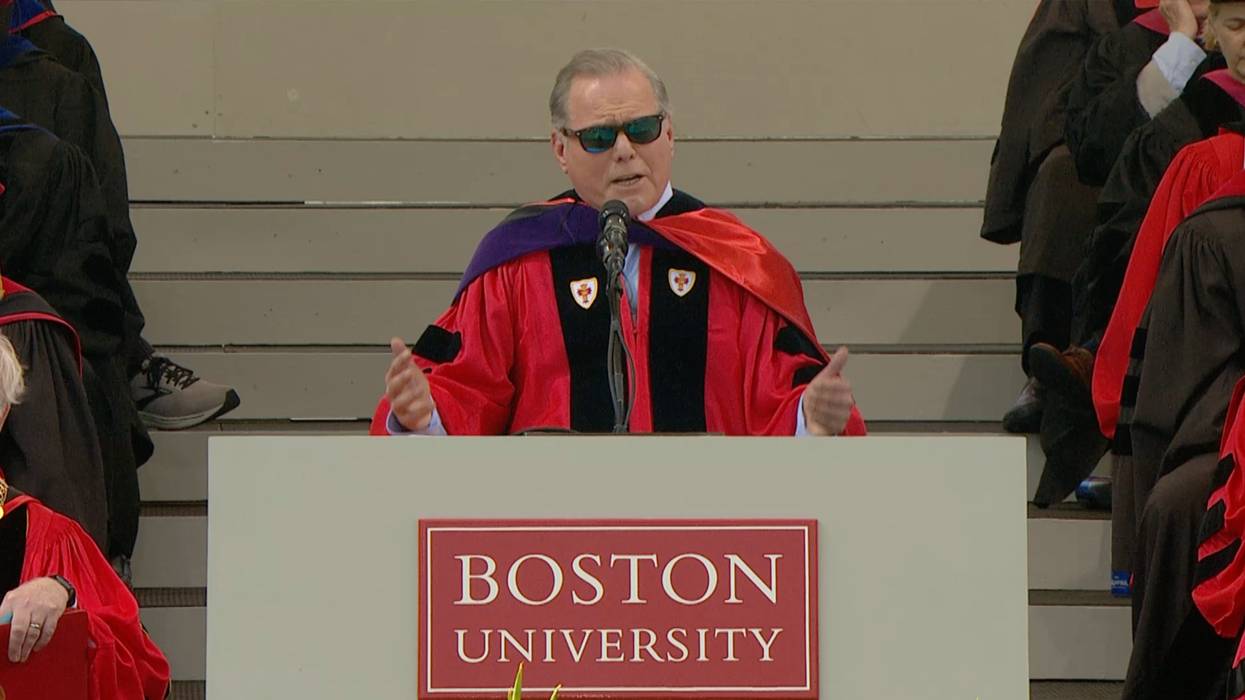
Writers Guild of America members and local allies picketed outside while the crowd in the stadium booed David Zaslav and made clear to the industry executive that "we don't want you here."
As unionized film and television writers across the United States continue to strike, Warner Bros. Discovery president and CEO David Zaslav was met with critical chants both inside and outside of Boston University's Sunday commencement ceremony, during which he spoke and received an honorary degree.
After weeks of negotiating with Zaslav's company as well as Amazon, Apple, Disney, NBCUniversal, Netflix, Paramount, and Sony under the the Alliance of Motion Picture and Television Producers (AMPTP), the Writers Guild of America (WGA) launched the strike in early May, saying that "the studios' responses to our proposals have been wholly insufficient, given the existential crisis writers are facing."
That same week, BU announced Zaslav as a commencement speaker, sparking backlash from students, alumni, community members, and the WGA, East director of communications, Jason Gordon, who expressed "deep disappointment with the university over its poor decision" to provide the industry CEO with a platform.
"Boston University should not give voice to someone who wants to destroy their students' ability to build a career in the film and television industry," Gordon told
The Boston Globe. "The university should expect students, Writers Guild members, as well as other unions and community groups to picket Zaslav's commencement address."
WGA members delivered the promised picket with support from local allies, including members of BU Young Democratic Socialists of America (YDSA) and Boston DSA, who made signs that said: "F*!# Zaslav! Solidarity With the Writers."
Within Nickerson Field, "boos and expletives rained down" on Zaslav, who graduated from the BU School of Law in 1985.
During his speech, the CEO did not address the ongoing strike, "or the several dozen students who turned their backs to him, and instead shared the strategies that helped him become one of Hollywood's most powerful figures," reported BU Today.
As The A.V. Club's Sam Barasanti wrote Sunday:
It seems like, for those of us who weren't there, that Zaslav's speech was as stunningly out-of-touch with reality as the decision to host him was in the first place, which speaks to a general contempt he seems to have for... oh, let's say everyone.
This is a man who was put in charge of a massive media empire, and the most notable things he has done with that power are burn money, dismantle one of the most prestigious brands in entertainment, double-dip on promoting J.K. Rowling, kick off the now-common trend of studios deleting content from their streaming services and making it completely inaccessible in some cases, and—how can we forget?—driving the writers who make his shows and movies to go on a strike that may soon lead to similar strikes from the DGA and SAG-AFTRA that would render Hollywood completely motionless.
According to The Hollywood Reporter, "'We don't want you here,' 'Pay your writers,' and 'Shut up, Zaslav' could be heard emanating from the crowd, messages similar to the prepared chants for the picket, including some created by the school's YDSA chapter members and school students who were inspired by BU hockey chants."
As The Hollywood Reporter detailed:
Students from BU's College of Communications, which houses its film and TV program, as well as the College of Fine Arts and some enrolled in the College of Arts and Sciences, were among those who had expressed interest or were expected to take part in the ceremony protest, according to Vanessa Barlett, a graduating senior who helped lead the student-led writers strike solidarity event inside Nickerson Field.
"I'm in the same college as a bunch of film and TV kids," Barlett, who studied political science and journalism and was among those who created the day's official chants, told The Hollywood Reporter ahead of the event. "I'm friends with a lot of people in the College of Fine Arts, people who are in the theater arts program, so having a sense of solidarity is very important to me."
Some progressive lawmakers also weighed in—including Sen. Bernie Sanders (I-Vt.), who tweeted that "if Warner Bros Discovery can afford to pay its CEO David Zaslav $286 million in compensation over the past two years, it can afford to pay its writers much better wages and benefits. Mr. Zaslav: Listen to the Boston University students and the Writers Guild. Pay your writers."
Striking workers' demands from studios, which include pay increases and limits on artificial intelligence, "would gain writers approximately $429 million per year," according to WGA. "AMPTP's offer is approximately $86 million per year, 48% of which is from the minimums increase."
This article has been updated with tweets from Worcester DSA, Sen. Bernie Sanders, and Rep. Alexandria Ocasio-Cortez.

The ruling forces the airlines "to continue competing, eliminating anti-competitive revenue-sharing incentives and setting an important precedent against future consolidation in the industry," said one expert.
A Massachusetts-based federal judge on Friday sided with the Biden administration plus six states and the District of Columbia, which launched an antitrust challenge to American Airlines and JetBlue Airways' "de facto merger" for Boston and New York City.
The U.S. Department of Justice (DOJ) along with the attorneys general of Arizona, California, Florida, Massachusetts, Pennsylvania, Virginia, and D.C. filed a civil lawsuit over the airlines' Northeast Alliance (NEA) in September 2021.
"This case turns on what 'competition' means," U.S. District Court Judge Leo Sorokin, an appointee of former President Barack Obama, wrote Friday. "To the defendants, competition is enhanced if they join forces to unseat a powerful rival. The Sherman Act, however, has a different focus."
"Federal antitrust law is not concerned with making individual competitors larger or more powerful. It aims to preserve the free functioning of markets and foster participation by a diverse array of competitors," the judge added. "Those principles are generally undermined, rather than promoted, by agreements among horizontal competitors to dispense with competition and cooperate instead. That is precisely what happened here."
Sorokin stressed that "American and JetBlue are two of the four largest carriers operating in New York, and two of the largest three in Boston. Delta Air Lines is the only other carrier with a large presence in Boston. Besides Delta and United Airlines, no other carrier matches or approaches in size the defendants' respective positions in New York."
After noting that the pair established the "first-of-its-kind alliance" in 2020, he explained:
This was a sea change in the relationship between two airlines that were direct and aggressive competitors with decidedly different business models and cost structures. There is no doubt that savvy executives representing both defendants earnestly believe the NEA promotes the interests of their respective shareholders and will strengthen American and JetBlue in their rivalry against Delta (and, to a lesser extent, United) in New York and Boston. It is similarly beyond dispute that the NEA involves substantial coordination by two powerful competitors in an industry that, on a domestic level, is closely regulated, highly concentrated, and often volatile.
Reuters reported that after Sorokin ordered the end of the alliance within 30 days, "JetBlue shares fell 1.8% for the day, while American closed down 1.5%," and both airlines said "they were evaluating their next steps."
Meanwhile, the DOJ, its state partners, and other critics of consolidation celebrated the initial court victory.
"Today's decision is a win for Americans who rely on competition between airlines to travel affordably," said Attorney General Merrick Garland in a statement. "The Justice Department will continue to protect competition and enforce our antitrust laws in the heavily consolidated airline industry and across every industry."
American Economic Liberties Project senior fellow for aviation and travel William McGee agreed that the DOJ Antitrust Division's successful challenge of the NEA "is a win for passengers and the public."
"Blocking this de facto merger forces JetBlue and American to continue competing, eliminating anti-competitive revenue-sharing incentives and setting an important precedent against future consolidation in the industry," McGee said. "We hope to see a similar ruling in favor of the Justice Department's suit against the JetBlue-Spirit merger, another illegal deal that would accelerate concentration and drive up fares nationwide."
As Common Dreams reported in March, the DOJ joined with the attorneys general of Massachusetts, New York, and D.C. to file a civil suit against the JetBlue-Spirit merger, arguing that "by eliminating that competition and further consolidating the United States airlines industry, the proposed transaction will increase fares and reduce choice on routes across the country, raising costs for the flying public and harming cost-conscious fliers most acutely."
McGee said at the time that by "blocking this blatantly anti-competitive deal, the Department of Justice is standing up for passengers, workers, and communities across the country."

Arif Sayed Faisal was killed by Cambridge police on January 4 after appearing to have a mental health crisis. The Cambridge Police Department still won't say who killed the 20-year-old student.
Just four days into the new year, 20-year-old Bangladeshi immigrant and student Arif Sayed Faisal was shot and killed by police in Cambridge, Massachusetts, after appearing to have a mental health crisis. The Cambridge Police Department was quick to call the killing an “officer-involved shooting,” using language that police departments across the US use to shift the blame off of officers who kill or maim civilians. Cambridge police claimed that Faisal advanced towards officers with a knife in hand, implying that the police had no choice but to shoot him dead.
Faisal’s death sparked a level of movement that Cambridge city officials didn’t expect, Suhail Purkar, a local activist and organizer with the Party for Socialism and Liberation (PSL), told Peoples Dispatch. Purkar was a central organizer for a march of hundreds to the Cambridge Police Department headquarters on January 29, when protesters delivered a list of demands to police. These were: release the names of the officers and the unredacted police report; fire, indict, and convict the officers; fully fund alternative emergency response programs separate from the police; disarm and demilitarize the police; and reallocate police funding into community support and safety.
Since the killing, Cambridge Police Commissioner Christine Elow made a point to describe the Cambridge Police Department’s high level of training and claim that it is one of the most progressive departments in the country. “It goes to highlight that no amount of ‘training’ for the police, different curriculums, etc., are going to stop them from being an oppressive force and murdering people in the streets,” said Purkar.
“Initially [Cambridge authorities] were expecting both the Bangladeshi community and the Cambridge community at large, the Greater Boston community at large, to essentially just hold vigils, and paint murals, or basically make [the community response] something that’s very easy to ignore,” Purkar said. But Greater Boston immediately launched into a flurry of protest actions, fueled by the legacy of the anti-police brutality movement in the United States; the knowledge that, in 2022, US police killed more people than ever before; and the January 7 police killing of Tyre Nichols.
The movement for Faisal had international repercussions: demonstrators in Bangladesh protested the arrival of a US official in Dhaka, holding signs that read “Human Rights are Violated in the US Today” and “Justice for Faisal.”
Purkar, a young Indian immigrant and a resident of Somerville, a neighboring town, spoke to Peoples Dispatch about Faisal’s case and the state of the movement. “This is actually something that’s very personal to me,” he said. Purkar has lived in the greater Boston Area for two decades, and graduated from University of Massachusetts Boston, where Faisal was studying. Purkar also attends a mosque in the same affordable housing apartment complex that Faisal’s parents live in. “It could have easily been me,” Purkar said.
“How many stories like that?”
A key demand of organizers is to release the names of the police officers responsible for Faisal’s death, “so that we can investigate whether they have a history of racism, discrimination, and abuse of force,” said Purkar.
Purkar compared the movement for justice for Faisal to the movement for Tyre Nichols, a 29-year-old Black father beaten to death by Memphis police within a few days of when Faisal was killed. Protests against Nichols’ murder erupted in the last weekend of January after the footage of his beating was released to the public. In Nichols’ case, authorities in Memphis quickly fired, arrested, and charged five officers responsible for the beating, and disbanded the notorious “Scorpion Unit” that the officers were a part of.
“When the names of the police officers who murdered Tyre Nichols were released, members from the community came forward in Memphis and they said, hey, we’ve been brutalized by these same cops,” said Purkar. “We’ve been brutalized by the ‘Scorpion Unit,’ which has now been deactivated. [Scorpion has] a history of racism. They have a history of abuse of force. They have a history of brutalizing poor communities of color. How many stories like that [in Cambridge]? How many residents have been brutalized by these same officers in Cambridge that haven’t come forward so far? So that’s something that we really need to know.”
"How many residents have been brutalized by these same officers in Cambridge that haven’t come forward so far? So that’s something that we really need to know."
“It’s shocking that in Memphis, the names of the officers have been released, that they were fired and that criminal charges were brought against them,” Purkar said. However, for Purkar, this rare move was not because of “altruism” or “the righteousness of their heart.” He believes that Memphis officials released the officers’ names “they were scared of essentially another wave of upsurge against police brutality like we saw in this country in 2020.” The summer of 2020 saw the largest protest movement in US history following the police killing of George Floyd.
It is indeed rare that US police are charged with a crime as a result of a police killing—this has only happened in 2% of such cases from 2013 to 2022. According to the AP, when Derek Chauvin was found guilty for the killing of George Floyd, he was only the eighth police officer to be convicted of murder since 2005, despite the thousands of deaths at the hands of police in the US every year.
“It’s only because there has been such public pressure, because activists, including the PSL and other community members, actually shut down their City Council meeting and said that you can’t have business as usual, that they started to even respond more,” said Purkar, referring to the disruption of the January 23 Cambridge City Council meeting. There has since been a second disruption by activists on Monday, February 6.
“I can’t tell you exactly why Cambridge hasn’t released the names. But I think the motivating factor in Memphis was certainly that they were afraid of people expressing righteous indignation.”
Activists are also fighting to fire the officers responsible for Faisal’s death. Immediately following the shooting, the officer who killed Faisal, who had eight years of experience on the police force, was placed on paid leave. “In no other profession on this planet can you murder somebody in broad daylight and then go on paid vacation the next day,” Purkar said.
“[Faisal’s] family hasn’t received restitution, they haven’t received reparations,” Purkar said. “They’re grieving. They’re a very working class family. So that’s a central demand, to fire these officers right away, to not have these killer cops still working as public servants.”
Another demand is to prosecute the officers responsible, charge them, and convict them. “Those five officers [who killed Tyre Nichols], they have been imprisoned already and criminal charges have been brought forth against them. And that’s exactly what needs to happen in this case. And every case as well,” Purkar said.
In response to the actions to demand justice for Faisal, eight days after Faisal’s murder, Cambridge city officials held what they called a “community meeting” to share the results of their own investigation into the incident with the public. The meeting was attended by the Police Commissioner Christine Elow, City Manager Yi-An Huang, Mayor Sumbul Siddiqui, and other members of the Cambridge City Council. Hundreds of residents of the Greater Boston community gathered to demand transparency regarding Faisal’s killing.
At this meeting, Elow and Huang responded to these demands by claiming that there was a city policy preventing officials from releasing the names of the police officers responsible. The response was not acceptable for protesters who, according to Purkar, argued that the policy should be changed, “Policies are made by human beings,” he added.
“The whole world knows that George Floyd was killed by Derek Chauvin. We deserve to know who killed our brother!” Sharik Purkar, another Greater Boston anti-police brutality activist, addressing officials at the meeting on January 12. “You are the people with the power to make the policy. Supposedly you reflect our will. Do we wanna know who killed our brother?” The gathered crowd responded with a resounding “yes!”
"The whole world knows that George Floyd was killed by Derek Chauvin. We deserve to know who killed our brother!"
Elow told the assembled crowd that the police department must wait for the internal investigation into Faisal’s murder to complete.
Six days later, city officials met at a special session of the City Council on January 18. At this meeting, both Elow and Huang appeared to directly contradict their assertion that not releasing the officers’ names was an official city policy.
Mayor Siddiqui directly asked Commissioner Elow at the Council meeting, “We believe we heard at the community meeting that it was city policy not to reveal the officer’s name after the investigation is completed. Is this a policy passed by the previous Council, Cambridge Police Department policy, or part of the union contract?”
To which the Commissioner admitted, “It’s not a policy that is in writing, It has been past practice not to release names. There is no uniform, agreed upon standard.”
“It’s more of a practice, and not a policy,” Elow said.
Purkar said that Elow’s admission, appearing to contradict what was said on January 12, came as a result of public pressure by activists. At the City Council meeting, Elow essentially confessed that officials simply “don’t want to release the names,” Purkar told Peoples Dispatch.
At the January 18 City Council meeting, City Manager Huang acknowledged the community’s desire for the release of the names of the officers responsible for Faisal’s murder. “I can understand the desire for greater transparency,” he said. “At the same time, I think that there is also a reality that that level of transparency will increase the amount of public scrutiny, and potential harassment to the officer involved.”
In Purkar’s view, Huang had declared that “public scrutiny and transparency is bad.”
At a January 9 rally in front of Cambridge City Hall, the legal counsel for Faisal’s family announced that an inquest into the murder may not begin until 2024. “So that’s really [the City’s] game plan, to wait for people to forget, wait for the energy to die down so that they can have a long cover up,” Purkar said.
“We’ll be back!”
The Cambridge Police Department has yet to comply with any of the wider community’s demands. No names of officers have been released to the public.
But the movement for Tyre Nichols could positively impact the struggle for justice in Cambridge, Purkar said. “We see in Cambridge that there is this deep connection that is drawn between Faisal and Tyre Nichols. More and more, people are coming off the sidelines.”
“Initially in the community there was sadness, outrage, confusion. A mix of emotions, as you can expect, when a young person has been taken from us. It’s been a little more than three weeks now. In those [several] weeks, the reaction has turned into outrage as a result of the empty rhetoric of the politicians.”
After city officials refused to release names on January 12, members of the Greater Boston community successfully shut down the January 23 City Council meeting, afterwards chanting, “We’ll be back!” Community members once again shut down City Council on February 6.
On January 29, when demonstrators delivered demands to the Cambridge Police Department, Commissioner Elow was not present to receive the demands in person. Purkar speculated that she was “too cowardly to face her own constituents.”
Purkar and his fellow organizers have more actions planned in the future, especially focused on organizing university students. “But that’s the state of the movement, is that it’s actually growing,” he said. “More and more people are joining this fight and joining the struggle.”

U.S. President Joe Biden faces mounting pressure to take executive action to ensure that freight rail workers have paid sick leave, including from an open letter spearheaded by The Lever that's already been signed by over 10,000 people, according to the online news outlet.
Calls for Biden to issue such an order have been stacking up since the U.S. Senate passed a resolution forcing rail workers on the verge of striking to accept a White House-brokered agreement without paid sick days. On Friday, the president signed the measure for which he'd advocated, provoking widespread working-class outrage.
"You have previously stated, unequivocally, that all workers deserve paid sick leave. And yet you have just signed a bill from Congress to force unionized rail workers to go back to work without appropriate paid sick leave," begins the letter to Biden, which began circulating Friday.
The letter addressed to Biden continues:
Right now, you have the executive authority to extend paid sick leave to rail workers, and you do not need congressional approval to do that. We implore you to use that power right now.
No one, especially in the world's richest nation, should have to choose between forgoing pay or working through severe illness and family emergencies. Rail workers keep our infrastructure moving--their work is hard and critical to the success of our nation.
It is your moral obligation to immediately take executive action that fulfills your presidential campaign pledge to support paid sick days.
The Lever on Monday evening published a related video highlighting rail workers' frustrations with Biden, who claims to be the most pro-union president in U.S. history.
David Sirota, The Lever's founder and editor in chief, said Sunday that "Biden wants you to believe it's all Republicans' fault. But he has the power to do this right now."
Other critics of how Biden and Democratic congressional leaders responded to the rail dispute have also spent the past few days pushing for further action.
"If you are outraged about Congress' handling of the railway strike, join me in demanding that President Biden sign an executive order guaranteeing at least seven days of paid sick leave for railroad workers," said former Labor Secretary Robert Reich. "If these workers are vital to the economy, why not treat them as such?"
A Monday editorial from The Boston Globe also argued that "the status quo is simply untenable" and Biden should consider issuing an executive order--a call that came after the newspaper reported on about 200 protesters who picketed the president's visit to the John F. Kennedy Library and Museum in the Massachusetts city Friday afternoon, carrying signs that said "striking is a human right" and "please support sick days for workers."
As the editorial explains:
Congress could have added the sick days unions wanted to the deal, but a proposal to do so was blocked by Republican senators. But that shouldn't be the last word. As Biden himself said, "I've made it very clear: I'm going to fight for paid leave, not only for rail workers but for all Americans." So far, he hasn't explained exactly how he would do that. But one way he ought to explore is an executive order.
There is precedent. On Labor Day in 2015, former president Barack Obama signed an executive order that required all federal contractors to provide their employees with up to seven days of paid sick leave. But that order exempted rail companies. Biden could simply extend that policy to apply more broadly so that it includes rail workers as well, many of whom work for companies that are federal contractors because they ship things like U.S. mail or equipment for the Department of Defense. Doing so would not only benefit thousands of workers, but it would set a standard for the rest of the industry.
"It's unconscionable that after the last few years--in which the Covid pandemic forced the entire world to learn about the importance of sensible public health policies--American lawmakers and corporate leaders are still reluctant to grant workers any paid sick leave," the editorial concludes. "And while Biden can certainly celebrate the fact that his leadership helped avert a potentially catastrophic rail strike, he should stick to his word and push for paid sick leave to become a part of all workplaces."
This post has been updated with a new figure reflecting additional signatures endorsing the letter and a related video.