SUBSCRIBE TO OUR FREE NEWSLETTER
Daily news & progressive opinion—funded by the people, not the corporations—delivered straight to your inbox.
5
#000000
#FFFFFF
To donate by check, phone, or other method, see our More Ways to Give page.
Daily news & progressive opinion—funded by the people, not the corporations—delivered straight to your inbox.
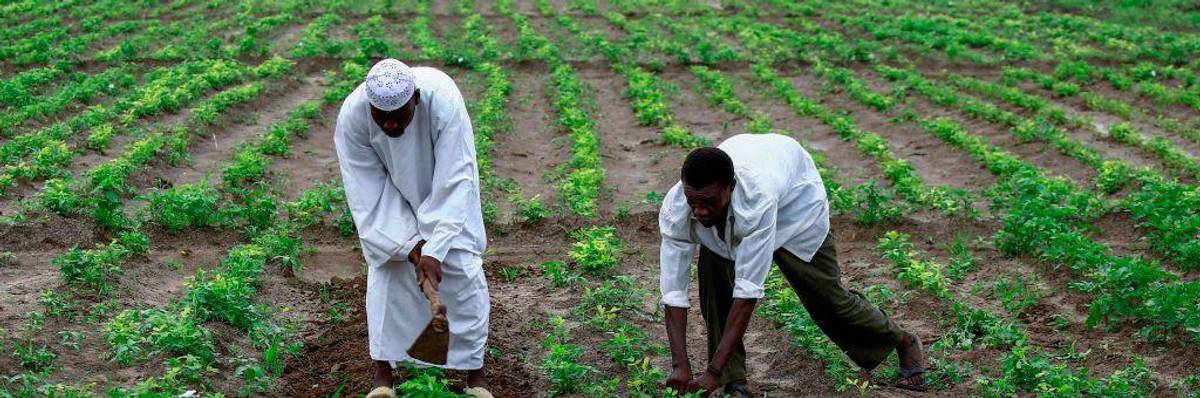
Poverty remains high, and severe food insecurity has increased 31% across AGRA's 13 countries, as measured by the United Nations. (Photo by ASHRAF SHAZLY/AFP via Getty Images)
As COVID-19 threatens farming communities across Africa already struggling with climate change, the continent is at a crossroads. Will its people and their governments continue trying to replicate industrial farming models promoted by developed countries? Or will they move boldly into the uncertain future, embracing ecological agriculture?
It is time to choose. Africa is projected to overtake South Asia by 2030 as the region with the greatest number of hungry people. An alarming 250 million people in Africa now suffer from "undernourishment," the U.N. term for chronic hunger. If policies do not change, experts project that number to soar to 433 million in 2030.
Green Revolution proponents have had 14 years to demonstrate they can lead Africa into a food-secure future. Billions of dollars later, they have failed.
The evidence is now convincing that the Green Revolution model of agriculture, with its commercial seeds and synthetic fertilizers, has failed to bring progress for Africa's farmers. Since 2006, under the banner of the billion-dollar Alliance for a Green Revolution for Africa (AGRA), that strategy has had an unprecedented opportunity to generate improved productivity, incomes, and food security for small-scale farmers. African governments have spent billions of dollars subsidizing and promoting the adoption of these imported technologies.
According to a recent report, "False Promises." evidence from AGRA's 13 countries indicates that it is taking Africa in the wrong direction. Productivity has improved marginally, and only for a few chosen crops such as maize. Others have withered in a drought of neglect from donor agencies and government leaders. In AGRA's 13 focus countries, the production of millet, a hearty, nutritious and climate-resilient grain, fell 24% while yields declined 21%. This leaves poor farmers with less crop diversity in their fields and less nutritious food on their children's plates.
Small-scale farming households, the intended beneficiaries of Green Revolution programs, seem scarcely better off. Poverty remains high, and severe food insecurity has increased 31% across AGRA's 13 countries, as measured by the United Nations.
Rwanda, the home country of AGRA's president, Agnes Kalibata, is held up as an example of AGRA's success. After all, maize production increased fourfold since AGRA began in 2006 under Kalibata's leadership as Agriculture Minister. The "False Promises" report refers to Rwanda as "AGRA's hungry poster child." All that maize apparently did not benefit the rural poor. Other crops went into decline and the number of undernourished Rwandans increased 41% since 2006, according to the most recent U.N. figures.
Green Revolution proponents have had 14 years to demonstrate they can lead Africa into a food-secure future. Billions of dollars later, they have failed. AGRA wrapped up its annual Green Revolution Forum September 11 without providing any substantive responses to the findings.
With a pandemic threatening to disrupt what climate change does not, Africa needs to take a different path, one that focuses on ecological farm management using low-cost, low-input methods that rely on a diversity of crops to improve soils and diets.
Many farmers are already blazing that trail, and some governments are following with bold steps to change course.
In fact, two of the three AGRA countries that have reduced both the number and share of undernourished people - Ethiopia and Mali - have done so in part due to policies that support ecological agriculture.
Ethiopia, which has reduced the incidence of undernourishment from 37% to 20% since 2006, has built on a 25-year effort in the northern Tigray Region to promote compost, not just chemical fertilizer, along with soil and water conservation practices, and biological control of pests. In field trials, such practices have proven more effective than Green Revolution approaches. The program was so successful it has become a national program and is currently being implemented in at least five regions.
Mali is the AGRA country that showed the greatest success in reducing the incidence of hunger (from 14% to 5% since 2006). According to a case study in the "False Promises" report, progress came not because of AGRA but because the government and farmers' organizations actively resisted its implementation. Land and seed laws guarantee farmers' rights to choose their crops and farming practices, and government programs promote not just maize but a wide variety of food crops.
Mali is part of a growing regional effort in West Africa to promote agroecology. According to a recent report by the International Panel of Experts on Sustainable Food Systems (IPES), the Economic Community of West African States (ECOWAS) has developed an Agroecology Transition Support Program to promote the shift away from Green Revolution practices. The work is supported by the U.N. Food and Agriculture Organization (FAO) as part of its "Scaling Up Agroecology" program.
In Burkina Faso, Mali, and Senegal, farmers' organizations are working with their governments to promote agroecology, including the subsidization of biofertilizers and other natural inputs as alternatives to synthetic fertilizers.
"We have seen agroecological practices improve the fertility of soils degraded by drought and chemical input use. We have seen producers' incomes increase thanks to the diversification of their crop production and the establishment of new distribution channels."
In the drylands of West Africa, farmers in Burkina Faso, Senegal, Ghana and Niger are leading "another kind of green revolution." They are regenerating tree growth and diversifying production as part of agro-forestry initiatives increasingly supported by national governments. This restores soil fertility, increases water retention, and has been shown to increase yields 40%-100% within five years while increasing farmer incomes and food security. It runs counter to AGRA's approach of agricultural intensification.
Senegal, which cut the incidence of severe hunger from 17% to 9% since 2006, is one of the regional leaders. Papa Abdoulaye Seck, Senegal's Ambassador to the FAO, summarized the reasons the government is so committed to the agroecological transition in a foreword to the IPES report:
"We have seen agroecological practices improve the fertility of soils degraded by drought and chemical input use. We have seen producers' incomes increase thanks to the diversification of their crop production and the establishment of new distribution channels. We have seen local knowledge enriched by modern science to develop techniques inspired by lived experience, with the capacity to reduce the impacts of climate change. And we have seen these results increase tenfold when they are supported by favorable policy frameworks, which place the protection of natural resources, customary land rights, and family farms at the heart of their action."
Those "favorable policy frameworks" are exactly what African farmers need from their governments as climate change and COVID-19 threaten food security. It is time for African governments to step back from the failing Green Revolution and chart a new food system that respects local cultures and communities by promoting low-cost, low-input ecological agriculture.
Dear Common Dreams reader, It’s been nearly 30 years since I co-founded Common Dreams with my late wife, Lina Newhouser. We had the radical notion that journalism should serve the public good, not corporate profits. It was clear to us from the outset what it would take to build such a project. No paid advertisements. No corporate sponsors. No millionaire publisher telling us what to think or do. Many people said we wouldn't last a year, but we proved those doubters wrong. Together with a tremendous team of journalists and dedicated staff, we built an independent media outlet free from the constraints of profits and corporate control. Our mission has always been simple: To inform. To inspire. To ignite change for the common good. Building Common Dreams was not easy. Our survival was never guaranteed. When you take on the most powerful forces—Wall Street greed, fossil fuel industry destruction, Big Tech lobbyists, and uber-rich oligarchs who have spent billions upon billions rigging the economy and democracy in their favor—the only bulwark you have is supporters who believe in your work. But here’s the urgent message from me today. It's never been this bad out there. And it's never been this hard to keep us going. At the very moment Common Dreams is most needed, the threats we face are intensifying. We need your support now more than ever. We don't accept corporate advertising and never will. We don't have a paywall because we don't think people should be blocked from critical news based on their ability to pay. Everything we do is funded by the donations of readers like you. When everyone does the little they can afford, we are strong. But if that support retreats or dries up, so do we. Will you donate now to make sure Common Dreams not only survives but thrives? —Craig Brown, Co-founder |
As COVID-19 threatens farming communities across Africa already struggling with climate change, the continent is at a crossroads. Will its people and their governments continue trying to replicate industrial farming models promoted by developed countries? Or will they move boldly into the uncertain future, embracing ecological agriculture?
It is time to choose. Africa is projected to overtake South Asia by 2030 as the region with the greatest number of hungry people. An alarming 250 million people in Africa now suffer from "undernourishment," the U.N. term for chronic hunger. If policies do not change, experts project that number to soar to 433 million in 2030.
Green Revolution proponents have had 14 years to demonstrate they can lead Africa into a food-secure future. Billions of dollars later, they have failed.
The evidence is now convincing that the Green Revolution model of agriculture, with its commercial seeds and synthetic fertilizers, has failed to bring progress for Africa's farmers. Since 2006, under the banner of the billion-dollar Alliance for a Green Revolution for Africa (AGRA), that strategy has had an unprecedented opportunity to generate improved productivity, incomes, and food security for small-scale farmers. African governments have spent billions of dollars subsidizing and promoting the adoption of these imported technologies.
According to a recent report, "False Promises." evidence from AGRA's 13 countries indicates that it is taking Africa in the wrong direction. Productivity has improved marginally, and only for a few chosen crops such as maize. Others have withered in a drought of neglect from donor agencies and government leaders. In AGRA's 13 focus countries, the production of millet, a hearty, nutritious and climate-resilient grain, fell 24% while yields declined 21%. This leaves poor farmers with less crop diversity in their fields and less nutritious food on their children's plates.
Small-scale farming households, the intended beneficiaries of Green Revolution programs, seem scarcely better off. Poverty remains high, and severe food insecurity has increased 31% across AGRA's 13 countries, as measured by the United Nations.
Rwanda, the home country of AGRA's president, Agnes Kalibata, is held up as an example of AGRA's success. After all, maize production increased fourfold since AGRA began in 2006 under Kalibata's leadership as Agriculture Minister. The "False Promises" report refers to Rwanda as "AGRA's hungry poster child." All that maize apparently did not benefit the rural poor. Other crops went into decline and the number of undernourished Rwandans increased 41% since 2006, according to the most recent U.N. figures.
Green Revolution proponents have had 14 years to demonstrate they can lead Africa into a food-secure future. Billions of dollars later, they have failed. AGRA wrapped up its annual Green Revolution Forum September 11 without providing any substantive responses to the findings.
With a pandemic threatening to disrupt what climate change does not, Africa needs to take a different path, one that focuses on ecological farm management using low-cost, low-input methods that rely on a diversity of crops to improve soils and diets.
Many farmers are already blazing that trail, and some governments are following with bold steps to change course.
In fact, two of the three AGRA countries that have reduced both the number and share of undernourished people - Ethiopia and Mali - have done so in part due to policies that support ecological agriculture.
Ethiopia, which has reduced the incidence of undernourishment from 37% to 20% since 2006, has built on a 25-year effort in the northern Tigray Region to promote compost, not just chemical fertilizer, along with soil and water conservation practices, and biological control of pests. In field trials, such practices have proven more effective than Green Revolution approaches. The program was so successful it has become a national program and is currently being implemented in at least five regions.
Mali is the AGRA country that showed the greatest success in reducing the incidence of hunger (from 14% to 5% since 2006). According to a case study in the "False Promises" report, progress came not because of AGRA but because the government and farmers' organizations actively resisted its implementation. Land and seed laws guarantee farmers' rights to choose their crops and farming practices, and government programs promote not just maize but a wide variety of food crops.
Mali is part of a growing regional effort in West Africa to promote agroecology. According to a recent report by the International Panel of Experts on Sustainable Food Systems (IPES), the Economic Community of West African States (ECOWAS) has developed an Agroecology Transition Support Program to promote the shift away from Green Revolution practices. The work is supported by the U.N. Food and Agriculture Organization (FAO) as part of its "Scaling Up Agroecology" program.
In Burkina Faso, Mali, and Senegal, farmers' organizations are working with their governments to promote agroecology, including the subsidization of biofertilizers and other natural inputs as alternatives to synthetic fertilizers.
"We have seen agroecological practices improve the fertility of soils degraded by drought and chemical input use. We have seen producers' incomes increase thanks to the diversification of their crop production and the establishment of new distribution channels."
In the drylands of West Africa, farmers in Burkina Faso, Senegal, Ghana and Niger are leading "another kind of green revolution." They are regenerating tree growth and diversifying production as part of agro-forestry initiatives increasingly supported by national governments. This restores soil fertility, increases water retention, and has been shown to increase yields 40%-100% within five years while increasing farmer incomes and food security. It runs counter to AGRA's approach of agricultural intensification.
Senegal, which cut the incidence of severe hunger from 17% to 9% since 2006, is one of the regional leaders. Papa Abdoulaye Seck, Senegal's Ambassador to the FAO, summarized the reasons the government is so committed to the agroecological transition in a foreword to the IPES report:
"We have seen agroecological practices improve the fertility of soils degraded by drought and chemical input use. We have seen producers' incomes increase thanks to the diversification of their crop production and the establishment of new distribution channels. We have seen local knowledge enriched by modern science to develop techniques inspired by lived experience, with the capacity to reduce the impacts of climate change. And we have seen these results increase tenfold when they are supported by favorable policy frameworks, which place the protection of natural resources, customary land rights, and family farms at the heart of their action."
Those "favorable policy frameworks" are exactly what African farmers need from their governments as climate change and COVID-19 threaten food security. It is time for African governments to step back from the failing Green Revolution and chart a new food system that respects local cultures and communities by promoting low-cost, low-input ecological agriculture.
As COVID-19 threatens farming communities across Africa already struggling with climate change, the continent is at a crossroads. Will its people and their governments continue trying to replicate industrial farming models promoted by developed countries? Or will they move boldly into the uncertain future, embracing ecological agriculture?
It is time to choose. Africa is projected to overtake South Asia by 2030 as the region with the greatest number of hungry people. An alarming 250 million people in Africa now suffer from "undernourishment," the U.N. term for chronic hunger. If policies do not change, experts project that number to soar to 433 million in 2030.
Green Revolution proponents have had 14 years to demonstrate they can lead Africa into a food-secure future. Billions of dollars later, they have failed.
The evidence is now convincing that the Green Revolution model of agriculture, with its commercial seeds and synthetic fertilizers, has failed to bring progress for Africa's farmers. Since 2006, under the banner of the billion-dollar Alliance for a Green Revolution for Africa (AGRA), that strategy has had an unprecedented opportunity to generate improved productivity, incomes, and food security for small-scale farmers. African governments have spent billions of dollars subsidizing and promoting the adoption of these imported technologies.
According to a recent report, "False Promises." evidence from AGRA's 13 countries indicates that it is taking Africa in the wrong direction. Productivity has improved marginally, and only for a few chosen crops such as maize. Others have withered in a drought of neglect from donor agencies and government leaders. In AGRA's 13 focus countries, the production of millet, a hearty, nutritious and climate-resilient grain, fell 24% while yields declined 21%. This leaves poor farmers with less crop diversity in their fields and less nutritious food on their children's plates.
Small-scale farming households, the intended beneficiaries of Green Revolution programs, seem scarcely better off. Poverty remains high, and severe food insecurity has increased 31% across AGRA's 13 countries, as measured by the United Nations.
Rwanda, the home country of AGRA's president, Agnes Kalibata, is held up as an example of AGRA's success. After all, maize production increased fourfold since AGRA began in 2006 under Kalibata's leadership as Agriculture Minister. The "False Promises" report refers to Rwanda as "AGRA's hungry poster child." All that maize apparently did not benefit the rural poor. Other crops went into decline and the number of undernourished Rwandans increased 41% since 2006, according to the most recent U.N. figures.
Green Revolution proponents have had 14 years to demonstrate they can lead Africa into a food-secure future. Billions of dollars later, they have failed. AGRA wrapped up its annual Green Revolution Forum September 11 without providing any substantive responses to the findings.
With a pandemic threatening to disrupt what climate change does not, Africa needs to take a different path, one that focuses on ecological farm management using low-cost, low-input methods that rely on a diversity of crops to improve soils and diets.
Many farmers are already blazing that trail, and some governments are following with bold steps to change course.
In fact, two of the three AGRA countries that have reduced both the number and share of undernourished people - Ethiopia and Mali - have done so in part due to policies that support ecological agriculture.
Ethiopia, which has reduced the incidence of undernourishment from 37% to 20% since 2006, has built on a 25-year effort in the northern Tigray Region to promote compost, not just chemical fertilizer, along with soil and water conservation practices, and biological control of pests. In field trials, such practices have proven more effective than Green Revolution approaches. The program was so successful it has become a national program and is currently being implemented in at least five regions.
Mali is the AGRA country that showed the greatest success in reducing the incidence of hunger (from 14% to 5% since 2006). According to a case study in the "False Promises" report, progress came not because of AGRA but because the government and farmers' organizations actively resisted its implementation. Land and seed laws guarantee farmers' rights to choose their crops and farming practices, and government programs promote not just maize but a wide variety of food crops.
Mali is part of a growing regional effort in West Africa to promote agroecology. According to a recent report by the International Panel of Experts on Sustainable Food Systems (IPES), the Economic Community of West African States (ECOWAS) has developed an Agroecology Transition Support Program to promote the shift away from Green Revolution practices. The work is supported by the U.N. Food and Agriculture Organization (FAO) as part of its "Scaling Up Agroecology" program.
In Burkina Faso, Mali, and Senegal, farmers' organizations are working with their governments to promote agroecology, including the subsidization of biofertilizers and other natural inputs as alternatives to synthetic fertilizers.
"We have seen agroecological practices improve the fertility of soils degraded by drought and chemical input use. We have seen producers' incomes increase thanks to the diversification of their crop production and the establishment of new distribution channels."
In the drylands of West Africa, farmers in Burkina Faso, Senegal, Ghana and Niger are leading "another kind of green revolution." They are regenerating tree growth and diversifying production as part of agro-forestry initiatives increasingly supported by national governments. This restores soil fertility, increases water retention, and has been shown to increase yields 40%-100% within five years while increasing farmer incomes and food security. It runs counter to AGRA's approach of agricultural intensification.
Senegal, which cut the incidence of severe hunger from 17% to 9% since 2006, is one of the regional leaders. Papa Abdoulaye Seck, Senegal's Ambassador to the FAO, summarized the reasons the government is so committed to the agroecological transition in a foreword to the IPES report:
"We have seen agroecological practices improve the fertility of soils degraded by drought and chemical input use. We have seen producers' incomes increase thanks to the diversification of their crop production and the establishment of new distribution channels. We have seen local knowledge enriched by modern science to develop techniques inspired by lived experience, with the capacity to reduce the impacts of climate change. And we have seen these results increase tenfold when they are supported by favorable policy frameworks, which place the protection of natural resources, customary land rights, and family farms at the heart of their action."
Those "favorable policy frameworks" are exactly what African farmers need from their governments as climate change and COVID-19 threaten food security. It is time for African governments to step back from the failing Green Revolution and chart a new food system that respects local cultures and communities by promoting low-cost, low-input ecological agriculture.