SUBSCRIBE TO OUR FREE NEWSLETTER
Daily news & progressive opinion—funded by the people, not the corporations—delivered straight to your inbox.
5
#000000
#FFFFFF
To donate by check, phone, or other method, see our More Ways to Give page.
Daily news & progressive opinion—funded by the people, not the corporations—delivered straight to your inbox.
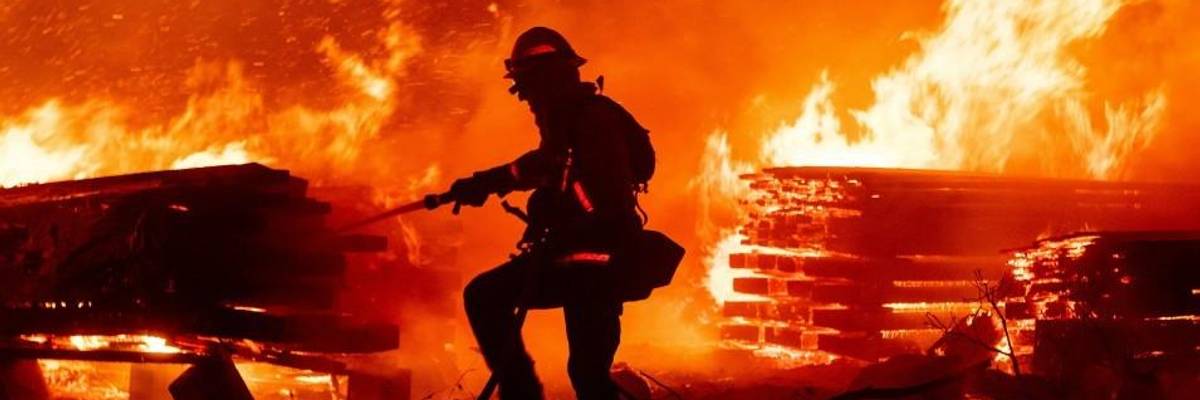
A firefighter uses a drip torch to set a backfire to protect houses in Adobe Canyon during the Nuns Fire on October 15, 2017 near Santa Rosa, California. (Photo: Josh Edelson/AFP via Getty Images)
This story originally appeared in The Nation and is republished here as part of Covering Climate Now, a global journalism collaboration strengthening coverage of the climate story.
To understand the planetary importance of this autumn's presidential election, check the calendar. Voting ends on November 3--and by a fluke of timing, on the morning of November 4 the United States is scheduled to pull out of the Paris Agreement.
President Trump announced that we would abrogate our Paris commitments during a Rose Garden speech in 2017. But under the terms of the accords, it takes three years to formalize the withdrawal. So on Election Day it won't be just Americans watching: The people of the world will see whether the country that has poured more carbon into the atmosphere than any other over the course of history will become the only country that refuses to cooperate in the one international effort to do something about the climate crisis.
Four more years will be enough to cement in place his anti-environmental policies and to make sure it's too late to really change course.
Trump's withdrawal benefited oil executives, who have donated millions of dollars to his reelection campaign, and the small, strange fringe of climate deniers who continue to insist that the planet is cooling. But most people living in the rational world were appalled. Polling showed widespread opposition, and by some measures, Trump is more out of line with the American populace on environmental issues than any other. In his withdrawal announcement he said he'd been elected "to represent the citizens of Pittsburgh, not Paris"; before the day was out, Pittsburgh's mayor had pledged that his city would follow the guidelines set in the French capital. Young people, above all, have despised the president's climate moves: Poll after poll shows that climate change is a top-tier issue with them and often the most important one--mostly, I think, because they've come to understand how tightly linked it is not just to their future but to questions of justice, equity, and race.
Here's the truth: At this late date, meeting the promises set in Paris will be nowhere near enough. If you add up the various pledges that nations made at that conference, they plan on moving so timidly that the planet's temperature will still rise more than 3 degrees Celsius from preindustrial levels. So far, we've raised the mercury 1 degree Celsius, and that's been enough to melt millions of square miles of ice in the Arctic, extend fire seasons for months, and dramatically alter the planet's rainfall patterns. Settling for 3 degrees is kind of like writing a global suicide note.
Happily, we could go much faster if we wanted. The price of solar and wind power has fallen so fast and so far in the last few years that they are now the cheapest power on earth. There are plenty of calculations to show it will soon be cheaper to build solar and wind farms than to operate the fossil fuel power stations we've already built. Climate-smart investments are also better for workers and economic equality. "We need to have climate justice, which means to invest in green energy, [which] creates three times more jobs than to invest in fossil fuel energy," United Nations Secretary General Antonio Guterres said in an interview with Covering Climate Now in September. If we wanted to make it happen, in other words, an energy revolution is entirely possible. The best new study shows that the United States could cut its current power sector emissions 80 percent by 2035 and create 20 million jobs along the way.
Joe Biden and Kamala Harris haven't pledged to move that quickly, but their climate plan is the farthest-reaching of any presidential ticket in history.
Joe Biden and Kamala Harris haven't pledged to move that quickly, but their climate plan is the farthest-reaching of any presidential ticket in history. More to the point, we can pressure them to go farther and faster. Already, seeing the polling on the wall, they've adopted many of the proposals of climate stalwarts like Washington Governor Jay Inslee. A team of Biden and Bernie Sanders representatives worked out a pragmatic but powerful compromise in talks before the Democratic National Convention; the Biden-Harris ticket seems primed to use a transition to green energy as a crucial part of a push to rebuild the pandemic-devastated economy.
Perhaps most important, they've pledged to try to lead the rest of the world in the climate fight. The United States has never really done this. Our role as the single biggest producer of hydrocarbons has meant that our response to global warming has always been crippled by the political power of Big Oil. But that power has begun to slip. Once the biggest economic force on the planet, the oil industry is a shadow of its former self. (You could buy all the oil companies in America for less than the cost of Apple; Tesla is worth more than any other auto company on earth.) And so it's possible that the hammerlock on policy exercised by this reckless industry will loosen if Trump is beaten.
But only if he's beaten. Four more years will be enough to cement in place his anti-environmental policies and to make sure it's too late to really change course. The world's climate scientists declared in 2018 that if we had any chance of meeting sane climate targets, we had to cut emissions almost in half by 2030. That's less than 10 years away. We're at the last possible moment to turn the wheel of the supertanker that is our government. Captain Trump wants to steer us straight onto the rocks, mumbling all the while about hoaxes. If we let him do it, history won't forgive us. Nor will the rest of the world.
Dear Common Dreams reader, It’s been nearly 30 years since I co-founded Common Dreams with my late wife, Lina Newhouser. We had the radical notion that journalism should serve the public good, not corporate profits. It was clear to us from the outset what it would take to build such a project. No paid advertisements. No corporate sponsors. No millionaire publisher telling us what to think or do. Many people said we wouldn't last a year, but we proved those doubters wrong. Together with a tremendous team of journalists and dedicated staff, we built an independent media outlet free from the constraints of profits and corporate control. Our mission has always been simple: To inform. To inspire. To ignite change for the common good. Building Common Dreams was not easy. Our survival was never guaranteed. When you take on the most powerful forces—Wall Street greed, fossil fuel industry destruction, Big Tech lobbyists, and uber-rich oligarchs who have spent billions upon billions rigging the economy and democracy in their favor—the only bulwark you have is supporters who believe in your work. But here’s the urgent message from me today. It's never been this bad out there. And it's never been this hard to keep us going. At the very moment Common Dreams is most needed, the threats we face are intensifying. We need your support now more than ever. We don't accept corporate advertising and never will. We don't have a paywall because we don't think people should be blocked from critical news based on their ability to pay. Everything we do is funded by the donations of readers like you. When everyone does the little they can afford, we are strong. But if that support retreats or dries up, so do we. Will you donate now to make sure Common Dreams not only survives but thrives? —Craig Brown, Co-founder |
This story originally appeared in The Nation and is republished here as part of Covering Climate Now, a global journalism collaboration strengthening coverage of the climate story.
To understand the planetary importance of this autumn's presidential election, check the calendar. Voting ends on November 3--and by a fluke of timing, on the morning of November 4 the United States is scheduled to pull out of the Paris Agreement.
President Trump announced that we would abrogate our Paris commitments during a Rose Garden speech in 2017. But under the terms of the accords, it takes three years to formalize the withdrawal. So on Election Day it won't be just Americans watching: The people of the world will see whether the country that has poured more carbon into the atmosphere than any other over the course of history will become the only country that refuses to cooperate in the one international effort to do something about the climate crisis.
Four more years will be enough to cement in place his anti-environmental policies and to make sure it's too late to really change course.
Trump's withdrawal benefited oil executives, who have donated millions of dollars to his reelection campaign, and the small, strange fringe of climate deniers who continue to insist that the planet is cooling. But most people living in the rational world were appalled. Polling showed widespread opposition, and by some measures, Trump is more out of line with the American populace on environmental issues than any other. In his withdrawal announcement he said he'd been elected "to represent the citizens of Pittsburgh, not Paris"; before the day was out, Pittsburgh's mayor had pledged that his city would follow the guidelines set in the French capital. Young people, above all, have despised the president's climate moves: Poll after poll shows that climate change is a top-tier issue with them and often the most important one--mostly, I think, because they've come to understand how tightly linked it is not just to their future but to questions of justice, equity, and race.
Here's the truth: At this late date, meeting the promises set in Paris will be nowhere near enough. If you add up the various pledges that nations made at that conference, they plan on moving so timidly that the planet's temperature will still rise more than 3 degrees Celsius from preindustrial levels. So far, we've raised the mercury 1 degree Celsius, and that's been enough to melt millions of square miles of ice in the Arctic, extend fire seasons for months, and dramatically alter the planet's rainfall patterns. Settling for 3 degrees is kind of like writing a global suicide note.
Happily, we could go much faster if we wanted. The price of solar and wind power has fallen so fast and so far in the last few years that they are now the cheapest power on earth. There are plenty of calculations to show it will soon be cheaper to build solar and wind farms than to operate the fossil fuel power stations we've already built. Climate-smart investments are also better for workers and economic equality. "We need to have climate justice, which means to invest in green energy, [which] creates three times more jobs than to invest in fossil fuel energy," United Nations Secretary General Antonio Guterres said in an interview with Covering Climate Now in September. If we wanted to make it happen, in other words, an energy revolution is entirely possible. The best new study shows that the United States could cut its current power sector emissions 80 percent by 2035 and create 20 million jobs along the way.
Joe Biden and Kamala Harris haven't pledged to move that quickly, but their climate plan is the farthest-reaching of any presidential ticket in history.
Joe Biden and Kamala Harris haven't pledged to move that quickly, but their climate plan is the farthest-reaching of any presidential ticket in history. More to the point, we can pressure them to go farther and faster. Already, seeing the polling on the wall, they've adopted many of the proposals of climate stalwarts like Washington Governor Jay Inslee. A team of Biden and Bernie Sanders representatives worked out a pragmatic but powerful compromise in talks before the Democratic National Convention; the Biden-Harris ticket seems primed to use a transition to green energy as a crucial part of a push to rebuild the pandemic-devastated economy.
Perhaps most important, they've pledged to try to lead the rest of the world in the climate fight. The United States has never really done this. Our role as the single biggest producer of hydrocarbons has meant that our response to global warming has always been crippled by the political power of Big Oil. But that power has begun to slip. Once the biggest economic force on the planet, the oil industry is a shadow of its former self. (You could buy all the oil companies in America for less than the cost of Apple; Tesla is worth more than any other auto company on earth.) And so it's possible that the hammerlock on policy exercised by this reckless industry will loosen if Trump is beaten.
But only if he's beaten. Four more years will be enough to cement in place his anti-environmental policies and to make sure it's too late to really change course. The world's climate scientists declared in 2018 that if we had any chance of meeting sane climate targets, we had to cut emissions almost in half by 2030. That's less than 10 years away. We're at the last possible moment to turn the wheel of the supertanker that is our government. Captain Trump wants to steer us straight onto the rocks, mumbling all the while about hoaxes. If we let him do it, history won't forgive us. Nor will the rest of the world.
This story originally appeared in The Nation and is republished here as part of Covering Climate Now, a global journalism collaboration strengthening coverage of the climate story.
To understand the planetary importance of this autumn's presidential election, check the calendar. Voting ends on November 3--and by a fluke of timing, on the morning of November 4 the United States is scheduled to pull out of the Paris Agreement.
President Trump announced that we would abrogate our Paris commitments during a Rose Garden speech in 2017. But under the terms of the accords, it takes three years to formalize the withdrawal. So on Election Day it won't be just Americans watching: The people of the world will see whether the country that has poured more carbon into the atmosphere than any other over the course of history will become the only country that refuses to cooperate in the one international effort to do something about the climate crisis.
Four more years will be enough to cement in place his anti-environmental policies and to make sure it's too late to really change course.
Trump's withdrawal benefited oil executives, who have donated millions of dollars to his reelection campaign, and the small, strange fringe of climate deniers who continue to insist that the planet is cooling. But most people living in the rational world were appalled. Polling showed widespread opposition, and by some measures, Trump is more out of line with the American populace on environmental issues than any other. In his withdrawal announcement he said he'd been elected "to represent the citizens of Pittsburgh, not Paris"; before the day was out, Pittsburgh's mayor had pledged that his city would follow the guidelines set in the French capital. Young people, above all, have despised the president's climate moves: Poll after poll shows that climate change is a top-tier issue with them and often the most important one--mostly, I think, because they've come to understand how tightly linked it is not just to their future but to questions of justice, equity, and race.
Here's the truth: At this late date, meeting the promises set in Paris will be nowhere near enough. If you add up the various pledges that nations made at that conference, they plan on moving so timidly that the planet's temperature will still rise more than 3 degrees Celsius from preindustrial levels. So far, we've raised the mercury 1 degree Celsius, and that's been enough to melt millions of square miles of ice in the Arctic, extend fire seasons for months, and dramatically alter the planet's rainfall patterns. Settling for 3 degrees is kind of like writing a global suicide note.
Happily, we could go much faster if we wanted. The price of solar and wind power has fallen so fast and so far in the last few years that they are now the cheapest power on earth. There are plenty of calculations to show it will soon be cheaper to build solar and wind farms than to operate the fossil fuel power stations we've already built. Climate-smart investments are also better for workers and economic equality. "We need to have climate justice, which means to invest in green energy, [which] creates three times more jobs than to invest in fossil fuel energy," United Nations Secretary General Antonio Guterres said in an interview with Covering Climate Now in September. If we wanted to make it happen, in other words, an energy revolution is entirely possible. The best new study shows that the United States could cut its current power sector emissions 80 percent by 2035 and create 20 million jobs along the way.
Joe Biden and Kamala Harris haven't pledged to move that quickly, but their climate plan is the farthest-reaching of any presidential ticket in history.
Joe Biden and Kamala Harris haven't pledged to move that quickly, but their climate plan is the farthest-reaching of any presidential ticket in history. More to the point, we can pressure them to go farther and faster. Already, seeing the polling on the wall, they've adopted many of the proposals of climate stalwarts like Washington Governor Jay Inslee. A team of Biden and Bernie Sanders representatives worked out a pragmatic but powerful compromise in talks before the Democratic National Convention; the Biden-Harris ticket seems primed to use a transition to green energy as a crucial part of a push to rebuild the pandemic-devastated economy.
Perhaps most important, they've pledged to try to lead the rest of the world in the climate fight. The United States has never really done this. Our role as the single biggest producer of hydrocarbons has meant that our response to global warming has always been crippled by the political power of Big Oil. But that power has begun to slip. Once the biggest economic force on the planet, the oil industry is a shadow of its former self. (You could buy all the oil companies in America for less than the cost of Apple; Tesla is worth more than any other auto company on earth.) And so it's possible that the hammerlock on policy exercised by this reckless industry will loosen if Trump is beaten.
But only if he's beaten. Four more years will be enough to cement in place his anti-environmental policies and to make sure it's too late to really change course. The world's climate scientists declared in 2018 that if we had any chance of meeting sane climate targets, we had to cut emissions almost in half by 2030. That's less than 10 years away. We're at the last possible moment to turn the wheel of the supertanker that is our government. Captain Trump wants to steer us straight onto the rocks, mumbling all the while about hoaxes. If we let him do it, history won't forgive us. Nor will the rest of the world.