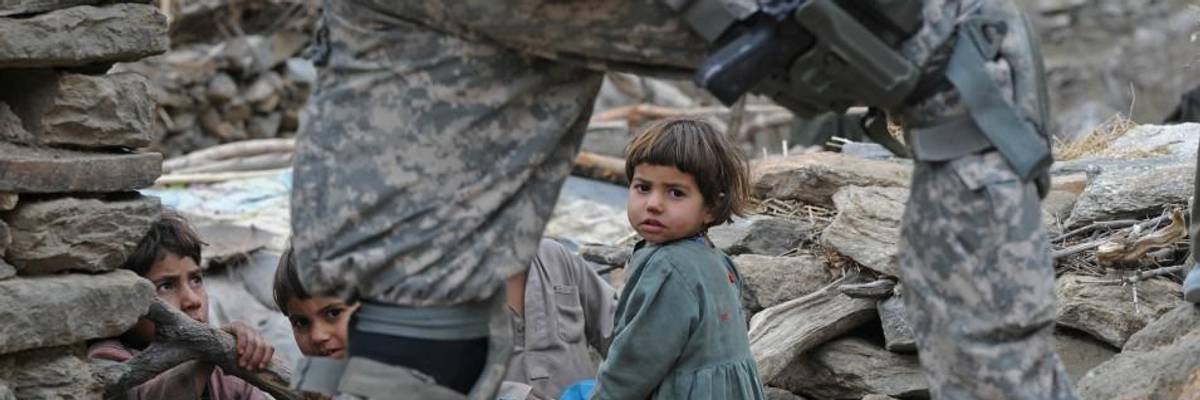
Afghan children look on as a U.S. soldier from the Provincial Reconstruction team (PRT) Steel Warriors patrols in the mountains of Nuristan Province on Dec. 19, 2009. (Photo: Tauseef Mustafa/AFP/Getty Images)
Targeting the ICC: Misguided Sanctions Imposed Yet Again
These new sanctions are theatrical overkill to further accentuate American exceptionalism.
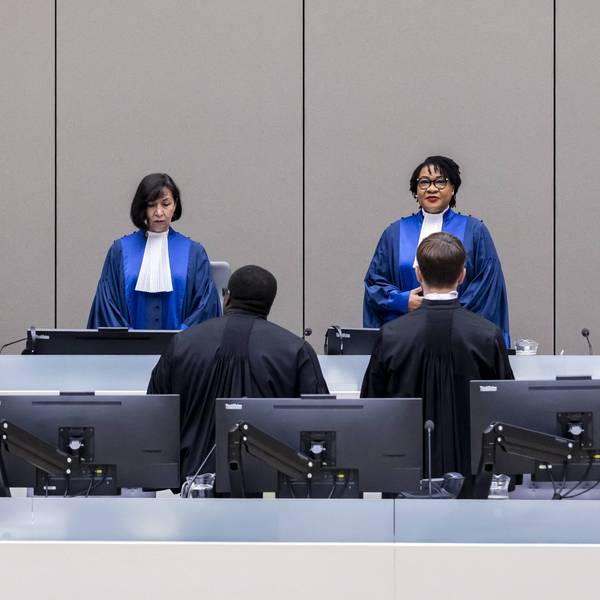
In what appears to have been a very well-orchestrated foreign policy action, President Donald Trump signed an executive order this week to impose targeted sanctions, including asset freezes and visa restrictions, on any staff of the International Criminal Court who would investigate U.S. military and intelligence personnel for alleged war crimes in Afghanistan. The travel sanctions are also aimed at the family members of the ICC chief prosecutor and other individuals to be identified later if involved in investigations.
From its beginning, this administration has echoed the right-wing mantra that the ICC infringes on U.S. sovereignty and creates an extraordinary level of jeopardy to U.S. military who are accountable only to U.S. law for war crimes.
The disregard and disdain of the ICC by the Trump administration is not new, nor are sanctions against the ICC chief prosecutor Fatou Bensouda. From its beginning, this administration has echoed the right-wing mantra that the ICC infringes on U.S. sovereignty and creates an extraordinary level of jeopardy to U.S. military who are accountable only to U.S. law for war crimes. This holds, they claim, even though the U.S. is not a party to the court. During his brief tenure as national security adviser, John Bolton echoed this concern numerous times, including threatening the ICC with sanctions if they investigated U.S. allies, specifically Israel. And the State Department already rescinded the U.S. visa of Ms. Bensouda last year.
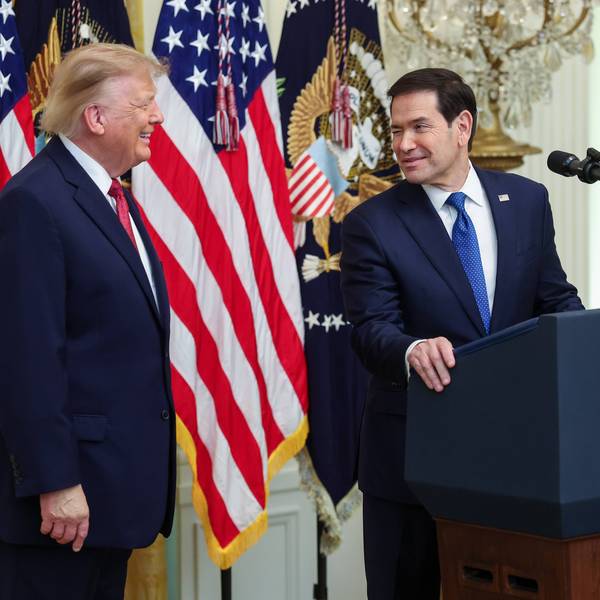
The signed order was quickly underscored by an announced "Press Availability" featuring Secretary of State Mike Pompeo, Secretary of Defense Mark Esper, National Security Adviser Robert O'Brien, and Attorney General William Barr. The assembling of four administration heavy hitters had the look of a major policy announcement about a broad sanctions campaign or a military action, rather than sanctions imposed against a few jurists. But the significance of the pomp and circumstance associated with this week's announcement was meant to message various audiences beyond the ICC.
In his remarks, Secretary Pompeo opened with a scenario where a former U.S. service person vacationing in Europe with his family would be subject to immediate arrest if the ICC were able to proceed with indictments and warrants from such an investigation. Therefore, the U.S. must deter investigations.
This imaging comes during a week when the president has been heavily criticized by former and current military leadership for his politicization of the U.S. Armed Forces against American citizens engaged in recent domestic protests.
This deepest sting came from the dramatic claim by Joint Chiefs of Staff Gen. Mark Milley publicly expressing his regret for participating in the president's controversial walk and photo op to St. John's Church just outside the White House last week.
Earlier in the year the president also incurred the criticism of U.S. military officials for pardoning U.S. servicemen who were convicted of war crimes by U.S. military justice. Among other purposes, then, the sanctions against the ICC serve as a not-so-veiled attempt by Trump to get back in the good graces of the military, particularly the rank and file.
But the larger political message was for Trump's base about America First and disdain for international institutions. The dramatic pronouncements against the ICC by the power four were as intense and robust as the administration began in 2017 regarding NATO, or in ending U.S. participation in the Paris climate agreement, our 2018 abrogation of the Joint Comprehensive Plan of Action (JCPOA), and the recent withdrawal from the World Health Organization.
After his "nightmare" sketch of the arrested U.S. soldier by ICC action, Pompeo referred to the court as "grossly ineffective," engaged in an "ideological crusade," "corrupt," and "a kangaroo court."
The sanctions against the ICC serve as a not-so-veiled attempt by Trump to get back in the good graces of the military, particularly the rank and file. But the larger political message was for Trump's base about America First and disdain for international institutions.
Esper affirmed the president's commitment to "protect Americans... from harassment, abuse, and overreach by organizations outside of our own justice system." O'Brien characterized the ICC as "ineffective, unaccountable, and is a politically motivated bureaucracy" and that "we do not need a corrupt and politicized international body to second guess our system of military justice."
And Barr claimed that the ICC "has become, in practice, little more than a political tool employed by unaccountable international elites," that is manipulated by foreign powers like Russia. He added that the Justice Department will investigate "substantial, credible information that raises concerns about a long history of financial corruption and malfeasance the highest levels of the office of the prosecutor."
We should not overlook Pompeo's using the term, "kangaroo court." That has been used frequently by Israeli Prime Minister Netanyahu, who repeated it as he applauded the U.S. designations. These sanctions against the ICC had been agreed in Pompeo's visit to Jerusalem in May. Netanyahu's opposition to the court has been even more vocal than Trump's. Netanyahu rejects the ICC investigating reports of Israel's crimes in the 2014 war in the Gaza Strip, which focus on property destruction and forced eviction the Palestinians from both the West Bank and East Jerusalem.
As has become its signature policy practice, the Trump administration is misusing economic sanctions regarding who gets targeted. Such punitive actions should be reserved for convicted human rights abusers and war criminals, not those who are specialists investigating these alleged crimes.
As has become its signature policy practice, the Trump administration is misusing economic sanctions regarding who gets targeted.
Washington also continues its misguided belief that sanctions constitute muscular diplomacy. Since the United States has many times, under different administrations, recorded the lack of jurisdiction of the ICC on U.S. servicepeople and activities, every nation and the court itself has had to accept the U.S. outside the ICC jurisdiction.
These new sanctions are theatrical overkill to further accentuate American exceptionalism. Unfortunately, they reveal U.S. unwillingness to do the hard work of joining allies in reforming international institutions and providing them the resources needed to accomplish their goals. In this case, where the investigations also include Afghan forces, the Taliban, and the Haqqani Network, the U.S. should share the ICC goal of holding perpetrators of mass atrocities and war crimes accountable. The latter has always been an American value, but it is significantly undermined by these sanctions.
We are at a crossroads
This country and this world are at a monumental crossroads. In a few short weeks, US voters will have an opportunity to beat back the forces of fascism and confront the billionaires who are rigging the economy, our media system, and our democracy, making it increasingly impossible for ordinary people to get by. We’re not just talking about the election. We’re talking about what must be done once these fascist elements are vanquished from power. We need a bolder set of solutions than what either major party has so far been willing to offer and a working-class movement ready to fight like hell for it. Trump didn't emerge from nowhere. The conditions that fueled MAGA authoritarianism were created by decades of radical neoliberal economic policies and a corrupt political system dominated by corporate interests. They slashed taxes on the super-rich, promising that the benefits would trickle down. They said giveaways to the corporate titans would make life more affordable for the rest of us. It was all bullshit. And when a bitter, betrayed populace searches for someone to blame, right-wing demagogues have little trouble finding scapegoats. People know when they're being lied to, but you won't hear any of this from the corporate media. Only independent journalism—powered and funded by people who believe in building a better world—can deliver truly trustworthy daily news. Our Fall Campaign is underway, and we need your help. To power our newsroom through the rest of the year, we need to raise $125,000 by midnight on October 31. So if you share our vision, please contribute whatever you can to sustain our work. |
In what appears to have been a very well-orchestrated foreign policy action, President Donald Trump signed an executive order this week to impose targeted sanctions, including asset freezes and visa restrictions, on any staff of the International Criminal Court who would investigate U.S. military and intelligence personnel for alleged war crimes in Afghanistan. The travel sanctions are also aimed at the family members of the ICC chief prosecutor and other individuals to be identified later if involved in investigations.
From its beginning, this administration has echoed the right-wing mantra that the ICC infringes on U.S. sovereignty and creates an extraordinary level of jeopardy to U.S. military who are accountable only to U.S. law for war crimes.
The disregard and disdain of the ICC by the Trump administration is not new, nor are sanctions against the ICC chief prosecutor Fatou Bensouda. From its beginning, this administration has echoed the right-wing mantra that the ICC infringes on U.S. sovereignty and creates an extraordinary level of jeopardy to U.S. military who are accountable only to U.S. law for war crimes. This holds, they claim, even though the U.S. is not a party to the court. During his brief tenure as national security adviser, John Bolton echoed this concern numerous times, including threatening the ICC with sanctions if they investigated U.S. allies, specifically Israel. And the State Department already rescinded the U.S. visa of Ms. Bensouda last year.
The signed order was quickly underscored by an announced "Press Availability" featuring Secretary of State Mike Pompeo, Secretary of Defense Mark Esper, National Security Adviser Robert O'Brien, and Attorney General William Barr. The assembling of four administration heavy hitters had the look of a major policy announcement about a broad sanctions campaign or a military action, rather than sanctions imposed against a few jurists. But the significance of the pomp and circumstance associated with this week's announcement was meant to message various audiences beyond the ICC.
In his remarks, Secretary Pompeo opened with a scenario where a former U.S. service person vacationing in Europe with his family would be subject to immediate arrest if the ICC were able to proceed with indictments and warrants from such an investigation. Therefore, the U.S. must deter investigations.
This imaging comes during a week when the president has been heavily criticized by former and current military leadership for his politicization of the U.S. Armed Forces against American citizens engaged in recent domestic protests.
This deepest sting came from the dramatic claim by Joint Chiefs of Staff Gen. Mark Milley publicly expressing his regret for participating in the president's controversial walk and photo op to St. John's Church just outside the White House last week.
Earlier in the year the president also incurred the criticism of U.S. military officials for pardoning U.S. servicemen who were convicted of war crimes by U.S. military justice. Among other purposes, then, the sanctions against the ICC serve as a not-so-veiled attempt by Trump to get back in the good graces of the military, particularly the rank and file.
But the larger political message was for Trump's base about America First and disdain for international institutions. The dramatic pronouncements against the ICC by the power four were as intense and robust as the administration began in 2017 regarding NATO, or in ending U.S. participation in the Paris climate agreement, our 2018 abrogation of the Joint Comprehensive Plan of Action (JCPOA), and the recent withdrawal from the World Health Organization.
After his "nightmare" sketch of the arrested U.S. soldier by ICC action, Pompeo referred to the court as "grossly ineffective," engaged in an "ideological crusade," "corrupt," and "a kangaroo court."
The sanctions against the ICC serve as a not-so-veiled attempt by Trump to get back in the good graces of the military, particularly the rank and file. But the larger political message was for Trump's base about America First and disdain for international institutions.
Esper affirmed the president's commitment to "protect Americans... from harassment, abuse, and overreach by organizations outside of our own justice system." O'Brien characterized the ICC as "ineffective, unaccountable, and is a politically motivated bureaucracy" and that "we do not need a corrupt and politicized international body to second guess our system of military justice."
And Barr claimed that the ICC "has become, in practice, little more than a political tool employed by unaccountable international elites," that is manipulated by foreign powers like Russia. He added that the Justice Department will investigate "substantial, credible information that raises concerns about a long history of financial corruption and malfeasance the highest levels of the office of the prosecutor."
We should not overlook Pompeo's using the term, "kangaroo court." That has been used frequently by Israeli Prime Minister Netanyahu, who repeated it as he applauded the U.S. designations. These sanctions against the ICC had been agreed in Pompeo's visit to Jerusalem in May. Netanyahu's opposition to the court has been even more vocal than Trump's. Netanyahu rejects the ICC investigating reports of Israel's crimes in the 2014 war in the Gaza Strip, which focus on property destruction and forced eviction the Palestinians from both the West Bank and East Jerusalem.
As has become its signature policy practice, the Trump administration is misusing economic sanctions regarding who gets targeted. Such punitive actions should be reserved for convicted human rights abusers and war criminals, not those who are specialists investigating these alleged crimes.
As has become its signature policy practice, the Trump administration is misusing economic sanctions regarding who gets targeted.
Washington also continues its misguided belief that sanctions constitute muscular diplomacy. Since the United States has many times, under different administrations, recorded the lack of jurisdiction of the ICC on U.S. servicepeople and activities, every nation and the court itself has had to accept the U.S. outside the ICC jurisdiction.
These new sanctions are theatrical overkill to further accentuate American exceptionalism. Unfortunately, they reveal U.S. unwillingness to do the hard work of joining allies in reforming international institutions and providing them the resources needed to accomplish their goals. In this case, where the investigations also include Afghan forces, the Taliban, and the Haqqani Network, the U.S. should share the ICC goal of holding perpetrators of mass atrocities and war crimes accountable. The latter has always been an American value, but it is significantly undermined by these sanctions.