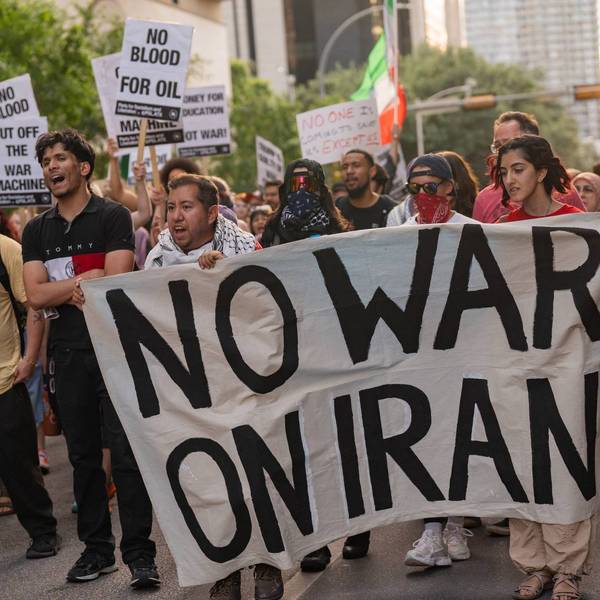
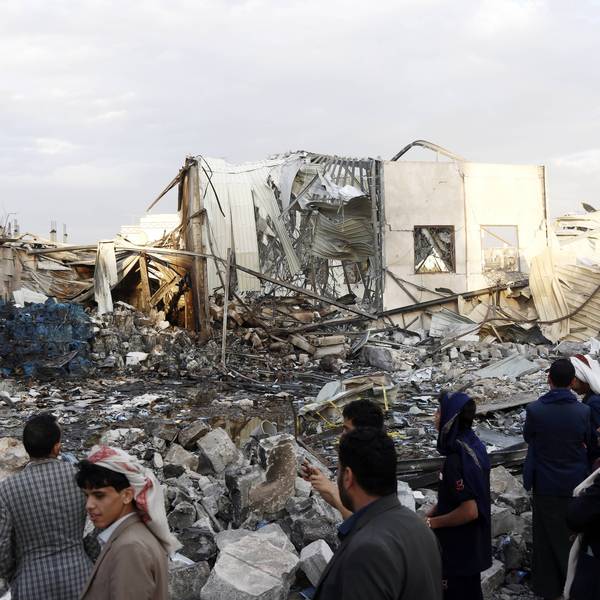
As if the horrific Saudi bombing of a Yemeni school bus that killed 44 children on August 9, 2018 wasn't bad enough, CNN reported that the bomb used in the attack was manufactured by Lockheed Martin, one of the major U.S. defense contractors. Nima Elbagir, reporting for CNN's Situation Room, showed a map of Yemen pinpointing several other attacks where large numbers of civilians have been killed by bombs from not only Lockheed Martin, but also General Dynamics and Raytheon. It was a rare moment when a mainstream US media outlet made the connection between U.S. weapons and the devastation they wreak.
It was a rare moment when a mainstream US media outlet made the connection between U.S. weapons and the devastation they wreak.
The footage of the Yemen attack is heartbreaking, showing bloodied and screaming children (the 'fortunate' survivors) still wearing their blue backpacks. A global outcry for the Saudis to stop bombing civilians and for the US to stop selling weapons to Saudi Arabia arose immediately.
Unfortunately, killing and maiming civilians with US weapons is a regular occurrence, as evidenced in our new CODEPINK report
War Profiteers: The U.S. War Machine and the Arming of Repressive Regimes. The report focuses on the five largest U.S. arms manufacturers--Lockheed Martin,
Boeing, Raytheon, Northrop Grumman and General Dynamics--and their dealings with three repressive nations: Saudi Arabia, Israel and Egypt.
The absolute monarchy of Saudi Arabia uses U.S. weapons to repress internal dissent and bomb Yemen into a humanitarian crisis that has spread death, cholera and
famine.
Israel has used American weapons for decades to maintain a 50-year-long hostile military occupation of Palestine and to turn Gaza into a 21st century version of the Warsaw Ghetto, policed with bombs, missiles, F-16s, Apache helicopters and snipers.
The Egyptian military used its American weapons to overthrow the fragile, fledgling
democracy that the Egyptian people won in the
Arab Spring in 2011, and then to massacre between 1,000 and 2,600 Egyptians in Cairo's Rabaa Square, the
deadliest massacre of peaceful protesters anywhere since China's massacre in Tiananmen Square in 1989.
The companies see only the revenues on their balance sheets, which are always in the black, never in the red like the blood that flows from the real-world results of the weapons they produce.
The examples cited above are just the tip of the iceberg, yet the arms industry turns a blind eye to the carnage and chaos it produces. The companies see only the revenues on their balance sheets, which are always in the black, never in the red like the blood that flows from the real-world results of the weapons they produce.
The current regime of U.S. arms exports is part of a deliberate strategy to outsource U.S. war-making, projecting military power through U.S.-armed allies as a substitute for direct
U.S. military action. This minimizes domestic opposition from a war-weary public, while serving the interests of the weapons industry with ever-growing sales or "military aid" to repressive governments.
A useful framework for understanding the forces driving the U.S. weapons industry is through the concept of the "military-industrial complex," which President Eisenhower warned against in his extraordinary farewell speech to the nation in 1961.
"This conjunction of an immense military establishment and a large arms industry is new in the American experience," Eisenhower told the American public. "The total influence--economic, political, even spiritual--is felt in every city, every State House, every office of the Federal government. Yet we must not fail to comprehend its grave implications....We must guard against the acquisition of unwarranted influence, whether sought or unsought, by the
military-industrial complex. The potential for the disastrous rise of misplaced power exists and will persist."
Eisenhower was deeply conscious of his tragic failure to end the
Cold War or rein in the military industrial complex, and he gave his farewell speech in the full awareness that his successors would be even more susceptible to these dangerous influences. He was even blunter in
a meeting with his closest aides, telling them, "God help this country when someone sits in this chair who doesn't know the military as well as I do."
God help us indeed! Not one of the eleven men who succeeded Eisenhower has stood up to these corrupting powers. When the Cold War finally ended in 1991, the dominant influence of the military-industrial complex ensured that the "peace dividend" the whole world so desperately hoped for was quickly trumped by the
"power dividend," an expansion of U.S. military power to exploit the vacuum left by the fall of the U.S.S.R.
Small reductions in U.S. military spending were offset by increased U.S. arms sales to foreign governments. The Bush administration used the First Gulf War in 1991 as a showcase for the destructive power of U.S. weapons, carpet bombing Iraq with 88,500 tons of bombs and titillating American television audiences who, for the first time, could watch war in real time from the comfort and safety of their living rooms..
Following the First Gulf War (Desert Storm), the U.S. military redeployed its planes and pilots from Kuwait to the Paris Air Show, where they launched a marketing blitz that led to record U.S. weapons sales and exports over the next three years, paving the way for President Clinton's second term to be even more lucrative for U.S. arms merchants.
In a kind of perverse irony, the biggest bonanza for the arms industry was the September 11, 2001 attack on the World Trade Center. The U.S. wars in Afghanistan and Iraq served as a pretext for a massive increase in U.S. weapons spending. Between 1999 and 2011, the U.S. spent $1.3 trillion on its wars, but above and beyond that is the $1.8 trillion spent to buy new warplanes, warships, weapons and equipment, most of which were unrelated to wars the U.S. was actually fighting.
As Obama launched his 2012 reelection campaign on the strength of winding down U.S. military involvement overseas, General Dynamics' annual report presciently reassured its investors that "while the level of U.S. defense spending will be impacted by...fiscal realities, there is not a foreseeable peace dividend."
The weapons manufacturers, referred to by Pope Francis as the "merchants of death," rely on a catastrophic business model that feeds on chaos, political instability, human rights violations, disregard for international law, and the triumph of militarism and brinkmanship over diplomacy. Sure enough, Obama's Department of Defense funding averaged $653.6 billion per year (in 2016 dollars), 3% more than under Bush Jr's, and 56% more than under Clinton. But, like Clinton in the 1990s, Obama offset small reductions in Pentagon weapons purchases with expanding foreign arms sales.
Then, as Trump took office in 2017, the Wall Street Journal predicted that "the global aerospace and defense (A&D) sector is likely to experience stronger growth in 2017 after multiple positive but subdued years," thanks to a "resurgence of global security threats, anticipated increases in U.S. defense budgets," and increased global arms sales. The Journal was right: the stocks of major arms producers hit record highs in 2017.
The time has come to look at the correlation between these record arms sales and the Saudi bombing of little school boys in Yemen, the Israeli shooting of peaceful protesters in Gaza, and the Egyptian government's record of extrajudicial killings and torture.
The weapons manufacturers, referred to by Pope Francis as the "merchants of death," rely on a catastrophic business model that feeds on chaos, political instability, human rights violations, disregard for international law, and the triumph of militarism and brinkmanship over diplomacy. Over 50 years ago, President Eisenhower warned that "an alert and knowledgeable citizenry" was needed to rein in the war machine. The world is still waiting for U.S. citizens to wake up and put an end to this insidious marriage between war and commerce.