The Obama Administration Torpedoes the Arms Trade Treaty
Quick: What is more heavily regulated, global trade of bananas or battleships? In late June, activists gathered in New York's Times Square to make the absurd point, that, unbelievably, "there are more rules governing your ability to trade a banana from one country to the next than governing your ability to trade an AK-47 or a military helicopter." So said Amnesty International USA's Suzanne Nossel at the protest, just before the start of the United Nations Conference on the Arms Trade Treaty (ATT), which ran from July 2 to July 27.
Quick: What is more heavily regulated, global trade of bananas or battleships? In late June, activists gathered in New York's Times Square to make the absurd point, that, unbelievably, "there are more rules governing your ability to trade a banana from one country to the next than governing your ability to trade an AK-47 or a military helicopter." So said Amnesty International USA's Suzanne Nossel at the protest, just before the start of the United Nations Conference on the Arms Trade Treaty (ATT), which ran from July 2 to July 27. Thanks to a last-minute declaration by the United States that it "needed more time" to review the short, 11-page treaty text, the conference ended last week in failure.

There isn't much that could be considered controversial in the treaty. Signatory governments agree not to export weapons to countries that are under an arms embargo, or to export weapons that would facilitate "the commission of genocide, crimes against humanity, war crimes" or other violations of international humanitarian law. Exports of arms are banned if they will facilitate "gender-based violence or violence against children" or be used for "transnational organized crime." Why does the United States need more time than the more than 90 other countries that had sufficient time to read and approve the text? The answer lies in the power of the gun lobby, the arms industry and the apparent inability of President Barack Obama to do the right thing, especially if it contradicts a cold, political calculation.
The Obama administration torpedoed the treaty exactly one week after the massacre in Aurora, Colo. In Colorado, Obama offered promises of "prayer and reflection." As New York City Mayor Michael Bloomberg said, commenting on Obama and Mitt Romney both avoiding a discussion of gun control, "Soothing words are nice, but maybe it's time the two people who want to be president of the United States stand up and tell us what they're going to do about it." Gun violence is a massive problem in the U.S., and it only seems to pierce the public consciousness when there is a massacre. Gun-rights advocates attack people who suggest more gun control is needed, accusing them of politicizing the massacre. Yet some elected officials are taking a stand. Gov. Pat Quinn of Illinois is seeking a ban on assault weapons, much like the ones in place in California, Connecticut, Massachusetts, New Jersey and New York.
The National Rifle Association's executive vice president, Wayne LaPierre, issued the threat before the U.N. conference that "Without apology, the NRA wants no part of any treaty that infringes on the precious right of lawful Americans to keep and bear arms." The NRA organized letters opposing the treaty, signed by 51 U.S. senators and 130 members of the House. After the conference ended in failure, the NRA took credit for killing it.
Of course, there is nothing in the treaty that would impact U.S. domestic gun laws. The rights protected by the cherished Second Amendment ("a well regulated militia being necessary to the security of a free state, the right of the people to keep and bear arms shall not be infringed") would remain intact. The NRA's interest lies not only with individual gun owners, but also with the U.S. weapons manufacturers and exporters. The United States is the world's largest weapons producer, exporter and importer. It is the regulation of this global flow of weaponry that most likely alarms the NRA, not the imagined prospect of the U.N. taking away the legally owned guns inside the U.S.
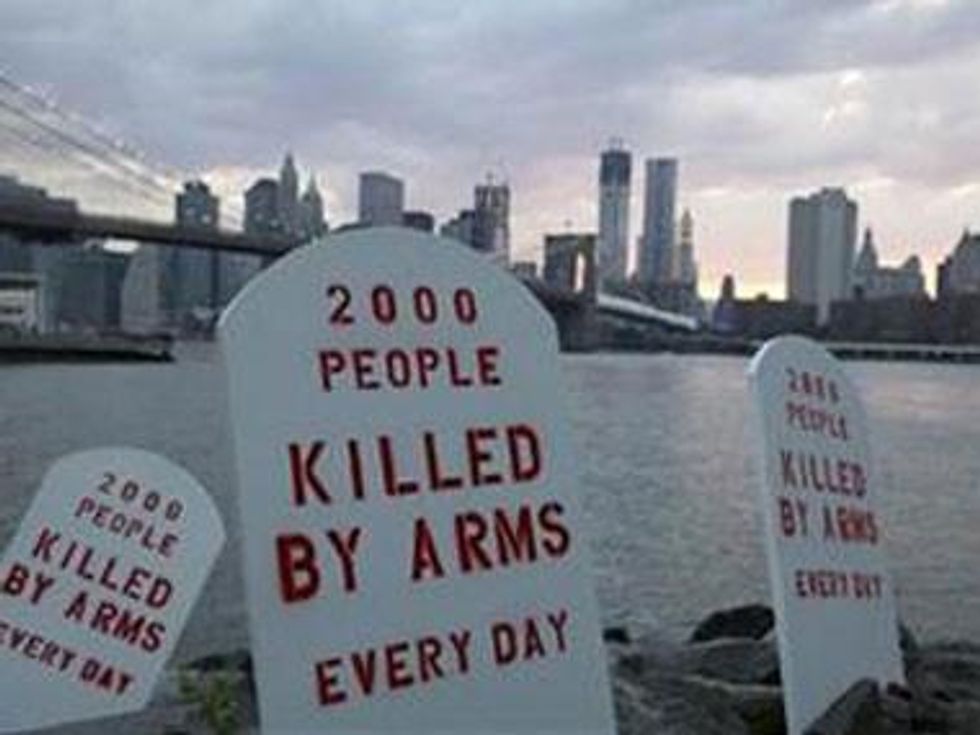
Protesters outside the U.N. during the ATT conference erected a mock graveyard, with each headstone reading, "2,000 people killed by arms every day." That's one person killed every minute. In many places around the world, massacres on the order of Aurora are all too common. Days after Aurora, at least nine people were killed in a U.S. drone strike in northwest Pakistan. Pakistani officials said the victims were suspected militants, but the Obama administration deems all adult-male drone targets as militants unless proven otherwise, posthumously.
After the conference wrapped without success, Suzanne Nossel said, "This was stunning cowardice by the Obama administration, which at the last minute did an about-face and scuttled progress toward a global arms treaty, just as it reached the finish line." These words were doubly strong, as she criticized the very State Department where she worked previously, under Hillary Clinton.

An Urgent Message From Our Co-Founder
Dear Common Dreams reader, It’s been nearly 30 years since I co-founded Common Dreams with my late wife, Lina Newhouser. We had the radical notion that journalism should serve the public good, not corporate profits. It was clear to us from the outset what it would take to build such a project. No paid advertisements. No corporate sponsors. No millionaire publisher telling us what to think or do. Many people said we wouldn't last a year, but we proved those doubters wrong. Together with a tremendous team of journalists and dedicated staff, we built an independent media outlet free from the constraints of profits and corporate control. Our mission has always been simple: To inform. To inspire. To ignite change for the common good. Building Common Dreams was not easy. Our survival was never guaranteed. When you take on the most powerful forces—Wall Street greed, fossil fuel industry destruction, Big Tech lobbyists, and uber-rich oligarchs who have spent billions upon billions rigging the economy and democracy in their favor—the only bulwark you have is supporters who believe in your work. But here’s the urgent message from me today. It's never been this bad out there. And it's never been this hard to keep us going. At the very moment Common Dreams is most needed, the threats we face are intensifying. We need your support now more than ever. We don't accept corporate advertising and never will. We don't have a paywall because we don't think people should be blocked from critical news based on their ability to pay. Everything we do is funded by the donations of readers like you. When everyone does the little they can afford, we are strong. But if that support retreats or dries up, so do we. Will you donate now to make sure Common Dreams not only survives but thrives? —Craig Brown, Co-founder |
Quick: What is more heavily regulated, global trade of bananas or battleships? In late June, activists gathered in New York's Times Square to make the absurd point, that, unbelievably, "there are more rules governing your ability to trade a banana from one country to the next than governing your ability to trade an AK-47 or a military helicopter." So said Amnesty International USA's Suzanne Nossel at the protest, just before the start of the United Nations Conference on the Arms Trade Treaty (ATT), which ran from July 2 to July 27. Thanks to a last-minute declaration by the United States that it "needed more time" to review the short, 11-page treaty text, the conference ended last week in failure.

There isn't much that could be considered controversial in the treaty. Signatory governments agree not to export weapons to countries that are under an arms embargo, or to export weapons that would facilitate "the commission of genocide, crimes against humanity, war crimes" or other violations of international humanitarian law. Exports of arms are banned if they will facilitate "gender-based violence or violence against children" or be used for "transnational organized crime." Why does the United States need more time than the more than 90 other countries that had sufficient time to read and approve the text? The answer lies in the power of the gun lobby, the arms industry and the apparent inability of President Barack Obama to do the right thing, especially if it contradicts a cold, political calculation.
The Obama administration torpedoed the treaty exactly one week after the massacre in Aurora, Colo. In Colorado, Obama offered promises of "prayer and reflection." As New York City Mayor Michael Bloomberg said, commenting on Obama and Mitt Romney both avoiding a discussion of gun control, "Soothing words are nice, but maybe it's time the two people who want to be president of the United States stand up and tell us what they're going to do about it." Gun violence is a massive problem in the U.S., and it only seems to pierce the public consciousness when there is a massacre. Gun-rights advocates attack people who suggest more gun control is needed, accusing them of politicizing the massacre. Yet some elected officials are taking a stand. Gov. Pat Quinn of Illinois is seeking a ban on assault weapons, much like the ones in place in California, Connecticut, Massachusetts, New Jersey and New York.
The National Rifle Association's executive vice president, Wayne LaPierre, issued the threat before the U.N. conference that "Without apology, the NRA wants no part of any treaty that infringes on the precious right of lawful Americans to keep and bear arms." The NRA organized letters opposing the treaty, signed by 51 U.S. senators and 130 members of the House. After the conference ended in failure, the NRA took credit for killing it.
Of course, there is nothing in the treaty that would impact U.S. domestic gun laws. The rights protected by the cherished Second Amendment ("a well regulated militia being necessary to the security of a free state, the right of the people to keep and bear arms shall not be infringed") would remain intact. The NRA's interest lies not only with individual gun owners, but also with the U.S. weapons manufacturers and exporters. The United States is the world's largest weapons producer, exporter and importer. It is the regulation of this global flow of weaponry that most likely alarms the NRA, not the imagined prospect of the U.N. taking away the legally owned guns inside the U.S.
Protesters outside the U.N. during the ATT conference erected a mock graveyard, with each headstone reading, "2,000 people killed by arms every day." That's one person killed every minute. In many places around the world, massacres on the order of Aurora are all too common. Days after Aurora, at least nine people were killed in a U.S. drone strike in northwest Pakistan. Pakistani officials said the victims were suspected militants, but the Obama administration deems all adult-male drone targets as militants unless proven otherwise, posthumously.
After the conference wrapped without success, Suzanne Nossel said, "This was stunning cowardice by the Obama administration, which at the last minute did an about-face and scuttled progress toward a global arms treaty, just as it reached the finish line." These words were doubly strong, as she criticized the very State Department where she worked previously, under Hillary Clinton.
Quick: What is more heavily regulated, global trade of bananas or battleships? In late June, activists gathered in New York's Times Square to make the absurd point, that, unbelievably, "there are more rules governing your ability to trade a banana from one country to the next than governing your ability to trade an AK-47 or a military helicopter." So said Amnesty International USA's Suzanne Nossel at the protest, just before the start of the United Nations Conference on the Arms Trade Treaty (ATT), which ran from July 2 to July 27. Thanks to a last-minute declaration by the United States that it "needed more time" to review the short, 11-page treaty text, the conference ended last week in failure.

There isn't much that could be considered controversial in the treaty. Signatory governments agree not to export weapons to countries that are under an arms embargo, or to export weapons that would facilitate "the commission of genocide, crimes against humanity, war crimes" or other violations of international humanitarian law. Exports of arms are banned if they will facilitate "gender-based violence or violence against children" or be used for "transnational organized crime." Why does the United States need more time than the more than 90 other countries that had sufficient time to read and approve the text? The answer lies in the power of the gun lobby, the arms industry and the apparent inability of President Barack Obama to do the right thing, especially if it contradicts a cold, political calculation.
The Obama administration torpedoed the treaty exactly one week after the massacre in Aurora, Colo. In Colorado, Obama offered promises of "prayer and reflection." As New York City Mayor Michael Bloomberg said, commenting on Obama and Mitt Romney both avoiding a discussion of gun control, "Soothing words are nice, but maybe it's time the two people who want to be president of the United States stand up and tell us what they're going to do about it." Gun violence is a massive problem in the U.S., and it only seems to pierce the public consciousness when there is a massacre. Gun-rights advocates attack people who suggest more gun control is needed, accusing them of politicizing the massacre. Yet some elected officials are taking a stand. Gov. Pat Quinn of Illinois is seeking a ban on assault weapons, much like the ones in place in California, Connecticut, Massachusetts, New Jersey and New York.
The National Rifle Association's executive vice president, Wayne LaPierre, issued the threat before the U.N. conference that "Without apology, the NRA wants no part of any treaty that infringes on the precious right of lawful Americans to keep and bear arms." The NRA organized letters opposing the treaty, signed by 51 U.S. senators and 130 members of the House. After the conference ended in failure, the NRA took credit for killing it.
Of course, there is nothing in the treaty that would impact U.S. domestic gun laws. The rights protected by the cherished Second Amendment ("a well regulated militia being necessary to the security of a free state, the right of the people to keep and bear arms shall not be infringed") would remain intact. The NRA's interest lies not only with individual gun owners, but also with the U.S. weapons manufacturers and exporters. The United States is the world's largest weapons producer, exporter and importer. It is the regulation of this global flow of weaponry that most likely alarms the NRA, not the imagined prospect of the U.N. taking away the legally owned guns inside the U.S.
Protesters outside the U.N. during the ATT conference erected a mock graveyard, with each headstone reading, "2,000 people killed by arms every day." That's one person killed every minute. In many places around the world, massacres on the order of Aurora are all too common. Days after Aurora, at least nine people were killed in a U.S. drone strike in northwest Pakistan. Pakistani officials said the victims were suspected militants, but the Obama administration deems all adult-male drone targets as militants unless proven otherwise, posthumously.
After the conference wrapped without success, Suzanne Nossel said, "This was stunning cowardice by the Obama administration, which at the last minute did an about-face and scuttled progress toward a global arms treaty, just as it reached the finish line." These words were doubly strong, as she criticized the very State Department where she worked previously, under Hillary Clinton.