

SUBSCRIBE TO OUR FREE NEWSLETTER
Daily news & progressive opinion—funded by the people, not the corporations—delivered straight to your inbox.
5
#000000
#FFFFFF
To donate by check, phone, or other method, see our More Ways to Give page.
Daily news & progressive opinion—funded by the people, not the corporations—delivered straight to your inbox.
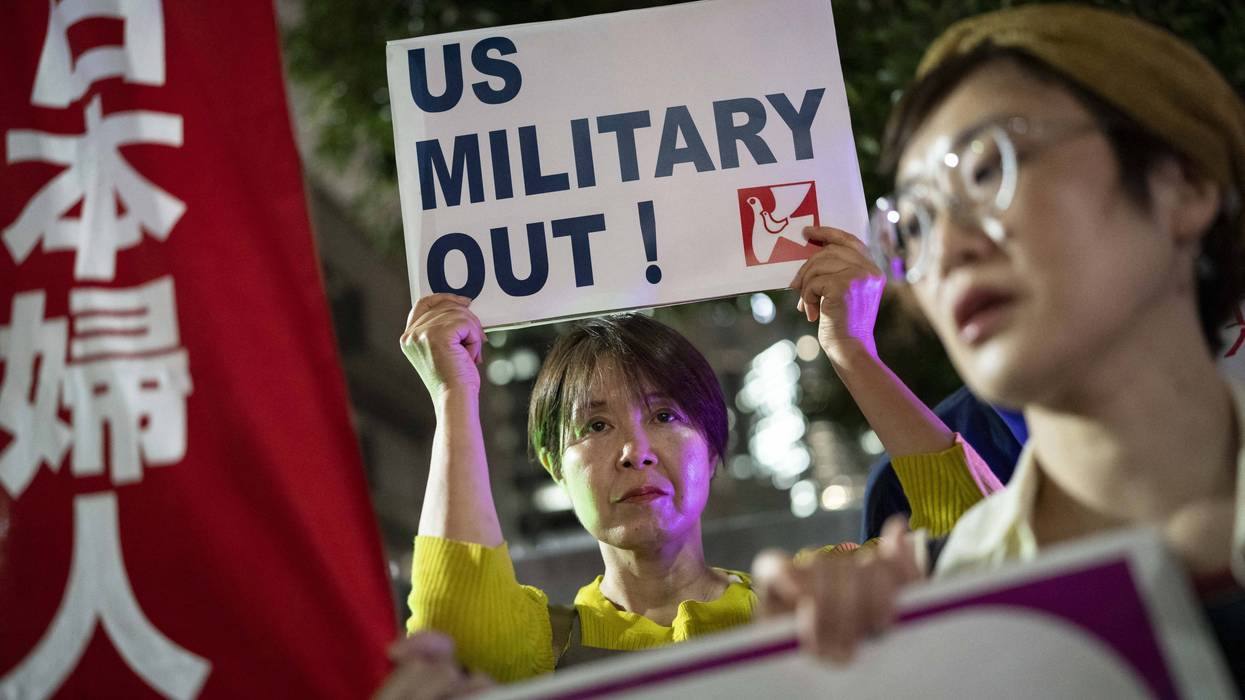
"As long as there are US military bases in Okinawa, such incidents will occur," said one former Japanese senator.
Anger over the US military presence in Okinawa is growing anew this week after Japanese police arrested a Marine Corps lance corporal accused of robbing and murdering a local woman, prompting protests and renewed calls for a revision of the US-Japan Status of Forces Agreement and even the removal of American bases.
Lance Cpl. Devin Jacob Ballard, 20, who is stationed at Marine Corps Air Station Futenma, was arrested Sunday on suspicion of killing 39-year-old Anna Yagi at the Naminoue Crustal Hotel in Naha early Saturday and stealing her wallet and backpack. Yagi died from asphyxiation caused by pressure to her neck, according to Okinawa police. Ballard has denied the allegations.
The Japan Times reported that area surveillance cameras captured footage of a man with "distinctive features," including tattoos on both arms and a shaved head, leaving the hotel carrying the woman’s backpack, which was later found nearby.
The killing sparked protests in Okinawa and Tokyo.
"How much longer do we have to bear this?" one protester asked outside the Okinawa prefectural government headquarters in Naha, according to Jiji Press.
A woman in her 40s from Nago said, "I feel it's a contradiction that a serviceman stationed at a US military base in Okinawa to protect Japan has killed a civilian."
Another woman at the protest said, "I don't want to see any more people hurt."
The advocacy group Femibridge Okinawa said on social media: "Anger has reached its boiling point. We don't want to hear words like 'refrain from commenting.'"
On Monday, Japanese Prime Minister Sanae Takaichi—who leads the right-wing Liberal Democratic Party (LDP) and supports US troops in Japan as a strategic deterrent to China—condemned the "heinous crime" in a speech to the Kokkai, or Parliament.
“The Japanese government has lodged a strong protest with the US side and has strongly demanded full cooperation with the investigation," she added, "as well as strict disciplinary action against US military personnel and thorough measures to prevent a recurrence of such incidents."
Okinawa Gov. Genta Koja, who has no party affiliation but was elected last month with LDP support, issued a statement Sunday calling Yagi's killing "absolutely unforgivable."
"I feel deeply outraged," he continued. "It has come as a great shock to residents of the prefecture, who are forced to live in close proximity to bases, and has sparked fresh anxiety."
“Although the prefecture has consistently demanded that the US military take measures to prevent recurrence whenever such incidents have occurred in the past, the fact that this type of incident has happened again compels us to conclude that the US military’s efforts to maintain discipline and educate its personnel are completely ineffective," Koja added.
US Ambassador to Japan George Glass—who on Sunday was summoned by Japanese Foreign Minister Toshimitsu Motegi over Yagi's killing—on Monday expressed his condolences and pledged "full cooperation" with investigators.
“I am speaking with US military commanders this week about how we continue to hold our American service members to the very highest levels of discipline and integrity,” he said, according to The Japan Times.
The Third Marine Expeditionary Force also said it was “actively cooperating" with Japanese officials in regard to the case, and that the US Marine Corps "takes these allegations very seriously and expects every Marine to adhere to the highest standards of behavior."
In Naha, Okinawa's prefectural capital, residents expressed their anxiety over the continued US military presence.
One 53-year-old woman said she has been "afraid to walk at night" in Naha.
"If we do not change the Japan-US Status of Forces Agreement, the crime of US soldiers will not decrease," she asserted.
Hidekiyo Shinkawa, 89, expressed outrage over the number of people killed by US troops in Okinawa over the past eight decades.
"When I was a junior high school student, a classmate of mine died after being hit by a US military vehicle," Shinkawa told Kumamoto Nichinichi Shimbun.
Okinawa was under US occupation from 1945-72. Today, the southern archipelago hosts 70% of US military bases in Japan and most of the 50,000 troops stationed in the country.
While many Okinawans appreciate the economic and security benefits of having US bases in their backyards, distrust of American troops in Okinawa—which was conquered during the closing months of World War II at the cost of over 100,000 civilian lives—runs deep.
Okinawans have been trying in vain to get the Americans to leave since the beginning of the occupation, when property was seized at gunpoint, residents were expelled, and homes and farms were bulldozed or burned. The Americans promised Okinawans good farmland and financial aid if they resettled in Bolivia. Thousands accepted the offer only to find themselves shipped off to an inhospitable wilderness where many died from disease. Much of the promised assistance was never delivered.
In Okinawa, the US military built more than 100 military facilities—over 30 of which are still in operation—on a series of islands roughly the size of Los Angeles. Washington forced the Japanese government to accept status of forces agreements that gave the US jurisdiction over all American personnel on Japanese soil.
US troops stationed in or visiting Okinawa have committed thousands of crimes, including at least dozens of murders and over 100 alleged rapes. In one six-month period in 1949, US troops killed 29 Okinawans and raped 18 more, including a 9-month-old infant.
The US military has also fired and lost nuclear weapons in local waters, leaked the deadly nerve agent sarin, and exposed residents to chlorine gas, to name but a handful of the most egregious environmental incidents over the decades.
Although the 1995 gang-rape of a 12-year-old girl by two Marines and a sailor led to a revision of the US-Japan SOFA so that Japanese authorities could convict and imprison Americans who commit the most heinous offenses—a development that led to scores of convictions—crimes against Okinawans and the local environment continue to this day.
On Monday, Koja argued in the wake of Yagi's killing that “to ensure that such an incident never happens again, I strongly urge the Japanese and US governments to take responsibility and implement effective, fundamental measures—including a review of the Japan-US Status of Forces Agreement.”
Some Japanese went even further, demanding an end to US bases in Okinawa.
"As long as there are US military bases in Okinawa, such incidents will occur, and the fear that such incidents will occur and that they may happen in the future will continue," wrote Keiko Itokazu, a former leftist lawmaker in the House of Councillors, the Kokkai's upper chamber.
"How long will this pain and sorrow be felt by the people, especially women?" she added. "Such incidents have been repeated in the past, and each time the government and the US military have said that they will provide proper education to US soldiers... But is this the result of education?"
Former Japanese Prime Minister Yukio Hatoyama said on social media: "Once again, an incident that should never have happened has occurred. A woman was murdered in a hotel in Naha City, and a Marine was arrested."
"Far from protecting Japan's peace, the safety of women in Okinawa is being threatened," he added. "As the nature of warfare changes, the Marines are no longer necessary for Japan's peace. Voices calling for the Marines to leave will likely grow louder in Okinawa."