SUBSCRIBE TO OUR FREE NEWSLETTER
Daily news & progressive opinion—funded by the people, not the corporations—delivered straight to your inbox.
5
#000000
#FFFFFF
To donate by check, phone, or other method, see our More Ways to Give page.

Daily news & progressive opinion—funded by the people, not the corporations—delivered straight to your inbox.
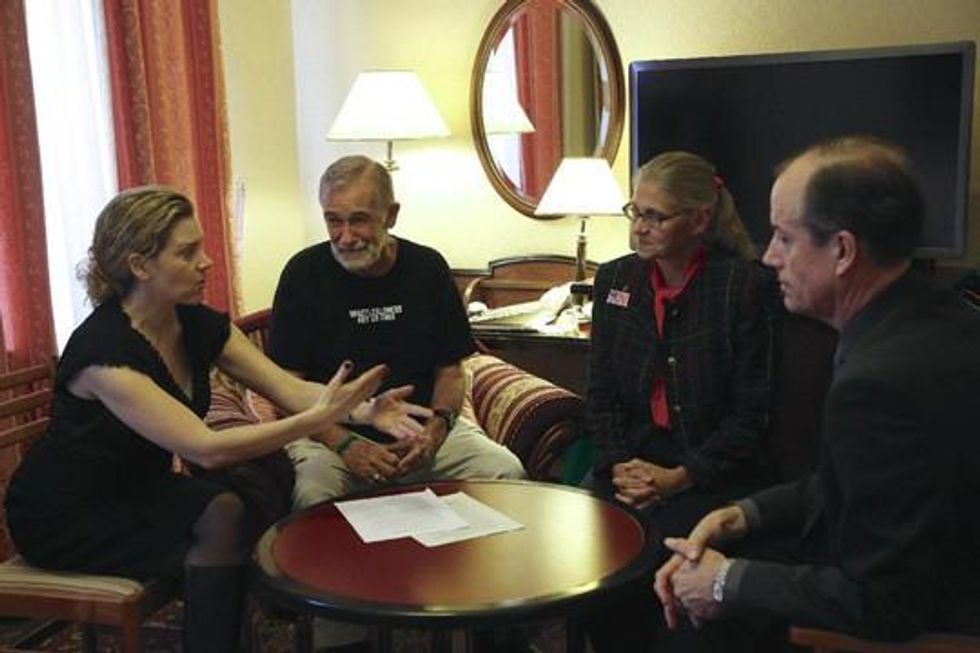
Here is Karen Kwiatowski's acceptance speech for the 2018 Sam Adams Award at a ceremony in Washington on Saturday night, preceded by the citation, that was read by former CIA analyst Ray McGovern.
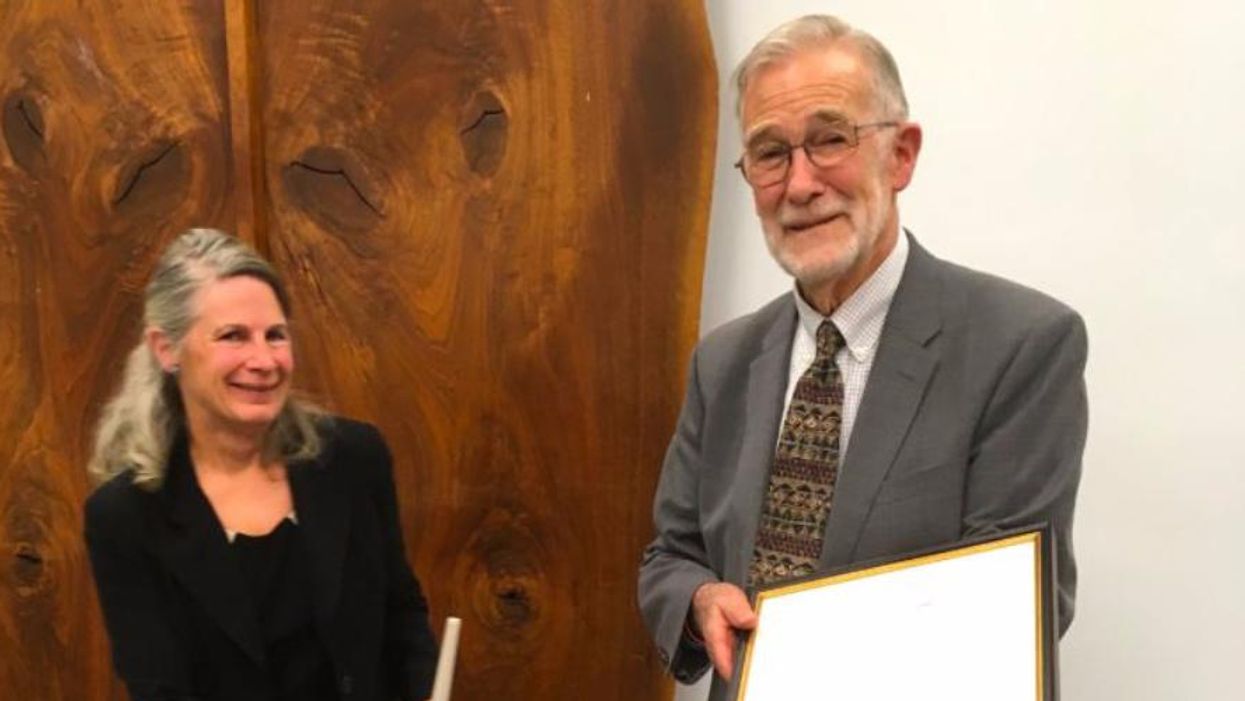
Know all ye by these presents that Karen Kwiatkowski is hereby honored with the traditional Sam Adams Corner-Brightener Candlestick Holder, in symbolic recognition of her courage in shining light into dark places.
"If you see something, say something," we so often hear. Karen Kwiatkowski took that saying to heart.
She saw her Pentagon superiors acting as eager accomplices to the Cheney/Bush administration's deceit in launching a war of aggression on Iraq. And she said something--and helped Knight Ridder reporters Warren Strobel and Jonathan Landay see beneath the official lies and get the sordid story right before the war.
Karen's courage brings to mind the clarion call of Rabbi Abraham Heschel against the perpetrators of an earlier war--Vietnam. "Few are guilty," he said, "but all are responsible. Indifference to evil is more insidious than evil itself." Karen would not be indifferent to evil.
Ed Snowden, Sam Adams awardee in 2013, noted that we tend to ignore some degree of evil in our daily life, but, as Ed put it, "We also have a breaking point and when people find that, they act." As did Karen. As did 16 of Karen's predecessors honored with this award.
With all the gloom and doom enveloping us, we tend to wonder whether people with the conscience and courage of Ed or Karen still exist in and outside our national security establishment. Our country is in dire need of new patriots of this kind.
Meanwhile, we call to mind the courageous example not only of Karen and Ed, but also of Coleen Rowley and Elizabeth Gun, our first two awardees, who took great risks in trying to head off the attack on Iraq. And we again honor Chelsea Manning and Julian Assange who is now isolated in what the U.N. has called "arbitrary detention," for exposing the war crimes resulting from that war.
Karen Kwiatkowski has made her own unique contribution to this company of conscience and courage, and Sam Adams Associates are pleased to honor her.
Presented this 8th day of December 2018 in Washington by admirers of the example set by the late CIA analyst, Sam Adams.
'Thoughts on the Sam Adams Award': Remarks by Lt. Col. Karen Kwiatowski
I am honored beyond belief to be the 2018 recipient of the Sam Adams Award, and I thank Ray McGovern and the Sam Adams Associates for Integrity in Intelligence, Veteran Intelligence Professionals for Sanity, Warren Strobel, and Jonathan Landay of Knight Ridder during the run up to the second invasion of Iraq, and Rob Reiner for putting together a great movie that was so consistently truthful, that for me, it looked almost like a documentary. I want to also thank the late David Hackworth, a man I never met who published my first anonymous essays from the Pentagon, and of course, Lew Rockwell, who has published so many of my essays examining and trying to understand our government and our offensive policies over the past 15 years.
It is in our country's interest--as security professionals, as intelligence professionals, as soldiers and citizens, as writers and newsmakers--to be sensitive to the lawlessness, the immorality, and the wrongdoing of the bureaucracies and the leaders of the organizations we are a part of.
There have been many American patriots and truth-tellers who have received the honor you have given me tonight--and I am going to name them here because I stand in awe of all of them:
Coleen Rowley of the FBI; Katharine Gun of British Intelligence; Sibel Edmonds of the FBI; Craig Murray, former U.K. ambassador to Uzbekistan; Sam Provance, former U.S. Army Sgt; Maj. Frank Grevil of Danish Army Intelligence; Larry Wilkerson, Col., U.S. Army (ret.), former chief of staff to Colin Powell at State; Julian Assange, of WikiLeaks: Thomas Drake, of NSA; Jesselyn Radack, formerly of Dept. of Justice and now National Security Director of Government Accountability Project; Thomas Fingar, former Deputy Director of National Intelligence and Director, National Intelligence Council, and Edward Snowden, former contractor for the National Security Agency; Chelsea Manning, U.S. Army Private who exposed (via WikiLeaks) key information on Afghanistan and Iraq, as well as State Department activities; and to retired National Security Agency official William Binney, who challenged decisions to ignore the Fourth Amendment in the government's massive--and wasteful--collection of electronic data.
Again, I am very humbled and almost speechless tonight.
But not entirely speechless. My backstory is pretty well-known to most people here, and to anyone who was interested in understanding U.S. war policy in the early 2000s. I had a small role to play, in concert with a number of other truth-tellers in media and in the national security bureaucracy. For every one of us, there were probably 20 to 50 people working beside us and around us, who understood a lot about what was happening, and who probably got a funny feeling about being in an organization where we all swore to uphold the Constitution, but in fact were engaged in promulgating lies of both omission and commission, mistruths and misdirection, aimed not at our enemies abroad but against the American people. We were lying, with the help of a compliant and war-supportive media, to patriots young and old. Millions of Americans were eager to enlist, to fight, to sacrifice their life and health--for a made-up government fairy tale.
A sense of unease, I believe, was shared by many, many people who never blew a whistle, and never said a word. To their credit, some of these people passively resisted within their organizations, and tried to set things straight where they could. Some of these people simply called their assignments guy and got orders out of the Pentagon, others were removed if they resisted too much. There is always a cost when you seriously question the directions or actions of the bureaucracy that employs you.
It is in our country's interest--as security professionals, as intelligence professionals, as soldiers and citizens, as writers and newsmakers--to be sensitive to the lawlessness, the immorality, and the wrongdoing of the bureaucracies and the leaders of the organizations we are a part of. That is the first thing we must cultivate and encourage--a sensitivity to and an awareness of something as simple as right and wrong. This is fundamental. From knowing right and wrong, we move to the factor that motivates so many whistleblowers, something that we all share as human beings, and that is an idea of justice.
The truth-tellers who have been honored with Sam Adams Award, and thousands of others we may not be aware of around the world, share a concept of justice. For those who try to correct our U.S. government, particularly in its initiation and exercise of war, state-sanctioned murder, and physical devastation of whole societies, we as American have tools that many others around the world don't have. We have a Constitution that many of us swore to uphold. Americans tend to have a good grounding in the fundamentals of right and wrong, derived from religion or tradition, or both. We live in something that calls itself a republic, and it is a fine form of government, with a solid set of rules.
But how do we get from a certain moral discomfort, from seeing something going on around us that is wrong, to trying to do something about it? How do we decide if we want to leave the room, turn our backs, put our head down, or instead take some sort of action that will put us on a collision course with very powerful people? What if we, as truth-tellers, are like blind men describing an elephant--we see only one part of a larger story? How do we decide that our faith in our leadership is misplaced, and that more is at stake then just our jobs?
When you look at the experiences of people who made the dangerous and difficult decision to act, like Daniel Ellsberg, and Sam Adams, and Sibel Edwards, Jesselyn Raddick, Colleen Rowley, Thomas Drake, Ed Snowden, Julian Assange, and many others, you realize that speaking up and doing the right thing had a primary impact. That impact wasn't improved transparency, a more informed democracy, a more aware and alert citizenry, and better government decisions by our elected leaders. Those were all secondary impacts, and in many cases tenuous, as the improved level of national understanding seems to last for less than a single generation. No, the primary impact was the unimaginable wrath of the state aimed at the life, livelihood, reputation, family, character, and credibility of the truth-teller. In several cases, this included physical and psychological abuse, prison time, gag orders, and even more devious programs. The rage of the state against these truth-tellers is not impulsive and short-lived--it is a forever project funded by tax dollars, and fueled by very profitable agendas.
Knowing all of this, can we really expect to see a healthy and growing flow of truth tellers, whistleblowers, and simply bold honest people speaking out about government lies?
I think we can, and I am optimistic about the possibilities of better government through honest, bold, and forthright people working in and around this government.
To start with, as I mentioned, we as government employees and uniformed service-members need to have a solid sense of right and wrong. We need to cultivate a sense of justice. In a wonderful way, our younger generations are well prepared for this, at least in terms of cultivating a sense of justice. The young people we see portrayed, often disparagingly, as young socialists may not completely understand the nature of government or the state, but they do cherish ideas of justice.
The more of us--specifically those working with and inside the U.S. government today--who tell the truth, the less likely that government embarrassment will result in harm to a whistleblower, and the less likely in the long run that we will see whistleblowers as we tend to see them today.
We also need people in government service who are sensitive to what is going on in their organizations, and how people are feeling and behaving around them. It is not coincidence that many of the people who have been honored by this award are women, who may be paying closer attention to the mood and morality of their organizations. There's a country song that has a line in it about "Old men talking about the weather, and old women talking about old men." We need both in our organizations, to be in tune with what is happening, and who is leading us.
We need people in government service who are willing to walk away from a job, and to say or even broadcast why they are leaving, without worrying about the next job, without worrying about being blacklisted, without worrying that they can't make their next house payment or college tuition payment, or the alimony or child support payment. We need people in government who travel light, so to speak, and do their job because they love what they are doing and what it stands for. This grounding and lack of rigid self-identification with their employing bureaucracy is extremely important. Thanks to technology and societal evolution, the younger generations of Americans are very likely to walk away from a job that they believe to be immoral, to act to correct what they see as wrong or unjust, and incidentally, are less likely to own a home, and more likely to define themselves by what they believe and stand for, not where they work, and how many promotions they had planned for themselves in that organization.
But even with our younger generations coming into government service--with a good sense of justice, a strong sense of self, and a willingness to speak openly about what they believe and know--there is risk when someone questions the collective government story.
There is risk in the act of challenging authority and one's peer group, risk of being wrong and suffering loss of credibility. There is the rational and real risk of incurring the rage of the state, and being jailed, harmed, ruined and even killed on the whispers of an incensed or threatened agency.
There is another risk that we really don't talk about much. I think most concerning for many people is the risk that you are actually right, that you have discovered something damning and dark in your country, in your government, in your organization. Once this happens, if it happens, your life is irreversibly changed, and nothing is ever going to be the same. Understanding how your government actually works, in particular how it works to create and provoke war and murder, how it works to extract the wealth of the nation and use this blessing to commit Constitutional crimes and untold evil, in your name--for many this understanding is not a gift, but a curse. I estimate at least 10 percent of our country, 20-30 million Americans, many of them veterans the U.S. Empire's global adventures in the past 50 years, feel this curse, and many of them deal with it by turning away from the dark side of Washington D.C., and not talking, writing, or speaking about what they know.
If anyone has followed the case of former Marine Sergeant Brandon Raub a few years ago, you realize that the government keeps a close and paranoid eye on what veterans are doing and saying. Given how things work today, they may be wise to turn away silently from the truth they know.
I think this is why it is often hard for us to demand more truth-tellers come forward, especially in the defense and security and intelligence arena, when we should be shouting it from the rooftops.
Some years ago, I did an online radio program where I would interview interesting people, like Ray McGovern and Sam Provance and Sibel Edmonds, among many others. One person, in our conversation, expressed surprise that I was a short (formerly) brown haired woman, when he thought I would be a tall blonde. I was reminded of this when watching Shock and Awe, because Rob Reiner and the writers did not know who I was, and they portrayed me as a tall light-haired woman, a modern day Viking of sorts. Notwithstanding that this is a popular and attractive stereotype, I think there is something to be learned here. We want to believe that anyone who stands up to authority, who knows his or her own mind, who is willing to enter into a battle of wills with the state, and to take a risk is somehow taller, stronger, bolder, and braver than the rest of us.
But it isn't true. There is something remarkably childlike and simple in being honest, in observing without fear what is happening around you, and reporting this to the person who pays the bills. In the case of the national security arena, the bill payer is the American people. To tell the truth is simple, honorable, and good for the health of the republic. The fact that it drives the security apparatus and the government crazy is just icing on the cake. Granted, we all need jobs, and our mental health, and we don't want to be imprisoned, tortured, or killed. But the more of us--specifically those working with and inside the U.S. government today--who tell the truth, the less likely that government embarrassment will result in harm to a whistleblower, and the less likely in the long run that we will see whistleblowers as we tend to see them today. In a world of that values honesty, they would be receiving the public commendation of a proud Congress, a grateful media and President, and a contented population.
We--average Americans--are increasingly controlled, spied on, monitored, tracked, threatened, boxed in, and shut down by tools that were first used and tested on some contrived wartime enemy.
I'm not a Pollyanna, and I'm worried about the role the U.S. government is playing at home and abroad. The kind of devastation that the U.S. tolerates, supports and initiates around the world--Afghanistan, Iraq, Libya, Syria, of course Yemen comes to mind, the horrendous situation that Julian Assange is still facing as we speak--is not limited to "overseas." The industrial warfare state is as dangerous to Americans as it is to Iraqis, Syrians, and Yemenis. The arts of the warfare state are already being practiced here, against Americans. We--average Americans--are increasingly controlled, spied on, monitored, tracked, threatened, boxed in, and shut down by tools that were first used and tested on some contrived wartime enemy.
You don't need me to tell you this, it's in every newspaper every day, on every page. It is our modern reality. Truth and transparency are its only antidote, and truth and transparency needs all of us. To live in a society, to be a citizen, to love your country -- you cannot sleepwalk through it.
People who value wisdom, people who value common sense, people who value justice and people who believe that being woke is a good thing--congratulations! You are the majority! You are alive, you are in charge of this country, and you can choose. America is worth preserving, healing, and saving - and if she is to be saved we will do it by first learning the difference between the truth and a lie, and then speaking the truth loudly, boldly, to anyone who will listen, over and over and over again.
Ecclesiastes says there is a time to be silent and a time to speak. The fortieth anniversary of the ugly end of the U.S. adventure in Vietnam is a time to speak - and especially of the squandered opportunities that existed earlier in the war to blow the whistle and stop the killing.
While my friend Daniel Ellsberg's leak of the Pentagon Papers in 1971 eventually helped to end the war, Ellsberg is the first to admit that he waited too long to reveal the unconscionable deceit that brought death and injury to millions.
Ecclesiastes says there is a time to be silent and a time to speak. The fortieth anniversary of the ugly end of the U.S. adventure in Vietnam is a time to speak - and especially of the squandered opportunities that existed earlier in the war to blow the whistle and stop the killing.
While my friend Daniel Ellsberg's leak of the Pentagon Papers in 1971 eventually helped to end the war, Ellsberg is the first to admit that he waited too long to reveal the unconscionable deceit that brought death and injury to millions.
I regret that, at first out of naivete and then cowardice, I waited even longer - until my own truth-telling no longer really mattered for the bloodshed in Vietnam. My hope is that there may be a chance this reminiscence might matter now - if only as a painful example of what I could and should have done, had I the courage back then. Opportunities to blow the whistle in time now confront a new generation of intelligence analysts - whether they work on Iraq, Syria, Afghanistan, ISIS or Iran.
Incidentally, on Iran, there was a very positive example last decade: courageous analysts led by intrepid (and bureaucratically skilled) former Assistant Secretary of State for Intelligence Thomas Fingar showed that honesty can still prevail within the system, even when truth is highly unwelcome.
The unanimous intelligence community conclusion of a National Intelligence Estimate of 2007 - that Iran had stopped working on a nuclear weapon four years earlier - played a huge role in thwarting plans by President George W. Bush and Vice President Dick Cheney to attack Iran in 2008, their last year in office. Bush says so in his memoir; and, on that one point, we can believe him.
After a half-century of watching such things closely, this is the only time in my experience that the key judgment of an NIE helped prevent a catastrophic, unwinnable war. Sadly, judging from the amateurism now prevailing in Washington's opaque policymaking circles, it seems clear that the White House pays little heed to those intelligence officers still trying to speak truth to power.
For them I have a suggestion: Don't just wring your hands, with an "I did everything I could to get the truth out." Chances are you have not done all you can. Ponder the stakes - the lives ended too early; the bodies and minds damaged forever; the hatred engendered against the United States; and the long-term harm to U.S. national interests - and think about blowing the whistle publicly to prevent unnecessary carnage and alienation.
I certainly wish I had done so about what I learned of the unconscionable betrayal by senior military and intelligence officers regarding Vietnam. More recently, I know that several of you intelligence analysts with a conscience wish you had blown the whistle on the fraud "justifying" war on Iraq. Spreading some truth around is precisely what you need to do now on Syria, Iraq, Ukraine and the "war on terror," for example.
I thought that by describing my own experience - negative as it is - and the remorse I continue to live with, I might assist those of you now pondering whether to step up to the plate and blow the whistle now, before it is again too late. So below is an article that I might call "Vietnam and Me."
My hope is to spare you the remorse of having to write, a decade or two from now, your own "Ukraine and Me" or "Syria and Me" or "Iraq and Me" or "Libya and Me" or "The War on Terror and Me." My article, from 2010, was entitled "How Truth Can Save Lives" and it began:
If independent-minded Web sites, like WikiLeaks or, say, Consortiumnews.com, existed 43 years ago, I might have risen to the occasion and helped save the lives of some 25,000 U.S. soldiers, and a million Vietnamese, by exposing the lies contained in just one SECRET/EYES ONLY cable from Saigon.
I need to speak out now because I have been sickened watching the herculean effort by Official Washington and our Fawning Corporate Media (FCM) to divert attention from the violence and deceit in Afghanistan, reflected in thousands of U.S. Army documents, by shooting the messenger(s) -- WikiLeaks and Pvt. Bradley Manning.
After all the indiscriminate death and destruction from nearly nine years of war, the hypocrisy is all too transparent when WikiLeaks and suspected leaker Manning are accused of risking lives by exposing too much truth. Besides, I still have a guilty conscience for what I chose NOT to do in exposing facts about the Vietnam War that might have saved lives.
The sad-but-true story recounted below is offered in the hope that those in similar circumstances today might show more courage than I was able to muster in 1967, and take full advantage of the incredible advancements in technology since then.
Many of my Junior Officer Trainee Program colleagues at CIA came to Washington in the early Sixties inspired by President John Kennedy's Inaugural speech in which he asked us to ask ourselves what we might do for our country. (Sounds corny nowadays, I suppose; I guess I'll just have to ask you to take it on faith. It may not have been Camelot exactly, but the spirit and ambience were fresh -- and good.)
Among those who found Kennedy's summons compelling was Sam Adams, a young former naval officer out of Harvard College. After the Navy, Sam tried Harvard Law School, but found it boring. Instead, he decided to go to Washington, join the CIA as an officer trainee, and do something more adventurous. He got more than his share of adventure.
Sam was one of the brightest and most dedicated among us. Quite early in his career, he acquired a very lively and important account -- that of assessing Vietnamese Communist strength early in the war. He took to the task with uncommon resourcefulness and quickly proved himself the consummate analyst.
Relying largely on captured documents, buttressed by reporting from all manner of other sources, Adams concluded in 1967 that there were twice as many Communists (about 600,000) under arms in South Vietnam as the U.S. military there would admit.
Dissembling in Saigon
Visiting Saigon during 1967, Adams learned from Army analysts that their commanding general, William Westmoreland, had placed an artificial cap on the official Army count rather than risk questions regarding "progress" in the war (sound familiar?).
It was a clash of cultures; with Army intelligence analysts saluting generals following politically dictated orders, and Sam Adams aghast at the dishonesty -- consequential dishonesty. From time to time I would have lunch with Sam and learn of the formidable opposition he encountered in trying to get out the truth.
Commiserating with Sam over lunch one day in late August 1967, I asked what could possibly be Gen. Westmoreland's incentive to make the enemy strength appear to be half what it actually was. Sam gave me the answer he had from the horse's mouth in Saigon.
Adams told me that in a cable dated Aug. 20, 1967, Westmoreland's deputy, Gen. Creighton Abrams, set forth the rationale for the deception. Abrams wrote that the new, higher numbers (reflecting Sam's count, which was supported by all intelligence agencies except Army intelligence, which reflected the "command position") "were in sharp contrast to the current overall strength figure of about 299,000 given to the press."
Abrams emphasized, "We have been projecting an image of success over recent months" and cautioned that if the higher figures became public, "all available caveats and explanations will not prevent the press from drawing an erroneous and gloomy conclusion."
No further proof was needed that the most senior U.S. Army commanders were lying, so that they could continue to feign "progress" in the war. Equally unfortunate, the crassness and callousness of Abrams's cable notwithstanding, it had become increasingly clear that rather than stand up for Sam, his superiors would probably acquiesce in the Army's bogus figures. Sadly, that's what they did.
CIA Director Richard Helms, who saw his primary duty quite narrowly as "protecting" the agency, set the tone. He told subordinates that he could not discharge that duty if he let the agency get involved in a heated argument with the U.S. Army on such a key issue in wartime.
This cut across the grain of what we had been led to believe was the prime duty of CIA analysts -- to speak truth to power without fear or favor. And our experience thus far had shown both of us that this ethos amounted to much more than just slogans. We had, so far, been able to "tell it like it is."
After lunch with Sam, for the first time ever, I had no appetite for dessert. Sam and I had not come to Washington to "protect the agency." And, having served in Vietnam, Sam knew first hand that thousands upon thousands were being killed in a feckless war.
What to Do?
I have an all-too-distinct memory of a long silence over coffee, as each of us ruminated on what might be done. I recall thinking to myself; someone should take the Abrams cable down to the New York Times (at the time an independent-minded newspaper).
Clearly, the only reason for the cable's SECRET/EYES ONLY classification was to hide deliberate deception of our most senior generals regarding "progress" in the war and deprive the American people of the chance to know the truth.
Going to the press was, of course, antithetical to the culture of secrecy in which we had been trained. Besides, you would likely be caught at your next polygraph examination. Better not to stick your neck out.
I pondered all this in the days after that lunch with Adams. And I succeeded in coming up with a slew of reasons why I ought to keep silent: a mortgage; a plum overseas assignment for which I was in the final stages of language training; and, not least, the analytic work -- important, exciting work on which Sam and I thrived.
Better to keep quiet for now, grow in gravitas, and live on to slay other dragons. Right?
One can, I suppose, always find excuses for not sticking one's neck out. The neck, after all, is a convenient connection between head and torso, albeit the "neck" that was the focus of my concern was a figurative one, suggesting possible loss of career, money and status - not the literal "necks" of both Americans and Vietnamese that were on the line daily in the war.
But if there is nothing for which you would risk your career "neck" - like, say, saving the lives of soldiers and civilians in a war zone - your "neck" has become your idol, and your career is not worthy of that. I now regret giving such worship to my own neck. Not only did I fail the neck test. I had not thought things through very rigorously from a moral point of view.
Promises to Keep?
As a condition of employment, I had signed a promise not to divulge classified information so as not to endanger sources, methods or national security. Promises are important, and one should not lightly violate them. Plus, there are legitimate reasons for protecting some secrets. But were any of those legitimate concerns the real reasons why Abrams's cable was stamped SECRET/EYES ONLY? I think not.
It is not good to operate in a moral vacuum, oblivious to the reality that there exists a hierarchy of values and that circumstances often determine the morality of a course of action. How does a written promise to keep secret everything with a classified stamp on it square with one's moral responsibility to stop a war based on lies? Does stopping a misbegotten war not supersede a secrecy promise?
Ethicists use the words "supervening value" for this; the concept makes sense to me. And is there yet another value? As an Army officer, I had taken a solemn oath to protect and defend the Constitution of the United States from all enemies, foreign and domestic.
How did the lying by the Army command in Saigon fit in with that? Were/are generals exempt? Should we not call them out when we learn of deliberate deception that subverts the democratic process? Can the American people make good decisions if they are lied to?
Would I have helped stop unnecessary killing by giving the New York Times the not-really-secret, SECRET/EYES ONLY cable from Gen. Abrams? We'll never know, will we? And I live with that. I could not take the easy way out, saying Let Sam Do It. Because I knew he wouldn't.
Sam chose to go through the established grievance channels and got the royal run-around, even after the Communist countrywide offensive at Tet in January-February 1968 proved beyond any doubt that his count of Communist forces was correct.
When the Tet offensive began, as a way of keeping his sanity, Adams drafted a caustic cable to Saigon saying, "It is something of an anomaly to be taking so much punishment from Communist soldiers whose existence is not officially acknowledged." But he did not think the situation at all funny.
Dan Ellsberg Steps In
Sam kept playing by the rules, but it happened that - unbeknown to Sam - Dan Ellsberg gave Sam's figures on enemy strength to the New York Times, which published them on March 19, 1968. Dan had learned that President Lyndon Johnson was about to bow to Pentagon pressure to widen the war into Cambodia, Laos and up to the Chinese border - perhaps even beyond.
Later, it became clear that his timely leak - together with another unauthorized disclosure to the Times that the Pentagon had requested 206,000 more troops - prevented a wider war. On March 25, Johnson complained to a small gathering, "The leaks to the New York Times hurt us. ... We have no support for the war. ... I would have given Westy the 206,000 men."
Ellsberg also copied the Pentagon Papers - the 7,000-page top-secret history of U.S. decision-making on Vietnam from 1945 to 1967 - and, in 1971, he gave copies to the New York Times, Washington Post and other news organizations.
In the years since, Ellsberg has had difficulty shaking off the thought that, had he released the Pentagon Papers sooner, the war might have ended years earlier with untold lives saved. Ellsberg has put it this way: "Like so many others, I put personal loyalty to the president above all else - above loyalty to the Constitution and above obligation to the law, to truth, to Americans, and to humankind. I was wrong."
And so was I wrong in not asking Sam for a copy of that cable from Gen. Abrams. Sam, too, eventually had strong regrets. Sam had continued to pursue the matter within CIA, until he learned that Dan Ellsberg was on trial in 1973 for releasing the Pentagon Papers and was being accused of endangering national security by revealing figures on enemy strength.
Which figures? The same old faked numbers from 1967! "Imagine," said Adams, "hanging a man for leaking faked numbers," as he hustled off to testify on Dan's behalf. (The case against Ellsberg was ultimately thrown out of court because of prosecutorial abuses committed by the Nixon administration.)
After the war drew down, Adams was tormented by the thought that, had he not let himself be diddled by the system, the entire left half of the Vietnam Memorial wall would not be there. There would have been no new names to chisel into such a wall.
Sam Adams died prematurely at age 55 with nagging remorse that he had not done enough.
In a letter appearing in the (then independent-minded) New York Times on Oct. 18, 1975, John T. Moore, a CIA analyst who worked in Saigon and the Pentagon from 1965 to 1970, confirmed Adams's story after Sam told it in detail in the May 1975 issue of Harper's magazine.
Moore wrote: "My only regret is that I did not have Sam's courage. ... The record is clear. It speaks of misfeasance, nonfeasance and malfeasance, of outright dishonesty and professional cowardice.
"It reflects an intelligence community captured by an aging bureaucracy, which too often placed institutional self-interest or personal advancement before the national interest. It is a page of shame in the history of American intelligence."
Tanks But No Thanks, Abrams
What about Gen. Creighton Abrams? Not every general gets the Army's main battle tank named after him. The honor, though, came not from his service in Vietnam, but rather from his courage in the early day of his military career, leading his tanks through German lines to relieve Bastogne during World War II's Battle of the Bulge. Gen. George Patton praised Abrams as the only tank commander he considered his equal.
As things turned out, sadly, 23 years later Abrams became a poster child for old soldiers who, as Gen. Douglas McArthur suggested, should "just fade away," rather than hang on too long after their great military accomplishments.
In May 1967, Abrams was picked to be Westmoreland's deputy in Vietnam and succeeded him a year later. But Abrams could not succeed in the war, no matter how effectively "an image of success" his subordinates projected for the media. The "erroneous and gloomy conclusions of the press" that Abrams had tried so hard to head off proved all too accurate.
Ironically, when reality hit home, it fell to Abrams to cut back U.S. forces in Vietnam from a peak of 543,000 in early 1969 to 49,000 in June 1972 -- almost five years after Abrams's progress-defending cable from Saigon. By 1972, some 58,000 U.S. troops, not to mention two to three million Vietnamese, had been killed.
Both Westmoreland and Abrams had reasonably good reputations when they started out, but not so much when they finished.
And Petraeus?
Comparisons can be invidious, but Gen. David Petraeus is another Army commander who has wowed Congress with his ribbons, medals and merit badges. A pity he was not born early enough to have served in Vietnam where he might have learned some real-life hard lessons about the limitations of counterinsurgency theories.
Moreover, it appears that no one took the trouble to tell him that in the early Sixties we young infantry officers already had plenty of counterinsurgency manuals to study at Fort Bragg and Fort Benning. There are many things one cannot learn from reading or writing manuals -- as many of my Army colleagues learned too late in the jungles and mountains of South Vietnam.
Unless one is to believe, contrary to all indications, that Petraeus is not all that bright, one has to assume he knows that the Afghanistan expedition is a folly beyond repair. So far, though, he has chosen the approach taken by Gen. Abrams in his August 1967 cable from Saigon. That is precisely why the ground-truth of the documents released by WikiLeaks is so important.
Whistleblowers Galore
And it's not just the WikiLeaks documents that have caused consternation inside the U.S. government. Investigators reportedly are rigorously pursuing the source that provided the New York Times with the texts of two cables (of 6 and 9 November 2009) from Ambassador Eikenberry in Kabul. [See Consortiumnews.com's "Obama Ignores Key Afghan Warning."]
To its credit, even today's far-less independent New York Times published a major story based on the information in those cables, while President Barack Obama was still trying to figure out what to do about Afghanistan. Later the Times posted the entire texts of the cables, which were classified Top Secret and NODIS (meaning "no dissemination" to anyone but the most senior officials to whom the documents were addressed).
The cables conveyed Eikenberry's experienced, cogent views on the foolishness of the policy in place and, implicitly, of any eventual decision to double down on the Afghan War. (That, of course, is pretty much what the President ended up doing.) Eikenberry provided chapter and verse to explain why, as he put it, "I cannot support [the Defense Department's] recommendation for an immediate Presidential decision to deploy another 40,000 here."
Such frank disclosures are anathema to self-serving bureaucrats and ideologues who would much prefer depriving the American people of information that might lead them to question the government's benighted policy toward Afghanistan, for example.
As the New York Times/Eikenberry cables show, even today's FCM (fawning corporate media) may sometimes display the old spunk of American journalism and refuse to hide or fudge the truth, even if the facts might cause the people to draw "an erroneous and gloomy conclusion," to borrow Gen. Abrams's words of 43 years ago.
Polished Pentagon Spokesman
Remember "Baghdad Bob," the irrepressible and unreliable Iraqi Information Minister at the time of the U.S.-led invasion? He came to mind as I watched Pentagon spokesman Geoff Morrell's chaotic, quixotic press briefing on Aug. 5 regarding the WikiLeaks exposures. The briefing was revealing in several respects. Clear from his prepared statement was what is bothering the Pentagon the most. Here's Morrell:
"WikiLeaks's webpage constitutes a brazen solicitation to U.S. government officials, including our military, to break the law. WikiLeaks's public assertion that submitting confidential material to WikiLeaks is safe, easy and protected by law is materially false and misleading. The Department of Defense therefore also demands that WikiLeaks discontinue any solicitation of this type."
Rest assured that the Defense Department will do all it can to make it unsafe for any government official to provide WikiLeaks with sensitive material. But it is contending with a clever group of hi-tech experts who have built in precautions to allow information to be submitted anonymously. That the Pentagon will prevail anytime soon is far from certain.
Also, in a ludicrous attempt to close the barn door after tens of thousands of classified documents had already escaped, Morrell insisted that WikiLeaks give back all the documents and electronic media in its possession. Even the normally docile Pentagon press corps could not suppress a collective laugh, irritating the Pentagon spokesman no end. The impression gained was one of a Pentagon Gulliver tied down by terabytes of Lilliputians.
Morrell's self-righteous appeal to the leaders of WikiLeaks to "do the right thing" was accompanied by an explicit threat that, otherwise, "We shall have to compel them to do the right thing." His attempt to assert Pentagon power in this regard fell flat, given the realities.
Morrell also chose the occasion to remind the Pentagon press corps to behave themselves or face rejection when applying to be embedded in units of U.S. armed forces. The correspondents were shown nodding docilely as Morrell reminded them that permission for embedding "is by no means a right. It is a privilege." The generals giveth and the generals taketh away.
It was a moment of arrogance -- and press subservience -- that would have sickened Thomas Jefferson or James Madison, not to mention the courageous war correspondents who did their duty in Vietnam. Morrell and the generals can control the "embeds"; they cannot control the ether. Not yet, anyway.
And that was all too apparent beneath the strutting, preening, and finger waving by the Pentagon's fancy silk necktie to the world. Actually, the opportunities afforded by WikiLeaks and other Internet Web sites can serve to diminish what few advantages there are to being in bed with the Army.
What Would I Have Done?
Would I have had the courage to whisk Gen. Abrams's cable into the ether in 1967, if WikiLeaks or other Web sites had been available to provide a major opportunity to expose the deceit of the top Army command in Saigon? The Pentagon can argue that using the Internet this way is not "safe, easy, and protected by law." We shall see.
Meanwhile, this way of exposing information that people in a democracy should know will continue to be sorely tempting -- and a lot easier than taking the risk of being photographed lunching with someone from the New York Times.
From what I have learned over these past 43 years, supervening moral values can, and should, trump lesser promises. Today, I would be determined to "do the right thing," if I had access to an Abrams-like cable from Petraeus in Kabul. And I believe that Sam Adams, if he were alive today, would enthusiastically agree that this would be the morally correct decision.
My article from 2010 ended with a footnote about the Sam Adams Associates for Integrity in Intelligence (SAAII), an organization created by Sam Adams's former CIA colleagues and other former intelligence analysts to hold up his example as a model for those in intelligence who would aspire to the courage to speak truth to power.
At the time there were seven recipients of an annual award bestowed on those who exemplified Sam Adam's courage, persistence and devotion to truth. Now, there have been 14 recipients: Coleen Rowley (2002), Katharine Gun (2003), Sibel Edmonds (2004), Craig Murray (2005), Sam Provance (2006), Frank Grevil (2007), Larry Wilkerson (2009), Julian Assange (2010), Thomas Drake (2011), Jesselyn Radack (2011), Thomas Fingar (2012), Edward Snowden (2013), Chelsea Manning (2014), William Binney (2015).
Ecclesiastes says there is a time to be silent and a time to speak. The fortieth anniversary of the ugly end of the U.S. adventure in Vietnam is a time to speak - and especially of the squandered opportunities that existed earlier in the war to blow the whistle and stop the killing.
While my friend Daniel Ellsberg's leak of the Pentagon Papers in 1971 eventually helped to end the war, Ellsberg is the first to admit that he waited too long to reveal the unconscionable deceit that brought death and injury to millions.
I regret that, at first out of naivete and then cowardice, I waited even longer - until my own truth-telling no longer really mattered for the bloodshed in Vietnam. My hope is that there may be a chance this reminiscence might matter now - if only as a painful example of what I could and should have done, had I the courage back then. Opportunities to blow the whistle in time now confront a new generation of intelligence analysts - whether they work on Iraq, Syria, Afghanistan, ISIS or Iran.
Incidentally, on Iran, there was a very positive example last decade: courageous analysts led by intrepid (and bureaucratically skilled) former Assistant Secretary of State for Intelligence Thomas Fingar showed that honesty can still prevail within the system, even when truth is highly unwelcome.
The unanimous intelligence community conclusion of a National Intelligence Estimate of 2007 - that Iran had stopped working on a nuclear weapon four years earlier - played a huge role in thwarting plans by President George W. Bush and Vice President Dick Cheney to attack Iran in 2008, their last year in office. Bush says so in his memoir; and, on that one point, we can believe him.
After a half-century of watching such things closely, this is the only time in my experience that the key judgment of an NIE helped prevent a catastrophic, unwinnable war. Sadly, judging from the amateurism now prevailing in Washington's opaque policymaking circles, it seems clear that the White House pays little heed to those intelligence officers still trying to speak truth to power.
For them I have a suggestion: Don't just wring your hands, with an "I did everything I could to get the truth out." Chances are you have not done all you can. Ponder the stakes - the lives ended too early; the bodies and minds damaged forever; the hatred engendered against the United States; and the long-term harm to U.S. national interests - and think about blowing the whistle publicly to prevent unnecessary carnage and alienation.
I certainly wish I had done so about what I learned of the unconscionable betrayal by senior military and intelligence officers regarding Vietnam. More recently, I know that several of you intelligence analysts with a conscience wish you had blown the whistle on the fraud "justifying" war on Iraq. Spreading some truth around is precisely what you need to do now on Syria, Iraq, Ukraine and the "war on terror," for example.
I thought that by describing my own experience - negative as it is - and the remorse I continue to live with, I might assist those of you now pondering whether to step up to the plate and blow the whistle now, before it is again too late. So below is an article that I might call "Vietnam and Me."
My hope is to spare you the remorse of having to write, a decade or two from now, your own "Ukraine and Me" or "Syria and Me" or "Iraq and Me" or "Libya and Me" or "The War on Terror and Me." My article, from 2010, was entitled "How Truth Can Save Lives" and it began:
If independent-minded Web sites, like WikiLeaks or, say, Consortiumnews.com, existed 43 years ago, I might have risen to the occasion and helped save the lives of some 25,000 U.S. soldiers, and a million Vietnamese, by exposing the lies contained in just one SECRET/EYES ONLY cable from Saigon.
I need to speak out now because I have been sickened watching the herculean effort by Official Washington and our Fawning Corporate Media (FCM) to divert attention from the violence and deceit in Afghanistan, reflected in thousands of U.S. Army documents, by shooting the messenger(s) -- WikiLeaks and Pvt. Bradley Manning.
After all the indiscriminate death and destruction from nearly nine years of war, the hypocrisy is all too transparent when WikiLeaks and suspected leaker Manning are accused of risking lives by exposing too much truth. Besides, I still have a guilty conscience for what I chose NOT to do in exposing facts about the Vietnam War that might have saved lives.
The sad-but-true story recounted below is offered in the hope that those in similar circumstances today might show more courage than I was able to muster in 1967, and take full advantage of the incredible advancements in technology since then.
Many of my Junior Officer Trainee Program colleagues at CIA came to Washington in the early Sixties inspired by President John Kennedy's Inaugural speech in which he asked us to ask ourselves what we might do for our country. (Sounds corny nowadays, I suppose; I guess I'll just have to ask you to take it on faith. It may not have been Camelot exactly, but the spirit and ambience were fresh -- and good.)
Among those who found Kennedy's summons compelling was Sam Adams, a young former naval officer out of Harvard College. After the Navy, Sam tried Harvard Law School, but found it boring. Instead, he decided to go to Washington, join the CIA as an officer trainee, and do something more adventurous. He got more than his share of adventure.
Sam was one of the brightest and most dedicated among us. Quite early in his career, he acquired a very lively and important account -- that of assessing Vietnamese Communist strength early in the war. He took to the task with uncommon resourcefulness and quickly proved himself the consummate analyst.
Relying largely on captured documents, buttressed by reporting from all manner of other sources, Adams concluded in 1967 that there were twice as many Communists (about 600,000) under arms in South Vietnam as the U.S. military there would admit.
Dissembling in Saigon
Visiting Saigon during 1967, Adams learned from Army analysts that their commanding general, William Westmoreland, had placed an artificial cap on the official Army count rather than risk questions regarding "progress" in the war (sound familiar?).
It was a clash of cultures; with Army intelligence analysts saluting generals following politically dictated orders, and Sam Adams aghast at the dishonesty -- consequential dishonesty. From time to time I would have lunch with Sam and learn of the formidable opposition he encountered in trying to get out the truth.
Commiserating with Sam over lunch one day in late August 1967, I asked what could possibly be Gen. Westmoreland's incentive to make the enemy strength appear to be half what it actually was. Sam gave me the answer he had from the horse's mouth in Saigon.
Adams told me that in a cable dated Aug. 20, 1967, Westmoreland's deputy, Gen. Creighton Abrams, set forth the rationale for the deception. Abrams wrote that the new, higher numbers (reflecting Sam's count, which was supported by all intelligence agencies except Army intelligence, which reflected the "command position") "were in sharp contrast to the current overall strength figure of about 299,000 given to the press."
Abrams emphasized, "We have been projecting an image of success over recent months" and cautioned that if the higher figures became public, "all available caveats and explanations will not prevent the press from drawing an erroneous and gloomy conclusion."
No further proof was needed that the most senior U.S. Army commanders were lying, so that they could continue to feign "progress" in the war. Equally unfortunate, the crassness and callousness of Abrams's cable notwithstanding, it had become increasingly clear that rather than stand up for Sam, his superiors would probably acquiesce in the Army's bogus figures. Sadly, that's what they did.
CIA Director Richard Helms, who saw his primary duty quite narrowly as "protecting" the agency, set the tone. He told subordinates that he could not discharge that duty if he let the agency get involved in a heated argument with the U.S. Army on such a key issue in wartime.
This cut across the grain of what we had been led to believe was the prime duty of CIA analysts -- to speak truth to power without fear or favor. And our experience thus far had shown both of us that this ethos amounted to much more than just slogans. We had, so far, been able to "tell it like it is."
After lunch with Sam, for the first time ever, I had no appetite for dessert. Sam and I had not come to Washington to "protect the agency." And, having served in Vietnam, Sam knew first hand that thousands upon thousands were being killed in a feckless war.
What to Do?
I have an all-too-distinct memory of a long silence over coffee, as each of us ruminated on what might be done. I recall thinking to myself; someone should take the Abrams cable down to the New York Times (at the time an independent-minded newspaper).
Clearly, the only reason for the cable's SECRET/EYES ONLY classification was to hide deliberate deception of our most senior generals regarding "progress" in the war and deprive the American people of the chance to know the truth.
Going to the press was, of course, antithetical to the culture of secrecy in which we had been trained. Besides, you would likely be caught at your next polygraph examination. Better not to stick your neck out.
I pondered all this in the days after that lunch with Adams. And I succeeded in coming up with a slew of reasons why I ought to keep silent: a mortgage; a plum overseas assignment for which I was in the final stages of language training; and, not least, the analytic work -- important, exciting work on which Sam and I thrived.
Better to keep quiet for now, grow in gravitas, and live on to slay other dragons. Right?
One can, I suppose, always find excuses for not sticking one's neck out. The neck, after all, is a convenient connection between head and torso, albeit the "neck" that was the focus of my concern was a figurative one, suggesting possible loss of career, money and status - not the literal "necks" of both Americans and Vietnamese that were on the line daily in the war.
But if there is nothing for which you would risk your career "neck" - like, say, saving the lives of soldiers and civilians in a war zone - your "neck" has become your idol, and your career is not worthy of that. I now regret giving such worship to my own neck. Not only did I fail the neck test. I had not thought things through very rigorously from a moral point of view.
Promises to Keep?
As a condition of employment, I had signed a promise not to divulge classified information so as not to endanger sources, methods or national security. Promises are important, and one should not lightly violate them. Plus, there are legitimate reasons for protecting some secrets. But were any of those legitimate concerns the real reasons why Abrams's cable was stamped SECRET/EYES ONLY? I think not.
It is not good to operate in a moral vacuum, oblivious to the reality that there exists a hierarchy of values and that circumstances often determine the morality of a course of action. How does a written promise to keep secret everything with a classified stamp on it square with one's moral responsibility to stop a war based on lies? Does stopping a misbegotten war not supersede a secrecy promise?
Ethicists use the words "supervening value" for this; the concept makes sense to me. And is there yet another value? As an Army officer, I had taken a solemn oath to protect and defend the Constitution of the United States from all enemies, foreign and domestic.
How did the lying by the Army command in Saigon fit in with that? Were/are generals exempt? Should we not call them out when we learn of deliberate deception that subverts the democratic process? Can the American people make good decisions if they are lied to?
Would I have helped stop unnecessary killing by giving the New York Times the not-really-secret, SECRET/EYES ONLY cable from Gen. Abrams? We'll never know, will we? And I live with that. I could not take the easy way out, saying Let Sam Do It. Because I knew he wouldn't.
Sam chose to go through the established grievance channels and got the royal run-around, even after the Communist countrywide offensive at Tet in January-February 1968 proved beyond any doubt that his count of Communist forces was correct.
When the Tet offensive began, as a way of keeping his sanity, Adams drafted a caustic cable to Saigon saying, "It is something of an anomaly to be taking so much punishment from Communist soldiers whose existence is not officially acknowledged." But he did not think the situation at all funny.
Dan Ellsberg Steps In
Sam kept playing by the rules, but it happened that - unbeknown to Sam - Dan Ellsberg gave Sam's figures on enemy strength to the New York Times, which published them on March 19, 1968. Dan had learned that President Lyndon Johnson was about to bow to Pentagon pressure to widen the war into Cambodia, Laos and up to the Chinese border - perhaps even beyond.
Later, it became clear that his timely leak - together with another unauthorized disclosure to the Times that the Pentagon had requested 206,000 more troops - prevented a wider war. On March 25, Johnson complained to a small gathering, "The leaks to the New York Times hurt us. ... We have no support for the war. ... I would have given Westy the 206,000 men."
Ellsberg also copied the Pentagon Papers - the 7,000-page top-secret history of U.S. decision-making on Vietnam from 1945 to 1967 - and, in 1971, he gave copies to the New York Times, Washington Post and other news organizations.
In the years since, Ellsberg has had difficulty shaking off the thought that, had he released the Pentagon Papers sooner, the war might have ended years earlier with untold lives saved. Ellsberg has put it this way: "Like so many others, I put personal loyalty to the president above all else - above loyalty to the Constitution and above obligation to the law, to truth, to Americans, and to humankind. I was wrong."
And so was I wrong in not asking Sam for a copy of that cable from Gen. Abrams. Sam, too, eventually had strong regrets. Sam had continued to pursue the matter within CIA, until he learned that Dan Ellsberg was on trial in 1973 for releasing the Pentagon Papers and was being accused of endangering national security by revealing figures on enemy strength.
Which figures? The same old faked numbers from 1967! "Imagine," said Adams, "hanging a man for leaking faked numbers," as he hustled off to testify on Dan's behalf. (The case against Ellsberg was ultimately thrown out of court because of prosecutorial abuses committed by the Nixon administration.)
After the war drew down, Adams was tormented by the thought that, had he not let himself be diddled by the system, the entire left half of the Vietnam Memorial wall would not be there. There would have been no new names to chisel into such a wall.
Sam Adams died prematurely at age 55 with nagging remorse that he had not done enough.
In a letter appearing in the (then independent-minded) New York Times on Oct. 18, 1975, John T. Moore, a CIA analyst who worked in Saigon and the Pentagon from 1965 to 1970, confirmed Adams's story after Sam told it in detail in the May 1975 issue of Harper's magazine.
Moore wrote: "My only regret is that I did not have Sam's courage. ... The record is clear. It speaks of misfeasance, nonfeasance and malfeasance, of outright dishonesty and professional cowardice.
"It reflects an intelligence community captured by an aging bureaucracy, which too often placed institutional self-interest or personal advancement before the national interest. It is a page of shame in the history of American intelligence."
Tanks But No Thanks, Abrams
What about Gen. Creighton Abrams? Not every general gets the Army's main battle tank named after him. The honor, though, came not from his service in Vietnam, but rather from his courage in the early day of his military career, leading his tanks through German lines to relieve Bastogne during World War II's Battle of the Bulge. Gen. George Patton praised Abrams as the only tank commander he considered his equal.
As things turned out, sadly, 23 years later Abrams became a poster child for old soldiers who, as Gen. Douglas McArthur suggested, should "just fade away," rather than hang on too long after their great military accomplishments.
In May 1967, Abrams was picked to be Westmoreland's deputy in Vietnam and succeeded him a year later. But Abrams could not succeed in the war, no matter how effectively "an image of success" his subordinates projected for the media. The "erroneous and gloomy conclusions of the press" that Abrams had tried so hard to head off proved all too accurate.
Ironically, when reality hit home, it fell to Abrams to cut back U.S. forces in Vietnam from a peak of 543,000 in early 1969 to 49,000 in June 1972 -- almost five years after Abrams's progress-defending cable from Saigon. By 1972, some 58,000 U.S. troops, not to mention two to three million Vietnamese, had been killed.
Both Westmoreland and Abrams had reasonably good reputations when they started out, but not so much when they finished.
And Petraeus?
Comparisons can be invidious, but Gen. David Petraeus is another Army commander who has wowed Congress with his ribbons, medals and merit badges. A pity he was not born early enough to have served in Vietnam where he might have learned some real-life hard lessons about the limitations of counterinsurgency theories.
Moreover, it appears that no one took the trouble to tell him that in the early Sixties we young infantry officers already had plenty of counterinsurgency manuals to study at Fort Bragg and Fort Benning. There are many things one cannot learn from reading or writing manuals -- as many of my Army colleagues learned too late in the jungles and mountains of South Vietnam.
Unless one is to believe, contrary to all indications, that Petraeus is not all that bright, one has to assume he knows that the Afghanistan expedition is a folly beyond repair. So far, though, he has chosen the approach taken by Gen. Abrams in his August 1967 cable from Saigon. That is precisely why the ground-truth of the documents released by WikiLeaks is so important.
Whistleblowers Galore
And it's not just the WikiLeaks documents that have caused consternation inside the U.S. government. Investigators reportedly are rigorously pursuing the source that provided the New York Times with the texts of two cables (of 6 and 9 November 2009) from Ambassador Eikenberry in Kabul. [See Consortiumnews.com's "Obama Ignores Key Afghan Warning."]
To its credit, even today's far-less independent New York Times published a major story based on the information in those cables, while President Barack Obama was still trying to figure out what to do about Afghanistan. Later the Times posted the entire texts of the cables, which were classified Top Secret and NODIS (meaning "no dissemination" to anyone but the most senior officials to whom the documents were addressed).
The cables conveyed Eikenberry's experienced, cogent views on the foolishness of the policy in place and, implicitly, of any eventual decision to double down on the Afghan War. (That, of course, is pretty much what the President ended up doing.) Eikenberry provided chapter and verse to explain why, as he put it, "I cannot support [the Defense Department's] recommendation for an immediate Presidential decision to deploy another 40,000 here."
Such frank disclosures are anathema to self-serving bureaucrats and ideologues who would much prefer depriving the American people of information that might lead them to question the government's benighted policy toward Afghanistan, for example.
As the New York Times/Eikenberry cables show, even today's FCM (fawning corporate media) may sometimes display the old spunk of American journalism and refuse to hide or fudge the truth, even if the facts might cause the people to draw "an erroneous and gloomy conclusion," to borrow Gen. Abrams's words of 43 years ago.
Polished Pentagon Spokesman
Remember "Baghdad Bob," the irrepressible and unreliable Iraqi Information Minister at the time of the U.S.-led invasion? He came to mind as I watched Pentagon spokesman Geoff Morrell's chaotic, quixotic press briefing on Aug. 5 regarding the WikiLeaks exposures. The briefing was revealing in several respects. Clear from his prepared statement was what is bothering the Pentagon the most. Here's Morrell:
"WikiLeaks's webpage constitutes a brazen solicitation to U.S. government officials, including our military, to break the law. WikiLeaks's public assertion that submitting confidential material to WikiLeaks is safe, easy and protected by law is materially false and misleading. The Department of Defense therefore also demands that WikiLeaks discontinue any solicitation of this type."
Rest assured that the Defense Department will do all it can to make it unsafe for any government official to provide WikiLeaks with sensitive material. But it is contending with a clever group of hi-tech experts who have built in precautions to allow information to be submitted anonymously. That the Pentagon will prevail anytime soon is far from certain.
Also, in a ludicrous attempt to close the barn door after tens of thousands of classified documents had already escaped, Morrell insisted that WikiLeaks give back all the documents and electronic media in its possession. Even the normally docile Pentagon press corps could not suppress a collective laugh, irritating the Pentagon spokesman no end. The impression gained was one of a Pentagon Gulliver tied down by terabytes of Lilliputians.
Morrell's self-righteous appeal to the leaders of WikiLeaks to "do the right thing" was accompanied by an explicit threat that, otherwise, "We shall have to compel them to do the right thing." His attempt to assert Pentagon power in this regard fell flat, given the realities.
Morrell also chose the occasion to remind the Pentagon press corps to behave themselves or face rejection when applying to be embedded in units of U.S. armed forces. The correspondents were shown nodding docilely as Morrell reminded them that permission for embedding "is by no means a right. It is a privilege." The generals giveth and the generals taketh away.
It was a moment of arrogance -- and press subservience -- that would have sickened Thomas Jefferson or James Madison, not to mention the courageous war correspondents who did their duty in Vietnam. Morrell and the generals can control the "embeds"; they cannot control the ether. Not yet, anyway.
And that was all too apparent beneath the strutting, preening, and finger waving by the Pentagon's fancy silk necktie to the world. Actually, the opportunities afforded by WikiLeaks and other Internet Web sites can serve to diminish what few advantages there are to being in bed with the Army.
What Would I Have Done?
Would I have had the courage to whisk Gen. Abrams's cable into the ether in 1967, if WikiLeaks or other Web sites had been available to provide a major opportunity to expose the deceit of the top Army command in Saigon? The Pentagon can argue that using the Internet this way is not "safe, easy, and protected by law." We shall see.
Meanwhile, this way of exposing information that people in a democracy should know will continue to be sorely tempting -- and a lot easier than taking the risk of being photographed lunching with someone from the New York Times.
From what I have learned over these past 43 years, supervening moral values can, and should, trump lesser promises. Today, I would be determined to "do the right thing," if I had access to an Abrams-like cable from Petraeus in Kabul. And I believe that Sam Adams, if he were alive today, would enthusiastically agree that this would be the morally correct decision.
My article from 2010 ended with a footnote about the Sam Adams Associates for Integrity in Intelligence (SAAII), an organization created by Sam Adams's former CIA colleagues and other former intelligence analysts to hold up his example as a model for those in intelligence who would aspire to the courage to speak truth to power.
At the time there were seven recipients of an annual award bestowed on those who exemplified Sam Adam's courage, persistence and devotion to truth. Now, there have been 14 recipients: Coleen Rowley (2002), Katharine Gun (2003), Sibel Edmonds (2004), Craig Murray (2005), Sam Provance (2006), Frank Grevil (2007), Larry Wilkerson (2009), Julian Assange (2010), Thomas Drake (2011), Jesselyn Radack (2011), Thomas Fingar (2012), Edward Snowden (2013), Chelsea Manning (2014), William Binney (2015).
During a standing-room-only event held at Unter den Linden 52 in the shadow of Berlin's Brandenburg Gate, Sam Adams Associates for Integrity in Intelligence (SAAII) presented its 14th annual award to ex-National Security Agency official William Binney on Jan.
During a standing-room-only event held at Unter den Linden 52 in the shadow of Berlin's Brandenburg Gate, Sam Adams Associates for Integrity in Intelligence (SAAII) presented its 14th annual award to ex-National Security Agency official William Binney on Jan. 22. Binney ended his 36-year career in intelligence after 9/11 when he learned that NSA Director Michael Hayden had removed Fourth Amendment privacy protections from the agency's surveillance of Americans.
More than half of the former Sam Adams award recipients, who were free to travel, took part in the award ceremony. In the not-free-to-travel category, Edward Snowden (recipient in 2013) took part via live-stream video from Russia; former Army Pvt. Chelsea (Bradley) Manning (2014) is serving a 35-year sentence for releasing to WikiLeaks video and classified messages revealing, among other things, U.S. war crimes in Iraq. And WikiLeaks publisher Julian Assange (2010) is well into his third year of confinement in Ecuador's London embassy where he has political asylum.
As the Berlin ceremony began, Sam Adams Associates made its first posthumous award to U.S. Ambassador to El Salvador Robert White, who died on Jan. 13, 2015. Longtime SAAII veteran David MacMichael accepted the award on Ambassador White's behalf and will give it to his widow.
White, like other foreign service officers who have been honored by SAAII, personified integrity by sacrificing his career in the early days of the Reagan administration rather than cover up torture, murder and other human rights crimes by Salvadoran "death squads" working with the U.S.-supported Salvadoran army.
Most memorably, White demanded justice for four American churchwomen who were raped and murdered in December 1980, upsetting the incoming Reagan administration's plans to downplay that case and other atrocities. [To hear Ambassador White discuss another atrocity, the murder of Salvadoran Archbishop Oscar Romero, click here. (Courtesy of journalist Don North)]
As a CIA analyst, MacMichael encountered similar attempts to conceal human rights crimes by U.S.-backed forces in Central America, an early example of the "politicized" intelligence pushed by Reagan's CIA Director William Casey and his deputy, Robert Gates. MacMichael quit his senior CIA position and testified at The Hague to the truth about the Reagan administration's secret war to overthrow Nicaragua's leftist Sandinista government.
The actions of White and MacMichael fit with the legacy of previous SAAII award recipients, such as former UK Ambassador to Uzbekistan Craig Murray (2005), who pleaded in vain for London to refuse to accept "intelligence" gotten by the most extreme kinds of torture, and U.S. Assistant Secretary of State for Intelligence Thomas Fingar (2012), whose professionalism and courage played a huge role in exposing the myth that Iran was working on a nuclear weapon.
[To watch the award event, click here and scroll down to the bottom of the article for the video coverage, which begins at minute 8:00 and ends at 1 hour, 26 minutes. (Courtesy of RT) Included are short presentations by Annie Machon, former UK MI5 whistleblower; Katharine Gun (awardee in 2003), GCHQ (the British NSA) whistleblower; Craig Murray (2005), former UK ambassador to the terror-friendly regime in Uzbekistan; Coleen Rowley (2002), FBI whistleblower about mistakes before 9/11; Thomas Drake (2011), former senior NSA executive; Jesselyn Radack (2011), former Department of Justice ethics adviser and first whistleblower on U.S torture and now attorney for other whistleblowers; Todd Pierce, Major, U.S. Army Judge Advocate (ret.) and defense counsel at Guantanamo; and Edward Snowden (2013), exposer of NSA abuses (via video live stream); Bill Binney with an engaging acceptance speech after the award citation was read aloud by Annie Machon (in English) and Elizabeth Murray (in German), after which SAAII's Berlin host Joerg Dreger gave closing remarks.]
Text of the citation follows:
The Sam Adams Associates for Integrity in Intelligence Presents its INTEGRITY AWARD for 2015 to: William Binney Know all ye by these presents that William Binney is hereby honored with the traditional Sam Adams Corner-Brightener Candlestick Holder, in symbolic recognition of Mr. Binney's courage in shining light into dark places.
Bill Binney represents the patriotic side of a duel between two unequal adversaries: an exceedingly powerful and ruthless state and Bill, an official who would not break his solemn oath to defend its Constitution. Like Tom Drake and Ed Snowden, he was determined to preserve his integrity, his privacy, and his personal honor.
On both sides of the Atlantic we hear the mantra: "After 9/11/2001 EVERYTHING CHANGED;" just like "everything changed" after the burning of the Reichstag on 2/27/1933. That event led many Germans into what the writer Sebastian Haffner called "sheepish submissiveness" -- with disastrous consequences.
As a young German lawyer in Berlin at the time, Haffner wrote in his diary one day after the Reichstag fire that Germans had suffered a nervous breakdown. "No one saw anything out of the ordinary in the fact that, from now on, one's telephone would be tapped, one's letters opened, and one's desk might be broken into."
What was missing, wrote Haffner, was "a solid inner kernel that cannot be shaken by external pressures and forces, something noble and steely, a reserve of pride, principle, and dignity to be drawn on in the hour or trial."
We are grateful that these traits were NOT missing in Bill Binney. Nor were they missing in Edward Snowden, whose patriotic risk-taking opened the way for Bill and his colleagues to expose the collect-it-all fanatics and the damage they do to privacy everywhere.
What Ed Snowden called "turnkey tyranny" can still be prevented. But this can only happen, if patriots like Bill Binney can jolt enough people out of "sheepish submissiveness." Goethe understood this 200 years ago when he warned, "No one is more a slave than he who thinks himself free, but is not."
"Niemand ist mehr Sklave, als der sich fur frei halt, ohne es zu sein*.
Presented this 22nd day of January 2015 in Berlin by admirers of the example set by the late CIA analyst, Sam Adams.
In German: The Sam Adams Associates for Integrity in Intelligence AUSZEICHNUNG FUER INTEGRITAET, 2015: William Binney
Nehmen Sie bitte alle zur Kenntnis, dass hiermit William Binney mit dem traditionsgemaessen Sam Adams Corner-Brightener (Ecken beleuchtenden) Kerzenstaender ausgezeichnet wird, als symbolische Ehrung fuer Mr Binney's Mut, auch dunkelste Ecken zu beleuchten.
Bill Binney repraesentiert die patriotische Seite eines Duells zwischen zwei ungleichen Gegnern: einem ueberaus maechtigen und ruecksichtslosen Staat auf der einen Seite und Bill, einem Beamten, der seinen Amtseid die Verfassung zu verteidigen nicht bricht. Wie Tom Drake und Edward Snowden war auch er entschlossen, seine Integritaet, Privatsphaere und persoenliche Ehre zu wahren.
Auf beiden Seiten des Atlantiks hoeren wir das Mantra: "Nach 9/11 wurde alles anders;" genauso wie "alles auf einmal anders war" nachdem der Reichstag am 27. Februar 1933 brannte. Letzteres fuehrte viele Deutsche in etwas, was Sebastian Haffner einst als "schafsmaessige Ergebenheit" bezeichnete, mit schrecklichen Konsequenzen.
Haffner war damals ein junger Anwalt in Berlin, und er schrieb einen Tag nach dem Reichstags-Brand in sein Tagebuch, dass die Deutschen gerade "einen kollektiven Nervenzusammenbruch" erlitten haetten. "Keiner fand etwas Besonderes dabei, dass man in Zukunft seine Telefongespraeche belauschen, seine Briefe oeffnen und seinen Schreibtisch erbrechen durfte."
Was fehlte, schrieb Haffner, war "ein fester Kern," der nicht durch aeusseren Druck und Zwang erschuettert werden konnte. "Eine gewisse adlige Haerte, eine Reserve an Stolz, Gesinnung, Selbstgewissheit, Wuerde," aus der man in Zeiten der Herausforderung schoepfen konnte.
Wir sind sehr dankbar, dass diese Eigenschaften Bill Binney nicht fehlten. Auch Edward Snowden zeigte sie reichlich, als seine patriotische Risikobereitschaft den Weg fuer Bill und seine Kollegen ebneten, damit sie den Schaden aufdecken konnten, den die Sammelwut der Fanatiker zur Folge hat, und beweisen konnten, dass die Privatsphaere ueberall gefaehrdet ist.
Was Ed Snowden als "Fertiggericht Tyrannei" (turnkey tyranny) bezeichnete, kann immer noch verhindert werden. Aber das kann nur passieren, wenn Patrioten wie Bill Binney genuegend Menschen aus der "schafsmaessigen Ergebenheit" aufwecken koennen. Goethe hat das schon vor 200 Jahren gewusst, als er gewarnt hat: "Niemand ist mehr Sklave, als der sich fuer frei haelt, ohne es zu sein."
Roster of SAAII awardees:
1 -- Coleen Rowley -- 2002
2 -- Katharine Gun -- 2003
3 -- Sibel Edmonds -- 2004
4 -- Craig Murray -- 2005
5 -- Sam Provance -- 2006
6 -Frank Grevil -- 2007
7 -- Larry Wilkerson -- 2009
8 -- Julian Assange -- 2010
9 -- Thomas Drake -- 2011
10 -Jesselyn Radack -- 2011
11 -Thomas Fingar -- 2012
12 -Edward Snowden - 2013
13 -Chelsea Manning - 2014
14 -William Binney - 2015
Editor's note: The artist's essay that follows accompanies the 'online unveiling'--exclusive to Common Dreams--of Shetterly's latest painting in his "Americans Who Tell the Truth" portrait series which present citizens throughout U.S. history who have courageously engaged in the social, environmental, or economic issues of their time.
Editor's note: The artist's essay that follows accompanies the 'online unveiling'--exclusive to Common Dreams--of Shetterly's latest painting in his "Americans Who Tell the Truth" portrait series which present citizens throughout U.S. history who have courageously engaged in the social, environmental, or economic issues of their time. This portrait of FBI whistleblower Sibel Edmonds* follows one of NSA whistleblower Edward Snowden unveiled on these pages in July.

"Senator Humphrey, I been praying about you, and I been thinking about you, and you're a good man. The only trouble is, you're afraid to do what you know is right."
Those words were spoken by Fannie Lou Hamer in Atlantic City in 1964. Hubert Humphrey, the soon-to-be running mate of Lyndon Johnson, had informed Ms. Hamer that her integrated Mississippi Freedom Democratic Party delegation would not be seated at the Democratic Convention, nor would they replace the all-white delegation sent to the convention by the Mississippi Democratic Party.
The reason I quote them here is that the problem she identifies--a good man afraid to do what he knows is right-- haunts our history. It haunts it because moral cowardice, euphemistically called political expediency, leads to injustice, denial and corruption.
When I was painting the portrait of the FBI whistleblower Sibel Edmonds, those words came back to me. Just three days after the 9/11 attacks, Edmonds received a call from the FBI. She had applied to the agency for an internship in 1997 and been given a battery of tests that probed her language abilities in Turkish, Farsi and Azerbaijani. The FBI, however, had never followed up with her. Now, scrambling to bolster their translation capabilities in the wake of the terrorist attack, the agency reached out to Edmonds. After a moment's consideration, Edmonds, who was then a full-time student working on degrees in criminal justice and psychology, agreed to come on part-time as a translator for the FBI, feeling compelled to answer this "call to duty."
What the FBI didn't realize was that Sibel was not simply a translator. They had hired a fierce convert to US ideals. In her 2012 book, Classified Woman, Edmonds describes inheriting her "love for freedom of speech and of the press, my dedication to the protection of due process, and my endless quest for government held accountable" from her Iranian Azerbaijani father. Her father, a surgeon and hospital administrator, had been subjected to interrogation and torture in Iran when he advocated for worker's rights in the hospital where he was employed.
As a teenager in Turkey, Edmonds wrote an essay for school in which she criticized Turkey's censorship laws. Her scared and angry teacher asked her to withdraw the essay, fearing that his student would be jailed and tortured. Edmonds' father backed his daughter's decision not to submit a different essay. Within months in 1988, Edmonds left for the United States and experienced "love at first sight." It was a place, she writes, where she could live "with the kind of freedom and rights that existed only in books and in my fantasies."
Edmonds began work at the FBI on September 20, 2001. She was fired without cause in March of 2002. In her six month stint at the agency, Edmonds witnessed blatant incompetence, personal agendas that compromised national security, and corruption at top levels of the American government. Despite mounting threats from superiors, Edmonds refused to turn a blind eye or walk quietly away from the agency, believing it was her responsibility to expose the wrongdoing she saw. Like most whistleblowers, she assumed that when FBI really understood what she was discovering, they would stop it. She reported to what she thought were a few good men, each of them afraid to do what was right. Their choice was to silence her.
As a translator, she was discovering intricate webs of corruption involving money laundering, illegal weapon and drug sales, and illicit trading in military and nuclear technology. The spinners of the webs were (are) fronted as Turkish construction companies operating in the US. In the web, and making huge profits from the deals, were very high ranking US officials in the Congress, State Department and Pentagon. Every time Edmonds was rebuffed she tried harder to get the FBI to pay attention. Once she was fired, she went to court to sue to make her knowledge public and the US courts responded by classifying all of her information as Top Secret. She had been muzzled.
We applaud whistleblowers for their courage to tell truth to power. However, that statement is at the best misleading, at the worst, false. Power is not listening, and it is making sure that others can't hear. Whistleblowers tell truth about power. And when that truth is about a corruption as deep and far-reaching as what Sibel Edmonds had uncovered, many people don't even want to know.
When she was given the 2006 PEN Newman First Amendment Award. Edmonds said in her acceptance speech, "... our freedom is under assault--not from terrorists--for they only attack us, not our freedom, and they can never prevail. No, the attacks on our freedom are from within, from our very own government: and unless we recognize these attacks ... and stand up, and speak out--no, shout out--against those in government who are attempting to silence the brave few who are warning us, then we are doomed to wake up one sad morning and wonder when and where our freedom died."
It seems that the information that Sibel Edmonds is sounding the alarm about, systemic corruption in all our branches of government, is information that many people, even good people, don't want to hear. Her message is similar to what William Pepper argued in a Memphis court in 1999, that the assassination of Martin Luther King, Jr. was carried out by a conspiracy of government and mafia forces; similar to what James Douglass asserts about CIA involvement in the assassination of JFK in his book JFK and the Unspeakable.
Many of us would prefer to ignore this kind of deep criminality on the part of our own government. Why? Is it too dangerous to confront? Irrelevant to the struggles of our everyday lives? Is what this acknowledgement would require of us as citizens too frightening?
We celebrate the lives of people like Dr. King, mourn and grieve in official ceremonies promoted by the government, but refuse to acknowledge that the government itself was involved in the crime of his death even when the evidence is readily available. In a sense then, all of us become accessories after the fact to the crime.
Unfortunately, we all inherit our legacy of denial. Our economic, political, historical and moral lives are too often shaped by failures of accountability. When Obama refused to prosecute the Bush administration for any of its crimes in order to look forward instead of looking back, he enabled this deep criminal denial. He also ensured that we would never be able to look forward because the past would be blocking our view. And in doing so, he also ensures that a republic based on the rule of law becomes little more than propaganda.
We are taught that our separation of powers makes justice inevitable. We are not taught that corrupt collaboration of those powers makes injustice unchallengeable, that "law" is being used to commit crime.
For Sibel Edmonds that situation is untenable. Her courage and tenacity in trying to expose these crimes is, even by whistleblower standards, remarkable. I urge everyone to read her book Classified Woman to find out what we don't want to know. She's not afraid to do what she knows is right.
*Poster prints of the Sibel Edmonds portrait are available from the Americans Who Tell the Truth website, the sale of which support the AWTT project's work in schools in Maine, where the artist is based, and around the country.

MOSCOW - National Security Agency whistleblower Edward Snowden, from his asylum in Russia, accepted an award on Wednesday from a group of former U.S. intelligence officials expressing support for his decision to divulge secrets about the NSA's electronic surveillance of Americans and people around the globe.
The award, named in honor of the late CIA analyst Sam Adams, was presented to Snowden at a ceremony in Moscow by previous recipients of the award bestowed by the Sam Adams Associates for Integrity in Intelligence (SAAII). The presenters included former FBI agent Coleen Rowley, former NSA official Thomas Drake, and former Justice Department official Jesselyn Radack, now with the Government Accountability Project. (Former CIA analyst Ray McGovern also took part.)
Snowden received the traditional Sam Adams Corner-Brighteneer Candlestick Holder, in symbolic recognition of his courage in shining light into dark places. Besides the presentation of the award, several hours were spent in informal conversation during which there was a wide consensus that, under present circumstances, Russia seemed the safest place for Snowden to be and that it was fortunate that Russia had rebuffed pressure to violate international law by turning him away.
Snowden showed himself not only to be in good health, but also in good spirits, and very much on top of world events, including the attacks on him personally. Shaking his head in disbelief, he acknowledged that he was aware that former NSA and CIA Director Michael Hayden, together with House Intelligence Committee Chair Mike Rogers, had hinted recently that he (Snowden) be put on the infamous "Kill List" for assassination.
In brief remarks from his visitors, Snowden was reassured -- first and foremost -- that he need no longer be worried that nothing significant would happen as a result of his decision to risk his future by revealing documentary proof that the U.S. government was playing fast and loose with the Constitutional rights of Americans.
Even amid the government shutdown, Establishment Washington and the normally docile "mainstream media" have not been able to deflect attention from the intrusive eavesdropping that makes a mockery of the Fourth Amendment. Even Congress is showing signs of awaking from its torpor.
In the somnolent Senate, a few hardy souls have gone so far as to express displeasure at having been lied to by Director of National Intelligence James Clapper and NSA Director Keith Alexander -- Clapper having formally apologized for telling the Senate Intelligence Committee eavesdropping-related things that were, in his words, "clearly erroneous" and Alexander having told now-discredited whoppers about the effectiveness of NSA's intrusive and unconstitutional methods in combating terrorism.
Coleen Rowley, the first winner of the Sam Adams Award (2002), cited some little-known history to remind Snowden that he is in good company as a whistleblower -- and not only because of previous Sam Adams honorees. She noted that in 1773, Benjamin Franklin leaked confidential information by releasing letters written by then-Lt. Governor of Massachusetts Thomas Hutchinson to Thomas Whatley, an assistant to the British Prime Minister.
The letters suggested that it was impossible for the colonists to enjoy the same rights as subjects living in England and that "an abridgement of what are called English liberties" might be necessary. The content of the letters was so damaging to the British government that Benjamin Franklin was dismissed as colonial Postmaster General and had to endure an hour-long censure from British Solicitor General Alexander Wedderburn.
Who's the Traitor?
Like Edward Snowden, Franklin was called a traitor for whistleblowing the truth about what the government was doing. As Franklin's biographer H.W. Brands wrote: "For an hour and a half [Wedderburn] hurled invective at Franklin, branding him a liar, a thief, an outcast from the company of all honest men, an ingrate. ... So slanderous was Wedderburn's diatribe that no London paper would print it."
Hat tip for this interesting bit of history to Tom Mullen and his Aug. 9 article in the Washington Times titled "Obama says Snowden no patriot. How would Ben Franklin's leak be treated today?" Ms. Rowley also drew from Mullen's comment:
"Tyrants slandering patriots is nothing new. History decided that Franklin was a patriot. It was not so kind to the Hutchinsons and Wedderburns. History will decide who the patriots were in the 21st century as well. It will not be concerned with health care programs or unemployment rates. More likely, it will be concerned with who attacked the fundamental principles of freedom and who risked everything to defend them."
The award citation to Snowden read, in part, "Sam Adams Associates are proud to honor Mr. Snowden's decision to heed his conscience and give priority to the Common Good over concerns about his own personal future. We are confident that others with similar moral fiber will follow his example in illuminating dark corners and exposing crimes that put our civil rights as free citizens in jeopardy. ...
"Heeding the dictates of conscience and patriotism, Mr. Snowden sacrificed his career and put his very life at risk, in order to expose what he called 'turnkey tyranny.' His whistleblowing has exposed a National Security Agency leadership captured by the intrusive capabilities offered by modern technology, with little if any thought to the strictures of law and Constitution. The documents he released show an NSA enabled, rather than restrained, by senior officials in all three branches of the U.S. government.
"Just as Private Manning and Julian Assange exposed criminality with documentary evidence, Mr. Snowden's beacon of light has pierced a thick cloud of deception. And, again like them, he has been denied some of the freedoms that whistleblowers have every right to enjoy.
"Mr. Snowden was also aware of the cruel indignities to which other courageous officials had been subjected -- whistleblowers like Sam Adams Award honorees (ex aequo in 2011) Thomas Drake and Jesselyn Radack -- when they tried to go through government channels to report abuses. Mr. Snowden was able to outmaneuver those who, as events have shown, are willing to go to ridiculous lengths to curtail his freedom and quarrel with his revelations. We are gratified that he has found a place of sanctuary where his rights under international law are respected.
"Whistleblower Daniel Ellsberg, a Sam Adams 'Awardee Emeritus,' has asserted that Mr. Snowden's whistleblowing has given U.S. citizens the possibility to roll back an 'executive coup against the Constitution.' This is a mark of the seriousness and importance of what Mr. Snowden has done.
"Like other truth-tellers before him, Edward Snowden took seriously his solemn oath to support and defend the Constitution of the United States against all enemies foreign and domestic. He was thus legally and morally obliged to let his fellow Americans know that their Fourth Amendment rights were being violated.
"The past few years have shown that courage is contagious. Thus, we expect that still others will now be emboldened to follow their consciences in blowing the whistle on other abuses of our liberties and in this way help stave off 'turnkey tyranny.'
"Presented this 9th day of October 2013 by admirers of the example set by the late CIA analyst, Sam Adams."
The Sam Adams associates also expressed gratitude for those who made this unusual gathering possible: Anatoly Kucherena, a lawyer for Snowden and founder and head of The Institute for Democracy and Cooperation in Moscow; WikiLeaks' Julian Assange (SAAII award winner in 2010); Sarah Harrison, also of WikiLeaks, who facilitated Mr. Snowden's extrication from Hong Kong and has been a constant presence with him since; other Internet transparency and privacy activists rendering encouragement and support, and, of course, Mr. Snowden himself for agreeing to host the first such visit to express solidarity with him in Russia.
The Sam Adams Award, named in honor of the late CIA analyst Sam Adams, has been given in previous years to truth-tellers Coleen Rowley of the FBI; Katharine Gun of British Intelligence; Sibel Edmonds of the FBI; Craig Murray, former UK ambassador to Uzbekistan; Sam Provance; former U.S. Army Sergeant at Abu Ghraib; Maj. Frank Grevil of Danish Army Intelligence; Larry Wilkerson, Colonel, U.S. Army (ret.), former chief of staff to Colin Powell at State; Julian Assange of WikiLeaks; Thomas Drake, former senior NSA official; Jesselyn Radack, Director of National Security and Human Rights, Government Accountability Project; and Thomas Fingar, former Assistant Secretary of State and Director, National Intelligence Council.
Sam Adams Associates for Integrity in Intelligence was established in 2002 by colleagues and admirers of the late CIA intelligence analyst Sam Adams to recognize those who uphold his example as a model for those in intelligence who would aspire to the courage to speak truth to power. In honoring Adams's memory, SAAII confers an award each year to someone in intelligence or related work who exemplifies Sam Adam's courage, persistence, and devotion to truth -- no matter the consequences.
It was Adams who discovered in 1967 that there were more than a half-million Vietnamese Communists under arms. This was roughly twice the number that the U.S. command in Saigon would admit to, lest Americans learn that claims of "progress" were bogus.
An earlier version of this article first appeared at Consortiumnews.com
"The national security state and the rule of law are mortal enemies... the national security state's apparatus needs arbitrary power. Such power has its own code, which is meant to govern or justify the behavior of the initiated--after the fact. It operates to protect the state apparatus from the citizenry." --Marcus Raskin
"...and I only am escaped alone to tell thee." --Book of Job, 1:15.
The day after I read and watched the video of Glenn Greenwald's interview with Edward Snowden in a hotel room in Hong Kong, I began to paint Snowden's portrait for the Americans Who Tell the Truth project.

There were few images of Snowden available--some stills from the video in which the subdued indoor lighting gives his face a bluish cast. And a few snapshots with flash that turn him yellow and obscure detail. His hair seemed different in the two versions, and the video never showed the top of his head. I had to make some assumptions. I began drawing until I thought I had a decent likeness, laid in some medium toned color all over his face, then began painting his eyes. If I can get the eyes right, the painting transforms. It becomes a real presence, looks at me, begins to talk to me about doubt, about vulnerability, about courage, about loneliness, about conscience, about anger. Begins to talk to me about defining moments and no going back. About justice being more important than himself.
* * * * * *
Snowden seemed to me a tiny chunk of the vast, submerged NSA iceberg, a chunk that had chipped itself free and willed itself to drift in the opposite direction. The one lemming that ran the other way.
* * * * * *
The debates about whether Snowden is a traitor or a hero seem wrong to me. He is both. He is traitor to the National Security State, but a hero to the idea of democracy.
He is a hero to the rule of law, but traitor to the rule of legal hypocrisy. Or, put another way, he's a traitor to the selective law of power and privilege. He's a hero to the rule of justice.
The debates about whether Snowden is a traitor or a hero seem wrong to me. He is both. He is traitor to the National Security State, but a hero to the idea of democracy.
I find it curious to hear our media and officials clamor on about the rule of law: Whatever else you may say, he did break the law! Well, of course he did. Haven't many of our heroes broken the law? What did the law say to Rosa Parks about where she could sit on a bus in Montgomery? What did the law say to Susan B. Anthony about her right as a woman to vote? What did the law say to Harriet Tubman about the legality of slavery? It was not for nothing that Thoreau said, "The law will never make men free. Men have got to make the law free." Isn't that what Edward Snowden is doing--saving us from unjust law? What is the law but a lump of self-serving clay in the hands of power? How easily the law can be shaped to make preemptive war legal, or torture, or rendition, or murder without due process, or total surveillance. I think the political philosopher Marcus Raskin says it best:
"Democracy and its operative principle, the rule of law, require a ground on which to stand. That ground is the truth. When the government lies, or is structured like our national security state to promote lies and self-deception, then our official structures have broken faith with the essential precondition for constitutional government in democracy. "
Edward Snowden is a traitor to those who say the law is about looking forward not back.
He's a hero to those who say that the law has to look back, requires a ground to stand on, in order to look forward. A law of convenience is no law at all.
Should Snowden have turned himself in? Confronted his accusers in court? I suspect his reason for not doing that was based in strategy rather than personal safety. He saw whistleblowers like Bradley Manning and John Kiriakou and Sibel Edmonds be denied the right to explain in court why they had to act. They are silenced in court. As a free but stateless man, he can continue to expose the duplicity of our surveillance state.
* * * * * *
In the 1950s and 1960s when I was young, a common Cold War refrain was Better Dead than Red! The slogan's aggressive political and moral content was that it was preferable to blow up the entire world with nuclear weapons than succumb to a totalitarian surveillance state.
And here we are today being asked by our president to weigh our freedom against our security, to decide in favor of security and accept the surveillance of all of us.
This surveillance comes not by a hammer or a sickle, but from the paranoia of our own power. Communist moles have not infiltrated the State Department and the Pentagon--we can do that very well for ourselves, thank you, with the help of corporate true believers. Joe McCarthy was right about the infiltration, but wrong about the perpetrators. So, are we red but not dead? Or, fascist and dead? Should we not resist?
* * * * * *
Secrecy. I'd prefer to be responsible for my own secrets. As well as my endearments, my stupid jokes, my political rants, my plans to meet friends, my birthday greetings, my thank you calls, my favorite lines of poetry, my expletives, my sorrows, my indiscretions, my struggles to understand spirituality, my attempts at solace. They're mine. They are me. I don't want some NSA voyeur collecting what's me and making it his. I empathize with some indigenous people who believe that taking their photo is stealing their soul. A man with a little black box walks away with you inside it. My secrets become his secrets. Who am I then?
* * * * * *
When I paint, I paint mostly with my fingers--more like sculpting, thinning and shaping color, mixing it, making the paint translucent to allow the color to come from underneath. The process is intimate. My fingers blot a highlight on the iris, smooth the pinkness at the inner edge of a nostril, rub a bluish shadow into the cheek, smudge the eyebrows into the occipital ridge, round a shadow to shape the lower lip. It's all about the intensity of seeing but accomplished as though I am blind and learning the contours of the face with my fingers.
* * * * * *
While I was working on the portrait, the US revoked Snowden's passport. He was in Russia, apparently sequestered in the airport, having one possible refuge after another cave to US pressure. He was now stateless. How strange! The man who believes so deeply in the purported values of his state that he risks everything for those values is then disowned by that state. In effect, by being disowned, he becomes the state. By disowning him, the state disowns its own values. He becomes the remnant of those values in exile. One person becomes bigger--morally, legally, courageously, spiritually--than the hypocritical state that denounced him. He's like Jonathan Swift's Gulliver being staked out and tied to the ground by the swarm of ant-like Lilliputians.
* * * * * *
While Snowden was tied down in Russia, I had to leave the portrait to attend a conference in Jordan about civic engagement and democracy in the Middle-East and North Africa. I bought a book there of the great Palestinian poet, Mahmoud Darwish, Absent Presence. In a section describing how it feels to live under Israeli occupation and surveillance, Darwish says, 'They interpreted your dreams before you had them.' Oh, I thought, exactly the goal of the NSA as they decipher metadata and comb emails to predict my actions before I have formulated them myself. An invasion of the privacy of the future as well as the present.
* * * * * *
An Aside: We hear apologists for the NSA say, Well, hell, we've got the technology; it's going to be used! As if there is no escaping the destiny of the invention. We also hear: We have the technology for hydraulic fracturing, so it will be used. And: Because the tar sands are there, we will use the oil. So, should I get used to the fact that because I have a big knife in my kitchen, I will have to stab myself in the back? Are we a species with conscious choice, or is our only option an inventive determinism leading to suicide?
* * * * * *
In his essay in the New Yorker about the NSA, Hendrik Hertzberg makes the good point that even if millions of people the world over are not being bugged except in terms of "metadata," maybe the intrusion is not so great for any one person, "But that does not mean no harm has been done. The harm is civic. The harm is collective. The harm is to the architecture of trust and accountability that supports an open society and democratic polity. The harm is to the reputation and, perhaps, the reality of the United States as such a society, such a polity."
Hertzberg's sentiments are fine and correct. But I am deeply bothered when anyone presents an argument based on the assumption that a viable "architecture of trust and accountability" is still standing in this country. As surely as the World Trade Towers, that building of civic faith was knocked down a long time ago and it serves none of us any good to act as though its mirage is still standing. To comfort ourselves with the belief that it does exist only plays into the hands of the powerful dissemblers who have taken it down. If you think you can see it, they can still pretend it's there for the good of us all. Of course, we can't survive as a polity without that architecture of trust and accountability. Which is why, first, we must drain the swamp of special interest money from our politics.
* * * * * *
An aside on "service": While tediously scratching in Snowden's hair and stippling his short mustache and goatee, my mind wanders. I think about the service he has tried to perform for the people of this country through his sacrifice. It's an unpaid and un-honored service. His service has some similarities to the service of our military. Their charge is to protect the Constitution. He took that oath and ordered himself to do that, too. But there are some vast differences. Our servicemen and women were betrayed by their government when they were sent to Iraq and required to risk their lives while killing people who were not a danger--nor intended to be--to this country or our Constitution. They are praised highly for their service--for the obvious reason that the praise obscures the crimes. Snowden is condemned for his service because it exposes crime and hypocrisy.
* * * * * *
A further aside: I travel a lot. Those of you who do, too, know that our domestic airlines offer a thank you to our military service personnel by letting them board planes first, sometimes upgrading them to first class, sometimes asking fellow passengers to applaud their service. This irritates me--not because these soldiers are not courageous & patriotic, but because it enforces the idea that the cause is just. I would love to hear--just once!--a flight attendant ask the passengers to acknowledge the peacemakers on board, to see a social justice activist be offered an upgrade to first class (and refuse it, of course).
* * * * * *
I decided to paint the background of Snowden's portrait a deep brown/black. No other color seemed right.
* * * * * *
Somebody asked me if I was going to paint Snowden's moles on his left cheek & neck. Of course, I said, my obligation is not to be a cosmetic surgeon. Quite the opposite. Part of my obligation as an artist is to paint whatever I see in people however it varies from the aesthetic ideal--the lopsided nose, the differently sized eyes, their blue-gray circles, a protruding ear, the thinning hair, crooked teeth. Nor is my task to judge what might be seen as character flaws in my subjects. We all have flaws. We all don't have courage. Part of my obligation is to make visible the courageous integrity that informs the face, how it radiates as beauty.
* * * * * *
One metric by which to measure Snowden's action: did it take courage or cowardice? The answer to this reminds me of Camilo Mejia, the first US soldier who, for refusing to go back to Iraq spent 9 months in prison. From prison Mejia wrote: "I was a coward, not for leaving the war, but for having been a part of it in the first place. I failed to fulfill my moral duty as a human being, and instead I chose to fulfill my duty as a soldier. What good is freedom if we are not able to live with our own actions? I am confined to a prison, but I feel, today more than ever, connected to all humanity. Behind these bars I sit a free man because I listened to a higher power, the voice of my conscience." He went on to say that he was also a hero--not because he led men into battle, but because he refused to do it anymore in that immoral war.
Edward Snowden was a traitor to the kind of duty that can make one feel part of something, but simultaneously rob one of humanity. He was a hero for following his conscience which required of him a profound and deeper duty.
In a recent essay in the New York Times, Roger Berkowitz, writing about Hannah Arendt, wrote,
"Arendt concluded that evil in the modern world is done neither by monsters nor by bureaucrats, but by joiners... Such joiners are not stupid; they are not robots. But they are thoughtless in the sense that they abandon their independence, their capacity to think for themselves, and instead commit themselves absolutely to the fictional truth of the movement. It is futile to reason with them. They inhabit an echo chamber, having no interest in learning what others believe. It is this thoughtless commitment that... makes them willing to employ technological implements of violence in the name of saving the world."
This quote may explain the deafening silence from others in the NSA to Snowden's action. Two of the only NSA employees to support Snowden have been Tom Drake and William Binney, fellow NSA apostates and courageous whistleblowers who tried years ago to make the same warning.
* * * * * *
My last task was to scratch a quote from Snowden into the surface of the portrait. As anyone who has listened to him knows, Snowden is articulate, measured, thoughtful and philosophically accurate about the ideas that support democracy and that impelled him to act. After considering many possible quotes, I chose one of the simplest and most obvious, one which the NSA with all of its super computers, eavesdropping equipment, and secrecy could not begin to understand:
"...the public needs to know the kinds of things a government does in its name, or the "consent of the governed" is meaningless.... The consent of the governed is not consent if it is not informed." --Edward Snowden
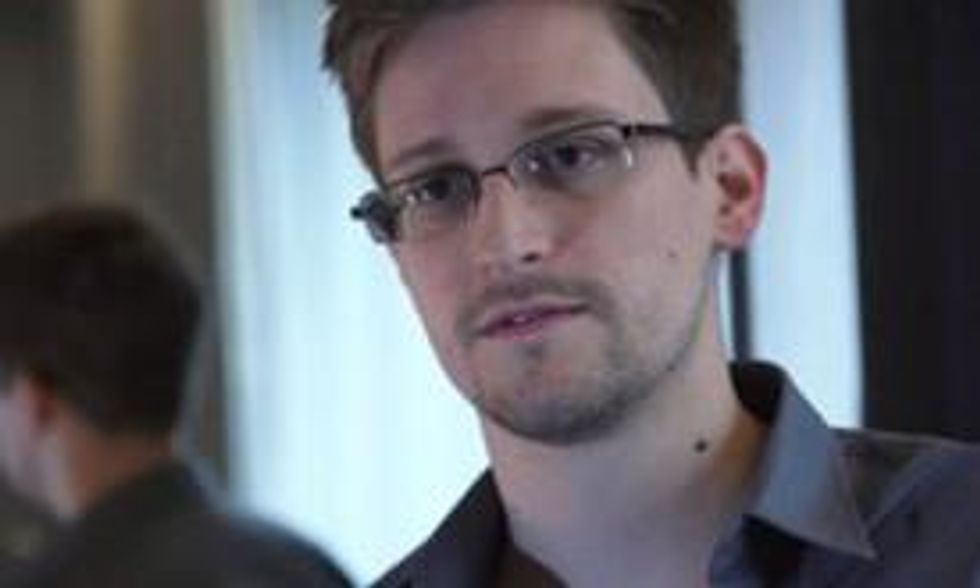
Before the U.S. government and the mainstream media engage in the customary character assassination of truth-teller Edward Snowden - a fate endured by Pfc. Bradley Manning and others - let's get on the record the motives he gave for releasing the trove of information on intrusive eavesdropping by the National Security Agency.

If what he did sounds weird, this is only because there are so precious few like him who will stand on principle and risk everything. Snowden explained that if the public does not know about these intrusive programs, there is no room for citizen input regarding how they square with our constitutional rights.
Snowden, who was living in Hawaii with a promising career and a salary said to be about $200,000 a year, told the London Guardian: "I'm willing to sacrifice all of that because I can't in good conscience allow the U.S. government to destroy privacy, Internet freedom, and basic liberties for people around the world with this massive surveillance machine they're now building."
He added that he wanted to reveal the "federation of secret law, unequal pardon, and irresistible executive powers that rule the world I love. ... What they're doing poses an existential threat to democracy."
Snowden enlisted in the Army in 2003 and began training to join the Special Forces. He told the Guardian: "I wanted to fight in the Iraq war because I felt like I had an obligation as a human being to help free people from oppression." He quickly found, though, that, in his words, "Most of the people training us seemed pumped up about killing Arabs, not helping anyone." Snowden broke both legs in a training accident and was discharged.
In several key respects, the experiences of Snowden resemble those of Bradley Manning. Both took the enlisted person's oath to "support and defend the Constitution of the United States against all enemies, foreign and domestic." As a condition of employment, both signed a promise not to disclose classified information; and both witnessed at close hand flagrant abuses that their consciences told them they needed to expose.
All this required them to go back on their secrecy promise, in order to achieve a greater good. What they were able to understand, and act on, is what ethicists call a "supervening value." [See Daniel C. Maguire's The Manning Trial's Real Defendant" regarding the moral balancing act between democracy's need for information and government insistence on secrecy.]
It didn't require a law degree for Bradley Manning and Edward Snowden to understand how the Bush and Obama administrations were playing fast and loose with key provisions of the Constitution of the United States.
'Safety' Before Constitution
As for the current President, he seems to have been editing the oath he took to "preserve, protect, and defend the Constitution of the United States." Few caught it when he preached on national security on May 23, but Greg Sargent noted in the Washington Post that Obama defined his commander-in-chief role as requiring him to tilt toward national security and away from civil liberties - clearly prioritizing the latter out of a warped zero-sum mindset.
Obama said "constitutional issues" must be "weighed" against "my responsibility to protect the American people." Got that? He was even more explicit last Friday about how he sees these choices. "You can't have 100 percent security and also then have 100 percent privacy and zero inconvenience," Obama said. "We're going to have to make some choices as a society. ... There are trade-offs involved."
Regarding his priorities, he said: "When I came into this office I made two commitments ... Number one, to keep the American people safe; and Number two, to uphold the Constitution. And that includes what I consider to be a constitutional right to privacy and an observance of civil liberties."
Thanks for tacking on that last sentence, Mr. President, but your defense of the incredibly wide and intrusive programs - alien to Fourth Amendment protections - strain credulity well beyond the breaking point. You lost me when you described the recently revealed eavesdropping programs that suck up data on billions of our communications daily as "very narrowly circumscribed" and "very focused."
In July 2008, when Congress passed and President Bush signed a law making government eavesdropping easier and granting immunity to telecommunications companies, which had already violated, together with the Bush administration, our Fourth Amendment rights, this seemed to me a watershed. What possible incentive would the telecoms now have for abiding by the Constitution, I asked myself.
When I heard that then-Sen. Barack Obama had flip-flopped on this vote - as he was burnishing his national security "cred" for his White House run - I wrote him an open letter. He had said he would vote against the bill, before he decided to vote for this major revision of the Foreign Intelligence and Surveillance Act (FISA) of 1978.
I gave my open letter the title "It's a Deal Breaker for This Intelligence Officer." Here's the main part:
"July 3, 2008
"Dear Senator Obama,
"I speak from 30 years of experience in intelligence work. I don't know who actually briefed you on the eavesdropping legislation, but the bill is unnecessary for intelligence collection and POISON for our civil liberties -- not even to mention the unconscionable retroactive immunity provision.
"You have made a big mistake, Senator, in indicating you intend to vote for it. There is still time to change your mind. That's what big people do. Your 'explanation' was unworthy of one who has sworn to protect and defend the Constitution of the United States (including the Fourth Amendment)."
'Turnkey Tyranny'
The consequences of this law are what Snowden ended up warning us against in the video arranged by the Guardian, after he reviewed some of what he had seen from his vantage point. His window into the National Security Agency and its management no doubt provided unflattering insight into the behavior of its leaders and their nodding, dismissive acquaintance with any limitations in existing law.
Air Force Gen. Michael Hayden who saluted smartly when ordered by President Bush and Vice President Dick Cheney to discard what had been known as NSA's "First Commandment - Thou shalt not eavesdrop on Americans without a warrant." The rubric-justification was: "After 9/11, everything changed" - including any need to pay much attention to the law. Like the telecom corporations, Hayden was not only held harmless and forgiven but lauded for his patriotism
And if you think his successor, Army General Keith Alexander, feels constrained by his own oath of office, think again. It is a felony to lie to Congress. He did. In olden days it would have been an embarrassing, career-ending story. Not for Alexander. The "mainstream media" has lionized him rather than holding him accountable. And he now sports four stars and not only directs NSA but also is Commander of the U.S. Cyber Command.
It's a long but instructive story: In December 2005, top New York Times executives belatedly decided to let the rest of us in on the fact that the George W. Bush administration had been eavesdropping on American citizens without the court warrants required by the Foreign Intelligence Surveillance Act (FISA) of 1978.
The Times had learned of this several months before the presidential election of 2004 but acquiesced to White House entreaties to suppress the damaging information. However, in late fall 2005, Times correspondent James Risen prepared to publish a book, State of War: The Secret History of the CIA and the Bush Administration," revealing the warrantless eavesdropping anyway. Times publisher, Arthur Sulzberger, Jr., recognized that he could procrastinate no longer.
It would simply be too embarrassing to have Risen's book on the street with Sulzberger and his associates pretending that this explosive eavesdropping story did not fit Adolph Ochs's trademark criterion: All The News That's Fit To Print. (The Times' own ombudsman, Public Editor Byron Calame, later branded the newspaper's explanation for the long delay in publishing this story "woefully inadequate.")
When Sulzberger told his friends in the White House that he could no longer hold off on publishing in the newspaper, he was summoned to the Oval Office for a counseling session with President Bush on Dec. 5, 2005. Bush tried in vain to talk him out of putting the story in the Times. The truth would out; part of it, at least - in 11 days.
Gen. Alexander Out of the Loop
Unfortunately for National Security Agency Director Lt. Gen. Keith Alexander, the White House neglected to tell him that the cat would soon be out of the bag. So on Dec. 6, Alexander spoke from the old dishonest talking points in assuring visiting House Intelligence Committee member Rush Holt, D-New Jersey, that the NSA did not eavesdrop on Americans without a court order.
Still possessed of the quaint notion that generals and other senior officials are not supposed to lie brazenly to congressional oversight committees, Holt wrote a blistering letter to Gen. Alexander after the Times, on Dec. 16, front-paged a feature by Risen and Eric Lichtblau, "Bush Lets U.S. Spy on Callers Without Courts."
But House Intelligence Committee chair Pete Hoekstra, R-Michigan, apparently found Holt's scruples benighted; Hoekstra did nothing to hold Alexander accountable for misleading Holt, his most experienced committee member, who had served as an intelligence analyst at the State Department.
What followed struck me as bizarre. The day after the Dec. 16 Times feature article, the President of the United States publicly admitted to a demonstrably impeachable offense. Authorizing illegal electronic surveillance was a key provision of the second article of impeachment against President Richard Nixon. On July 27, 1974, this and two other articles of impeachment were approved by bipartisan votes in the House Judiciary Committee and likely would have passed the House if Nixon had not chosen to resign on Aug. 9, 1974.
Yet, far from expressing remorse or regret about his warrantless wiretaps, President Bush bragged about having authorized the surveillance "more than 30 times since the September the 11th attacks," and said he would continue to do so. The President also said: "Leaders in Congress have been briefed more than a dozen times on this authorization and the activities conducted under it."
On Dec. 19, 2005, then-Attorney General Alberto Gonzales and then-NSA Director Michael Hayden held a press conference to answer questions about the surveillance program. Gonzales was asked why the White House decided to flout FISA rather than attempt to amend it, choosing instead a "backdoor approach." He answered:
"We have had discussions with Congress ... as to whether or not FISA could be amended to allow us to adequately deal with this kind of threat, and we were advised that that would be difficult, if not impossible." Impossible? Regarding that time, James Risen quipped: "In October 2001, you could have set up guillotines on the public streets of America."
It was not difficult to infer that the surveillance program, soon to be given the respectable label of the "Terrorist Surveillance Program," was of such scope and intrusiveness that, even amid highly stoked fear, it would have elicited public outrage.
Almost All the News Fit to Print
Like the giant telecoms, the New York Times never had to issue a mea culpa for hiding the crass violations of our Fourth Amendment rights until after the 2004 election and another year for good measure.
The issue arose again in a curious way on Sept. 13, 2010, at a large event at the New York Times hosted by then-Managing Editor Jill Abramson in honor of Daniel Ellsberg for his release of the Pentagon Papers, which the Times and others published in June 1971. (Dan invited me to come along; better late than never, we thought.)
Abramson alluded in a matter-of-fact way to a particularly egregious episode in which the Times did not cover itself in glory. But one would not have gleaned the latter from Abramson's casual mention of how the Times had published "the story about the NSA's eavesdropping program."
Abramson: The issue [of government pressure] became salient once again after 9/11, when the Times and other publications were the recipients of requests from the Bush White House to occasionally withhold publication of stories that involved secrets and national security issues. Probably the most famous one involved our publication of the story about the NSA's eavesdropping program.
Ellsberg: By the way, as the only non-Times person up here, I shouldn't refrain from saying, I've been very publicly very critical of the Times' decision to withhold the NSA wiretap story -- not only, for a whole year, but very critically, past the election of 2004. I think it's quite possible that the revelation that the president had, for three years, been blatantly violating the law ...
Abramson (interrupting): Although in truth, it wasn't known in real time at the election, the gravity of the legal issue was not.
Ellsberg: The legal issue, perhaps. ...
Abramson: So --
Ellsberg: The -- a whole year. I think that did make a difference.
Abramson: The thing is when the government says -- you know, by publishing a story you're harming the national security, you're helping the terrorists. I mean there are still people today who argue that the NSA program was the crown jewel, the most valuable anti-terrorism program that the Bush administration had going, and that it was terribly wrong of the Times to --
Ellsberg: And the Times went ahead.
Abramson: -- publish.
Ellsberg: In the end, that's what I'm saying.
Abramson: In the end, we did go ahead. But I'm saying these are not cavalier decisions.
Anyone want to guess why Ed Snowden chose the Guardian of London (and also the Washington Post) over the "paper of record" for his disclosures?
The Need for Truth-Tellers
In September 2004 Daniel Ellsberg and I drafted an appeal to those who might have been thinking of what Bradley Manning and now Ed Snowden have had the courage to do. It is included below as a reminder that blowing the whistle on war crimes and on gross violations of the U.S. Constitution is a laudable form of patriotism. The last time I checked the professional help promised in 2004 was reaffirmed.
September 9, 2004
APPEAL TO: Current Government Officials
FROM: The Truth-Telling Coalition
It is time for unauthorized truth telling.
Citizens cannot make informed choices if they do not have the facts--for example, the facts that have been wrongly concealed about the ongoing war in Iraq: the real reasons behind it, the prospective costs in blood and treasure, and the setback it has dealt to efforts to stem terrorism. Administration deception and cover-up on these vital matters has so far been all too successful in misleading the public.
Many Americans are too young to remember Vietnam. Then, as now, senior government officials did not tell the American people the truth. Now, as then, insiders who know better have kept their silence, as the country was misled into the most serious foreign policy disaster since Vietnam.
Some of you have documentation of wrongly concealed facts and analyses that--if brought to light--would impact heavily on public debate regarding crucial matters of national security, both foreign and domestic. We urge you to provide that information now, both to Congress and, through the media, to the public. ...
There is a growing network of support for whistleblowers. In particular, for anyone who wishes to know the legal implications of disclosures they may be contemplating, the ACLU stands ready to provide pro bono legal counsel, with lawyer-client privilege. The Project on Government Oversight (POGO) will offer advice on whistle blowing, dissemination and relations with the media.
Needless to say, any unauthorized disclosure that exposes your superiors to embarrassment entails personal risk. Should you be identified as the source, the price could be considerable, including loss of career and possibly even prosecution. Some of us know from experience how difficult it is to countenance such costs. But continued silence brings an even more terrible cost, as our leaders persist in a disastrous course and young Americans come home in coffins or with missing limbs. ...
We know how misplaced loyalty to bosses, agencies, and careers can obscure the higher allegiance all government officials owe the Constitution, the sovereign public, and the young men and women put in harm's way. We urge you to act on those higher loyalties. ... Truth telling is a patriotic and effective way to serve the nation. The time for speaking out is now.
SIGNATORIES
Appeal from the Truth-Telling Coalition
Edward Costello, Former Special Agent (Counterintelligence), Federal Bureau of Investigation
Sibel Edmonds, Former Language Specialist, Federal Bureau of Investigation
Daniel Ellsberg, Former official, U.S. Departments of Defense and State
John D. Heinberg, Former Economist, Employment and Training Administration, U.S. Department of Labor
Larry C. Johnson, Former Deputy Director for Anti-Terrorism Assistance, Transportation Security, and Special Operations, Department of State, Office of the Coordinator for Counter Terrorism
Lt. Col Karen Kwiatowski, USAF (ret.), who served in the Pentagon's Office of Near East Planning
John Brady Kiesling, Former Political Counselor, U.S. Embassy, Athens, Department of State
David MacMichael, Former Senior Estimates Officer, National Intelligence Council, Central Intelligence Agency
Ray McGovern, Former Analyst, Central Intelligence Agency
Philip G. Vargas, Ph.D., J.D., Dir. Privacy & Confidentiality Study, Commission on Federal Paperwork (Author/Director: "The Vargas Report on Government Secrecy" -- CENSORED)
Ann Wright, Retired U.S. Army Reserve Colonel and U.S. Foreign Service Officer
An earlier version of this article first appeared at Consortiumnews.com
Thomas Fingar, former Director of the National Intelligence Council, will receive the annual award from Sam Adams Associates for Integrity in Intelligence in recognition of Fingar's work from 2005 to 2008 restoring respect for the battered discipline of U.S. intelligence analysis after the fraudulent assessments on Iraq's non-existent WMD.

In 2007, as chief of intelligence analysis, Fingar managed a thoroughly professional - and unsparingly honest - National Intelligence Estimate on the live-wire issue of Iran's nuclear program. That NIE was instrumental in thwarting plans by President George W. Bush and Vice President Dick Cheney to attack Iran before they left office.
At the time, it was widely believed in the Official Washington that Tehran was developing a nuclear weapon but, as a seasoned intelligence professional, Fingar was allergic to "group think." He recruited the best experts and ordered an empirical, bottom-up approach to the evidence. And, as luck would have it, some critical new intelligence became available in 2007 during the drafting.
Thus, in the Iran NIE of early November 2007, all 16 U.S. intelligence agencies judged "with high confidence" that Iran had halted its nuclear weapon design and weaponization work in 2003. That key judgment has been revalidated in testimony to Congress every year since.
Fingar, now a professor at Stanford, is teaching in its overseas program at Oxford in the United Kingdom. The award - named for the late CIA analyst Sam Adams who challenged the U.S. military's overly optimistic claims about Vietcong and North Vietnamese troop strength during the Vietnam War - will be presented to Fingar at the historic Oxford Union.
Discussing his upcoming award with Sam Adams Associates, Fingar showed little patience with the nonsensical charges that he and his analysts had to endure after the NIE on Iran hit the streets. He reminded us:
"The whole purpose was to provide as accurate and objective a picture of what we knew at the time. To have done otherwise would have been unprofessional and inconsistent with the reason we have an intelligence establishment.
"Every other characterization of security-related affairs provided to decision makers has, or is assumed to have, a policy agenda. The Intelligence Community exists not just to provide analyses based on 'all' the information available to others - plus, when it can get it, information not available to others - but also, and more importantly, to assemble and assess the information as objectively as possible.
"The job of the Intelligence Community is to help decision makers to make better-informed decisions. It most emphatically is not to lead or pressure them to decide issues in a particular way. ... It is also the reason we spend billions of dollars on intelligence analysis. ... In a fundamental way, we were simply 'doing our jobs' when we produced the Iran NIE.
"Those who did not like the conclusions knew or soon realized that they could not challenge our findings by disputing the existence or meaning of our evidence, so they pursued a different course. The ploy was completely transparent: allege that those who wrote the NIE were intelligence amateurs who had a political agenda, and claim that the alleged principal authors had been career-long opponents of President Bush.
"There are many 'problems' with this line of attack - problems that were overlooked by a remarkable number of journalists. ... I didn't write the NIE but, at the time, I had 37 years of intelligence experience - probably no longer an amateur.
" Neocon critics never explained why, if I had been a career-long opponent of George W. Bush, he had nominated me to be an assistant secretary of state, endorsed my selection as the first Deputy Director of National Intelligence for Analysis, and approved my selection to supervise preparation of materials for his daily briefing."
Blocking a Dash to War
Without doubt, the NIE on Iran's nuclear program made another rash decision to go to war in the Middle East untenable.
I myself have been involved in intelligence analysis for 50 years - 27 at the CIA; two as an Army infantry/intelligence officer, and the rest as a close observer. Yet, the November 2007 NIE is the only one I know of that deserves unambiguous credit for stopping an unnecessary war, one that could have been even more disastrous than the Bush administration's excellent adventure in Iraq.
Don't take my word for it. In his memoir Decision Points, President George W. Bush acknowledged that the "eye-popping" findings of the 2007 NIE "tied my hands on the military side. ... After the NIE, how could I possibly explain using the military to destroy the nuclear facilities of a country the intelligence community said had no active nuclear weapons program?
"I don't know why the NIE was written the way it was ... I certainly hoped intelligence analysts weren't trying to influence policy. Whatever the explanation, the NIE had a big impact - and not a good one."
As Bush's comment made clear, intelligence analysts do not operate in a political vacuum. The real professionals, however, construct a protective shield against political influence, bias and an understandable-but-anathema eagerness to please superiors in the White House.
When I tell Washington cognoscenti that this shielding can actually work, and that the debacle with "intelligence" on Iraq was the "Cheney/Bush exemption to the rule," their eyes roll in disbelief. Everyone in Washington is perceived to have a political agenda. It takes guts for senior intelligence officials to avoid playing into that perception.
Perhaps President Bush and Vice President Cheney can be forgiven for assuming that all senior intelligence officials are as eager to politicize their work as were former CIA Director George Tenet, his deputy John McLaughlin, and the senior managers who had bubbled to the top - with disastrous consequences for Iraq.
More than two decades had gone by since Director William Casey and his protege, Robert Gates, began politicizing intelligence big-time. That is usually enough time to corrupt thoroughly any institution - and that proved to be true for the CIA. However, after the Iraq WMD catastrophe, professionals like Fingar stepped in to begin righting the intelligence ship.
The November 2007 NIE landed like a dead fish on the White House doorstep, causing the neocons and other war hawks to challenge the unanimous judgment of all 16 intelligence agencies as naive. The drafters were pilloried with charges that they were soft on Iran and just trying to stop a war! But the deed was done; and we were spared another unnecessary bloodletting.
Oxford Site for Award
The Oxford Union will be hosting the Sam Adams Associates for Integrity in Intelligence award ceremony on Jan. 23. The ceremony will feature several individuals well known in the field of intelligence and related topics, including an exclusive address via videolink from Julian Assange, who won the award in 2010.
The award is one of the few accolades for high-level whistleblowers who have taken risks to honor the public's need to know. Also at the Oxford ceremony will be several previous Sam Adams awardees, including Coleen Rowley, Katharine Gun, Craig Murray, and Thomas Drake. The acceptance speech by Dr. Fingar will be followed by briefer remarks from a few previous Sam Adams awardees.
Sam Adams Associates for Integrity in Intelligence was established in 2002 by colleagues and admirers of the late CIA intelligence analyst Sam Adams to recognize those who uphold his example as a model for those in intelligence who would aspire to the courage to speak truth to power. In honoring Adams's memory, SAAII confers an award each year to someone in intelligence or related work who exemplifies Sam Adam's courage, persistence, and devotion to truth -- no matter the consequences.
It was Adams who discovered in 1967 that there were more than a half-million Vietnamese Communists under arms. This was roughly twice the number that the U.S. command in Saigon would admit to, lest Americans learn that claims of "progress" were bogus. As proven later in court, Gen. William Westmoreland had simply limited the number Army intelligence was allowed to carry on its books. His deputy, Gen. Creighton Abrams revealed the deception in a cable from Saigon:
A SECRET/EYES ONLY cable from Abrams on Aug. 20, 1967 stated: "We have been projecting an image of success over recent months," and cautioned that if the higher figures became public, "all available caveats and explanations will not prevent the press from drawing an erroneous and gloomy conclusion."
The Communist countrywide offensive during Tet (January/February 1968) made it clear that the generals had been lying and that Sam Adams' higher figures were correct. Senior officials of the Washington Establishment were aware of the deception, but lacked the courage to stand up to Westmoreland. Sam Adams himself was too much a creature of the system to go "outside channels."
A few weeks after Tet, however, Daniel Ellsberg rose to the occasion. Ellsberg learned that Westmoreland was asking for 206,000 more troops to widen the war into Cambodia, Laos, and North Vietnam -- right up to the border with China, and perhaps beyond. Someone (we still don't know who) promptly leaked to the New York Times Westmoreland's troop request, emboldening Ellsberg to do likewise with Sam Adams' figures.
It was Ellsberg's first unauthorized disclosure. He had come to the view that leaking truth about a deceitful war would be "a patriotic and constructive act." On March 19, 1968, the Times published a stinging story based on Adams's figures.
On March 25, President Johnson complained to a small group, "The leaks to the New York Times hurt us. ... We have no support for the war. This is caused by the 206,000 troop request and the leaks. ... I would have given Westy the 206,000 men." On March 31, 1968, Johnson ordered a bombing pause, opted for negotiations, and announced that he would not run for another term in November.
Sam Adams continued to press for honesty but stayed "inside channels" -- and failed. He died at 55 of a heart attack in 1988, nagged by the thought that, had he gone to the media, thousands of lives might have been saved. His story is told in War of Numbers, published posthumously.
The annual Sam Adams Award has been given in previous years to truth tellers Coleen Rowley of the FBI; Katharine Gun of British Intelligence; Sibel Edmonds of the FBI; Craig Murray, former UK ambassador to Uzbekistan; Sam Provance; former US Army Sgt at Abu Ghraib; Maj. Frank Grevil of Danish Army Intelligence; Larry Wilkerson, Col., U.S. Army (ret.), former chief of staff to Colin Powell at State; Julian Assange of WikiLeaks; and (ex aequo) to Thomas Drake, former senior official of NSA and Jesselyn Radack, Director of National Security and Human Rights, Government Accountability Project.
Controversy generated by recent reporting by Eric Lichtblau and Scott Shane of the New York Times about Food and Drug Administration spying on its doctors and scientists focuses on the blatant invasions of privacy, with Sen. Charles Grassley, R- Iowa, complaining of "Gestapo" tactics. But what about us?
What about the thousands of patients exposed to unnecessarily dangerous levels of radiation during mammogram screening and colonoscopies by General Electric medical imaging devices.

As the Times reported, the F.D.A. spying focused on doctors who believed the agency gave shortshrift to concerns about excessive radiation coming from medical imaging devices. Lichtblau and Shane wrote:
"The extraordinary surveillance effort grew out of a bitter dispute lasting years between the scientists and their bosses at the F.D.A. over the scientists' claims that faulty review procedures at the agency had led to the approval of medical imaging devices for mammograms and colonoscopies that exposed patients to dangerous levels of radiation.
"A confidential government review in May by the Office of Special Counsel, which deals with the grievances of government workers, found that the scientists' medical claims were valid enough to warrant a full investigation into what it termed 'a substantial and specific danger to public safety.'"
During the first few decades of my life, there were no such scan scams to worry about. The influence of the pharmaceutical corporations, however, was already huge -- and dangerous. Often, it took courageous whistleblowers -- people of integrity unwilling to betray the public trust -- to prevent disaster.
Thalidomide
It has been more than 50 years since my first extended visit to Europe as a university student. Most readers will be too young to remember, but a "wonder-drug," Thalidomide, had just come on the market. This drug gave temporary rest and relief to millions, especially prospective mothers with morning sickness and problems sleeping. It was very popular in Germany.
Stationed in Germany more than a decade later, I witnessed the human results of the horrible side effects of Thalidomide, which had become available all over Europe, and beyond. Over 10,000 babies in 46 countries were born without limbs or otherwise disfigured and disabled. Those still alive would be in their late forties/early fifties now.
How did the United States escape this plague? One whistleblower, a woman named Frances Kelsey of the U.S. Food and Drug Administration saw through the charade of the drug company swindlers and stood up to it.
Although Dr. Kelsey came under extreme pressure to fall in step and approve Thalidomide, she scorned the testing that had been done by the Thalidomide manufacturer and blocked introduction of the drug into America.
For her unusual courage and integrity, President John Kennedy gave her the President's Award for Distinguished Federal Civilian Serivce in 1962, after it became clear that she had singlehandedly prevented a public health disaster from befalling us in the United States.
Dr. Kelsey will be 98 on July 24; her courage should be celebrated -- particularly in the light of the behavior of our present-day F.D.A. The F.D.A.'s current commissioner, Dr. Margaret Hamburg, should be put on the griddle -- and sooner rather than later.
As the Sixties and Seventies wore on, the horrible damage caused by the drug made itself known. And what also became clear was the reality that a decade of American babies born whole, with all their limbs, owed a debt of gratitude to Frances Kelsey, whistleblower par excellence!
A close friend of mine, Tom Clark, tells me that he is of that generation. Tom added that his mother suffered miserably from morning sickness in bearing him. He is gratefully aware that he might well be missing a limb or two today, had his mother been able to acquire Thalidomide in the United States.
What happens to the likes of Dr. Kelsey at the F.D.A. today? Sadly, modern-day whistleblowers - whether in government, industry or even the press - more often than not face severe career reprisals, legal action and sometimes imprisonment, like Pvt. Bradley Manning jailed for allegedly leaking classified government documents to WikiLeaks. Rarely do truth-tellers get presidential awards.
Which reminds me of an open letter that ten other veterans of government service and I signed nearly eight years ago, on Sept. 9, 2004. Our "Truth-Telling Coalition" directed an appeal to "Current Government Officials." We wrote:
It is time for unauthorized truth telling.
Citizens cannot make informed choices if they do not have the facts -- for example, the facts that have been wrongly concealed about the ongoing war in Iraq: the real reasons behind it, the prospective costs in blood and treasure, and the setback it has dealt to efforts to stem terrorism. Administration deception and cover-up on these vital matters has so far been all too successful in misleading the public.
Many Americans are too young to remember Vietnam. Then, as now, senior government officials did not tell the American people the truth. Now, as then, insiders who know better have kept their silence, as the country was misled into the most serious foreign policy disaster since Vietnam.
Some of you have documentation of wrongly concealed facts and analyses that -- if brought to light -- would impact heavily on public debate regarding crucial matters of national security, both foreign and domestic. We urge you to provide that information now, both to Congress and, through the media, to the public.
Thanks to our First Amendment, there is in America no broad Officials Secrets Act, nor even a statutory basis for the classification system. Only very rarely would it be appropriate to reveal information of the three types whose disclosure has been expressly criminalized by Congress: communications intelligence, nuclear data, and the identity of U.S. intelligence operatives. However, this administration has stretched existing criminal laws to cover other disclosures in ways never contemplated by Congress.
There is a growing network of support for whistleblowers. In particular, for anyone who wishes to know the legal implications of disclosures they may be contemplating, the ACLU stands ready to provide pro bono legal counsel, with lawyer-client privilege. The Project on Government Oversight (POGO) will offer advice on whistle blowing, dissemination and relations with the media.
Needless to say, any unauthorized disclosure that exposes your superiors to embarrassment entails personal risk. Should you be identified as the source, the price could be considerable, including loss of career and possibly even prosecution. Some of us know from experience how difficult it is to countenance such costs. But continued silence brings an even more terrible cost, as our leaders persist in a disastrous course and young Americans come home in coffins or with missing limbs.
This is precisely what happened at this comparable stage in the Vietnam War. Some of us live with profound regret that we did not at that point expose the administration's dishonesty and perhaps prevent the needless slaughter of 50,000 more American troops and some 2 to 3 million Vietnamese over the next ten years.
We know how misplaced loyalty to bosses, agencies, and careers can obscure the higher allegiance all government officials owe the Constitution, the sovereign public, and the young men and women put in harm's way. We urge you to act on those higher loyalties.
A hundred forty thousand young Americans are risking their lives every day in Iraq for dubious purpose. Our country has urgent need of comparable moral courage from its public officials. Truth telling is a patriotic and effective way to serve the nation. The time for speaking out is now.
SIGNATORIES
Appeal from the Truth-Telling Coalition
Edward Costello, Former Special Agent (Counterintelligence), Federal Bureau of Investigation
Sibel Edmonds, Former Language Specialist, Federal Bureau of Investigation
Daniel Ellsberg, Former official, U.S. Departments of Defense and State
John D. Heinberg, Former Economist, Employment and Training Administration, U.S. Department of Labor
Larry C. Johnson, Former Deputy Director for Anti-Terrorism Assistance, Transportation Security, and Special Operations, Department of State, Office of the Coordinator for Counter Terrorism
Lt. Col Karen Kwiatowski, USAF (ret.), who served in the Pentagon's Office of Near East Planning
John Brady Kiesling, Former Political Counselor, U.S. Embassy, Athens, Department of State
David MacMichael, Former Senior Estimates Officer, National Intelligence Council, Central Intelligence Agency
Ray McGovern, Former Analyst, Central Intelligence Agency
Philip G. Vargas, Ph.D., J.D., Dir. Privacy & Confidentiality Study, Commission on Federal Paperwork (Author/Director: "The Vargas Report on Government Secrecy" -- CENSORED)
Ann Wright, Retired U.S. Army Reserve Colonel and U.S. Foreign Service Officer
An earlier version of this article appeared at Consortiumnews.com