

SUBSCRIBE TO OUR FREE NEWSLETTER
Daily news & progressive opinion—funded by the people, not the corporations—delivered straight to your inbox.
5
#000000
#FFFFFF
To donate by check, phone, or other method, see our More Ways to Give page.
Daily news & progressive opinion—funded by the people, not the corporations—delivered straight to your inbox.
President’s FY27 budget slashes programs that help families cover everyday costs to pour half-a-trillion into the Iran war and Pentagon as Americans’ trust in Trump’s economic agenda hits record lows
Today, President Trump released his administration’s FY2027 budget, doubling down on an unpopular economic agenda that is raising costs and ripping away support for working families. Trump’s budget proposes deep cuts to programs that help families afford energy bills and housing costs, while gutting worker protections to bankroll the Pentagon and Trump’s Iran war.
Since Trump launched his war on Iran, Americans have paid $8.4 billion more at the pump, adding to rising prices driven by his tariffs and economic chaos. Just this week, Trump said it’s “not possible” to help Americans afford health care or childcare because “we’re fighting wars.”
Though just 3 in 10 voters approve of Trump’s handling of the economy and two-thirds disapprove of his war in Iran, the president is pressing ahead with his misguided agenda instead of providing relief to American families.
Groundwork’s Managing Director of Policy and Advocacy Elizabeth Pancotti reacted,
“President Trump has made it abundantly clear he has no intention of providing an ounce of relief to Americans crushed under the weight of his unpopular and misguided agenda. Instead, he wants to hand the Pentagon a $500 billion blank check, paid for by gutting vital programs that help families afford heating bills, that ensure workers are protected on the job, and that provide a lifeline to small businesses. Despite pressing forward in Iran, the war he seems most interested in waging is one on the wallets of everyday Americans.”
To speak to a Groundwork expert about the damage Trump’s proposed budget will cause, email press@groundworkcollaborative.org.

Soaring energy costs caused by the illegal war of choice are driving up food costs and taking a toll on regional GDP, while soaring prices for US consumers could affect upcoming midterm elections.
Soaring energy prices caused by the US-Israeli war of choice on Iran is driving up global food prices while shrinking the economies of Gulf Arab states targeted in Iranian counterstrikes, according to a pair of reports published this week by United Nations agencies.
On Friday, the UN Food and Agriculture Organization (FAO) published its latest Food Price Index (FFPI), which measures the monthly change in international costs of a basket of basic grocery items. The FFPI rose 2.4% over February levels.
"Price indices across all commodity groups—cereals, meat, dairy, vegetable oils, and sugar—rose to varying degrees, reflecting not only underlying market fundamentals but also responses to higher energy prices linked to the conflict escalation in the Near East," FAO said in a statement.
"If the conflict stretches beyond 40 days with high input costs with current low margins, farmers will have to choose: Farm the same with fewer inputs, plant less, or switch to less intensive fertilizer crops," said FAO Chief Economist Máximo Torero.
"Those choices will hit future yields and shape our food supply and commodity prices for the rest of this year and all of the next," Torero added.
As CNBC's Garrett Downs reported Thursday:
Food faces a number of new inflationary pressures due to the Iran war and the closure of the Strait of Hormuz. The increase in oil costs is raising the price of diesel, necessary for farmers and the trucks and railroads that carry food across the country. Fertilizer is also being choked by the closure of the strait. And even plastic, a petrochemical product that’s commonly used in food packaging, could also contribute to higher checkout costs.
“The price of food is going to move quite a lot,” Kjetil Storesletten, an economist and professor at the University of Minnesota, told Downs. “If you put those things together, that it’s a big chunk of the price of producing food and that the price increased a lot, it suggests that all of the increased price in fertilizer is going to be passed through to food.”
@fao.org Food Price Index rose in March for 2nd month in a row largely due to conflict in the Near East.Pressure on fertilizer supplies & elevated energy prices add uncertainty to markets despite a comfortable global food supply situation.FAO Chief Economist @maximotorero.bsky.social explains.
[image or embed]
— Food and Agriculture Organization of the United Nations (@fao.org) April 3, 2026 at 9:39 AM
Meanwhile, the UN Development Program (UNDP) earlier this week unveiled an assessment suggesting that the war may cost affected Mideast economies between 3.7% and 6% of their collective gross domestic product (GDP) and push as many as 4 million people into poverty.
"The escalation has exposed structural vulnerabilities of the Arab states region and underscored a stark reality that even a short-lived shock can generate profound, widespread, and persistent socioeconomic impacts across the Arab states region," UNDP said.
"While the current military escalation remains geographically concentrated, its impacts are propagating through interconnected systems—trade corridors, energy markets, financial flows, and logistics networks—transforming a localized escalation into a systemic regional shock," the agency added.
Last month, the UN World Food Program warned that the US-Israeli war on Iran and its associated impacts on the global economy could push 45 million more people around the world into acute hunger this year.
In the United States, experts warn that as the war drags on, grocery prices will continue to rise, posing a political risk to Republicans who, along with President Donald Trump, campaigned on promises to immediately lower the cost of key consumer items including food and gasoline—which now averages over $4 per gallon, up from $3.10 on the day the president returned to the White House.
Democratic members of the Joint Economic Committee released a report Thursday showing that higher pump prices have cost Americans $8.4 billion over the first month of the Iran War.
Democrats are looking to capitalize on consumer angst and Republicans' broken promises—not only on prices but also on "no new wars"—in the upcoming midterm elections.
“Our messaging is affordability and accountability,” Rep. Jared Huffman (D-Calif.) told CNBC on Thursday. “It’s a pretty tailored message, pretty narrowly focused, and on both of those pillars, Trump is making our arguments even more compelling.”
As Trump seeks an unprecedented $1.5 trillion in military spending for the next fiscal year, Rep. Vicente Gonzalez (D-Texas) argued that voters have had enough.
“It just pisses them off more,” he said of Trump's broken promises. "When people hear that, they’re like, ‘Hey, I can’t pay for groceries and you want to go pay for a war in the Middle East?’ I think that’s going to be a tough sell.”
Following Rep. Ro Khanna’s Call, Our Revolution Launches Petition Urging Senate Democrats to Hold the Line—No Confirmation Without a Commitment to Release Epstein Files, Prosecute Those Involved, and Uphold the Rule of Law
In the wake of President Trump’s removal of Pam Bondi, Our Revolution, the largest grassroots-funded progressive political organizing group in the country, is calling on Senate Democrats to withhold any vote on confirming a new Attorney General until there is a clear commitment to release all Epstein-related files and pursue real accountability.
The call follows a statement issued yesterday by Rep. Ro Khanna, who urged senators to refuse any confirmation vote absent full transparency and prosecutions. Khanna, a leading voice in pushing for the release of the files, working across the aisle to elevate the issue, defend survivors, and demand accountability previously called for Bondi to be held accountable and removed.
With the vacancy at the Department of Justice, the call underscores a broader truth: even in the minority, Democrats have the power to shape outcomes—if they are willing to use it.
In response, Our Revolution is circulating a national grassroots petition calling on Senate Democrats to hold the line and use their leverage to force accountability at the highest levels.
Joseph Geevarghese, Executive Director of Our Revolution, said, “The American people are tired of a system where the powerful operate under a different set of rules. This is a moment to draw a line. There should be no confirmation vote without a clear commitment to release the Epstein files, pursue prosecutions, and restore trust in the rule of law.”
As the Epstein case has come to symbolize a deeper crisis where the wealthy and well-connected operate under a different set of rules, the public demand for transparency and accountability continues to grow.
Our Revolution is calling on Senate Democrats to condition any confirmation vote on a clear commitment from the next Attorney General to:
Even in the minority, Senate Democrats have tools to exert pressure—by withholding votes, slowing proceedings, and setting clear conditions. That leverage must be used.
To request an interview with Mr. Geevarghese, please contact: media@ourrevolution.com
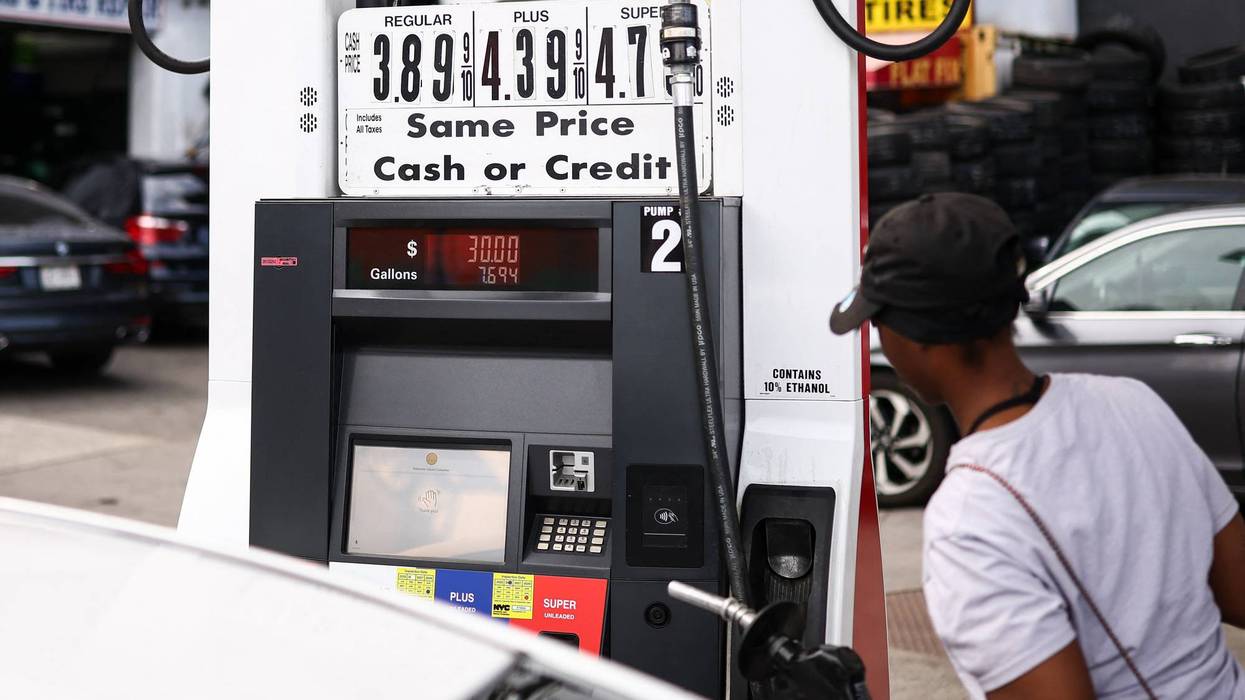
“From the grocery store to the doctor’s office to the gas pump, congressional Republicans are financially crushing working Americans at every turn," said one economic justice campaigner.
As President Donald Trump's Pentagon pushed Congress to approve $1.5 trillion in new military funding, including $200 billion for the US-Israeli war on Iran, congressional Democrats found that the working Americans whose taxes would fund those appropriations have spent $8.4 billion that otherwise could have gone to groceries, childcare, and other essentials—all at the gas pump.
Democratic members of the Joint Economic Committee released a report Thursday—two days after average gas prices in the US reached $4 per gallon, the highest in nearly four years—showing that those higher prices have forced Americans to pay 35% more on gas than they did a month ago, before Trump joined Israeli Prime Minister Benjamin Netanyahu in attacking Iran.
A month after Iran closed the Strait of Hormuz in retaliation for the war that's killed more than 2,000 Iranians and well over 1,000 people across the Middle East as the conflict has widened, it now costs $145 to fill up just one gas tank for a Ford F-150 pickup truck—$37 more than it did in February.
An SUV costs an average of $58 to fill up, an increase of $15, while a sedan costs $52 on average—$13 more than it did before the war.
The analysis was released a day after Trump unequivocally stated that, despite his campaign pledge to make life more affordable for Americans, his administration's priority is "fighting wars," not ensuring the government provides childcare and healthcare that families can afford.
"We can’t take care of daycare," said Trump. “It’s not possible for us to take care of daycare, Medicaid, Medicare, all these individual things.”
“Families are paying more at the pump because Republicans in Congress would rather spend billions of dollars on a war that raises costs than find ways to actually make life more affordable."
The advocacy group Unrig Our Economy noted Friday that the war in Iran, which is supported by nearly every Republican in Congress—is just the latest way in which the GOP under the Trump administration has "raised costs and squeezed families." The Joint Economic Committee found in February that Americans had gotten stuck with the bill due to Trump's aggressive tariffs on imports, which he had claimed would generate massive revenue—but which actually cost the average family more than $1,700 in one year as companies passed off the higher cost of goods and materials to consumers.
“From the grocery store to the doctor’s office to the gas pump, congressional Republicans are financially crushing working Americans at every turn," said Unrig Our Economy campaign director Leor Tal.
The committee Democrats also found last month that the average US electric bill rose by $110, or 6.4%, in 2025, driven by Trump's cancellations of renewable energy projects, his push for liquefied natural gas exports, and his demand for an expansion of artificial intelligence data centers.
"Meanwhile, [Republican] attacks on Americans’ healthcare have sent premiums skyrocketing and put over 15 million Americans at risk of losing health insurance. Now, they want to cut healthcare even more to bankroll their costly and unnecessary war," said Unrig Our Economy, referring to Republicans' call to further cut federal health spending to pay for the Iran war.
As Americans have spent more at the gas pump and the White House has offered shifting explanations for why the US continues to wage war on Iran, public approval for the conflict has remained low. Nearly 60% of Americans said late last month that the war has already gone "too far" as the president threatened to escalate further, and 56% of respondents to a poll by Data for Progress said they believe the conflict will benefit Israel, not the US.
This week, two-thirds of people who responded to a CNN poll said they disapproved of the war and did not believe Trump has a clear plan. More than three-quarters said they would not support the Pentagon's request for $200 billion to fund further military action.
But Trump, who White House Chief of Staff Susie Wiles admitted this week has been getting a "rose-colored view" of the war in Iran during official briefings, told reporters Thursday that Americans are so relieved that the US and Israel are attacking Iran and killed Ayatollah Ali Khamenei on the first day of the war that they are not concerned about the financial toll the war is taking on their families.
"We have a country that's not going to be throwing a nuclear weapon at us in six months," said Trump. "They're feeling a lot safer."
US intelligence has determined Iran did not pose an imminent threat to the United States.
“Families are paying more at the pump," said Tal, "because Republicans in Congress would rather spend billions of dollars on a war that raises costs than find ways to actually make life more affordable."