SUBSCRIBE TO OUR FREE NEWSLETTER
Daily news & progressive opinion—funded by the people, not the corporations—delivered straight to your inbox.
5
#000000
#FFFFFF
To donate by check, phone, or other method, see our More Ways to Give page.
Daily news & progressive opinion—funded by the people, not the corporations—delivered straight to your inbox.
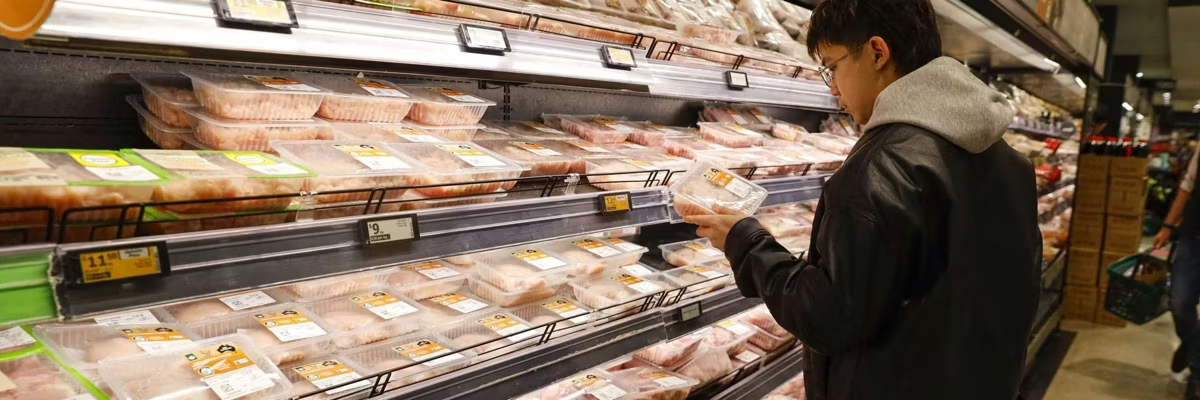
A man checks meat prices at a Woolworths supermarket in Melbourne, Australia on March 28, 2026.
Soaring energy costs caused by the illegal war of choice are driving up food costs and taking a toll on regional GDP, while soaring prices for US consumers could affect upcoming midterm elections.
Soaring energy prices caused by the US-Israeli war of choice on Iran is driving up global food prices while shrinking the economies of Gulf Arab states targeted in Iranian counterstrikes, according to a pair of reports published this week by United Nations agencies.
On Friday, the UN Food and Agriculture Organization (FAO) published its latest Food Price Index (FFPI), which measures the monthly change in international costs of a basket of basic grocery items. The FFPI rose 2.4% over February levels.
"Price indices across all commodity groups—cereals, meat, dairy, vegetable oils, and sugar—rose to varying degrees, reflecting not only underlying market fundamentals but also responses to higher energy prices linked to the conflict escalation in the Near East," FAO said in a statement.
"If the conflict stretches beyond 40 days with high input costs with current low margins, farmers will have to choose: Farm the same with fewer inputs, plant less, or switch to less intensive fertilizer crops," said FAO Chief Economist Máximo Torero.
"Those choices will hit future yields and shape our food supply and commodity prices for the rest of this year and all of the next," Torero added.
As CNBC's Garrett Downs reported Thursday:
Food faces a number of new inflationary pressures due to the Iran war and the closure of the Strait of Hormuz. The increase in oil costs is raising the price of diesel, necessary for farmers and the trucks and railroads that carry food across the country. Fertilizer is also being choked by the closure of the strait. And even plastic, a petrochemical product that’s commonly used in food packaging, could also contribute to higher checkout costs.
“The price of food is going to move quite a lot,” Kjetil Storesletten, an economist and professor at the University of Minnesota, told Downs. “If you put those things together, that it’s a big chunk of the price of producing food and that the price increased a lot, it suggests that all of the increased price in fertilizer is going to be passed through to food.”
@fao.org Food Price Index rose in March for 2nd month in a row largely due to conflict in the Near East.Pressure on fertilizer supplies & elevated energy prices add uncertainty to markets despite a comfortable global food supply situation.FAO Chief Economist @maximotorero.bsky.social explains.
[image or embed]
— Food and Agriculture Organization of the United Nations (@fao.org) April 3, 2026 at 9:39 AM
Meanwhile, the UN Development Program (UNDP) earlier this week unveiled an assessment suggesting that the war may cost affected Mideast economies between 3.7% and 6% of their collective gross domestic product (GDP) and push as many as 4 million people into poverty.
"The escalation has exposed structural vulnerabilities of the Arab states region and underscored a stark reality that even a short-lived shock can generate profound, widespread, and persistent socioeconomic impacts across the Arab states region," UNDP said.
"While the current military escalation remains geographically concentrated, its impacts are propagating through interconnected systems—trade corridors, energy markets, financial flows, and logistics networks—transforming a localized escalation into a systemic regional shock," the agency added.
Last month, the UN World Food Program warned that the US-Israeli war on Iran and its associated impacts on the global economy could push 45 million more people around the world into acute hunger this year.
In the United States, experts warn that as the war drags on, grocery prices will continue to rise, posing a political risk to Republicans who, along with President Donald Trump, campaigned on promises to immediately lower the cost of key consumer items including food and gasoline—which now averages over $4 per gallon, up from $3.10 on the day the president returned to the White House.
Democratic members of the Joint Economic Committee released a report Thursday showing that higher pump prices have cost Americans $8.4 billion over the first month of the Iran War.
Democrats are looking to capitalize on consumer angst and Republicans' broken promises—not only on prices but also on "no new wars"—in the upcoming midterm elections.
“Our messaging is affordability and accountability,” Rep. Jared Huffman (D-Calif.) told CNBC on Thursday. “It’s a pretty tailored message, pretty narrowly focused, and on both of those pillars, Trump is making our arguments even more compelling.”
As Trump seeks an unprecedented $1.5 trillion in military spending for the next fiscal year, Rep. Vicente Gonzalez (D-Texas) argued that voters have had enough.
“It just pisses them off more,” he said of Trump's broken promises. "When people hear that, they’re like, ‘Hey, I can’t pay for groceries and you want to go pay for a war in the Middle East?’ I think that’s going to be a tough sell.”
Dear Common Dreams reader, It’s been nearly 30 years since I co-founded Common Dreams with my late wife, Lina Newhouser. We had the radical notion that journalism should serve the public good, not corporate profits. It was clear to us from the outset what it would take to build such a project. No paid advertisements. No corporate sponsors. No millionaire publisher telling us what to think or do. Many people said we wouldn't last a year, but we proved those doubters wrong. Together with a tremendous team of journalists and dedicated staff, we built an independent media outlet free from the constraints of profits and corporate control. Our mission has always been simple: To inform. To inspire. To ignite change for the common good. Building Common Dreams was not easy. Our survival was never guaranteed. When you take on the most powerful forces—Wall Street greed, fossil fuel industry destruction, Big Tech lobbyists, and uber-rich oligarchs who have spent billions upon billions rigging the economy and democracy in their favor—the only bulwark you have is supporters who believe in your work. But here’s the urgent message from me today. It's never been this bad out there. And it's never been this hard to keep us going. At the very moment Common Dreams is most needed, the threats we face are intensifying. We need your support now more than ever. We don't accept corporate advertising and never will. We don't have a paywall because we don't think people should be blocked from critical news based on their ability to pay. Everything we do is funded by the donations of readers like you. When everyone does the little they can afford, we are strong. But if that support retreats or dries up, so do we. Will you donate now to make sure Common Dreams not only survives but thrives? —Craig Brown, Co-founder |
Soaring energy prices caused by the US-Israeli war of choice on Iran is driving up global food prices while shrinking the economies of Gulf Arab states targeted in Iranian counterstrikes, according to a pair of reports published this week by United Nations agencies.
On Friday, the UN Food and Agriculture Organization (FAO) published its latest Food Price Index (FFPI), which measures the monthly change in international costs of a basket of basic grocery items. The FFPI rose 2.4% over February levels.
"Price indices across all commodity groups—cereals, meat, dairy, vegetable oils, and sugar—rose to varying degrees, reflecting not only underlying market fundamentals but also responses to higher energy prices linked to the conflict escalation in the Near East," FAO said in a statement.
"If the conflict stretches beyond 40 days with high input costs with current low margins, farmers will have to choose: Farm the same with fewer inputs, plant less, or switch to less intensive fertilizer crops," said FAO Chief Economist Máximo Torero.
"Those choices will hit future yields and shape our food supply and commodity prices for the rest of this year and all of the next," Torero added.
As CNBC's Garrett Downs reported Thursday:
Food faces a number of new inflationary pressures due to the Iran war and the closure of the Strait of Hormuz. The increase in oil costs is raising the price of diesel, necessary for farmers and the trucks and railroads that carry food across the country. Fertilizer is also being choked by the closure of the strait. And even plastic, a petrochemical product that’s commonly used in food packaging, could also contribute to higher checkout costs.
“The price of food is going to move quite a lot,” Kjetil Storesletten, an economist and professor at the University of Minnesota, told Downs. “If you put those things together, that it’s a big chunk of the price of producing food and that the price increased a lot, it suggests that all of the increased price in fertilizer is going to be passed through to food.”
@fao.org Food Price Index rose in March for 2nd month in a row largely due to conflict in the Near East.Pressure on fertilizer supplies & elevated energy prices add uncertainty to markets despite a comfortable global food supply situation.FAO Chief Economist @maximotorero.bsky.social explains.
[image or embed]
— Food and Agriculture Organization of the United Nations (@fao.org) April 3, 2026 at 9:39 AM
Meanwhile, the UN Development Program (UNDP) earlier this week unveiled an assessment suggesting that the war may cost affected Mideast economies between 3.7% and 6% of their collective gross domestic product (GDP) and push as many as 4 million people into poverty.
"The escalation has exposed structural vulnerabilities of the Arab states region and underscored a stark reality that even a short-lived shock can generate profound, widespread, and persistent socioeconomic impacts across the Arab states region," UNDP said.
"While the current military escalation remains geographically concentrated, its impacts are propagating through interconnected systems—trade corridors, energy markets, financial flows, and logistics networks—transforming a localized escalation into a systemic regional shock," the agency added.
Last month, the UN World Food Program warned that the US-Israeli war on Iran and its associated impacts on the global economy could push 45 million more people around the world into acute hunger this year.
In the United States, experts warn that as the war drags on, grocery prices will continue to rise, posing a political risk to Republicans who, along with President Donald Trump, campaigned on promises to immediately lower the cost of key consumer items including food and gasoline—which now averages over $4 per gallon, up from $3.10 on the day the president returned to the White House.
Democratic members of the Joint Economic Committee released a report Thursday showing that higher pump prices have cost Americans $8.4 billion over the first month of the Iran War.
Democrats are looking to capitalize on consumer angst and Republicans' broken promises—not only on prices but also on "no new wars"—in the upcoming midterm elections.
“Our messaging is affordability and accountability,” Rep. Jared Huffman (D-Calif.) told CNBC on Thursday. “It’s a pretty tailored message, pretty narrowly focused, and on both of those pillars, Trump is making our arguments even more compelling.”
As Trump seeks an unprecedented $1.5 trillion in military spending for the next fiscal year, Rep. Vicente Gonzalez (D-Texas) argued that voters have had enough.
“It just pisses them off more,” he said of Trump's broken promises. "When people hear that, they’re like, ‘Hey, I can’t pay for groceries and you want to go pay for a war in the Middle East?’ I think that’s going to be a tough sell.”
Soaring energy prices caused by the US-Israeli war of choice on Iran is driving up global food prices while shrinking the economies of Gulf Arab states targeted in Iranian counterstrikes, according to a pair of reports published this week by United Nations agencies.
On Friday, the UN Food and Agriculture Organization (FAO) published its latest Food Price Index (FFPI), which measures the monthly change in international costs of a basket of basic grocery items. The FFPI rose 2.4% over February levels.
"Price indices across all commodity groups—cereals, meat, dairy, vegetable oils, and sugar—rose to varying degrees, reflecting not only underlying market fundamentals but also responses to higher energy prices linked to the conflict escalation in the Near East," FAO said in a statement.
"If the conflict stretches beyond 40 days with high input costs with current low margins, farmers will have to choose: Farm the same with fewer inputs, plant less, or switch to less intensive fertilizer crops," said FAO Chief Economist Máximo Torero.
"Those choices will hit future yields and shape our food supply and commodity prices for the rest of this year and all of the next," Torero added.
As CNBC's Garrett Downs reported Thursday:
Food faces a number of new inflationary pressures due to the Iran war and the closure of the Strait of Hormuz. The increase in oil costs is raising the price of diesel, necessary for farmers and the trucks and railroads that carry food across the country. Fertilizer is also being choked by the closure of the strait. And even plastic, a petrochemical product that’s commonly used in food packaging, could also contribute to higher checkout costs.
“The price of food is going to move quite a lot,” Kjetil Storesletten, an economist and professor at the University of Minnesota, told Downs. “If you put those things together, that it’s a big chunk of the price of producing food and that the price increased a lot, it suggests that all of the increased price in fertilizer is going to be passed through to food.”
@fao.org Food Price Index rose in March for 2nd month in a row largely due to conflict in the Near East.Pressure on fertilizer supplies & elevated energy prices add uncertainty to markets despite a comfortable global food supply situation.FAO Chief Economist @maximotorero.bsky.social explains.
[image or embed]
— Food and Agriculture Organization of the United Nations (@fao.org) April 3, 2026 at 9:39 AM
Meanwhile, the UN Development Program (UNDP) earlier this week unveiled an assessment suggesting that the war may cost affected Mideast economies between 3.7% and 6% of their collective gross domestic product (GDP) and push as many as 4 million people into poverty.
"The escalation has exposed structural vulnerabilities of the Arab states region and underscored a stark reality that even a short-lived shock can generate profound, widespread, and persistent socioeconomic impacts across the Arab states region," UNDP said.
"While the current military escalation remains geographically concentrated, its impacts are propagating through interconnected systems—trade corridors, energy markets, financial flows, and logistics networks—transforming a localized escalation into a systemic regional shock," the agency added.
Last month, the UN World Food Program warned that the US-Israeli war on Iran and its associated impacts on the global economy could push 45 million more people around the world into acute hunger this year.
In the United States, experts warn that as the war drags on, grocery prices will continue to rise, posing a political risk to Republicans who, along with President Donald Trump, campaigned on promises to immediately lower the cost of key consumer items including food and gasoline—which now averages over $4 per gallon, up from $3.10 on the day the president returned to the White House.
Democratic members of the Joint Economic Committee released a report Thursday showing that higher pump prices have cost Americans $8.4 billion over the first month of the Iran War.
Democrats are looking to capitalize on consumer angst and Republicans' broken promises—not only on prices but also on "no new wars"—in the upcoming midterm elections.
“Our messaging is affordability and accountability,” Rep. Jared Huffman (D-Calif.) told CNBC on Thursday. “It’s a pretty tailored message, pretty narrowly focused, and on both of those pillars, Trump is making our arguments even more compelling.”
As Trump seeks an unprecedented $1.5 trillion in military spending for the next fiscal year, Rep. Vicente Gonzalez (D-Texas) argued that voters have had enough.
“It just pisses them off more,” he said of Trump's broken promises. "When people hear that, they’re like, ‘Hey, I can’t pay for groceries and you want to go pay for a war in the Middle East?’ I think that’s going to be a tough sell.”