

SUBSCRIBE TO OUR FREE NEWSLETTER
Daily news & progressive opinion—funded by the people, not the corporations—delivered straight to your inbox.
5
#000000
#FFFFFF
To donate by check, phone, or other method, see our More Ways to Give page.
Daily news & progressive opinion—funded by the people, not the corporations—delivered straight to your inbox.
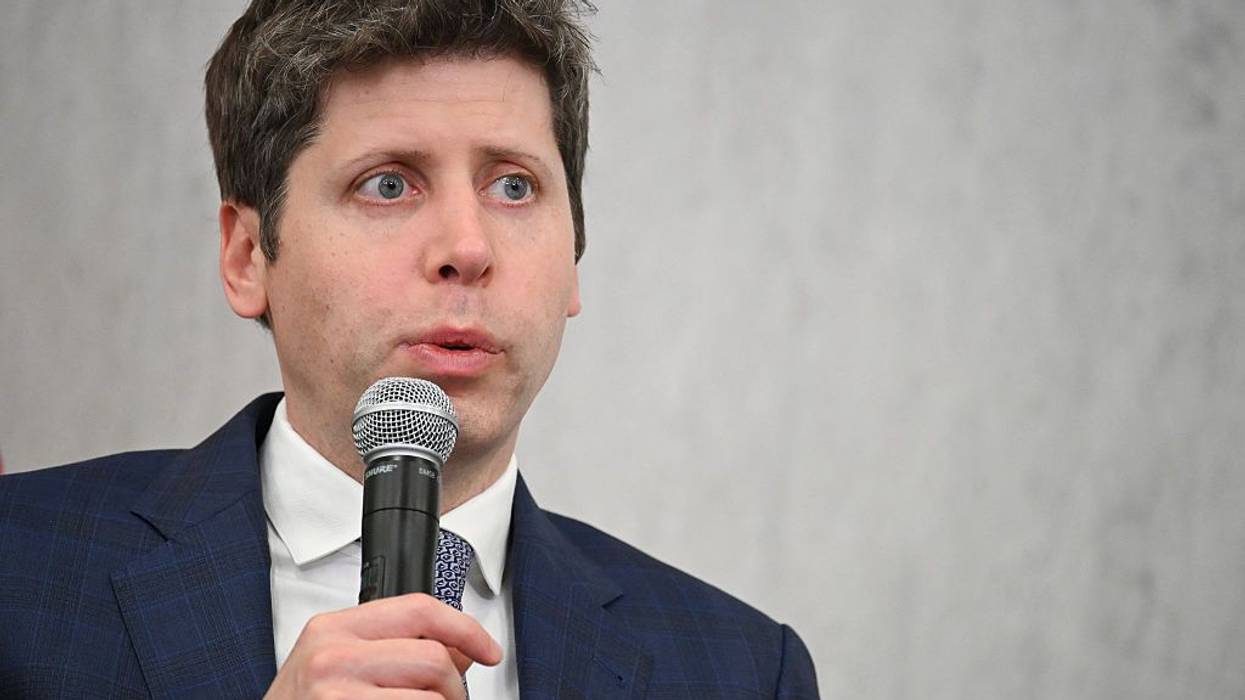
"The federal government shares the tech industry’s vision for AI to be embedded everywhere, displacing human thought and labor, and deepening the strains on the environment and climate."
With backlash against the artificial intelligence industry growing throughout the US, one government watchdog has created a database to help keep tabs on the people it describes as the biggest "AI villains."
The Revolving Door Project on Thursday launched a webpage that tracks the actions of major players in the AI industry and their ties to President Donald Trump's administration.
"The Trump administration is all in on artificial intelligence," the Revolving Door Project explained. "The federal government shares the tech industry’s vision for AI to be embedded everywhere, displacing human thought and labor, and deepening the strains on the environment and climate."
The watchdog added that the government is pursuing an "AI first" policy "despite little proof that its value for the American public is anywhere close to commensurate with its costs."
While there are several well known names on the Revolving Door Project's list—including SpaceX CEO Elon Musk, OpenAI CEO Sam Altman, and Oracle co-founder Larry Ellison—it also shines a light on more obscure figures including Chris Lehane, director of government affairs at OpenAI, and Greg Brockman, president of OpenAI.
Lehane is notable due to his long connections to Democratic Party politics, including a stint as a special assistant counsel in the Clinton administration and work as deputy campaign manager for former Vice President Al Gore's 2000 presidential campaign. Since then, he has mostly done public relations work for Silicon Valley firms, including Airbnb and Coinbase.
According to The Revolving Door Project, Lehane during the second Trump administration has been a big proponent of an AI regulatory framework that he describes as "reverse federalism" that aims to shut down individual states' powers to put guardrails on the industry.
Brockman, meanwhile, is much more traditionally aligned with the GOP, as he and his wife were the largest donors to the MAGA, Inc. super PAC in 2025, and he is described by the watchdog as "a regular attendee at White House events throughout Trump’s second term."
This coziness has helped Brockman push for policies beneficial to the AI industry such as fast-tracking data center construction and the aforementioned "reverse federalism" regulatory framework.
The Revolving Door Project also pays special attention to Marc Andreesen, co-founder of venture capital firm Andreessen Horowitz (a16z), whose allies the watchdog describes as "deeply entrenched" in the Trump administration.
Among the Andreesen acolytes to have worked in the Trump are Sriram Krishnan, a former general partner at a16z who served as a senior AI policy advisor; Peter Bowman-Davis, former engineering fellow at a16z who served as acting chief AI officer at the Department of Health and Human Services; and Scott Kupor, former managing partner at a16z who serves as director of the Office of Personnel Management.
Andreesen himself serves as a member of the President’s Council of Advisors on Science and Technology, which the Revolving Door Project describes as a "vessel... to freely lobby on behalf of the tech industry’s interests without the need for lobbyist intermediaries—especially at meetings with the president and his closest advisors."
In a newsletter explaining the purpose of the tracker, the Revolving Door Project's Fletcher Calcagno wrote that it was needed to help understand why the Trump administration so far has been willing to "accept Big Tech’s maximally irresponsible recommendations" for AI regulation.

"Having to hire human workers who might have pesky demands for more pay, better hours, or better working conditions is but a nuisance to them," one software engineer wrote about tech industry bosses.
A leading billionaire right-wing donor and tech evangelist raised eyebrows during a podcast appearance this week with a blunt explanation for why he believes artificial intelligence is superior to human workers.
The past few months have seen a wave of tech industry layoffs that companies have acknowledged were driven wholly or in part by AI: From Meta, which slashed 8,000 jobs on Wednesday and reassigned thousands of other workers to AI roles; to Intuit, which announced a cut of about 17% of its workforce the same day to put more focus on the emerging technology.
The venture capitalist Marc Andreessen, who leads one of Silicon Valley's most powerful venture capital firms, Andreessen Horowitz, declared as recently as last month that despite report after report of mass layoffs, "‘AI job loss’ narratives are all fake,” and the industry would facilitate a "massive jobs boom" because it allows individual workers to be "endlessly more productive."
But during an appearance on The Joe Rogan Experience on Tuesday, he seemed to suggest that he viewed the human workforce as not only inferior to AI but also an expendable nuisance that employers would be better off without.
He imagined the programmer of the future "overseeing an org chart of bots" numbering in the thousands, which would go on to exponentially increase productivity.
This, he said, is preferable to the current, inefficient model of hiring human laborers. He used the example of the graphic design work on Rogan's set to illustrate the point.
"You hire somebody... and you tell them you want a screen display and you want it to be an animated version of the thing you got back here," he said. "They spend, you know, two weeks doing it. It's like, 'Okay, that's pretty good, but I actually want the whole thing to be whatever, purple and green.' And they spend a week doing that. And they come back, and you're like, 'I actually prefer the old version.'"
“The guy gets, like, pissed at you because he’s like, ‘I just wasted my time.’ The bot’s like, 'No problem,' you know, no sweat, like whatever you want, and we can try it 12 more times if you want. Or you tell it, you know, this is terrible. Like, I can’t believe you came back to me with this. It has all these bugs. It’s like, ‘Oh, I’m so sorry. I’ll go fix these.’"
"By the way, [it] never gets drunk, never gets sick, never gets high," he continued.
"Never gets depressed because his girlfriend broke up with him," Rogan interjected.
"Never files HR complaints," Andreessen added.
Andreessen said this mass adoption of "armies" of AI workers would begin in tech fields like coding, but would quickly expand out to other fields like writing, medicine, and law.
He described artificial intelligence as technology that would grant workers a "universal basic superpower." But while some proponents of AI expansion imagine it as a tool to liberate workers from long hours by automating menial tasks, Andreessen said it was actually doing the opposite for workers in the coding world.
He said one would assume that “if AI coding makes them four times more productive... then maybe they’re working only a fourth the time and now they’ve got a great life,” but “what’s actually happened is virtually to a person, they’re all working more hours than ever to the point where there is a new term of art that’s used in the valley called the ‘AI vampire.’”
“You’re up all night doing AI coding because you are so productive," Andreessen said approvingly. "You’re getting so much done that you can’t turn off. The opportunity cost of going to sleep is too high because if you go to sleep, you won’t be with your 20 AI coding agents, keeping them working on all the projects that you have them working on. And so people stop sleeping.”
"They're clearly, clearly, clearly not taking care of themselves, and they're absolutely ecstatic," Andreessen said, "because they are able to produce five times, 20 times more code per hour than they could in the past."
The comments drew widespread backlash from critics across the political spectrum, who noted Andreessen's cavalier disregard for the fate of human workers in his imagined future scenario.
His mention of "HR complaints" in particular raised red flags for those who noted that the male-dominated worlds of Silicon Valley and venture capitalism have had many high-profile sexual harassment scandals.
But more broadly, it was interpreted as an expression of contempt for workers who demand a modicum of dignity from their jobs.
One software developer, who writes the Substack blog Dialectics of Decline on Substack under the name Scarlet, described Andreessen's comments as an encapsulation of an attitude that she recently said was "destroying the career I once loved."
I noticed that my bosses were getting infected with the mind virus sold to them by the AI hype men. They started to believe we weren’t needed anymore, or, if we were, we were now capable of producing 10x the amount of code in the same amount of time...
Having to hire human workers who might have pesky demands for more pay, better hours, or better working conditions is but a nuisance to them. They want to streamline their businesses by—ideally—not needing to hire humans at all. They are being sold a dream of a 100% agent-operated business where they purchase tokens instead of labor hours, and at a fraction of the cost. After all, agents won’t ever try to unionize. They don’t need weekends off. They don’t get sick or fall pregnant. They can’t strike. They won’t fight back.
It’s a mindset that Andreessen—one of the most prominent fixtures of the so-called “tech right” that spent big to elect Trump in 2024—is apparently seeking to export to the entire country.
Andreessen Horowitz and its billionaire founders have dumped an unprecedented $115 million to influence elections in the 2026 midterm cycle, more than other more prominent donors like Elon Musk and George Soros.
According to a report last week from the New York Times:
Already Andreessen Horowitz has put $47.5 million into the crypto super PAC network, Fairshake, since Election Day 2024. And the firm’s interests have expanded beyond crypto. It helped found Leading the Future, a super PAC network focused on electing pro-artificial intelligence legislators, which is modeled on Fairshake, and donated $50 million to it. Fairshake and Leading the Future both back Republicans and Democrats.
Andreessen Horowitz and its co-founders have also together donated $12 million to MAGA Inc., President Trump’s super PAC, including $6 million in March. A trust linked to Mr. Andreessen donated nearly $900,000 to the Republican National Committee that same month.
Andreessen's comments on Rogan's show inspired calls from progressive legislators, including Silicon Valley's Rep. Ro Khanna (D-Calif.), who said it was an example of why Washington should "tax agentic AI more than workers" rather than providing tax breaks to companies that invest in AI infrastructure.
But the influence of tech oligarchs like Andreessen is also starting to unnerve some on the right, like the influential conservative pundit James Lindsay, who said he was getting "really sick of anti-human tech weirdos leading anything."