SUBSCRIBE TO OUR FREE NEWSLETTER
Daily news & progressive opinion—funded by the people, not the corporations—delivered straight to your inbox.
5
#000000
#FFFFFF
To donate by check, phone, or other method, see our More Ways to Give page.


Daily news & progressive opinion—funded by the people, not the corporations—delivered straight to your inbox.
"The oil industry's allies in Congress are ignoring public opinion and the undeniable realities of the climate crisis by moving to drill on the sacred Coastal Plain and endanger the freedom of local communities."
Indigenous leaders joined with climate and wildlife defenders on Friday to blast President Donald Trump's administration and Republicans in Congress over the newly announced fossil fuel lease sale for the Arctic National Wildlife Refuge's Coastal Plain in Alaska.
The US Department of the Interior's Bureau of Land Management revealed Friday that it will hold the first of four legally mandated lease sales on June 5. The so-called One Big Beautiful Bill Act—which congressional Republicans passed and Trump signed last summer—requires BLM to hold the other three sales by 2035.
ANWR's Coastal Plain spans over 1.5 million acres and is known for its biodiversity. As a BLM webpage details, it is also believed to contain 4.25-11.8 billion barrels of "technically recoverable oil," according to US Geological Survey estimates.
Trump returned to the White House last year backed by Big Oil's campaign cash, and his deputy interior secretary, Kate MacGregor, said Friday that "after three acts of Congress and several successful lawsuits making it abundantly clear that oil and gas leasing in this area of Alaska is lawful, it is a great honor to once again announce another Coastal Plain lease sale."
MacGregor framed the forthcoming sale as just one piece of the administration's pro-fossil fuel agenda, adding that "President Trump has long supported Alaska's important contribution to American energy dominance, and Interior is proud to take the necessary and durable steps to unleash these important resources on behalf of the American people."
Earlier attempts to open up ANWR to drilling suggest that the sale may not draw much industry interest. Taxpayers for Common Sense pointed out Friday that two previous ones required by the Trump GOP's Tax Cut and Jobs Act "were originally estimated to bring taxpayers almost $1 billion in revenue but fell far short of this projection. The first lease sale, held in January 2021, brought in just $16.5 million. The second lease sale, held in January 2025, attracted no bidders and generated no revenue."
However, as the Anchorage Daily News reported, the plan for the next sale "comes on the heels of another recent lease sale, in the National Petroleum Reserve-Alaska to the west of the refuge, that drew heavy interest from oil companies," which "raises questions about how much bidding might occur in the refuge," particularly as Trump's war on Iran has driven up global oil prices.
Still, critics highlighted the previous ANWR sales—including the Wilderness Society's Alaska senior manager, Meda DeWitt, who said: "Once again, the oil industry's allies in Congress are ignoring public opinion and the undeniable realities of the climate crisis by moving to drill on the sacred Coastal Plain and endanger the freedom of local communities to sustain their cultures and lifestyles for generations to come."
"Two previous lease sales have already been economic failures, proving that the absurd Arctic Refuge leasing program should be eliminated and permanent protection must be provided for the calving grounds of the Porcupine Caribou herd," DeWitt argued.
The Arctic Refuge is the crown jewel of the American National Wildlife Refuge System – opening it up to drilling endangers the wildlife and the indigenous communities who have called the refuge their home for thousands of years.
— Senate Energy Dems (@energydems.senate.gov) April 17, 2026 at 1:24 PM
America Fitzpatrick of the League of Conservation Voters (LCV) similarly said that "time and again, the American people have said that they oppose drilling in the Arctic Refuge. The last lease sale in 2024 yielded no bids. Drilling here is not only bad economic—it's reckless and wildly unpopular. Instead of further handcuffing us to be more dependent on fossil fuels, the administration should focus on prioritizing cleaner, more affordable, and more reliable energy sources like clean energy."
"We simply cannot drill our way out of high energy costs," declared Fitzpatrick, the group's conservation program director. "The US is already producing more oil and gas than ever before, but when Trump forced a global energy crisis, prices skyrocketed once again. LCV stands with the Gwich'in people in their fight to ensure there is no drilling in the Arctic Refuge. Not now, not ever."
The Gwich'in, Indigenous people who live in Alaska and Canada, have long defended the refuge from fossil fuel intrusion, and are currently engaged in litigation over the Trump Interior Department's leasing program for the Coastal Plain.
"The Neets'ąįį Gwich'in have made our position clear that any development on the Coastal Plain would have irreversible, adverse effects on our people, our culture, and our way of life," Raeann Garnett, first chief of the Native Village of Venetie Tribal Government, said Friday. "This lease sale, once again, disregards our sovereignty and is a direct threat to the sacred land that sustains our people."
Karlas Norman, first chief of the Venetie Village Council, stressed that "no amount of money will make this land any less sacred to our people or any less vital to our way of life. The Trump administration's most recent actions to advance oil and gas development on the Coastal Plain does not change the fact that this land is sacred, that industry has walked away, and that the Gwich'in people will never stop fighting to protect it."
Galen Gilbert, first chief of the Arctic Village Council, charged that "the Trump administration's relentless push to auction off this sacred land despite overwhelming public opposition and industry that has already signaled they are not interested, makes clear that this administration values corporate interests over the rights and lives of Indigenous peoples."
Gilbert also vowed that "we will continue to fight with every tool available to protect the Coastal Plain for our children and all future generations."
Kristen Moreland, executive director of the Gwich'in Steering Committee, also pledged that "the Gwich’in Nation remains committed to be a voice for the caribou, and to fight oil and gas development in the Arctic Refuge."
"We condemn these efforts by the Trump administration to exploit the calving grounds of the Porcupine Caribou herd for short-term gain, and we know that the majority of Americans stand beside us in opposing development in this cherished and irreplaceable landscape," Moreland continued. "We have been raising our voices and fight[ing] for the protection of this sacred land and our way of life for decades—and we are not backing down now."
Also noting the US public's position, Andy Moderow, senior director of policy at Alaska Wilderness League, put pressure on the industry to stay away from the lease sale later this spring.
"For decades, the American people have recognized that the Arctic Refuge is not an industrial zone for oil development, and this sale simply runs counter to common sense," said Moderow. "Any oil and gas company that is even thinking about buying these leases should know that, if they do, they will be sending a clear message to the American people—that no place in Alaska is too sacred to drill in a quest for corporate profits. We urge companies to take a pass on the Arctic Refuge lease sale, and we look forward to rightfully restoring protections for this landscape in the years to come."
According to the Anchorage Daily News, "Elizabeth Manning, a spokesperson with Earthjustice, said in an email Friday that any new leases will be subject to a lawsuit brought by Natural Resources Defense Council, Center for Biological Diversity, and Friends of the Earth."
“Such corporate impunity would twist the knife of the climate crisis that is already directly harming people across the country," said one campaigner.
Green groups warned Friday that Big Oil-backed Republican legislation would give fossil fuel companies immunity from laws or lawsuits aimed at holding them accountable for their role in causing the climate emergency.
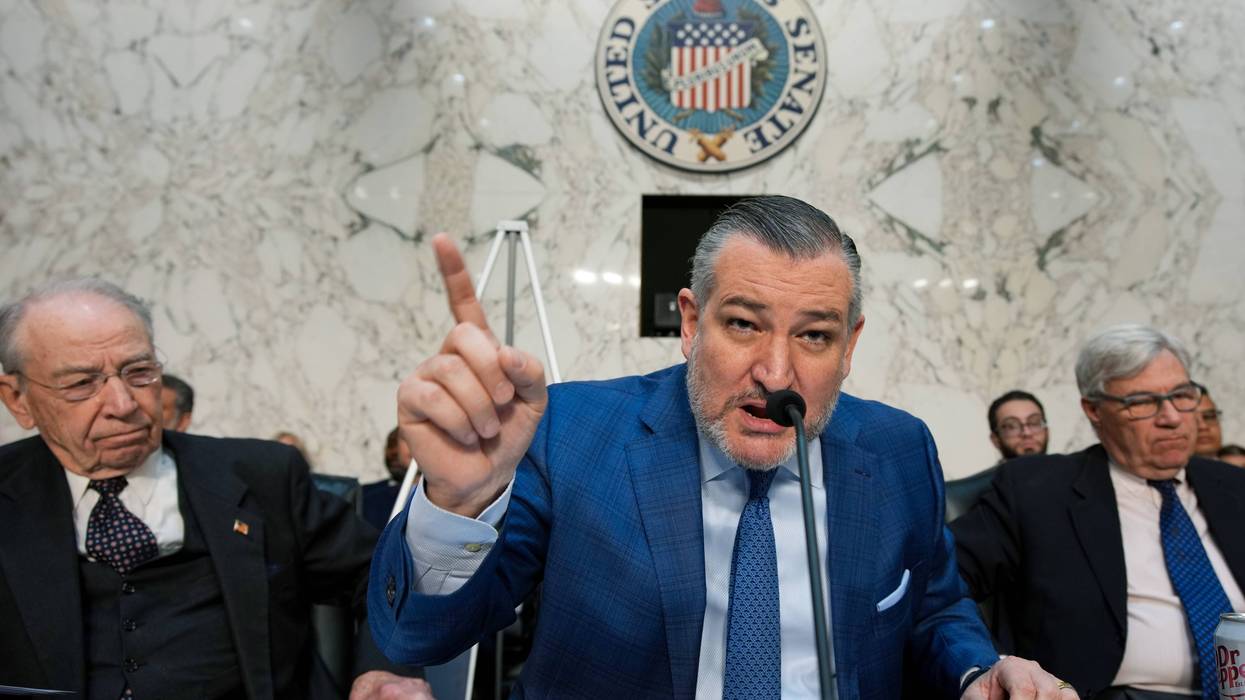
On Thursday, Sen. Ted Cruz (R-Texas) introduced a bill co-sponsored by Sens. Ted Budd (R-NC), Tom Cotton (R-Ark.), and Mike Lee (R-Utah) that, if passed, would "prohibit liability against those engaged in the mining, extraction, production, refinement, transportation, distribution, marketing, manufacture, or sale of energy for damages or injunctive or other relief from the use of their products, and for other purposes."
Congresswoman Harriet Hageman (R-Wyo.) on Friday introduced the House version of the legislation, dubbed the Stop Climate Shakedowns Act of 2026, "to protect American energy from leftist legal crusades punishing lawful activity," as her office put it.
🚨After months of fossil fuel industry lobbying, Republican lawmakers have introduced federal legislation that would give oil and gas companies immunity from any laws or lawsuits that aim to hold them accountable for their role in the climate crisis. Time to get loud: 📣 NO IMMUNITY FOR BIG OIL 📣
[image or embed]
— Center for Climate Integrity (@climateintegrity.org) April 17, 2026 at 12:30 PM
If passed, the legislation would ban retroactive climate liability lawsuits, dismiss any such litigation pending upon the law's enactment, void all state energy penalty laws, and affirm that the federal government maintains exclusive authority and jurisdiction over the regulation of greenhouse gas emissions and other interstate environmental standards.
Other Republican-controlled states including Tennesseee and Utah have recently passed such legislation, and others—including Iowa, Louisiana, and Oklahoma—have introduced similar bills.
“This blatant championing of some of the world’s largest polluters shows how far certain elected officials will go to undermine democratic policymaking and deny people and communities access to justice," Kathy Mulvey, climate accountability campaign director at the Union of Concerned Scientists, said Friday.
"No company should be above the law, especially those that planned, funded, and continue to engage in a coordinated decadeslong campaign to protect their profits by deceiving the public and blocking climate action," Mulvey continued.
"Such corporate impunity would twist the knife of the climate crisis that is already directly harming people across the country," she added. "Congress must not capitulate to wealthy special interests. Communities deserve the right to hold polluters accountable for the deadly and costly harms they are causing.”
Former Democratic Washington Gov. Jay Inslee said in a statement that “every elected official who cares about the interests of their constituents more than those of corporate polluters should oppose this disgraceful proposal."
"Juries are a fundamental bastion of democracy, and it’s beyond dangerous to allow powerful and wealthy corporations to shield themselves from ever having to face jurors’ judgment," he added.
The Center for Climate Integrity said the bill "would put Big Oil above the law."
“Big Oil companies have raked in massive profits at the pump while lying to the American people about the catastrophic harm of their products, and now they want to deny Americans their rightful day in court and stick taxpayers with the bill for the mess they made," Center for Climate Integrity president Richard Wiles said Friday. "If fossil fuel companies have done nothing wrong, why do they need immunity?”
While these and other climate advocates denounced the bill, their congressional sponsors—and those lawmakers' fossil fuel industry campaign donors—applauded its introduction.
“Energy security is national security, and we will not self-sabotage our critical industries with a cascade of costly lawsuits and extreme penalties that jeopardize American drilling,” Hageman said in a statement. “America’s energy producers should be protected from the dangerous legal precedent that would be set by the retroactive punishment of lawful activity.”
American Fuel & Petrochemical Manufacturers president and CEO Chet Thompson and American Petroleum Institute president and CEO Mike Sommers said in a joint statement, "We thank Sen. Cruz and Rep. Hageman for introducing legislation to stop a growing patchwork of state laws and lawsuits that threaten American energy and risk raising costs for consumers.”
“These efforts to retroactively penalize companies for lawfully meeting consumer demand are misguided and counterproductive," the lobbyists added. "Congress should act decisively to reaffirm federal authority over national energy policy and end this activist-driven state overreach.”
Eleven states—California, Connecticut, Delaware, Hawaii, Maine, Massachusetts, Michigan, Minnesota, New Jersey, Rhode Island, and Vermont—along with the District of Columbia and dozens of city, county, and tribal governments have ongoing lawsuits seeking to hold fossil fuel companies accountable for lying to the public about their products’ role in causing and worsening climate change.
On Friday, the right-wing US Supreme Court unanimously issued an important procedural ruling that certain environmental damage lawsuits—in this case, one challenging Chevron's destruction of coastal wetlands in Louisiana—can be moved from state to generally friendlier federal courts. This, after a jury in Plaquemines Parish ordered Chevron and two other companies to pay $744 million in damages for harming coastal wetlands, a verdict that was appealed.
The US Supreme Court's decision came as its justices prepare to hear Suncor Energy Inc. v. County Commissioners of Boulder County, a case in which the plaintiffs—three Suncor entities and ExxonMobil—are seeking to relocate a climate damages lawsuit from Colorado to federal court.
Big Oil-backed efforts to relocate cases to friendlier forums come amid wins for climate defenders, most notably Held v. Montana, a historic 2024 state court ruling in favor of youth-led plaintiffs based on the Montana Constitution's right to "a clean and healthful environment."
"While others open wounds, we want to mend them and cure them," said Spanish Prime Minister Pedro Sánchez.
Arriving in Spain on Friday for a two-day visit that will center on a gathering of progressive leaders from more than 100 political parties across five continents, Brazilian President Luiz Inácio Lula da Silva emphasized that the summit was not "an anti-Trump meeting."
But the contrast between US President Donald Trump's violent foreign and domestic policies and the international meeting, which will focus on wage inequality and electoral strategy for progressives, was unmistakable as Spanish President Pedro Sánchez opened the gathering at a press conference in Barcelona on Friday.
"We want to double our efforts to work for peace and for a reinforced multilateral order. While others open wounds, we want to mend them and cure them,” said Sánchez.
Da Silva—who is commonly called Lula—and Sánchez, as well as other leaders who will be attending the weekend event, have spoken out forcefully against Trump's policies and the rise of the far right in the US, Germany, Italy, and other European countries.
Sánchez has refused to allow US fighter planes to use Spanish military bases for missions in the US-Israeli war on Iran and closed the country's airspace to American military aircraft—plus doubled down on his condemnation of Trump and Israeli Prime Minister Benjamin Netanyahu's war even after the US president threatened Spain with a trade embargo.
Lula expressed solidarity with Pope Leo this week after the pontiff denounced the Iran war, and Mexican President Claudia Sheinbaum, who will also attend the meeting, took aim last month at Trump's claim that her country is the "epicenter of cartel violence"—blaming the US for the flow of illegal weapons into Mexico.
Lula emphasized that the 3,000 attendees of the summit, which will include the IV Meeting in Defense of Democracy as well as a gathering called the Global Progressive Mobilization on Saturday, will "discuss the state of democracy, to see what went wrong and what we have to do to repair it."
The Brazilian president added that "Brazil and Spain are side by side in the trenches together."
“We are an example that it is possible to find solutions to problems without giving into the empty promises of extremism," said Lula. "Democracy must go beyond just voting and bring real benefits to people’s lives.”
Sánchez added that "in a world that doubts and fragments, Spain and Brazil open a new chapter convinced that our countries have something the world needs: the strength to build bridges where others raise walls."
The Global Progressive Mobilization meeting will include roundtables dedicated to discussing economic inequality and other issues at a time when, as one report showed earlier this month, the richest 0.1% of people on the planet are stashing more than $2.8 trillion in tax havens—more than the wealth owned by the entire bottom 50% of humanity.
The economic hardships of working people have only been exacerbated by the war on Iran, which has sent global energy prices soaring.
US Sen. Chris Murphy (D-Conn.) is the only federal US official planning to attend the gathering, while New York City Mayor Zohran Mamdani—who has swiftly taken steps toward enacting a universal childcare program and announced a plan to tax second homes valued at over $5 million since taking office in January, is scheduled to participate virtually.
Also on Saturday, Lula and Sánchez will host the IV Meeting in Defense of Democracy, a summit first held in 2024 with the aim of combating "extremism, polarization, and misinformation."
European Council President António Costa, South African President Cyril Ramaphosa, Colombian President Gustavo Petro, and leaders from Albania, Ghana, and Lithuania are among those attending the meeting on democracy.
Lula said the large number of attendees is evidence that progressive governments are winning more influence around the world despite the rise of authoritarian political parties.
"Our flock is growing. We must give hope to the world," said Lula. "Otherwise, what happened with [Nazi leader Adolf] Hitler is going to happen."
Economist Gabriel Zucman, who joined Mamdani this week in publishing an op-ed calling for an end to regressive tax systems and highlighting a proposal for a 2% tax on the wealth of those with more than €100 million, or $117 million, expressed hope that the global left is amassing power by building a cooperative international movement.
"The good news is that, from Zohran Mamdani and [Congresswoman] Alexandria Ocasio-Cortez in New York to Pedro Sánchez in Spain, from Lula in Brazil to [Green Party Leader] Zack Polanski in the UK, we may be seeing the early signs of a new cross-border alliance taking shape against global oligarchy," said Zucman. "And I have no doubt that in this fight—the defining battle of the 21st century—democracy will prevail. See you in Barcelona this weekend to press ahead!"
"The economic havoc wreaked by this war has damaged virtually every sector imaginable, and we need the BLS to factor in the full implications of what the war will mean for the American economy," the senator wrote.
As President Donald Trump's war in Iran fuels inflation across the US economy, Sen. Ed Markey wrote to the acting head of the US Bureau of Labor Statistics to demand updated consumer price data that accounts for these costs.
Markey (Mass.), the ranking Democrat on the Senate Committee on Small Business and Entrepreneurship, already wrote the acting commissioner of BLS, William Wiatrowski, once on March 9, to demand price updates back when the war was just over a week old. He said he received no response.
In a follow-up letter sent Friday, Markey said that in the intervening weeks, "the impact of the crisis has deepened considerably," with repeated blockages to the critical Strait of Hormuz disrupting the global trade of oil and other commodities.
Even with the strait reopened amid a tentative 10-day ceasefire between Israel and Lebanon, Iran has indicated it will not hesitate to close the waterway again if that agreement—which is already fraying after less than 24 hours—falls apart.
"The economic havoc wreaked by this war has damaged virtually every sector imaginable, and we need the BLS to factor in the full implications of what the war will mean for the American economy," Markey wrote.
He pointed out that since his last letter, average gas prices in the US had surpassed $4.00 per gallon, a 40% increase since the US and Israel launched the first attacks against Iran on February 28.
Citing data from the US Energy Information Administration, Markey wrote that "small businesses and individual car owners are struggling with the prospect of more than $540 per vehicle in added annual gas costs."
Beyond gas, he pointed to other steep price hikes: Fertilizer prices have shot up 30% since the war began, costs he warned would be pushed to consumers at grocery stores in the coming months. Where a month ago, grocery bills were predicted to rise 3% this year, the latest report from the Department of Agriculture now projects a more than 6% increase.
This is on top of rising transport costs due to higher jet fuel and diesel prices, which have led airlines to jack up baggage costs and shipping companies like UPS, Amazon, and FedEx to raise delivery fees.
"Increased transportation costs affect virtually every facet of the supply chains our economy relies on," Markey said. "And yet, we have yet to hear any concrete plan from the administration regarding an end to the conflict, a solution to alleviate these costs, or any attempt at providing relief for Americans.”
In recent days, Trump and his underlings have brushed aside concerns about sharp price hikes due to the war.
At an economic event in Las Vegas on Thursday, Trump described them as "fake inflation because of the fuel, the energy prices." He's previously suggested that price hikes from the war "didn’t matter" to him because they're "short-term" and that Americans concerned about their pocketbooks should care more about the threat of Iran.
Trump's approval rating on the economy hit its lowest point ever recorded this week, with just 40% approving of his handling of the economy compared to 59% disapproving in a Navigator Research poll published Thursday. In that same poll, more than two-thirds of Americans (68%) said the economy was in either "poor" or "not so good" shape.
When asked about these dismal polling numbers by a reporter on Thursday, Trump's top economic adviser, Scott Bessent, shrugged it off, saying that "in their heart of hearts," Americans "feel good" about the economy, and that he was "not sure what they're telling the survey people."
"Understandably, Americans remain skeptical that President Trump has a plan of any kind," Markey said. "They cannot afford to fly blind, as Trump apparently elects to."
The senator said: "Facing thousands of dollars in higher prices for gasoline, groceries, and utilities—not to mention the hundreds of billions of their taxpayer money that Trump is requesting to pay for the war itself—American families and small businesses must budget and plan for the future. BLS must put forward consumer price projections that reflect the disastrous consequences of Trump’s illegal war.”