

SUBSCRIBE TO OUR FREE NEWSLETTER
Daily news & progressive opinion—funded by the people, not the corporations—delivered straight to your inbox.
5
#000000
#FFFFFF
To donate by check, phone, or other method, see our More Ways to Give page.
Daily news & progressive opinion—funded by the people, not the corporations—delivered straight to your inbox.
"This is neither 'peace' nor 'strength,'" said one policy expert. "It's gruesome."
US Secretary of State Marco Rubio spoke publicly for the first time Wednesday about a shift in the Pentagon's boat bombing operations, in which the US in recent days has begun interdicting suspected refueling vessels for drug boats in Ecuador's territorial waters—but he made clear that the military is also still killing people aboard boats, as it did Wednesday in the latest bombing in the Caribbean.
US Southern Command announced that Joint Task Force Western Hemisphere—the recently rebranded name of the Trump administration's expanding military operation that it says is aimed at stopping drug trafficking—had executed its latest "lethal kinetic strike" on a boat operating along known "narco-trafficking routes in the Caribbean," killing three people that the US claimed were "narco-terrorists."
"Confirmed intelligence revealed the vessel's active involvement in narco-trafficking," said US Southern Command, releasing no evidence of the boat's illegal activities.
International legal experts have emphasized that the US is not in an authorized military conflict with drug cartels and that drug trafficking under international law is treated as a crime by law enforcement agencies—not as an act of force that the US can legally respond to with military action.
Officials and military service members involved in the strikes may be liable for war crimes or murder, experts have warned. Some of the at least 230 victims of the boat bombings since last September have been identified, with family members saying they were not even involved in drug trafficking.
Historian Alexander Aviña used the term "serial killer empire" to describe the Trump administration after the latest bombing.
Adam Isacson of the Washington Office on Latin America noted that the announcement by US Southern Command Wednesday night was the first in more than a year of attacks in which the strike order was "not attributed to a person."
Isacson also pointed out that according to Customs and Border Patrol data, there is little, if any, evidence that bombing boats and killing crew members and passengers in the Caribbean and eastern Pacific Ocean has done anything to stop the flow of drugs into the US.
Outside the US Embassy in Quito, Ecuador, Rubio told reporters Wednesday that as the US also begins conducting joint operations with Ecuador to interdict suspected refueling vessels in the country's territorial waters, "we have to operate according to their laws."
In those operations, people aboard the boats have been removed and handed over to Ecuadorian authorities before the US has conducted strikes.
Rubio at one point referred to the lethal boat bombings as operations that took place "earlier, last year," but also emphasized, "We still blow up ships if need be."
Brian Finucane of the International Crisis Group said the administration is continuing its campaign of "illegal killing in a make-believe war."
The latest boat bombing also came as Rubio announced that the US was designating Los Tiguerones, an Ecuadorian gang, as a foreign terrorist organization, empowering the administration to freeze the group's assets in US financial institutions.
The designation does not give the US the legal authority to carry out military strikes against Los Tiguerones or other gangs the administration has designated as terrorist groups—but a key element of Joint Task Force Western Hemisphere's expansion in Latin America has been joint military operations, including a US-Ecuadorian joint attack on a dairy farm where officials had claimed drug traffickers were operating.
The new designation "is part of [the administration's] narrative about a new 'War on Terror' against the narcos," said Finucane.
Glaeldys González Calanche, an analyst with the International Crisis Group, told The New York Times that Los Tiguerones has had diminishing power and influence in Ecuador in recent years and expressed surprise at the designation.
Ecuadorian gangs "operate at the lowest links of the chain" of drug trafficking operations in Latin America, González told the Times. “They provide services, like moving cargo from point A to point B. Ecuadorian groups are not decisive, they aren’t major players.”
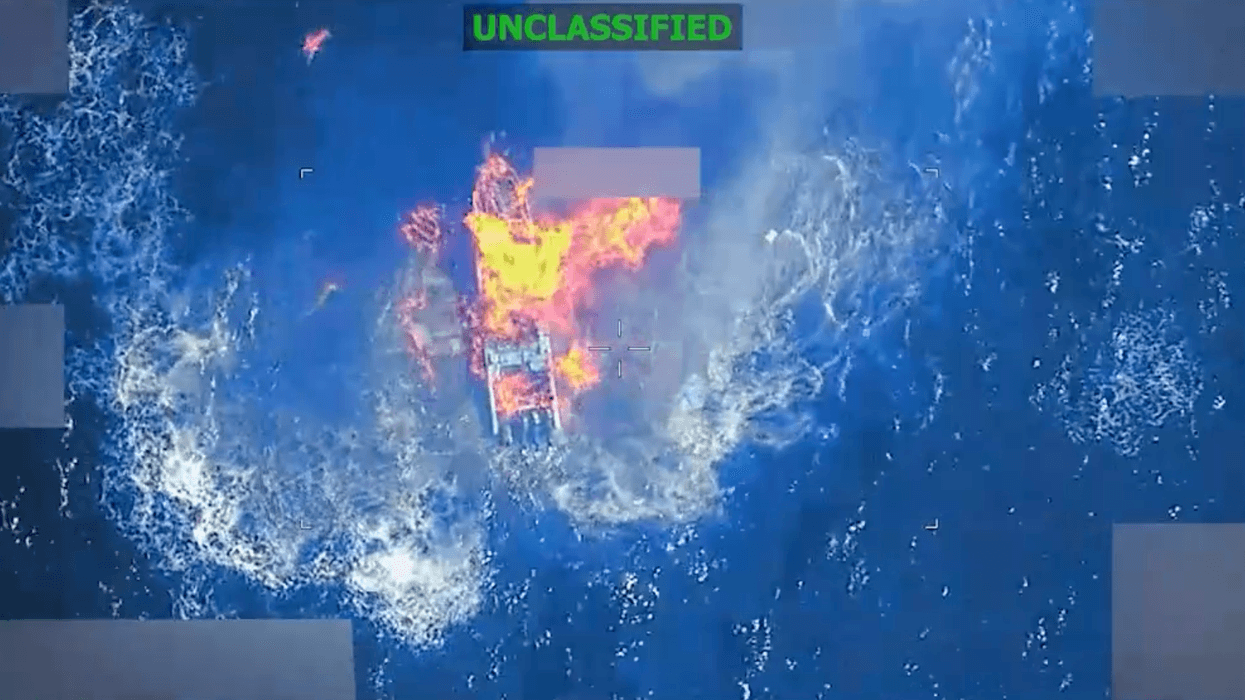
More than 200 people have been killed in US strikes targeting boats in the Caribbean Sea and Pacific Ocean that the Trump administration claimed—without providing evidence—were smuggling drugs.
The US military said Tuesday that one person was killed and two others survived the latest attack on a boat that the Trump administration claimed—again without providing concrete evidence—was involved in smuggling drugs in the eastern Pacific Ocean.
"On June 16, at the direction of the commander of US Southern Command Gen. Francis L. Donovan, Joint Task Force Southern Spear conducted a lethal kinetic strike on a vessel operated by Designated Terrorist Organizations," SOUTHCOM said in a statement.
"Intelligence confirmed the vessel was transiting along known narco-trafficking routes in the Eastern Pacific and was engaged in narco-trafficking operations," the statement continued. "One male narco-terrorist was killed during this action, and there were two male survivors."
SOUTHCOM added that it "immediately notified [the] US Coast Guard to activate the Search and Rescue system for the survivors."
It is not known whether the survivors were saved.
The attack—in which no US forces were harmed—was one of more than 60 that have occurred in the Caribbean Sea and Pacific Ocean since US President Donald Trump launched the campaign early last September. More than 200 people have been killed.
Relatives of people killed in some of the boat strikes, as well as officials in Venezuela and Colombia, say that at least some of the victims were fishers who were not part of the illicit drug trade.
Colombian President Gustavo Petro has accused the US of “murder." Venezuelan President Nicolás Maduro was abducted during a US invasion in January and imprisoned in the United States on dubious narco-terrorism charges.
In January, relatives of two Trinidadian fishers killed in the strikes filed a federal wrongful death lawsuit in Massachusetts.
Experts argue that the strikes are illegal. Adam Isacson of the Washington Office on Latin America previously said that even in cases of vessels that were involved in drug trafficking, the bombings were illegal and “the equivalent of straight-up massacring 16-year-old drug dealers on US street corners.”
Just Security editor-in-chief and New York University School of Law professor Ryan Goodman said last month that the “overwhelming consensus of experts, myself included, assess these to be murder because no armed conflict” is occurring, adding that they would be a “war crime if it were armed conflict"—and possibly even a "crime against humanity."
Responding to Tuesday's strike, former Human Rights Watch executive director Kenneth Roth lamented what he called "another Trump-authorized murder" and act of "blatant criminality."