SUBSCRIBE TO OUR FREE NEWSLETTER
Daily news & progressive opinion—funded by the people, not the corporations—delivered straight to your inbox.
5
#000000
#FFFFFF
To donate by check, phone, or other method, see our More Ways to Give page.
Daily news & progressive opinion—funded by the people, not the corporations—delivered straight to your inbox.
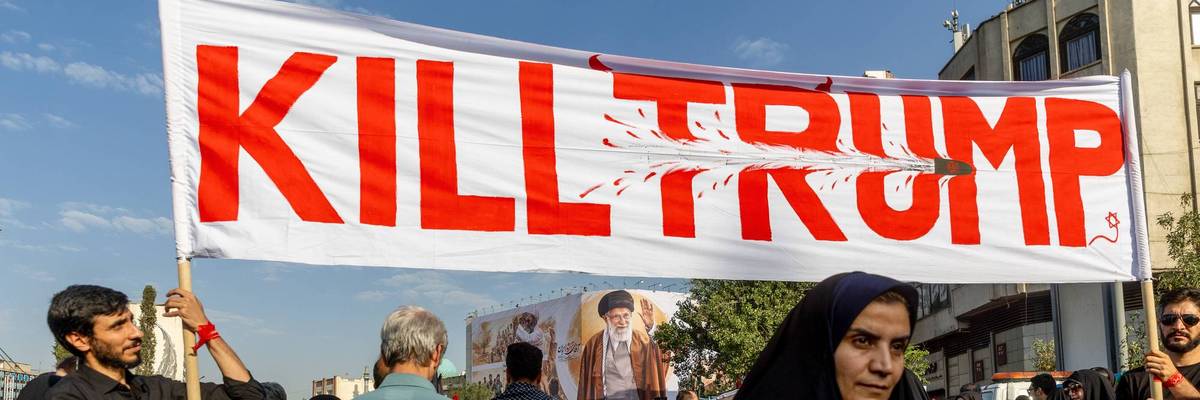
Mourners display a banner that reads, "Kill Trump" during the third day of funeral ceremonies for Iran's slain Supreme Leader Ayatollah Ali Khamenei on July 6, 2026 in Tehran, Iran.
When Netanyahu proposed to Trump that they embark on regime change in Iran by assassinating its top leadership, neither seems to have imagined that this action would come back to bite them.
Soon after the Israeli and US attacks on Iran assassinated its supreme leader, Ayatollah Ali Khamenei, and four of his family members, as well as other senior leaders, President Donald Trump urged Iranians to rise up, saying: “To the great proud people of Iran, I say tonight that the hour of your freedom is at hand. When we are finished, take over your government. It will be yours to take. This will be probably be your only chance for generations." Israeli Prime Minister Benjamin Netanyahu did the same in a video addressing the Iranian people, saying, “This is an opportunity that comes only once in every generation.” He called on them to “take to the streets in your millions and unite to bring down the ruling system.”
However, far from creating the outcome they fervently hoped for, the regime that emerged, after further assassinations, is “younger, savvier, ruthless, and more hard-line than ever.”
This is also evidenced by the choice of the second son of Khamenei as the new supreme leader. Mojtaba Khamenei (who was also injured in the attack on the Khamenei residence) was elected by a unanimous vote of the Assembly of Experts—after pressure by the Islamic Revolutionary Guard Corps (IRGC) with whom he has close ties. According to the Atlantic Council, “In political ideology and jurisprudence, Khamenei is considered to be more hard-line than his father.” Moreover, a source in Tehran notes: “They’ve just killed his family... He’s bloodthirsty now.”
The hard-liners appear to have further strengthened their hand during the recent week-long funeral events attended by millions. Ultra hard-line politicians are now publicly condemning the Iranian politicians involved in peace talks, including Parliamentary Speaker Mohammad Bagher Ghalibad and Foreign Minister Abbas Araghchi. This may account for the resumption of Iranian attacks on ships in the Strait of Hormuz in recent days—in spite of the ceasefire—which has led to several new rounds of fighting between the US and Iran.
The massive funeral event not only confirmed Khamenei’s status as a martyr, but also galvanized a tremendous desire for revenge in the Iranian population, with mourners waving red flags of revenge, chanting, “Death to America” and “Death to Israel,” and carrying signs calling for the killing of Trump and Netanyahu.
On the second day of the events, to thunderous applause, Poet Mohammad Resouli stated ominously: “Why is the most bastard man in the world still alive? The world is no longer a good place for Trump. Why should we not kill the man who killed our imam? It would be a disgrace if we did not.”
The attacks on Iran were, in fact, a violation of international law, since they do not meet the requirements of Article 51 of the United Nations Charter regarding the right to self-defense but, instead, violate Article 2(4), which states, “All Members shall refrain in their international relations from the threat or use of force against the territorial integrity or political independence of any state, or in any other manner inconsistent with the Purposes of the United Nations.”
In an article in The Guardian, entitled “Into the Void: How Trump Killed International Law,” the authors argue that “amid this chaos, there has been one consistent target for Trump’s contempt: the constraints imposed by international law, and its value system built around national sovereignty, including the prohibition of the use of force...” Indeed, in an interview with The New York Times in January, Trump made this point explicit: “I don’t need international law,” arguing that his power is limited only by “my own morality, my own mind.”
The killing of Khamenei was also in breach of the generally-accepted international taboo against the assassination of leaders. In fact, Trump also violated domestic US law—by violating Executive Order 11906, which states that “no employee of the United States Government shall engage in or conspire to engage in, political assassination.” This order, signed by President Gerald Ford 50 years ago, followed congressional investigations into previous US assassination plots against foreign leaders, such as Fidel Castro. Presidents Jimmy Carter and Ronald Reagan both broadened the scope of the ban, which is still in force, by dropping the “political” qualifier, making it illegal to “engage in assassination” per se.
Taboos such as these represent socially agreed-upon norms that certain actions are forbidden, and they play a crucial role in maintaining social order. Their codification in law helps to solidify the regulation of social interaction. Breaking a taboo can have serious consequences that, in extreme circumstances, can trigger violence.
In an article entitled, “Trump Opens the Pandora’s Box of Assassination,” Columbia University historian Timothy Naftali writes:
As killing foreign leaders gets easier for us, harming our leaders also presumably gets easier for others. The international taboo against foreign political assassinations has arguably had a stabilizing effect... To put a fine point on it, however tempting it may be to eliminate troublesome foreign leaders, no policy makers in a democracy wants to spark acts of retaliation that cost the lives of our own leaders in turn.
Luca Trenta and Arturo Jiminez-Bacardi, in “Khamenei Killing and the Perilous Death of the Assassination Ban,” suggest, “When a new Congress is sworn in next year, it should open an investigation into the Khamenei operation, hold public deliberations on the role of assassination in US foreign policy, and finally enact a statutory ban that unambiguously prohibits and criminalizes assassination once and for all.”
It has been argued that both the US and Israel began lowering their restrictions to the taboo on assassinations (or “targeted killings” as the US likes to call them or “eliminations” as the Israelis call them) in response to major terrorist attacks.
After the horrendous events of 9/11, and during the subsequent “war on terror,” it became common practice for the US to assassinate al-Qaeda operatives, including Osama-bin-Laden, as well as “terrorists” from other groups. Wikipedia offers a long list.
At the end of Trump’s first term, the US took a step closer to assassinating members of government when, on January 3, 2020, it assassinated Qasem Soleimani, “the second most powerful man in Iran,” who was commander of the Quds Force branch of the IRGC—justifying it by calling him a “terrorist” and providing a long list of grievous abuses.
However, it wasn’t long before the dangers of this action became evident, as US authorities uncovered several plots by Iranians to assassinate Trump administration officials associated with the killing, including Trump himself.
Israel also seemed to have increased its policy of “eliminations” following the horrific October 7, 2023 events, by assassinating the Hamas leader, Ismail Haniyeh, in Tehran in July 2024 and Hezbollah leader, Hassan Nasrallah, in September 2024, as well as many others. A long list is also available on Wikipedia.
Clearly, Trump is already feeling the heat from the Khamenei assassination. In a news conference at the end of the recent NATO summit in Türkiye, he said, “I’m No. 1 on the kill list for Iran,” joking that he would rather be “No. 1 on TikTok.” He added: “They had leaders; they’re gone, and they had another set of leaders; they’re gone. Now they have another set of leaders, they may be gone, who knows, and you know, I may be gone too, because I’m their No. 1 target.”
Indeed, because of concerns for his security, the Secret Service urged Trump to fly from Türkiye to the UK on the old Air Force One (which he did) rather than taking the retrofitted Qatari-gifted plane, since there are questions about whether the new Air Force One has the same defensive systems as the old one.
The intense Iranian desire for revenge will be likely to plague Trump, Netanyahu, members of their administrations, and their security services into the foreseeable future.
Surely it would have been much wiser to have adhered to international and domestic law and to have respected the taboo on the assassination of leaders. After all, this is what international law and established taboos are meant to do—establish rules of behavior to protect the social and international order.
As Trenta and Jimenez-Bacardi state:
The political vacuums that follow the assassination of heads of state can lead to civil war, chaos, unrest, and cycles of revenge. The Khamenei assassination has already turned into a regional war and sparked a global economic crisis. Simply put, a new era of political assassinations is likely to make the world less safe.
Let us hope that the revenge currently being called for in Iran never eventuates. Not only would it be tragic for a US president to be assassinated, but it could also be disastrous for Iran, since Trump has vowed that he would destroy the country in the event that it were successful in assassinating him, saying: “That would be the end. I’ve left instructions, if they do it, they get obliterated, there won’t be anything left.”
This has to be taken seriously since it could lead to even more unspeakable outcomes, potentially the breaking of another crucial taboo—on the use of nuclear weapons.
Dear Common Dreams reader, It’s been nearly 30 years since I co-founded Common Dreams with my late wife, Lina Newhouser. We had the radical notion that journalism should serve the public good, not corporate profits. It was clear to us from the outset what it would take to build such a project. No paid advertisements. No corporate sponsors. No millionaire publisher telling us what to think or do. Many people said we wouldn't last a year, but we proved those doubters wrong. Together with a tremendous team of journalists and dedicated staff, we built an independent media outlet free from the constraints of profits and corporate control. Our mission has always been simple: To inform. To inspire. To ignite change for the common good. Building Common Dreams was not easy. Our survival was never guaranteed. When you take on the most powerful forces—Wall Street greed, fossil fuel industry destruction, Big Tech lobbyists, and uber-rich oligarchs who have spent billions upon billions rigging the economy and democracy in their favor—the only bulwark you have is supporters who believe in your work. But here’s the urgent message from me today. It's never been this bad out there. And it's never been this hard to keep us going. At the very moment Common Dreams is most needed, the threats we face are intensifying. We need your support now more than ever. We don't accept corporate advertising and never will. We don't have a paywall because we don't think people should be blocked from critical news based on their ability to pay. Everything we do is funded by the donations of readers like you. When everyone does the little they can afford, we are strong. But if that support retreats or dries up, so do we. Will you donate now to make sure Common Dreams not only survives but thrives? —Craig Brown, Co-founder |
Soon after the Israeli and US attacks on Iran assassinated its supreme leader, Ayatollah Ali Khamenei, and four of his family members, as well as other senior leaders, President Donald Trump urged Iranians to rise up, saying: “To the great proud people of Iran, I say tonight that the hour of your freedom is at hand. When we are finished, take over your government. It will be yours to take. This will be probably be your only chance for generations." Israeli Prime Minister Benjamin Netanyahu did the same in a video addressing the Iranian people, saying, “This is an opportunity that comes only once in every generation.” He called on them to “take to the streets in your millions and unite to bring down the ruling system.”
However, far from creating the outcome they fervently hoped for, the regime that emerged, after further assassinations, is “younger, savvier, ruthless, and more hard-line than ever.”
This is also evidenced by the choice of the second son of Khamenei as the new supreme leader. Mojtaba Khamenei (who was also injured in the attack on the Khamenei residence) was elected by a unanimous vote of the Assembly of Experts—after pressure by the Islamic Revolutionary Guard Corps (IRGC) with whom he has close ties. According to the Atlantic Council, “In political ideology and jurisprudence, Khamenei is considered to be more hard-line than his father.” Moreover, a source in Tehran notes: “They’ve just killed his family... He’s bloodthirsty now.”
The hard-liners appear to have further strengthened their hand during the recent week-long funeral events attended by millions. Ultra hard-line politicians are now publicly condemning the Iranian politicians involved in peace talks, including Parliamentary Speaker Mohammad Bagher Ghalibad and Foreign Minister Abbas Araghchi. This may account for the resumption of Iranian attacks on ships in the Strait of Hormuz in recent days—in spite of the ceasefire—which has led to several new rounds of fighting between the US and Iran.
The massive funeral event not only confirmed Khamenei’s status as a martyr, but also galvanized a tremendous desire for revenge in the Iranian population, with mourners waving red flags of revenge, chanting, “Death to America” and “Death to Israel,” and carrying signs calling for the killing of Trump and Netanyahu.
On the second day of the events, to thunderous applause, Poet Mohammad Resouli stated ominously: “Why is the most bastard man in the world still alive? The world is no longer a good place for Trump. Why should we not kill the man who killed our imam? It would be a disgrace if we did not.”
The attacks on Iran were, in fact, a violation of international law, since they do not meet the requirements of Article 51 of the United Nations Charter regarding the right to self-defense but, instead, violate Article 2(4), which states, “All Members shall refrain in their international relations from the threat or use of force against the territorial integrity or political independence of any state, or in any other manner inconsistent with the Purposes of the United Nations.”
In an article in The Guardian, entitled “Into the Void: How Trump Killed International Law,” the authors argue that “amid this chaos, there has been one consistent target for Trump’s contempt: the constraints imposed by international law, and its value system built around national sovereignty, including the prohibition of the use of force...” Indeed, in an interview with The New York Times in January, Trump made this point explicit: “I don’t need international law,” arguing that his power is limited only by “my own morality, my own mind.”
The killing of Khamenei was also in breach of the generally-accepted international taboo against the assassination of leaders. In fact, Trump also violated domestic US law—by violating Executive Order 11906, which states that “no employee of the United States Government shall engage in or conspire to engage in, political assassination.” This order, signed by President Gerald Ford 50 years ago, followed congressional investigations into previous US assassination plots against foreign leaders, such as Fidel Castro. Presidents Jimmy Carter and Ronald Reagan both broadened the scope of the ban, which is still in force, by dropping the “political” qualifier, making it illegal to “engage in assassination” per se.
Taboos such as these represent socially agreed-upon norms that certain actions are forbidden, and they play a crucial role in maintaining social order. Their codification in law helps to solidify the regulation of social interaction. Breaking a taboo can have serious consequences that, in extreme circumstances, can trigger violence.
In an article entitled, “Trump Opens the Pandora’s Box of Assassination,” Columbia University historian Timothy Naftali writes:
As killing foreign leaders gets easier for us, harming our leaders also presumably gets easier for others. The international taboo against foreign political assassinations has arguably had a stabilizing effect... To put a fine point on it, however tempting it may be to eliminate troublesome foreign leaders, no policy makers in a democracy wants to spark acts of retaliation that cost the lives of our own leaders in turn.
Luca Trenta and Arturo Jiminez-Bacardi, in “Khamenei Killing and the Perilous Death of the Assassination Ban,” suggest, “When a new Congress is sworn in next year, it should open an investigation into the Khamenei operation, hold public deliberations on the role of assassination in US foreign policy, and finally enact a statutory ban that unambiguously prohibits and criminalizes assassination once and for all.”
It has been argued that both the US and Israel began lowering their restrictions to the taboo on assassinations (or “targeted killings” as the US likes to call them or “eliminations” as the Israelis call them) in response to major terrorist attacks.
After the horrendous events of 9/11, and during the subsequent “war on terror,” it became common practice for the US to assassinate al-Qaeda operatives, including Osama-bin-Laden, as well as “terrorists” from other groups. Wikipedia offers a long list.
At the end of Trump’s first term, the US took a step closer to assassinating members of government when, on January 3, 2020, it assassinated Qasem Soleimani, “the second most powerful man in Iran,” who was commander of the Quds Force branch of the IRGC—justifying it by calling him a “terrorist” and providing a long list of grievous abuses.
However, it wasn’t long before the dangers of this action became evident, as US authorities uncovered several plots by Iranians to assassinate Trump administration officials associated with the killing, including Trump himself.
Israel also seemed to have increased its policy of “eliminations” following the horrific October 7, 2023 events, by assassinating the Hamas leader, Ismail Haniyeh, in Tehran in July 2024 and Hezbollah leader, Hassan Nasrallah, in September 2024, as well as many others. A long list is also available on Wikipedia.
Clearly, Trump is already feeling the heat from the Khamenei assassination. In a news conference at the end of the recent NATO summit in Türkiye, he said, “I’m No. 1 on the kill list for Iran,” joking that he would rather be “No. 1 on TikTok.” He added: “They had leaders; they’re gone, and they had another set of leaders; they’re gone. Now they have another set of leaders, they may be gone, who knows, and you know, I may be gone too, because I’m their No. 1 target.”
Indeed, because of concerns for his security, the Secret Service urged Trump to fly from Türkiye to the UK on the old Air Force One (which he did) rather than taking the retrofitted Qatari-gifted plane, since there are questions about whether the new Air Force One has the same defensive systems as the old one.
The intense Iranian desire for revenge will be likely to plague Trump, Netanyahu, members of their administrations, and their security services into the foreseeable future.
Surely it would have been much wiser to have adhered to international and domestic law and to have respected the taboo on the assassination of leaders. After all, this is what international law and established taboos are meant to do—establish rules of behavior to protect the social and international order.
As Trenta and Jimenez-Bacardi state:
The political vacuums that follow the assassination of heads of state can lead to civil war, chaos, unrest, and cycles of revenge. The Khamenei assassination has already turned into a regional war and sparked a global economic crisis. Simply put, a new era of political assassinations is likely to make the world less safe.
Let us hope that the revenge currently being called for in Iran never eventuates. Not only would it be tragic for a US president to be assassinated, but it could also be disastrous for Iran, since Trump has vowed that he would destroy the country in the event that it were successful in assassinating him, saying: “That would be the end. I’ve left instructions, if they do it, they get obliterated, there won’t be anything left.”
This has to be taken seriously since it could lead to even more unspeakable outcomes, potentially the breaking of another crucial taboo—on the use of nuclear weapons.
Soon after the Israeli and US attacks on Iran assassinated its supreme leader, Ayatollah Ali Khamenei, and four of his family members, as well as other senior leaders, President Donald Trump urged Iranians to rise up, saying: “To the great proud people of Iran, I say tonight that the hour of your freedom is at hand. When we are finished, take over your government. It will be yours to take. This will be probably be your only chance for generations." Israeli Prime Minister Benjamin Netanyahu did the same in a video addressing the Iranian people, saying, “This is an opportunity that comes only once in every generation.” He called on them to “take to the streets in your millions and unite to bring down the ruling system.”
However, far from creating the outcome they fervently hoped for, the regime that emerged, after further assassinations, is “younger, savvier, ruthless, and more hard-line than ever.”
This is also evidenced by the choice of the second son of Khamenei as the new supreme leader. Mojtaba Khamenei (who was also injured in the attack on the Khamenei residence) was elected by a unanimous vote of the Assembly of Experts—after pressure by the Islamic Revolutionary Guard Corps (IRGC) with whom he has close ties. According to the Atlantic Council, “In political ideology and jurisprudence, Khamenei is considered to be more hard-line than his father.” Moreover, a source in Tehran notes: “They’ve just killed his family... He’s bloodthirsty now.”
The hard-liners appear to have further strengthened their hand during the recent week-long funeral events attended by millions. Ultra hard-line politicians are now publicly condemning the Iranian politicians involved in peace talks, including Parliamentary Speaker Mohammad Bagher Ghalibad and Foreign Minister Abbas Araghchi. This may account for the resumption of Iranian attacks on ships in the Strait of Hormuz in recent days—in spite of the ceasefire—which has led to several new rounds of fighting between the US and Iran.
The massive funeral event not only confirmed Khamenei’s status as a martyr, but also galvanized a tremendous desire for revenge in the Iranian population, with mourners waving red flags of revenge, chanting, “Death to America” and “Death to Israel,” and carrying signs calling for the killing of Trump and Netanyahu.
On the second day of the events, to thunderous applause, Poet Mohammad Resouli stated ominously: “Why is the most bastard man in the world still alive? The world is no longer a good place for Trump. Why should we not kill the man who killed our imam? It would be a disgrace if we did not.”
The attacks on Iran were, in fact, a violation of international law, since they do not meet the requirements of Article 51 of the United Nations Charter regarding the right to self-defense but, instead, violate Article 2(4), which states, “All Members shall refrain in their international relations from the threat or use of force against the territorial integrity or political independence of any state, or in any other manner inconsistent with the Purposes of the United Nations.”
In an article in The Guardian, entitled “Into the Void: How Trump Killed International Law,” the authors argue that “amid this chaos, there has been one consistent target for Trump’s contempt: the constraints imposed by international law, and its value system built around national sovereignty, including the prohibition of the use of force...” Indeed, in an interview with The New York Times in January, Trump made this point explicit: “I don’t need international law,” arguing that his power is limited only by “my own morality, my own mind.”
The killing of Khamenei was also in breach of the generally-accepted international taboo against the assassination of leaders. In fact, Trump also violated domestic US law—by violating Executive Order 11906, which states that “no employee of the United States Government shall engage in or conspire to engage in, political assassination.” This order, signed by President Gerald Ford 50 years ago, followed congressional investigations into previous US assassination plots against foreign leaders, such as Fidel Castro. Presidents Jimmy Carter and Ronald Reagan both broadened the scope of the ban, which is still in force, by dropping the “political” qualifier, making it illegal to “engage in assassination” per se.
Taboos such as these represent socially agreed-upon norms that certain actions are forbidden, and they play a crucial role in maintaining social order. Their codification in law helps to solidify the regulation of social interaction. Breaking a taboo can have serious consequences that, in extreme circumstances, can trigger violence.
In an article entitled, “Trump Opens the Pandora’s Box of Assassination,” Columbia University historian Timothy Naftali writes:
As killing foreign leaders gets easier for us, harming our leaders also presumably gets easier for others. The international taboo against foreign political assassinations has arguably had a stabilizing effect... To put a fine point on it, however tempting it may be to eliminate troublesome foreign leaders, no policy makers in a democracy wants to spark acts of retaliation that cost the lives of our own leaders in turn.
Luca Trenta and Arturo Jiminez-Bacardi, in “Khamenei Killing and the Perilous Death of the Assassination Ban,” suggest, “When a new Congress is sworn in next year, it should open an investigation into the Khamenei operation, hold public deliberations on the role of assassination in US foreign policy, and finally enact a statutory ban that unambiguously prohibits and criminalizes assassination once and for all.”
It has been argued that both the US and Israel began lowering their restrictions to the taboo on assassinations (or “targeted killings” as the US likes to call them or “eliminations” as the Israelis call them) in response to major terrorist attacks.
After the horrendous events of 9/11, and during the subsequent “war on terror,” it became common practice for the US to assassinate al-Qaeda operatives, including Osama-bin-Laden, as well as “terrorists” from other groups. Wikipedia offers a long list.
At the end of Trump’s first term, the US took a step closer to assassinating members of government when, on January 3, 2020, it assassinated Qasem Soleimani, “the second most powerful man in Iran,” who was commander of the Quds Force branch of the IRGC—justifying it by calling him a “terrorist” and providing a long list of grievous abuses.
However, it wasn’t long before the dangers of this action became evident, as US authorities uncovered several plots by Iranians to assassinate Trump administration officials associated with the killing, including Trump himself.
Israel also seemed to have increased its policy of “eliminations” following the horrific October 7, 2023 events, by assassinating the Hamas leader, Ismail Haniyeh, in Tehran in July 2024 and Hezbollah leader, Hassan Nasrallah, in September 2024, as well as many others. A long list is also available on Wikipedia.
Clearly, Trump is already feeling the heat from the Khamenei assassination. In a news conference at the end of the recent NATO summit in Türkiye, he said, “I’m No. 1 on the kill list for Iran,” joking that he would rather be “No. 1 on TikTok.” He added: “They had leaders; they’re gone, and they had another set of leaders; they’re gone. Now they have another set of leaders, they may be gone, who knows, and you know, I may be gone too, because I’m their No. 1 target.”
Indeed, because of concerns for his security, the Secret Service urged Trump to fly from Türkiye to the UK on the old Air Force One (which he did) rather than taking the retrofitted Qatari-gifted plane, since there are questions about whether the new Air Force One has the same defensive systems as the old one.
The intense Iranian desire for revenge will be likely to plague Trump, Netanyahu, members of their administrations, and their security services into the foreseeable future.
Surely it would have been much wiser to have adhered to international and domestic law and to have respected the taboo on the assassination of leaders. After all, this is what international law and established taboos are meant to do—establish rules of behavior to protect the social and international order.
As Trenta and Jimenez-Bacardi state:
The political vacuums that follow the assassination of heads of state can lead to civil war, chaos, unrest, and cycles of revenge. The Khamenei assassination has already turned into a regional war and sparked a global economic crisis. Simply put, a new era of political assassinations is likely to make the world less safe.
Let us hope that the revenge currently being called for in Iran never eventuates. Not only would it be tragic for a US president to be assassinated, but it could also be disastrous for Iran, since Trump has vowed that he would destroy the country in the event that it were successful in assassinating him, saying: “That would be the end. I’ve left instructions, if they do it, they get obliterated, there won’t be anything left.”
This has to be taken seriously since it could lead to even more unspeakable outcomes, potentially the breaking of another crucial taboo—on the use of nuclear weapons.