SUBSCRIBE TO OUR FREE NEWSLETTER
Daily news & progressive opinion—funded by the people, not the corporations—delivered straight to your inbox.
5
#000000
#FFFFFF
To donate by check, phone, or other method, see our More Ways to Give page.
Daily news & progressive opinion—funded by the people, not the corporations—delivered straight to your inbox.
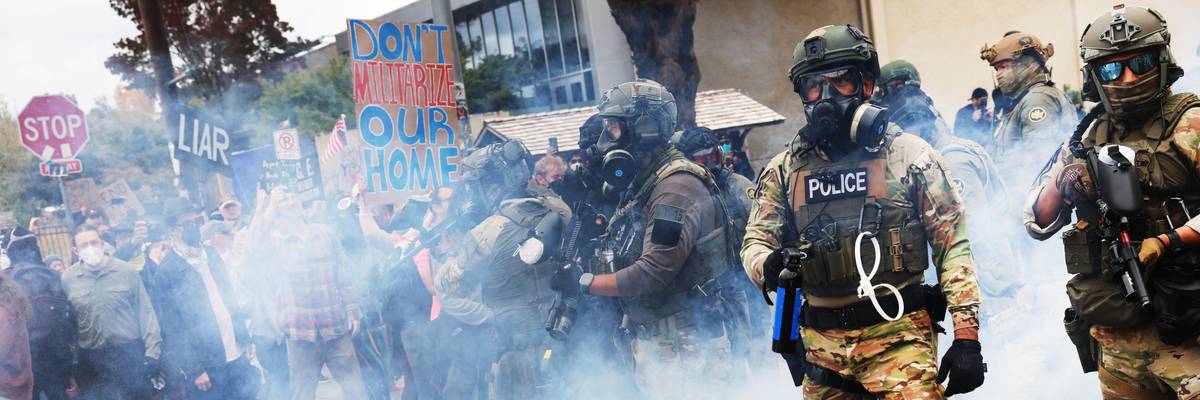
Federal agents, including members of the Department of Homeland Security, the Border Patrol, and police, clash with protesters outside a downtown U.S. Immigration and Customs Enforcement (ICE) facility on October 04, 2025 in Portland, Oregon.
Trump’s second term is indeed so much worse than the first, and I fear that we haven’t seen anything yet.
Does it feel like the Trumpian nightmare has been around forever? How and when will it end? Does Trump’s second term signify the end of the neoliberal order? Is his cronyism unique in the history of US capitalism? And why is the wannabe emperor of the world preparing to strike Venezuela?
Political scientist, political economist, author, and journalist C. J. Polychroniou takes a crack at these questions posed in the interview below by the French-Greek independent journalist and writer Alexandra Boutri.
Alexandra Boutri: Donald Trump’s second term in the White House began on January 20, 2025. Yet, although he has been in office for a little over 10 months, it already feels like he’s been there forever. Do you have that same odd feeling? If so, why is that?
C. J. Polychroniou: Yes, sometimes it does feel like he’s been in power forever because his actions as President during the relatively short time since his return to power have been appalling, marked by depraved cruelty, moral blindness, and unprecedented corruption. He has unleashed something utterly terrifying, chaos by distraction around the world and terror on the USA. The first tactic is part of his wish to reassert US dominance in global capitalism. The second tactic is part of his plan to spread fear and oppress all those who stand on his path of constructing a neofascist, white Christian America run by oligarchs. He is not just a pathological liar and the biggest con artist in US history, traits which the liberal media frequently applies to him, but also a malignant narcissist, a sadistic and tyrannical buffoon who believes he can do whatever he pleases, that is, operate outside his legal and constitutional authority, by virtue of the fact that he is in charge of the world’s most powerful nation. Trump hates democracy and the idea of an open society and detests the rule of law. Trump’s second term is indeed so much worse than the first, and I fear that we haven’t seen anything yet. The Trumpian nightmare is really just underway, and it will take a lot more resistance than what has already taken place to stop the dictator’s attacks against civil society, his destruction of the environment, and the acceleration of the climate crisis.
Alexandra Boutri: Trump’s approval ratings are sinking. Is this important? Can we subsequently hope to see a shift in some of his policies on account of the fact that his approval rating is dropping even among core Republican voters?
C. J. Polychroniou: I have looked closely at the latest data on Trump’s job approval rating and popularity. According to the most recent Gallop poll, Trump’s approval rating was at 36%. However, RealClear Polling shows that 42% of Americans approve of Trump’s job performance, which is utterly shocking considering the horrifying consequences of his actions. It is something that makes one wonder whether the real problem is Trump himself or a rather huge chuck of the US electorate. While I don’t know how important these job approval ratings really are, it is probably more important to look at Trump’s approval rating by state. There, we find that Trump’s popularity remains positive in Republican-dominated states, although the Gallop poll mentioned earlier also shows that Republicans’ approval has slipped by eight points. Equally worth noting is that Trump’s disapproval rating (55.3%) is not far off from what it was during his first term (54.9%), according to statistician and political analyst Nate Silver. In sum, Trump’s base is still very much with him and the main issue dividing his MAGA movement appears to be over the Epstein files! I do not have hopes for a shift in any of his odious and outright evil policies.
Alexandra Boutri: It has been said that Trump’s turn to protectionism is a death blow to neoliberalism and that what best describes his regime is cronyist state capitalism. What are your own thoughts on these matters? Has Trump abandoned neoliberalism?
C. J. Polychroniou: Politics and economics aren’t black and white. Politics is more of an art than science, and economics is definitely not a hard science. As academic disciplines, both politics and economics are regarded as social sciences. But while hard science is based on concrete laws, social science, though it can follow the scientific method, lacks universal laws and subjectivity all too often enters rather freely into analyses. As Richard Feynman once quipped, “Social science is an example of a science which is not a science….They follow the forms…but they don’t get any laws.”
To be more specific, there is no such thing as a “free market” and no such thing as a “pure” capitalist system. Neoliberalism, which relies heavily on free-markets and advocates privatization and marketization, has always depended on the state to carry out its anti-social agenda. The state not only shapes and enforces rules for markets but most of the major technological developments and innovations have been fueled by the federal government. Global neoliberalism itself has been a state-driven enterprise. It was initiated by the United States sometime around the mid-1970s and revolved around a regime of an unimpeded movement of capital, good and services. The global economy itself was regulated by global governance institutions such as the International Monetary Fund (IMF), the World Bank, and the World Trade Organization (WTO) although the United States itself played a significant role in enforcing the rules of global neoliberalism. The new political order in global economic affairs served quite well the United States on account of its financial hegemony, but China’s full integration into the global capitalist economy saw the rise of a new imperial power and its emergence as something of a model for the developing world. China’s growth over the past four decades was many times over that of the US. Eventually, China would displace the US and become the “manufacturing workshop of the world” and overtake the US to become the top trading partner to more than 140 countries.
Enter Trump. Since coming to power, Trump has been obsessed with the idea of bringing manufacturing back to the US and reducing the trade deficit. To do so, he inaugurated a new protectionist age, which is in full swing during his second term in office. Trump’s protectionist economic policies, which we should file under the label “economics nationalism,” represent a strategy for restoring US supremacy (and thus profitability) in global economics affairs and reindustrializing the United States. In practical terms, this means not only enforcing “reciprocal tariffs” on all countries exporting goods to the United States but using military force to regain hegemonic control over Latin America and the Pacific and threatening China into submission. I believe all these policies are destined to fail, rather miserably, while causing in the process a lot of pain and suffering to a lot of people.
Does Trump’s approach to global economic affairs represent the end of the neoliberal order? I don’t think so. What he is trying to do is “Make American Corporations Great Again.” He is trying to change the relation between state, corporations, and the world economy, not the nature of the global capitalist system. The main dynamic and contradiction will remain between capital and labor, exploitation and oppression. Other states will be even more inclined than before to resort to even more extreme forms of neoliberal capitalist exploitation for the benefit of their own capital bosses. Indeed, workers’ rights are collapsing across the world, according to the 2025 Global Rights Index published by the International Trade Union Confederation. On the domestic front, Trump’s policies are unmistakably neoliberal. In fact, he has gone beyond deregulation and liberalization by embarking on the grand project of making workers even more vulnerable to abuse by eliminating key workplace protections and making it even more difficult for them to form a union. And his whole approach to the environment is as neoliberal as it can get.
I have a rather similar line of analysis regarding the debate between crony capitalism (describing an economy of close relationship between businesspeople and government officials) and neoliberalism. First, capitalism coexists and connects with greed and corruption. In fact, cronyism is inherent to capitalism. Capitalism tends to oligopoly, which strengthens the relationship between key government officials and business people. The US has had a crony oligarchy all along. People speak today of Trump’s cronyism as if it is a new phenomenon in American capitalism when the reality is that it has been around for a very long time. The George W. Bush administration was accused in fact of taking cronyism to a new level. Now of course we can say with certainty that Trump has not only taken cronyism to a new level but is actually using the presidency for self-enrichment. But let’s not fool ourselves by thinking that cronyism has somehow surfaced in the US because of Donald Trump. As far as neoliberalism specifically is concerned, research has shown that the neoliberal policies promoted by the IMF in the developing world foster crony capitalism. In sum, I do not accept the distinction between cronyism and (neo)liberal capitalism.
Alexandra Boutri: Why is Trump preparing to strike Venezuela?
C. J. Polychroniou: I can think of a number of reasons. One is because of his need to manufacture crises in order to draw attention away from his domestic crimes and shenanigans. He also wants to bring down the Maduro regime because of its close ties to China and Russia. I think geopolitical calculations figure large in Trump’s plan to strike Venezuela and it’s part of a new strategy in Latin America with the intent being to reassert US dominance over a region that Washington used to control not long ago. The US military build-up in the Caribbean is not to fight drugs. Of course, don’t expect Trump to seek the authorization of Congress to wage war against Venezuela. And he won’t be the first president not to do so. Many presidents have acted without Congress declaring war. The imperial presidency was established long before Trump, although the orange man is bent on being both “imperial president at home and emperor abroad.”
Dear Common Dreams reader, It’s been nearly 30 years since I co-founded Common Dreams with my late wife, Lina Newhouser. We had the radical notion that journalism should serve the public good, not corporate profits. It was clear to us from the outset what it would take to build such a project. No paid advertisements. No corporate sponsors. No millionaire publisher telling us what to think or do. Many people said we wouldn't last a year, but we proved those doubters wrong. Together with a tremendous team of journalists and dedicated staff, we built an independent media outlet free from the constraints of profits and corporate control. Our mission has always been simple: To inform. To inspire. To ignite change for the common good. Building Common Dreams was not easy. Our survival was never guaranteed. When you take on the most powerful forces—Wall Street greed, fossil fuel industry destruction, Big Tech lobbyists, and uber-rich oligarchs who have spent billions upon billions rigging the economy and democracy in their favor—the only bulwark you have is supporters who believe in your work. But here’s the urgent message from me today. It's never been this bad out there. And it's never been this hard to keep us going. At the very moment Common Dreams is most needed, the threats we face are intensifying. We need your support now more than ever. We don't accept corporate advertising and never will. We don't have a paywall because we don't think people should be blocked from critical news based on their ability to pay. Everything we do is funded by the donations of readers like you. When everyone does the little they can afford, we are strong. But if that support retreats or dries up, so do we. Will you donate now to make sure Common Dreams not only survives but thrives? —Craig Brown, Co-founder |
Does it feel like the Trumpian nightmare has been around forever? How and when will it end? Does Trump’s second term signify the end of the neoliberal order? Is his cronyism unique in the history of US capitalism? And why is the wannabe emperor of the world preparing to strike Venezuela?
Political scientist, political economist, author, and journalist C. J. Polychroniou takes a crack at these questions posed in the interview below by the French-Greek independent journalist and writer Alexandra Boutri.
Alexandra Boutri: Donald Trump’s second term in the White House began on January 20, 2025. Yet, although he has been in office for a little over 10 months, it already feels like he’s been there forever. Do you have that same odd feeling? If so, why is that?
C. J. Polychroniou: Yes, sometimes it does feel like he’s been in power forever because his actions as President during the relatively short time since his return to power have been appalling, marked by depraved cruelty, moral blindness, and unprecedented corruption. He has unleashed something utterly terrifying, chaos by distraction around the world and terror on the USA. The first tactic is part of his wish to reassert US dominance in global capitalism. The second tactic is part of his plan to spread fear and oppress all those who stand on his path of constructing a neofascist, white Christian America run by oligarchs. He is not just a pathological liar and the biggest con artist in US history, traits which the liberal media frequently applies to him, but also a malignant narcissist, a sadistic and tyrannical buffoon who believes he can do whatever he pleases, that is, operate outside his legal and constitutional authority, by virtue of the fact that he is in charge of the world’s most powerful nation. Trump hates democracy and the idea of an open society and detests the rule of law. Trump’s second term is indeed so much worse than the first, and I fear that we haven’t seen anything yet. The Trumpian nightmare is really just underway, and it will take a lot more resistance than what has already taken place to stop the dictator’s attacks against civil society, his destruction of the environment, and the acceleration of the climate crisis.
Alexandra Boutri: Trump’s approval ratings are sinking. Is this important? Can we subsequently hope to see a shift in some of his policies on account of the fact that his approval rating is dropping even among core Republican voters?
C. J. Polychroniou: I have looked closely at the latest data on Trump’s job approval rating and popularity. According to the most recent Gallop poll, Trump’s approval rating was at 36%. However, RealClear Polling shows that 42% of Americans approve of Trump’s job performance, which is utterly shocking considering the horrifying consequences of his actions. It is something that makes one wonder whether the real problem is Trump himself or a rather huge chuck of the US electorate. While I don’t know how important these job approval ratings really are, it is probably more important to look at Trump’s approval rating by state. There, we find that Trump’s popularity remains positive in Republican-dominated states, although the Gallop poll mentioned earlier also shows that Republicans’ approval has slipped by eight points. Equally worth noting is that Trump’s disapproval rating (55.3%) is not far off from what it was during his first term (54.9%), according to statistician and political analyst Nate Silver. In sum, Trump’s base is still very much with him and the main issue dividing his MAGA movement appears to be over the Epstein files! I do not have hopes for a shift in any of his odious and outright evil policies.
Alexandra Boutri: It has been said that Trump’s turn to protectionism is a death blow to neoliberalism and that what best describes his regime is cronyist state capitalism. What are your own thoughts on these matters? Has Trump abandoned neoliberalism?
C. J. Polychroniou: Politics and economics aren’t black and white. Politics is more of an art than science, and economics is definitely not a hard science. As academic disciplines, both politics and economics are regarded as social sciences. But while hard science is based on concrete laws, social science, though it can follow the scientific method, lacks universal laws and subjectivity all too often enters rather freely into analyses. As Richard Feynman once quipped, “Social science is an example of a science which is not a science….They follow the forms…but they don’t get any laws.”
To be more specific, there is no such thing as a “free market” and no such thing as a “pure” capitalist system. Neoliberalism, which relies heavily on free-markets and advocates privatization and marketization, has always depended on the state to carry out its anti-social agenda. The state not only shapes and enforces rules for markets but most of the major technological developments and innovations have been fueled by the federal government. Global neoliberalism itself has been a state-driven enterprise. It was initiated by the United States sometime around the mid-1970s and revolved around a regime of an unimpeded movement of capital, good and services. The global economy itself was regulated by global governance institutions such as the International Monetary Fund (IMF), the World Bank, and the World Trade Organization (WTO) although the United States itself played a significant role in enforcing the rules of global neoliberalism. The new political order in global economic affairs served quite well the United States on account of its financial hegemony, but China’s full integration into the global capitalist economy saw the rise of a new imperial power and its emergence as something of a model for the developing world. China’s growth over the past four decades was many times over that of the US. Eventually, China would displace the US and become the “manufacturing workshop of the world” and overtake the US to become the top trading partner to more than 140 countries.
Enter Trump. Since coming to power, Trump has been obsessed with the idea of bringing manufacturing back to the US and reducing the trade deficit. To do so, he inaugurated a new protectionist age, which is in full swing during his second term in office. Trump’s protectionist economic policies, which we should file under the label “economics nationalism,” represent a strategy for restoring US supremacy (and thus profitability) in global economics affairs and reindustrializing the United States. In practical terms, this means not only enforcing “reciprocal tariffs” on all countries exporting goods to the United States but using military force to regain hegemonic control over Latin America and the Pacific and threatening China into submission. I believe all these policies are destined to fail, rather miserably, while causing in the process a lot of pain and suffering to a lot of people.
Does Trump’s approach to global economic affairs represent the end of the neoliberal order? I don’t think so. What he is trying to do is “Make American Corporations Great Again.” He is trying to change the relation between state, corporations, and the world economy, not the nature of the global capitalist system. The main dynamic and contradiction will remain between capital and labor, exploitation and oppression. Other states will be even more inclined than before to resort to even more extreme forms of neoliberal capitalist exploitation for the benefit of their own capital bosses. Indeed, workers’ rights are collapsing across the world, according to the 2025 Global Rights Index published by the International Trade Union Confederation. On the domestic front, Trump’s policies are unmistakably neoliberal. In fact, he has gone beyond deregulation and liberalization by embarking on the grand project of making workers even more vulnerable to abuse by eliminating key workplace protections and making it even more difficult for them to form a union. And his whole approach to the environment is as neoliberal as it can get.
I have a rather similar line of analysis regarding the debate between crony capitalism (describing an economy of close relationship between businesspeople and government officials) and neoliberalism. First, capitalism coexists and connects with greed and corruption. In fact, cronyism is inherent to capitalism. Capitalism tends to oligopoly, which strengthens the relationship between key government officials and business people. The US has had a crony oligarchy all along. People speak today of Trump’s cronyism as if it is a new phenomenon in American capitalism when the reality is that it has been around for a very long time. The George W. Bush administration was accused in fact of taking cronyism to a new level. Now of course we can say with certainty that Trump has not only taken cronyism to a new level but is actually using the presidency for self-enrichment. But let’s not fool ourselves by thinking that cronyism has somehow surfaced in the US because of Donald Trump. As far as neoliberalism specifically is concerned, research has shown that the neoliberal policies promoted by the IMF in the developing world foster crony capitalism. In sum, I do not accept the distinction between cronyism and (neo)liberal capitalism.
Alexandra Boutri: Why is Trump preparing to strike Venezuela?
C. J. Polychroniou: I can think of a number of reasons. One is because of his need to manufacture crises in order to draw attention away from his domestic crimes and shenanigans. He also wants to bring down the Maduro regime because of its close ties to China and Russia. I think geopolitical calculations figure large in Trump’s plan to strike Venezuela and it’s part of a new strategy in Latin America with the intent being to reassert US dominance over a region that Washington used to control not long ago. The US military build-up in the Caribbean is not to fight drugs. Of course, don’t expect Trump to seek the authorization of Congress to wage war against Venezuela. And he won’t be the first president not to do so. Many presidents have acted without Congress declaring war. The imperial presidency was established long before Trump, although the orange man is bent on being both “imperial president at home and emperor abroad.”
Does it feel like the Trumpian nightmare has been around forever? How and when will it end? Does Trump’s second term signify the end of the neoliberal order? Is his cronyism unique in the history of US capitalism? And why is the wannabe emperor of the world preparing to strike Venezuela?
Political scientist, political economist, author, and journalist C. J. Polychroniou takes a crack at these questions posed in the interview below by the French-Greek independent journalist and writer Alexandra Boutri.
Alexandra Boutri: Donald Trump’s second term in the White House began on January 20, 2025. Yet, although he has been in office for a little over 10 months, it already feels like he’s been there forever. Do you have that same odd feeling? If so, why is that?
C. J. Polychroniou: Yes, sometimes it does feel like he’s been in power forever because his actions as President during the relatively short time since his return to power have been appalling, marked by depraved cruelty, moral blindness, and unprecedented corruption. He has unleashed something utterly terrifying, chaos by distraction around the world and terror on the USA. The first tactic is part of his wish to reassert US dominance in global capitalism. The second tactic is part of his plan to spread fear and oppress all those who stand on his path of constructing a neofascist, white Christian America run by oligarchs. He is not just a pathological liar and the biggest con artist in US history, traits which the liberal media frequently applies to him, but also a malignant narcissist, a sadistic and tyrannical buffoon who believes he can do whatever he pleases, that is, operate outside his legal and constitutional authority, by virtue of the fact that he is in charge of the world’s most powerful nation. Trump hates democracy and the idea of an open society and detests the rule of law. Trump’s second term is indeed so much worse than the first, and I fear that we haven’t seen anything yet. The Trumpian nightmare is really just underway, and it will take a lot more resistance than what has already taken place to stop the dictator’s attacks against civil society, his destruction of the environment, and the acceleration of the climate crisis.
Alexandra Boutri: Trump’s approval ratings are sinking. Is this important? Can we subsequently hope to see a shift in some of his policies on account of the fact that his approval rating is dropping even among core Republican voters?
C. J. Polychroniou: I have looked closely at the latest data on Trump’s job approval rating and popularity. According to the most recent Gallop poll, Trump’s approval rating was at 36%. However, RealClear Polling shows that 42% of Americans approve of Trump’s job performance, which is utterly shocking considering the horrifying consequences of his actions. It is something that makes one wonder whether the real problem is Trump himself or a rather huge chuck of the US electorate. While I don’t know how important these job approval ratings really are, it is probably more important to look at Trump’s approval rating by state. There, we find that Trump’s popularity remains positive in Republican-dominated states, although the Gallop poll mentioned earlier also shows that Republicans’ approval has slipped by eight points. Equally worth noting is that Trump’s disapproval rating (55.3%) is not far off from what it was during his first term (54.9%), according to statistician and political analyst Nate Silver. In sum, Trump’s base is still very much with him and the main issue dividing his MAGA movement appears to be over the Epstein files! I do not have hopes for a shift in any of his odious and outright evil policies.
Alexandra Boutri: It has been said that Trump’s turn to protectionism is a death blow to neoliberalism and that what best describes his regime is cronyist state capitalism. What are your own thoughts on these matters? Has Trump abandoned neoliberalism?
C. J. Polychroniou: Politics and economics aren’t black and white. Politics is more of an art than science, and economics is definitely not a hard science. As academic disciplines, both politics and economics are regarded as social sciences. But while hard science is based on concrete laws, social science, though it can follow the scientific method, lacks universal laws and subjectivity all too often enters rather freely into analyses. As Richard Feynman once quipped, “Social science is an example of a science which is not a science….They follow the forms…but they don’t get any laws.”
To be more specific, there is no such thing as a “free market” and no such thing as a “pure” capitalist system. Neoliberalism, which relies heavily on free-markets and advocates privatization and marketization, has always depended on the state to carry out its anti-social agenda. The state not only shapes and enforces rules for markets but most of the major technological developments and innovations have been fueled by the federal government. Global neoliberalism itself has been a state-driven enterprise. It was initiated by the United States sometime around the mid-1970s and revolved around a regime of an unimpeded movement of capital, good and services. The global economy itself was regulated by global governance institutions such as the International Monetary Fund (IMF), the World Bank, and the World Trade Organization (WTO) although the United States itself played a significant role in enforcing the rules of global neoliberalism. The new political order in global economic affairs served quite well the United States on account of its financial hegemony, but China’s full integration into the global capitalist economy saw the rise of a new imperial power and its emergence as something of a model for the developing world. China’s growth over the past four decades was many times over that of the US. Eventually, China would displace the US and become the “manufacturing workshop of the world” and overtake the US to become the top trading partner to more than 140 countries.
Enter Trump. Since coming to power, Trump has been obsessed with the idea of bringing manufacturing back to the US and reducing the trade deficit. To do so, he inaugurated a new protectionist age, which is in full swing during his second term in office. Trump’s protectionist economic policies, which we should file under the label “economics nationalism,” represent a strategy for restoring US supremacy (and thus profitability) in global economics affairs and reindustrializing the United States. In practical terms, this means not only enforcing “reciprocal tariffs” on all countries exporting goods to the United States but using military force to regain hegemonic control over Latin America and the Pacific and threatening China into submission. I believe all these policies are destined to fail, rather miserably, while causing in the process a lot of pain and suffering to a lot of people.
Does Trump’s approach to global economic affairs represent the end of the neoliberal order? I don’t think so. What he is trying to do is “Make American Corporations Great Again.” He is trying to change the relation between state, corporations, and the world economy, not the nature of the global capitalist system. The main dynamic and contradiction will remain between capital and labor, exploitation and oppression. Other states will be even more inclined than before to resort to even more extreme forms of neoliberal capitalist exploitation for the benefit of their own capital bosses. Indeed, workers’ rights are collapsing across the world, according to the 2025 Global Rights Index published by the International Trade Union Confederation. On the domestic front, Trump’s policies are unmistakably neoliberal. In fact, he has gone beyond deregulation and liberalization by embarking on the grand project of making workers even more vulnerable to abuse by eliminating key workplace protections and making it even more difficult for them to form a union. And his whole approach to the environment is as neoliberal as it can get.
I have a rather similar line of analysis regarding the debate between crony capitalism (describing an economy of close relationship between businesspeople and government officials) and neoliberalism. First, capitalism coexists and connects with greed and corruption. In fact, cronyism is inherent to capitalism. Capitalism tends to oligopoly, which strengthens the relationship between key government officials and business people. The US has had a crony oligarchy all along. People speak today of Trump’s cronyism as if it is a new phenomenon in American capitalism when the reality is that it has been around for a very long time. The George W. Bush administration was accused in fact of taking cronyism to a new level. Now of course we can say with certainty that Trump has not only taken cronyism to a new level but is actually using the presidency for self-enrichment. But let’s not fool ourselves by thinking that cronyism has somehow surfaced in the US because of Donald Trump. As far as neoliberalism specifically is concerned, research has shown that the neoliberal policies promoted by the IMF in the developing world foster crony capitalism. In sum, I do not accept the distinction between cronyism and (neo)liberal capitalism.
Alexandra Boutri: Why is Trump preparing to strike Venezuela?
C. J. Polychroniou: I can think of a number of reasons. One is because of his need to manufacture crises in order to draw attention away from his domestic crimes and shenanigans. He also wants to bring down the Maduro regime because of its close ties to China and Russia. I think geopolitical calculations figure large in Trump’s plan to strike Venezuela and it’s part of a new strategy in Latin America with the intent being to reassert US dominance over a region that Washington used to control not long ago. The US military build-up in the Caribbean is not to fight drugs. Of course, don’t expect Trump to seek the authorization of Congress to wage war against Venezuela. And he won’t be the first president not to do so. Many presidents have acted without Congress declaring war. The imperial presidency was established long before Trump, although the orange man is bent on being both “imperial president at home and emperor abroad.”