SUBSCRIBE TO OUR FREE NEWSLETTER
Daily news & progressive opinion—funded by the people, not the corporations—delivered straight to your inbox.
5
#000000
#FFFFFF
To donate by check, phone, or other method, see our More Ways to Give page.
Daily news & progressive opinion—funded by the people, not the corporations—delivered straight to your inbox.
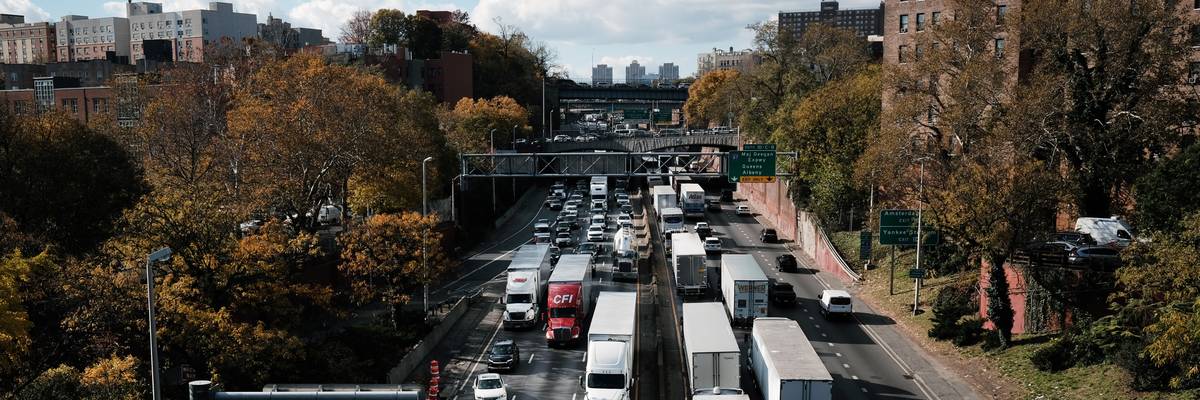
Cars and trucks move along the Cross Bronx Expressway, a notorious stretch of highway in New York City that is often choked with traffic and contributes to pollution and poor air quality on November 16, 2021 in New York City.
Instead of making our health a priority, the administration has chosen to delay progress in order preserve a pollution-producing and car-centric status quo.
Picture this: You’re a kid in New York City living in the South Bronx and you have asthma. While friends go outside to play, you stay behind, worried that an asthma attack could send you to the hospital. Your neighborhood is surrounded by three highways and five bridges, with 300 trucks driving by every hour spewing toxic pollution. Unfortunately, this is common for many children in the lower income areas of the city who face disproportionate air pollution. Children in the South Bronx face a 17% asthma risk, over double the national average. In 2016, asthma-related ER visits were over six times higher in New York City’s low-income areas.
Neighborhoods like the South Bronx and Harlem are uniquely vibrant, but their problem with pollution is not unique as over a third of us—39% of the country—live in areas with failing air quality grades. Despite this clear public health crisis, the Trump administration is actively dismantling solutions to reduce these transportation emissions that disproportionately harm low-income communities and communities of color.
Traffic, industrial activity, and other sources create Particulate Matter 2.5 (soot) pollution. In NYC, soot contributes to 2,000 deaths and 5,150 emergency visits and hospitalizations for respiratory and heart disease each year.
Increased emergency room visits, cancer rates, and even premature deaths are the consequences of our current economic system and policies that pollute our communities, schools, workplaces, and places of worship. Traffic, industrial activity, and other sources create Particulate Matter 2.5 (soot) pollution. In NYC, soot contributes to 2,000 deaths and 5,150 emergency visits and hospitalizations for respiratory and heart disease each year. For people of color this risk is greater as they are 2.3 times more likely than white people to live in a county with failing air quality grades. Our freight system, which moves the goods we all rely on, creates especially dangerous “Diesel Death Zones,” that harm primarily low-income and communities of color. Freight trucks and buses make up less than 10% of the vehicles on U.S. roads, but are responsible for more than half of the soot and nitrogen oxide emissions from the transportation sector. Decades of racist zoning decisions, weak environmental and public health protections, and other discriminatory policies have resulted in a dirty transportation system that overwhelmingly hurts our communities.
The reality is not hopeless: The electrification of personal and freight vehicles, the expansion of mass transit, and other strategies can expand affordable transportation options, reduce air pollution, and save lives. Electrifying trucking and transitioning our grid to clean renewable energy would result in over $1.2 trillion in public health benefits and an 84% decrease in deaths from diesel emissions by 2050. With public transit expansion, we could further reduce emissions and lower transportation costs for families. Currently, low-income families spend around 30% of their salary on transportation, but with transit expansion we could save residents in urban areas an average of $2,000 per year. This would also open up options for those unable to drive and save 84,000 lives from traffic fatalities by 2050. The bottom line is that transitioning to cleaner vehicles and improving public transit makes us healthier and more connected, reduces emissions driving climate change, creates jobs, and boosts the economy.
For decades, WE ACT for Environmental Justice has advocated for and advanced equitable, clean transportation regulations and investments at the city, state, and federal levels. In New York, our initiatives, including the successful Dirty Diesel campaign, helped reduce emissions from the Metropolitan Transportation Authority’s (MTA) bus fleet by 95% citywide. At the Federal level, WE ACT and the “Clean Air for the Long Haul” cohort worked with the Biden-Harris administration and the Environmental Protection Agency (EPA) to update federal regulations to reduce pollution from vehicles. We also advocated passing the largest ever investments for climate justice, which provided long-needed funds for decarbonizing transportation through the Inflation Reduction Act (IRA) and Infrastructure Investment and Jobs Act (IIJA), as well as to advance landmark executive orders. After decades of advocacy, the Biden-Harris administration finally began moving toward a holistic approach to center environmental justice.
Freight trucks and buses make up less than 10% of the vehicles on U.S. roads, but are responsible for more than half of the soot and nitrogen oxide emissions from the transportation sector.
Today, this progress is under threat as the Trump administration and Republican allies are determined to attack environmental justice and dismantle these policies. On his first day in office, President Donald Trump signed Executive Order 14154 “Unleashing American Energy,” which called to repeal the “Electric Vehicle (EV) Mandate.” The term “EV Mandate” conflated several federal and state regulations that curbed vehicle emissions. Under the false banner of protecting consumer choice, the administration aims to undo protective emissions regulations, despite pleas from even automakers not to do so. In addition, the administration has rescinded memos that directed state transportation agencies to take into account environmental justice in transportation planning. Most viciously, the administration illegally froze funds for programs like the Clean School Bus Program, established under IIJA, which supports school districts in transitioning to clean, zero-emission buses. This threatens the health of children and families, and puts school districts in a difficult position.
Instead of making our health a priority, the administration has chosen to delay progress in order preserve a pollution-producing and car-centric status quo. Actions violating the U.S. Constitution, rule of law, and sound science, along with ignoring the needs of everyday people, have become hallmarks of this administration. Now, Trump and his allies are attempting to illegally remove California’s right to lead in the clean transportation transition by repealing the state’s waivers to regulate vehicle emissions. The administration is also interfering in NYC’s efforts to curb emissions and to fund the MTA’s public transportation through congestion pricing.
Right now, we need our elected officials to stand up for their constituents, for clean air, and for our future. Vulnerable communities across the country bear the overwhelming majority and heavy toll of air pollution, economic struggles, and worsening extreme weather driven by the climate crisis. Our leaders should address these issues, not make them worse to serve the interests of polluting industries.
We have the opportunity to clean up our dirty transportation sector, address and reverse decades of discriminatory policies, and better our lives. Children with asthma; families; and residents of the South Bronx, Harlem, and communities nationwide deserve clean air and fair, accessible transportation. The Trump administration and allies are pushing to shift us into reverse; instead, we must protect our clean transportation progress and drive positive change forward.
Dear Common Dreams reader, It’s been nearly 30 years since I co-founded Common Dreams with my late wife, Lina Newhouser. We had the radical notion that journalism should serve the public good, not corporate profits. It was clear to us from the outset what it would take to build such a project. No paid advertisements. No corporate sponsors. No millionaire publisher telling us what to think or do. Many people said we wouldn't last a year, but we proved those doubters wrong. Together with a tremendous team of journalists and dedicated staff, we built an independent media outlet free from the constraints of profits and corporate control. Our mission has always been simple: To inform. To inspire. To ignite change for the common good. Building Common Dreams was not easy. Our survival was never guaranteed. When you take on the most powerful forces—Wall Street greed, fossil fuel industry destruction, Big Tech lobbyists, and uber-rich oligarchs who have spent billions upon billions rigging the economy and democracy in their favor—the only bulwark you have is supporters who believe in your work. But here’s the urgent message from me today. It's never been this bad out there. And it's never been this hard to keep us going. At the very moment Common Dreams is most needed, the threats we face are intensifying. We need your support now more than ever. We don't accept corporate advertising and never will. We don't have a paywall because we don't think people should be blocked from critical news based on their ability to pay. Everything we do is funded by the donations of readers like you. When everyone does the little they can afford, we are strong. But if that support retreats or dries up, so do we. Will you donate now to make sure Common Dreams not only survives but thrives? —Craig Brown, Co-founder |
Picture this: You’re a kid in New York City living in the South Bronx and you have asthma. While friends go outside to play, you stay behind, worried that an asthma attack could send you to the hospital. Your neighborhood is surrounded by three highways and five bridges, with 300 trucks driving by every hour spewing toxic pollution. Unfortunately, this is common for many children in the lower income areas of the city who face disproportionate air pollution. Children in the South Bronx face a 17% asthma risk, over double the national average. In 2016, asthma-related ER visits were over six times higher in New York City’s low-income areas.
Neighborhoods like the South Bronx and Harlem are uniquely vibrant, but their problem with pollution is not unique as over a third of us—39% of the country—live in areas with failing air quality grades. Despite this clear public health crisis, the Trump administration is actively dismantling solutions to reduce these transportation emissions that disproportionately harm low-income communities and communities of color.
Traffic, industrial activity, and other sources create Particulate Matter 2.5 (soot) pollution. In NYC, soot contributes to 2,000 deaths and 5,150 emergency visits and hospitalizations for respiratory and heart disease each year.
Increased emergency room visits, cancer rates, and even premature deaths are the consequences of our current economic system and policies that pollute our communities, schools, workplaces, and places of worship. Traffic, industrial activity, and other sources create Particulate Matter 2.5 (soot) pollution. In NYC, soot contributes to 2,000 deaths and 5,150 emergency visits and hospitalizations for respiratory and heart disease each year. For people of color this risk is greater as they are 2.3 times more likely than white people to live in a county with failing air quality grades. Our freight system, which moves the goods we all rely on, creates especially dangerous “Diesel Death Zones,” that harm primarily low-income and communities of color. Freight trucks and buses make up less than 10% of the vehicles on U.S. roads, but are responsible for more than half of the soot and nitrogen oxide emissions from the transportation sector. Decades of racist zoning decisions, weak environmental and public health protections, and other discriminatory policies have resulted in a dirty transportation system that overwhelmingly hurts our communities.
The reality is not hopeless: The electrification of personal and freight vehicles, the expansion of mass transit, and other strategies can expand affordable transportation options, reduce air pollution, and save lives. Electrifying trucking and transitioning our grid to clean renewable energy would result in over $1.2 trillion in public health benefits and an 84% decrease in deaths from diesel emissions by 2050. With public transit expansion, we could further reduce emissions and lower transportation costs for families. Currently, low-income families spend around 30% of their salary on transportation, but with transit expansion we could save residents in urban areas an average of $2,000 per year. This would also open up options for those unable to drive and save 84,000 lives from traffic fatalities by 2050. The bottom line is that transitioning to cleaner vehicles and improving public transit makes us healthier and more connected, reduces emissions driving climate change, creates jobs, and boosts the economy.
For decades, WE ACT for Environmental Justice has advocated for and advanced equitable, clean transportation regulations and investments at the city, state, and federal levels. In New York, our initiatives, including the successful Dirty Diesel campaign, helped reduce emissions from the Metropolitan Transportation Authority’s (MTA) bus fleet by 95% citywide. At the Federal level, WE ACT and the “Clean Air for the Long Haul” cohort worked with the Biden-Harris administration and the Environmental Protection Agency (EPA) to update federal regulations to reduce pollution from vehicles. We also advocated passing the largest ever investments for climate justice, which provided long-needed funds for decarbonizing transportation through the Inflation Reduction Act (IRA) and Infrastructure Investment and Jobs Act (IIJA), as well as to advance landmark executive orders. After decades of advocacy, the Biden-Harris administration finally began moving toward a holistic approach to center environmental justice.
Freight trucks and buses make up less than 10% of the vehicles on U.S. roads, but are responsible for more than half of the soot and nitrogen oxide emissions from the transportation sector.
Today, this progress is under threat as the Trump administration and Republican allies are determined to attack environmental justice and dismantle these policies. On his first day in office, President Donald Trump signed Executive Order 14154 “Unleashing American Energy,” which called to repeal the “Electric Vehicle (EV) Mandate.” The term “EV Mandate” conflated several federal and state regulations that curbed vehicle emissions. Under the false banner of protecting consumer choice, the administration aims to undo protective emissions regulations, despite pleas from even automakers not to do so. In addition, the administration has rescinded memos that directed state transportation agencies to take into account environmental justice in transportation planning. Most viciously, the administration illegally froze funds for programs like the Clean School Bus Program, established under IIJA, which supports school districts in transitioning to clean, zero-emission buses. This threatens the health of children and families, and puts school districts in a difficult position.
Instead of making our health a priority, the administration has chosen to delay progress in order preserve a pollution-producing and car-centric status quo. Actions violating the U.S. Constitution, rule of law, and sound science, along with ignoring the needs of everyday people, have become hallmarks of this administration. Now, Trump and his allies are attempting to illegally remove California’s right to lead in the clean transportation transition by repealing the state’s waivers to regulate vehicle emissions. The administration is also interfering in NYC’s efforts to curb emissions and to fund the MTA’s public transportation through congestion pricing.
Right now, we need our elected officials to stand up for their constituents, for clean air, and for our future. Vulnerable communities across the country bear the overwhelming majority and heavy toll of air pollution, economic struggles, and worsening extreme weather driven by the climate crisis. Our leaders should address these issues, not make them worse to serve the interests of polluting industries.
We have the opportunity to clean up our dirty transportation sector, address and reverse decades of discriminatory policies, and better our lives. Children with asthma; families; and residents of the South Bronx, Harlem, and communities nationwide deserve clean air and fair, accessible transportation. The Trump administration and allies are pushing to shift us into reverse; instead, we must protect our clean transportation progress and drive positive change forward.
Picture this: You’re a kid in New York City living in the South Bronx and you have asthma. While friends go outside to play, you stay behind, worried that an asthma attack could send you to the hospital. Your neighborhood is surrounded by three highways and five bridges, with 300 trucks driving by every hour spewing toxic pollution. Unfortunately, this is common for many children in the lower income areas of the city who face disproportionate air pollution. Children in the South Bronx face a 17% asthma risk, over double the national average. In 2016, asthma-related ER visits were over six times higher in New York City’s low-income areas.
Neighborhoods like the South Bronx and Harlem are uniquely vibrant, but their problem with pollution is not unique as over a third of us—39% of the country—live in areas with failing air quality grades. Despite this clear public health crisis, the Trump administration is actively dismantling solutions to reduce these transportation emissions that disproportionately harm low-income communities and communities of color.
Traffic, industrial activity, and other sources create Particulate Matter 2.5 (soot) pollution. In NYC, soot contributes to 2,000 deaths and 5,150 emergency visits and hospitalizations for respiratory and heart disease each year.
Increased emergency room visits, cancer rates, and even premature deaths are the consequences of our current economic system and policies that pollute our communities, schools, workplaces, and places of worship. Traffic, industrial activity, and other sources create Particulate Matter 2.5 (soot) pollution. In NYC, soot contributes to 2,000 deaths and 5,150 emergency visits and hospitalizations for respiratory and heart disease each year. For people of color this risk is greater as they are 2.3 times more likely than white people to live in a county with failing air quality grades. Our freight system, which moves the goods we all rely on, creates especially dangerous “Diesel Death Zones,” that harm primarily low-income and communities of color. Freight trucks and buses make up less than 10% of the vehicles on U.S. roads, but are responsible for more than half of the soot and nitrogen oxide emissions from the transportation sector. Decades of racist zoning decisions, weak environmental and public health protections, and other discriminatory policies have resulted in a dirty transportation system that overwhelmingly hurts our communities.
The reality is not hopeless: The electrification of personal and freight vehicles, the expansion of mass transit, and other strategies can expand affordable transportation options, reduce air pollution, and save lives. Electrifying trucking and transitioning our grid to clean renewable energy would result in over $1.2 trillion in public health benefits and an 84% decrease in deaths from diesel emissions by 2050. With public transit expansion, we could further reduce emissions and lower transportation costs for families. Currently, low-income families spend around 30% of their salary on transportation, but with transit expansion we could save residents in urban areas an average of $2,000 per year. This would also open up options for those unable to drive and save 84,000 lives from traffic fatalities by 2050. The bottom line is that transitioning to cleaner vehicles and improving public transit makes us healthier and more connected, reduces emissions driving climate change, creates jobs, and boosts the economy.
For decades, WE ACT for Environmental Justice has advocated for and advanced equitable, clean transportation regulations and investments at the city, state, and federal levels. In New York, our initiatives, including the successful Dirty Diesel campaign, helped reduce emissions from the Metropolitan Transportation Authority’s (MTA) bus fleet by 95% citywide. At the Federal level, WE ACT and the “Clean Air for the Long Haul” cohort worked with the Biden-Harris administration and the Environmental Protection Agency (EPA) to update federal regulations to reduce pollution from vehicles. We also advocated passing the largest ever investments for climate justice, which provided long-needed funds for decarbonizing transportation through the Inflation Reduction Act (IRA) and Infrastructure Investment and Jobs Act (IIJA), as well as to advance landmark executive orders. After decades of advocacy, the Biden-Harris administration finally began moving toward a holistic approach to center environmental justice.
Freight trucks and buses make up less than 10% of the vehicles on U.S. roads, but are responsible for more than half of the soot and nitrogen oxide emissions from the transportation sector.
Today, this progress is under threat as the Trump administration and Republican allies are determined to attack environmental justice and dismantle these policies. On his first day in office, President Donald Trump signed Executive Order 14154 “Unleashing American Energy,” which called to repeal the “Electric Vehicle (EV) Mandate.” The term “EV Mandate” conflated several federal and state regulations that curbed vehicle emissions. Under the false banner of protecting consumer choice, the administration aims to undo protective emissions regulations, despite pleas from even automakers not to do so. In addition, the administration has rescinded memos that directed state transportation agencies to take into account environmental justice in transportation planning. Most viciously, the administration illegally froze funds for programs like the Clean School Bus Program, established under IIJA, which supports school districts in transitioning to clean, zero-emission buses. This threatens the health of children and families, and puts school districts in a difficult position.
Instead of making our health a priority, the administration has chosen to delay progress in order preserve a pollution-producing and car-centric status quo. Actions violating the U.S. Constitution, rule of law, and sound science, along with ignoring the needs of everyday people, have become hallmarks of this administration. Now, Trump and his allies are attempting to illegally remove California’s right to lead in the clean transportation transition by repealing the state’s waivers to regulate vehicle emissions. The administration is also interfering in NYC’s efforts to curb emissions and to fund the MTA’s public transportation through congestion pricing.
Right now, we need our elected officials to stand up for their constituents, for clean air, and for our future. Vulnerable communities across the country bear the overwhelming majority and heavy toll of air pollution, economic struggles, and worsening extreme weather driven by the climate crisis. Our leaders should address these issues, not make them worse to serve the interests of polluting industries.
We have the opportunity to clean up our dirty transportation sector, address and reverse decades of discriminatory policies, and better our lives. Children with asthma; families; and residents of the South Bronx, Harlem, and communities nationwide deserve clean air and fair, accessible transportation. The Trump administration and allies are pushing to shift us into reverse; instead, we must protect our clean transportation progress and drive positive change forward.