SUBSCRIBE TO OUR FREE NEWSLETTER
Daily news & progressive opinion—funded by the people, not the corporations—delivered straight to your inbox.
5
#000000
#FFFFFF
To donate by check, phone, or other method, see our More Ways to Give page.
Daily news & progressive opinion—funded by the people, not the corporations—delivered straight to your inbox.
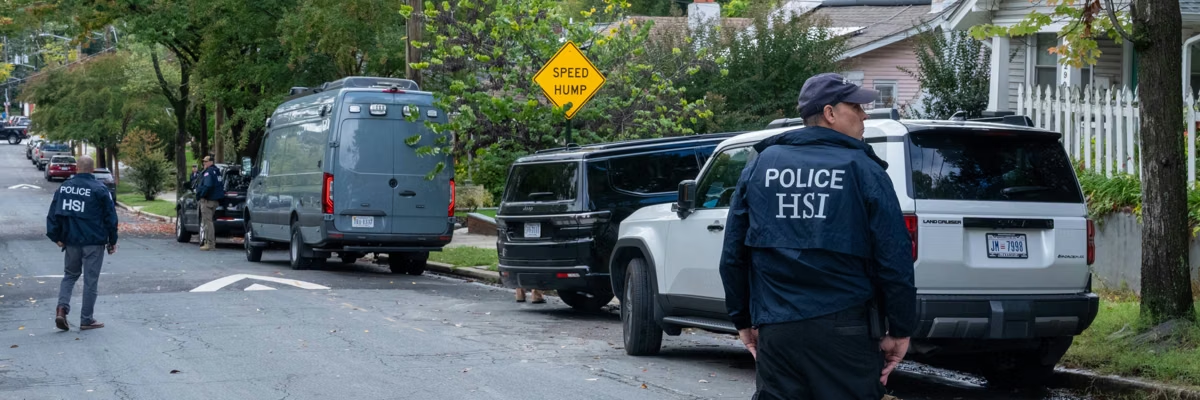
Homeland Security Investigations police search the home of Rep. Ilhan Omar (D-Minn.) on October 12, 2026 in Washington, DC.
From the International Criminal Court to the home of Ilhan Omar, the use of government power demands more than another news cycle of outrage.
I am tired of writing about Donald Trump.
I have spent years writing about this man, and lately I find myself wondering what more there is to say. Another attack on an institution, another spectacle, another announcement that sends the news cycle spinning. An editor at City Watch LA recently told me he was no longer interested in receiving Trump pieces because readers were tuning out. I understood. I have felt that fatigue myself.
Still, four developments in the first 12 days of October have been difficult to ignore. The Trump administration imposed sanctions on the International Criminal Court, announced plans to live stream a military execution, struck an agreement for Russian diesel, and sent federal agents to search the Washington home of Rep. Ilhan Omar (D-Minn.)
What matters now is whether the public continues to demand explanations, whether institutions retain the independence to do their jobs, and whether the law applies equally to the powerful and their critics.
These events are different. They should not be collapsed into a single accusation of wrongdoing. But together they raise a question that reaches beyond the latest controversy: What happens when the exercise of government power becomes so relentless that the public begins to accept what once would have demanded sustained scrutiny?
Consider the International Criminal Court (ICC). Navi Pillay, the South African jurist whose career challenged apartheid and advanced the prosecution of sexual violence as a weapon of genocide, was recently awarded the Nobel Peace Prize for her human rights work. She also led a United Nations commission that concluded Israel had committed genocide in Gaza, a finding Israel rejects.
Trump responded by resharing a social media post claiming he deserved the prize. His administration imposed sanctions on the ICC, accusing the court of unfairly targeting Americans.
The timing does not establish that the Nobel decision caused the sanctions. The underlying issue is more consequential than presidential resentment. International courts exist to investigate grave crimes, including those committed by people with political power. Their decisions can be challenged, their jurisdiction disputed, and their procedures scrutinized. None of this gives governments a blank check to punish institutions for examining their conduct.
Martin Luther King Jr. wrote in his Letter from Birmingham Jail, “Injustice anywhere is a threat to justice everywhere.” King was confronting a country that repeatedly found reasons to delay accountability for its own injustices. His words remain relevant when governments invoke sovereignty to resist scrutiny they expect other nations to accept.
The United States cannot credibly demand accountability abroad while treating the prospect of international accountability as an intolerable affront at home.
The proposed military execution raises a different concern. Nidal Malik Hasan, a former Army psychiatrist, murdered 13 people and wounded 32 others at Fort Hood in 2009. His scheduled execution by firing squad on December 3 is expected to be live streamed, according to Associated Press reporting.
The victims and their families deserve to remain at the center of any discussion of Hasan's crimes. Their suffering does not, however, settle the question of what the state should make of an execution.
Capital punishment is already an assertion of the government's power to take a human life. Broadcasting that act introduces another question: What purpose does the spectacle serve?
In Reflections on the Guillotine, Albert Camus called capital punishment “the most premeditated of murders.” He was challenging the assumption that the state's decision to kill becomes morally uncomplicated once it has passed through a legal process.
A sentence can be lawful and still invite serious moral examination. If a public broadcast is supposed to deter violence, the administration should explain the evidence supporting that claim. We should be wary of a government that treats the public display of death as a demonstration of strength.
The Russian diesel agreement presents a more practical contradiction. On October 9, Trump announced that Russia would supply more than 300,000 tons of diesel, with additional shipments expected. The announcement came as the administration was pursuing economic pressure on Moscow over its invasion of Ukraine.
Negotiating with an adversary is not inherently wrong. Fuel prices matter to families, workers, and businesses, and a president has a responsibility to address them. An energy agreement might have an economic rationale.
But the administration owes the public an explanation of how this arrangement fits its broader policy. If economic pressure is meant to persuade Moscow to change its conduct, what happens when Washington purchases a major energy supply from Russia? What are the terms, when will the fuel arrive, and how much relief can consumers reasonably expect?
For Ukrainians living with the consequences of the invasion, American commitments matter. For Americans struggling with fuel costs, promised savings matter. Neither group should have to rely on presidential boasts in place of a clear accounting.
Then, on Monday morning, federal agents searched Ilhan Omar's home in Washington, DC.
The Justice Department confirmed that Homeland Security Investigations had executed a judicially authorized search warrant as part of an ongoing criminal investigation. Authorities provided few details about the inquiry. Reporting indicated that it involved immigration-related allegations, which Omar has denied.
A search warrant does not establish guilt. The public does not yet have enough information to determine whether the search was justified or whether political considerations influenced the investigation. Those distinctions are essential.
But the circumstances deserve attention. Trump has repeatedly attacked Omar, questioned her patriotism, and told her to return to where she came from. The search occurred weeks before the November midterm elections, as Omar seeks reelection. Omar described the action as an attempt to target political enemies and weaponize federal law enforcement. Democratic congressional leaders also questioned the timing.
The Justice Department must be able to investigate credible allegations against elected officials. No member of Congress should be above the law. But the reverse principle matters just as much: No president should be able to use federal law enforcement to intimidate political opponents.
The question is not whether Omar should receive special treatment. It is whether she is receiving the same treatment any other American would receive, under the same standards, free of political interference.
When a president repeatedly singles out an opponent and federal agents subsequently search her home shortly before an election, the public has legitimate reasons to demand answers. The government should welcome the scrutiny necessary to establish that its actions are lawful and impartial.
These four stories concern different institutions and different forms of power. Their connection lies in the questions they leave unanswered. Who holds powerful people accountable? What limits should constrain the state's use of violence? Can a government reconcile its economic decisions with its international commitments? Can federal law enforcement remain independent when the president has made a political opponent the target of repeated attacks?
I hesitate to call any particular week a turning point. American history contains too many grave injustices for that claim to come easily. The country has survived slavery, segregation, political repression, and wars justified by falsehoods. Yet history offers no guarantee that democratic institutions will protect themselves. They depend on people willing to defend their purpose and insist on their independence.
I do not expect this article to change the administration's course. I am not even certain that writing another article about Trump will reach readers who have stopped paying attention. But exhaustion is not an argument for silence. It is a condition that those who benefit from public distraction can exploit.
A threshold is not always crossed in a single dramatic moment. It can become visible through a series of decisions, each defended on its own terms, until the accumulation begins to change what a country considers acceptable.
The Nobel Prize, the proposed execution broadcast, the diesel agreement, and the search of Omar's home may ultimately be remembered as separate episodes. Their consequences will depend on facts still emerging and decisions yet to be made. What matters now is whether the public continues to demand explanations, whether institutions retain the independence to do their jobs, and whether the law applies equally to the powerful and their critics.
I am tired of writing about Donald Trump. I am more concerned about what happens if we become too tired to ask what his administration is doing in our name.
Dear Common Dreams reader, It’s been nearly 30 years since I co-founded Common Dreams with my late wife, Lina Newhouser. We had the radical notion that journalism should serve the public good, not corporate profits. It was clear to us from the outset what it would take to build such a project. No paid advertisements. No corporate sponsors. No millionaire publisher telling us what to think or do. Many people said we wouldn't last a year, but we proved those doubters wrong. Together with a tremendous team of journalists and dedicated staff, we built an independent media outlet free from the constraints of profits and corporate control. Our mission has always been simple: To inform. To inspire. To ignite change for the common good. Building Common Dreams was not easy. Our survival was never guaranteed. When you take on the most powerful forces—Wall Street greed, fossil fuel industry destruction, Big Tech lobbyists, and uber-rich oligarchs who have spent billions upon billions rigging the economy and democracy in their favor—the only bulwark you have is supporters who believe in your work. But here’s the urgent message from me today. It's never been this bad out there. And it's never been this hard to keep us going. At the very moment Common Dreams is most needed, the threats we face are intensifying. We need your support now more than ever. We don't accept corporate advertising and never will. We don't have a paywall because we don't think people should be blocked from critical news based on their ability to pay. Everything we do is funded by the donations of readers like you. When everyone does the little they can afford, we are strong. But if that support retreats or dries up, so do we. Will you donate now to make sure Common Dreams not only survives but thrives? —Craig Brown, Co-founder |
I am tired of writing about Donald Trump.
I have spent years writing about this man, and lately I find myself wondering what more there is to say. Another attack on an institution, another spectacle, another announcement that sends the news cycle spinning. An editor at City Watch LA recently told me he was no longer interested in receiving Trump pieces because readers were tuning out. I understood. I have felt that fatigue myself.
Still, four developments in the first 12 days of October have been difficult to ignore. The Trump administration imposed sanctions on the International Criminal Court, announced plans to live stream a military execution, struck an agreement for Russian diesel, and sent federal agents to search the Washington home of Rep. Ilhan Omar (D-Minn.)
What matters now is whether the public continues to demand explanations, whether institutions retain the independence to do their jobs, and whether the law applies equally to the powerful and their critics.
These events are different. They should not be collapsed into a single accusation of wrongdoing. But together they raise a question that reaches beyond the latest controversy: What happens when the exercise of government power becomes so relentless that the public begins to accept what once would have demanded sustained scrutiny?
Consider the International Criminal Court (ICC). Navi Pillay, the South African jurist whose career challenged apartheid and advanced the prosecution of sexual violence as a weapon of genocide, was recently awarded the Nobel Peace Prize for her human rights work. She also led a United Nations commission that concluded Israel had committed genocide in Gaza, a finding Israel rejects.
Trump responded by resharing a social media post claiming he deserved the prize. His administration imposed sanctions on the ICC, accusing the court of unfairly targeting Americans.
The timing does not establish that the Nobel decision caused the sanctions. The underlying issue is more consequential than presidential resentment. International courts exist to investigate grave crimes, including those committed by people with political power. Their decisions can be challenged, their jurisdiction disputed, and their procedures scrutinized. None of this gives governments a blank check to punish institutions for examining their conduct.
Martin Luther King Jr. wrote in his Letter from Birmingham Jail, “Injustice anywhere is a threat to justice everywhere.” King was confronting a country that repeatedly found reasons to delay accountability for its own injustices. His words remain relevant when governments invoke sovereignty to resist scrutiny they expect other nations to accept.
The United States cannot credibly demand accountability abroad while treating the prospect of international accountability as an intolerable affront at home.
The proposed military execution raises a different concern. Nidal Malik Hasan, a former Army psychiatrist, murdered 13 people and wounded 32 others at Fort Hood in 2009. His scheduled execution by firing squad on December 3 is expected to be live streamed, according to Associated Press reporting.
The victims and their families deserve to remain at the center of any discussion of Hasan's crimes. Their suffering does not, however, settle the question of what the state should make of an execution.
Capital punishment is already an assertion of the government's power to take a human life. Broadcasting that act introduces another question: What purpose does the spectacle serve?
In Reflections on the Guillotine, Albert Camus called capital punishment “the most premeditated of murders.” He was challenging the assumption that the state's decision to kill becomes morally uncomplicated once it has passed through a legal process.
A sentence can be lawful and still invite serious moral examination. If a public broadcast is supposed to deter violence, the administration should explain the evidence supporting that claim. We should be wary of a government that treats the public display of death as a demonstration of strength.
The Russian diesel agreement presents a more practical contradiction. On October 9, Trump announced that Russia would supply more than 300,000 tons of diesel, with additional shipments expected. The announcement came as the administration was pursuing economic pressure on Moscow over its invasion of Ukraine.
Negotiating with an adversary is not inherently wrong. Fuel prices matter to families, workers, and businesses, and a president has a responsibility to address them. An energy agreement might have an economic rationale.
But the administration owes the public an explanation of how this arrangement fits its broader policy. If economic pressure is meant to persuade Moscow to change its conduct, what happens when Washington purchases a major energy supply from Russia? What are the terms, when will the fuel arrive, and how much relief can consumers reasonably expect?
For Ukrainians living with the consequences of the invasion, American commitments matter. For Americans struggling with fuel costs, promised savings matter. Neither group should have to rely on presidential boasts in place of a clear accounting.
Then, on Monday morning, federal agents searched Ilhan Omar's home in Washington, DC.
The Justice Department confirmed that Homeland Security Investigations had executed a judicially authorized search warrant as part of an ongoing criminal investigation. Authorities provided few details about the inquiry. Reporting indicated that it involved immigration-related allegations, which Omar has denied.
A search warrant does not establish guilt. The public does not yet have enough information to determine whether the search was justified or whether political considerations influenced the investigation. Those distinctions are essential.
But the circumstances deserve attention. Trump has repeatedly attacked Omar, questioned her patriotism, and told her to return to where she came from. The search occurred weeks before the November midterm elections, as Omar seeks reelection. Omar described the action as an attempt to target political enemies and weaponize federal law enforcement. Democratic congressional leaders also questioned the timing.
The Justice Department must be able to investigate credible allegations against elected officials. No member of Congress should be above the law. But the reverse principle matters just as much: No president should be able to use federal law enforcement to intimidate political opponents.
The question is not whether Omar should receive special treatment. It is whether she is receiving the same treatment any other American would receive, under the same standards, free of political interference.
When a president repeatedly singles out an opponent and federal agents subsequently search her home shortly before an election, the public has legitimate reasons to demand answers. The government should welcome the scrutiny necessary to establish that its actions are lawful and impartial.
These four stories concern different institutions and different forms of power. Their connection lies in the questions they leave unanswered. Who holds powerful people accountable? What limits should constrain the state's use of violence? Can a government reconcile its economic decisions with its international commitments? Can federal law enforcement remain independent when the president has made a political opponent the target of repeated attacks?
I hesitate to call any particular week a turning point. American history contains too many grave injustices for that claim to come easily. The country has survived slavery, segregation, political repression, and wars justified by falsehoods. Yet history offers no guarantee that democratic institutions will protect themselves. They depend on people willing to defend their purpose and insist on their independence.
I do not expect this article to change the administration's course. I am not even certain that writing another article about Trump will reach readers who have stopped paying attention. But exhaustion is not an argument for silence. It is a condition that those who benefit from public distraction can exploit.
A threshold is not always crossed in a single dramatic moment. It can become visible through a series of decisions, each defended on its own terms, until the accumulation begins to change what a country considers acceptable.
The Nobel Prize, the proposed execution broadcast, the diesel agreement, and the search of Omar's home may ultimately be remembered as separate episodes. Their consequences will depend on facts still emerging and decisions yet to be made. What matters now is whether the public continues to demand explanations, whether institutions retain the independence to do their jobs, and whether the law applies equally to the powerful and their critics.
I am tired of writing about Donald Trump. I am more concerned about what happens if we become too tired to ask what his administration is doing in our name.
I am tired of writing about Donald Trump.
I have spent years writing about this man, and lately I find myself wondering what more there is to say. Another attack on an institution, another spectacle, another announcement that sends the news cycle spinning. An editor at City Watch LA recently told me he was no longer interested in receiving Trump pieces because readers were tuning out. I understood. I have felt that fatigue myself.
Still, four developments in the first 12 days of October have been difficult to ignore. The Trump administration imposed sanctions on the International Criminal Court, announced plans to live stream a military execution, struck an agreement for Russian diesel, and sent federal agents to search the Washington home of Rep. Ilhan Omar (D-Minn.)
What matters now is whether the public continues to demand explanations, whether institutions retain the independence to do their jobs, and whether the law applies equally to the powerful and their critics.
These events are different. They should not be collapsed into a single accusation of wrongdoing. But together they raise a question that reaches beyond the latest controversy: What happens when the exercise of government power becomes so relentless that the public begins to accept what once would have demanded sustained scrutiny?
Consider the International Criminal Court (ICC). Navi Pillay, the South African jurist whose career challenged apartheid and advanced the prosecution of sexual violence as a weapon of genocide, was recently awarded the Nobel Peace Prize for her human rights work. She also led a United Nations commission that concluded Israel had committed genocide in Gaza, a finding Israel rejects.
Trump responded by resharing a social media post claiming he deserved the prize. His administration imposed sanctions on the ICC, accusing the court of unfairly targeting Americans.
The timing does not establish that the Nobel decision caused the sanctions. The underlying issue is more consequential than presidential resentment. International courts exist to investigate grave crimes, including those committed by people with political power. Their decisions can be challenged, their jurisdiction disputed, and their procedures scrutinized. None of this gives governments a blank check to punish institutions for examining their conduct.
Martin Luther King Jr. wrote in his Letter from Birmingham Jail, “Injustice anywhere is a threat to justice everywhere.” King was confronting a country that repeatedly found reasons to delay accountability for its own injustices. His words remain relevant when governments invoke sovereignty to resist scrutiny they expect other nations to accept.
The United States cannot credibly demand accountability abroad while treating the prospect of international accountability as an intolerable affront at home.
The proposed military execution raises a different concern. Nidal Malik Hasan, a former Army psychiatrist, murdered 13 people and wounded 32 others at Fort Hood in 2009. His scheduled execution by firing squad on December 3 is expected to be live streamed, according to Associated Press reporting.
The victims and their families deserve to remain at the center of any discussion of Hasan's crimes. Their suffering does not, however, settle the question of what the state should make of an execution.
Capital punishment is already an assertion of the government's power to take a human life. Broadcasting that act introduces another question: What purpose does the spectacle serve?
In Reflections on the Guillotine, Albert Camus called capital punishment “the most premeditated of murders.” He was challenging the assumption that the state's decision to kill becomes morally uncomplicated once it has passed through a legal process.
A sentence can be lawful and still invite serious moral examination. If a public broadcast is supposed to deter violence, the administration should explain the evidence supporting that claim. We should be wary of a government that treats the public display of death as a demonstration of strength.
The Russian diesel agreement presents a more practical contradiction. On October 9, Trump announced that Russia would supply more than 300,000 tons of diesel, with additional shipments expected. The announcement came as the administration was pursuing economic pressure on Moscow over its invasion of Ukraine.
Negotiating with an adversary is not inherently wrong. Fuel prices matter to families, workers, and businesses, and a president has a responsibility to address them. An energy agreement might have an economic rationale.
But the administration owes the public an explanation of how this arrangement fits its broader policy. If economic pressure is meant to persuade Moscow to change its conduct, what happens when Washington purchases a major energy supply from Russia? What are the terms, when will the fuel arrive, and how much relief can consumers reasonably expect?
For Ukrainians living with the consequences of the invasion, American commitments matter. For Americans struggling with fuel costs, promised savings matter. Neither group should have to rely on presidential boasts in place of a clear accounting.
Then, on Monday morning, federal agents searched Ilhan Omar's home in Washington, DC.
The Justice Department confirmed that Homeland Security Investigations had executed a judicially authorized search warrant as part of an ongoing criminal investigation. Authorities provided few details about the inquiry. Reporting indicated that it involved immigration-related allegations, which Omar has denied.
A search warrant does not establish guilt. The public does not yet have enough information to determine whether the search was justified or whether political considerations influenced the investigation. Those distinctions are essential.
But the circumstances deserve attention. Trump has repeatedly attacked Omar, questioned her patriotism, and told her to return to where she came from. The search occurred weeks before the November midterm elections, as Omar seeks reelection. Omar described the action as an attempt to target political enemies and weaponize federal law enforcement. Democratic congressional leaders also questioned the timing.
The Justice Department must be able to investigate credible allegations against elected officials. No member of Congress should be above the law. But the reverse principle matters just as much: No president should be able to use federal law enforcement to intimidate political opponents.
The question is not whether Omar should receive special treatment. It is whether she is receiving the same treatment any other American would receive, under the same standards, free of political interference.
When a president repeatedly singles out an opponent and federal agents subsequently search her home shortly before an election, the public has legitimate reasons to demand answers. The government should welcome the scrutiny necessary to establish that its actions are lawful and impartial.
These four stories concern different institutions and different forms of power. Their connection lies in the questions they leave unanswered. Who holds powerful people accountable? What limits should constrain the state's use of violence? Can a government reconcile its economic decisions with its international commitments? Can federal law enforcement remain independent when the president has made a political opponent the target of repeated attacks?
I hesitate to call any particular week a turning point. American history contains too many grave injustices for that claim to come easily. The country has survived slavery, segregation, political repression, and wars justified by falsehoods. Yet history offers no guarantee that democratic institutions will protect themselves. They depend on people willing to defend their purpose and insist on their independence.
I do not expect this article to change the administration's course. I am not even certain that writing another article about Trump will reach readers who have stopped paying attention. But exhaustion is not an argument for silence. It is a condition that those who benefit from public distraction can exploit.
A threshold is not always crossed in a single dramatic moment. It can become visible through a series of decisions, each defended on its own terms, until the accumulation begins to change what a country considers acceptable.
The Nobel Prize, the proposed execution broadcast, the diesel agreement, and the search of Omar's home may ultimately be remembered as separate episodes. Their consequences will depend on facts still emerging and decisions yet to be made. What matters now is whether the public continues to demand explanations, whether institutions retain the independence to do their jobs, and whether the law applies equally to the powerful and their critics.
I am tired of writing about Donald Trump. I am more concerned about what happens if we become too tired to ask what his administration is doing in our name.