SUBSCRIBE TO OUR FREE NEWSLETTER
Daily news & progressive opinion—funded by the people, not the corporations—delivered straight to your inbox.
5
#000000
#FFFFFF
To donate by check, phone, or other method, see our More Ways to Give page.
Daily news & progressive opinion—funded by the people, not the corporations—delivered straight to your inbox.
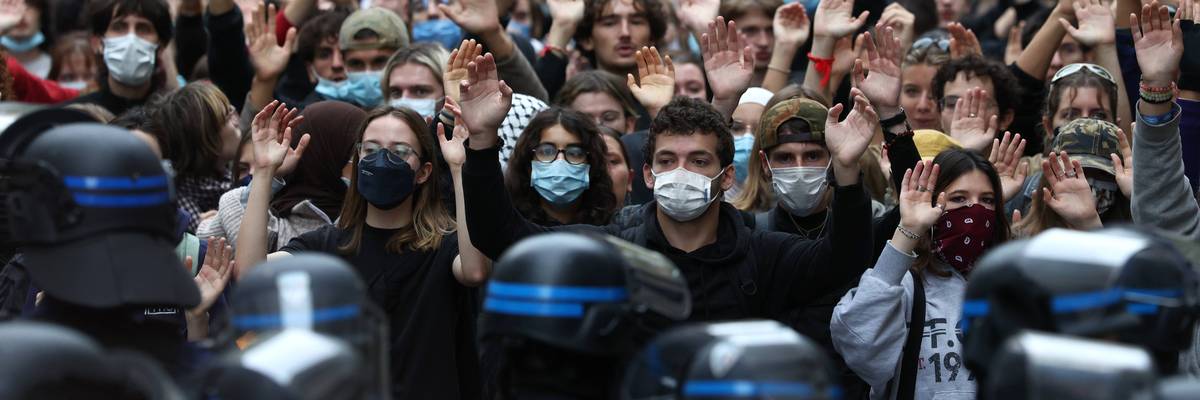
Students raise their hands in front of Police officers as they demonstrate outside Sciences Po during a protest over school overcrowding and decay on October 7, 2026 in Paris, France.
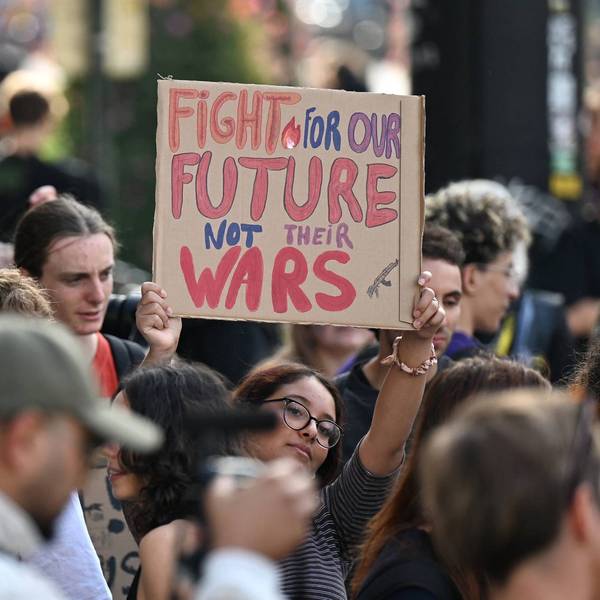
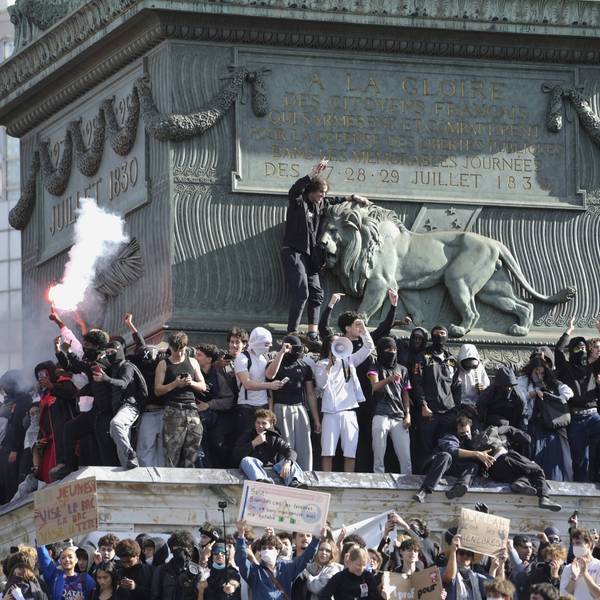
The banging of war drums in France and the student protests there for better schools bring to the fore the class interests of the rulers and the ruled.
A recent Al Jazeera piece entitled, “Can Protests in Europe Bring About Change?” is instructive. A guest from academia shared a key assumption behind the budget priorities of the Macron government in France, as high school students protested for improved learning and teaching conditions, amid a drop in living standards; the affordability crisis of rising fuel, food, and rent prices; and stagnating wages.
The economic crisis of neoliberal capitalism for the poor and working classes, with youth protesters pushing back against this order, is playing out in the streets of Austria, Belgium, France, Greece, Ireland, Italy, and Spain, along with Albania and Serbia (non-European Union nations). Back to “Can protests in Europe bring about change?” Rainbow Murray, a professor of politics at Queen Mary University of London, stated in the Al Jazeera piece that there are obstacles to the French government increasing its investments in public services such as education.
Why? The professor cited Russia's threat to France. The corporate and upper class control of the national government is not a threat to the working class majority, apparently.
The political donor class in France’s private sector benefits from Macron's budget priorities. High school students and their teachers don’t benefit. This contradiction seeks a resolution, one that is impossible to predict.
That ideology serves the economic interests of a tiny minority against a laboring many across neoliberal capitalist governments in the Global North. EU student protests for more government spending on public services such as education have no parallel in the US. American student protests that have come the closest to the French uprising have been walkouts against school shootings, such as the recent one in Bend, Oregon.
In the meantime, France is stepping up military spending to defend against apparent threats from Russia, despite or because of its war with Ukraine. President Emmanuel Macron has called for French rearmament to accelerate, doubling military spending in the 2027 budget from its level in 2017, when the first of his two terms began.
French high school students see their government’s funneling money into the military instead of their education as unacceptable. Students' rejection of that budget priority brings its importance to the national but also global radar screen. That's an important development, broadening the boundaries of the possible outcomes for the poor and working class across the Global North.
In the meantime, the political donor class in France’s private sector benefits from Macron's budget priorities. High school students and their teachers don’t benefit. This contradiction seeks a resolution, one that is impossible to predict.
It's easier to look back at government budget decisions. Here's one. “French carmaker Renault has agreed to cooperate with French defence company Turgis Gaillard to produce drones for Ukraine in a move supported by the French Ministry of Defence,” according to the Financial Times. For Renault, profits in drone making versus car making are fine.
Meanwhile, the Russian bear is threatening France. The same bear that lost 27 million people defeating the German Nazis in World War II also threatened the US during the Cold War. In both cases, a threat from Russia has fueled increased military spending.
The geopolitical context of France’s student protests is the unprovoked and unpopular US-Israel attack on Iran and Ukraine’s US- and NATO-backed war with Russia. Geopolitics flows from the profit interests of the domestic donor class. Look no farther than the tech billionaires profiting from fat government contracts after donating millions of dollars to the president, GOP politicians, and so-called opposition Democrats who support forever wars now and in the post-World War II past.
The banging of war drums in France and the student protests there for better schools bring to the fore the class interests of the rulers and the ruled. Will protests in Europe yield social change that improves the lives of protesters? To say that's a heavy lift is an understatement, given the resources that the prosperous few have—beginning with government violence, a fascist option—to maintain a status quo.
This country and this world are at a monumental crossroads. US voters have an opportunity to beat back the forces of fascism and confront the billionaires who are rigging the economy, our media system, and our democracy, making it increasingly impossible for ordinary people to get by. We’re not just talking about the election. We’re talking about what must be done once these fascist elements are vanquished from power. We need a bolder set of solutions than what either major party has so far been willing to offer and a working-class movement ready to fight like hell for it. Trump didn't emerge from nowhere. The conditions that fueled MAGA authoritarianism were created by decades of radical neoliberal economic policies and a corrupt political system dominated by corporate interests. They slashed taxes on the super-rich, promising that the benefits would trickle down. They said giveaways to the corporate titans would make life more affordable for the rest of us. It was all bullshit. And when a bitter, betrayed populace searches for someone to blame, right-wing demagogues have little trouble finding scapegoats. People know when they're being lied to, but you won't hear any of this from the corporate media. Only independent journalism—powered and funded by people who believe in building a better world—can deliver truly trustworthy daily news. If you share our vision, please contribute whatever you can to sustain our work. |
A recent Al Jazeera piece entitled, “Can Protests in Europe Bring About Change?” is instructive. A guest from academia shared a key assumption behind the budget priorities of the Macron government in France, as high school students protested for improved learning and teaching conditions, amid a drop in living standards; the affordability crisis of rising fuel, food, and rent prices; and stagnating wages.
The economic crisis of neoliberal capitalism for the poor and working classes, with youth protesters pushing back against this order, is playing out in the streets of Austria, Belgium, France, Greece, Ireland, Italy, and Spain, along with Albania and Serbia (non-European Union nations). Back to “Can protests in Europe bring about change?” Rainbow Murray, a professor of politics at Queen Mary University of London, stated in the Al Jazeera piece that there are obstacles to the French government increasing its investments in public services such as education.
Why? The professor cited Russia's threat to France. The corporate and upper class control of the national government is not a threat to the working class majority, apparently.
The political donor class in France’s private sector benefits from Macron's budget priorities. High school students and their teachers don’t benefit. This contradiction seeks a resolution, one that is impossible to predict.
That ideology serves the economic interests of a tiny minority against a laboring many across neoliberal capitalist governments in the Global North. EU student protests for more government spending on public services such as education have no parallel in the US. American student protests that have come the closest to the French uprising have been walkouts against school shootings, such as the recent one in Bend, Oregon.
In the meantime, France is stepping up military spending to defend against apparent threats from Russia, despite or because of its war with Ukraine. President Emmanuel Macron has called for French rearmament to accelerate, doubling military spending in the 2027 budget from its level in 2017, when the first of his two terms began.
French high school students see their government’s funneling money into the military instead of their education as unacceptable. Students' rejection of that budget priority brings its importance to the national but also global radar screen. That's an important development, broadening the boundaries of the possible outcomes for the poor and working class across the Global North.
In the meantime, the political donor class in France’s private sector benefits from Macron's budget priorities. High school students and their teachers don’t benefit. This contradiction seeks a resolution, one that is impossible to predict.
It's easier to look back at government budget decisions. Here's one. “French carmaker Renault has agreed to cooperate with French defence company Turgis Gaillard to produce drones for Ukraine in a move supported by the French Ministry of Defence,” according to the Financial Times. For Renault, profits in drone making versus car making are fine.
Meanwhile, the Russian bear is threatening France. The same bear that lost 27 million people defeating the German Nazis in World War II also threatened the US during the Cold War. In both cases, a threat from Russia has fueled increased military spending.
The geopolitical context of France’s student protests is the unprovoked and unpopular US-Israel attack on Iran and Ukraine’s US- and NATO-backed war with Russia. Geopolitics flows from the profit interests of the domestic donor class. Look no farther than the tech billionaires profiting from fat government contracts after donating millions of dollars to the president, GOP politicians, and so-called opposition Democrats who support forever wars now and in the post-World War II past.
The banging of war drums in France and the student protests there for better schools bring to the fore the class interests of the rulers and the ruled. Will protests in Europe yield social change that improves the lives of protesters? To say that's a heavy lift is an understatement, given the resources that the prosperous few have—beginning with government violence, a fascist option—to maintain a status quo.