SUBSCRIBE TO OUR FREE NEWSLETTER
Daily news & progressive opinion—funded by the people, not the corporations—delivered straight to your inbox.
5
#000000
#FFFFFF
To donate by check, phone, or other method, see our More Ways to Give page.
Daily news & progressive opinion—funded by the people, not the corporations—delivered straight to your inbox.
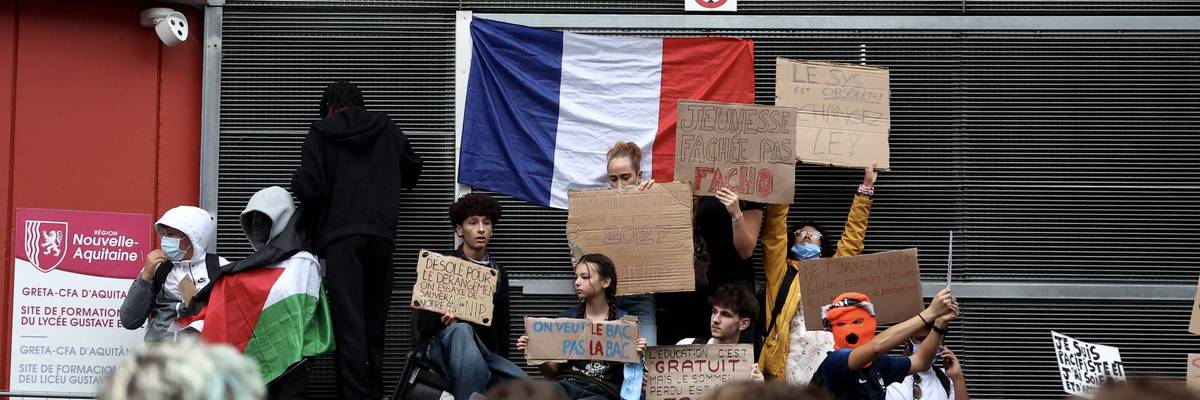
Protesting students carry out blockading action outside the Gustave Eiffel secondary school in Bordeaux, south-western France, on October 1, 2026.
The French student movement has a long history of political activism based on organized protests and occupations not only for the improvement of their learning experience and school conditions but also against capitalism, consumerism, imperialism, and police repression.
France is presently in the throes of nationwide student protests that have turned increasingly violent as the police crack down on students, using tear gas and heavy-handed tactics as students blockade entrances to their schools and even set fire to several schools across France.
The students, aged between 15 and 18, are protesting over poor school conditions (overcrowded classrooms, crumbling infrastructure, heavy workloads, teacher shortages) and demand increased funding for schools. Thousands have been detained, mostly minors, and dozens injured, including some 50 law enforcement officers.
The high school protests begun in Aubervilliers, a low-income Paris suburb, but quickly spread nationwide, as usually happens with students protests in France. University students have now joined high school schools across France, thus creating an even more volatile situation for the French government. Incidentally, the student protests are unfolding alongside massive public-sector protests over pay and working conditions.
French students have also shown that they are always on the side of the workers’ fight for better working conditions and in their struggle for an alternative socioeconomic and political order.
France is indeed in crisis mode, economically, politically, and socially. Weak growth and deteriorating public finances have been the norm for several years now, while austerity is being advanced by the political establishment as the only available solution to the country’s economic problems and financial misery. French Prime Minister Sébastien Lecornu presented an austerity-driven government budget on October 1 that proposes 43 billion euros in new fiscal measures to reduce the deficit.
However, the budget bill is surely expected to face a rough ride as France has a deeply divided parliament that has repeatedly rejected austerity-driven budget proposals, forcing in fact several prime ministers since 2022 to step down. Lecornu’s government may very well be the next one to collapse as it is highly unlikely that either Marine Le Pen’s far-right National Rally (RN) party or Jean-Luc Mélenchon’s left-wing France Unbowed (LFI) party (which France’s Interior Ministry has actually classified as far left) will make compromises, especially in light of the fact that France’s next presidential election is scheduled for April 18 and May 2, 2027, and looks like the run-off election will be between Le Pen and Mélenchon.
In addition, France’s bond market is under growing pressure as its 10-year yield has reached the highest level since 2002. With the cost of borrowing money hitting a peak, France, which has faced sluggish growth for years, is likely to see even slower growth in 2027 than in 2026. This situation seems to be serving the far-right RN party particularly well, which has already scored a “historic victory” by securing enough seats in the recently held Senate election to establish its own caucus for the first time.
In the meantime, the student protests are being used both by Le Pen and government officials to target Jean-Luc Mélenchon’s party for allegedly deploying agitators and using rhetoric to stoke students’ anger.
There is little doubt that the concerns of French students are legitimate. Their grievances with the poor state of schools have been building since this summer’s heatwaves, which exposed “the poor state of schools, with poor insulation and no air conditioning,” according to Vincent Latour, a professor of British Studies at the University of Toulouse-II-Le Mirail. Moreover, the president of Union Syndicale Lycéenne (USL), 19-year old Ryad Rani, said that student grievances had elicited no response from the government and that the movement will continue with the protests until its demands are satisfied.
The French student movement has a long history of political activism based on organized protests and occupations not only for the improvement of their learning experience and school conditions but also against capitalism, consumerism, imperialism, and police repression. It doesn’t need outside agitators in order to mobilize and take action into its own hands and is definitely not controlled by any political party. French students have also shown that they are always on the side of the workers’ fight for better working conditions and in their struggle for an alternative socioeconomic and political order, which is precisely why the current student protests coincided with the public-sector workers strike against the government’s austerity policies. And poor school conditions are not the only reason behind the ongoing student protests. As Mael Breton, a high school student taking part in the protests said, “We want fewer police because we think there is a huge amount of police repression, both against high school student movements and social movements more generally.”
It is true that local MPs from the LFI party were quick to lend support to the protests and the blockades once they started. But those actions were not initiated by the LFI, and students outright rejected “claims that they are manipulated by radical-left politicians.” Once the protests and the blockades started, students utilized various social media platforms to articulate their grievances and make their slogans and the measures taken known to the rest of French society.
The year 1968 was one of great turmoil and unrest. We live in a different world today. But what was true for workers and students in May 68, remains true for today’s generation of French students: “The struggle continues.”
Dear Common Dreams reader, It’s been nearly 30 years since I co-founded Common Dreams with my late wife, Lina Newhouser. We had the radical notion that journalism should serve the public good, not corporate profits. It was clear to us from the outset what it would take to build such a project. No paid advertisements. No corporate sponsors. No millionaire publisher telling us what to think or do. Many people said we wouldn't last a year, but we proved those doubters wrong. Together with a tremendous team of journalists and dedicated staff, we built an independent media outlet free from the constraints of profits and corporate control. Our mission has always been simple: To inform. To inspire. To ignite change for the common good. Building Common Dreams was not easy. Our survival was never guaranteed. When you take on the most powerful forces—Wall Street greed, fossil fuel industry destruction, Big Tech lobbyists, and uber-rich oligarchs who have spent billions upon billions rigging the economy and democracy in their favor—the only bulwark you have is supporters who believe in your work. But here’s the urgent message from me today. It's never been this bad out there. And it's never been this hard to keep us going. At the very moment Common Dreams is most needed, the threats we face are intensifying. We need your support now more than ever. We don't accept corporate advertising and never will. We don't have a paywall because we don't think people should be blocked from critical news based on their ability to pay. Everything we do is funded by the donations of readers like you. When everyone does the little they can afford, we are strong. But if that support retreats or dries up, so do we. Will you donate now to make sure Common Dreams not only survives but thrives? —Craig Brown, Co-founder |
France is presently in the throes of nationwide student protests that have turned increasingly violent as the police crack down on students, using tear gas and heavy-handed tactics as students blockade entrances to their schools and even set fire to several schools across France.
The students, aged between 15 and 18, are protesting over poor school conditions (overcrowded classrooms, crumbling infrastructure, heavy workloads, teacher shortages) and demand increased funding for schools. Thousands have been detained, mostly minors, and dozens injured, including some 50 law enforcement officers.
The high school protests begun in Aubervilliers, a low-income Paris suburb, but quickly spread nationwide, as usually happens with students protests in France. University students have now joined high school schools across France, thus creating an even more volatile situation for the French government. Incidentally, the student protests are unfolding alongside massive public-sector protests over pay and working conditions.
French students have also shown that they are always on the side of the workers’ fight for better working conditions and in their struggle for an alternative socioeconomic and political order.
France is indeed in crisis mode, economically, politically, and socially. Weak growth and deteriorating public finances have been the norm for several years now, while austerity is being advanced by the political establishment as the only available solution to the country’s economic problems and financial misery. French Prime Minister Sébastien Lecornu presented an austerity-driven government budget on October 1 that proposes 43 billion euros in new fiscal measures to reduce the deficit.
However, the budget bill is surely expected to face a rough ride as France has a deeply divided parliament that has repeatedly rejected austerity-driven budget proposals, forcing in fact several prime ministers since 2022 to step down. Lecornu’s government may very well be the next one to collapse as it is highly unlikely that either Marine Le Pen’s far-right National Rally (RN) party or Jean-Luc Mélenchon’s left-wing France Unbowed (LFI) party (which France’s Interior Ministry has actually classified as far left) will make compromises, especially in light of the fact that France’s next presidential election is scheduled for April 18 and May 2, 2027, and looks like the run-off election will be between Le Pen and Mélenchon.
In addition, France’s bond market is under growing pressure as its 10-year yield has reached the highest level since 2002. With the cost of borrowing money hitting a peak, France, which has faced sluggish growth for years, is likely to see even slower growth in 2027 than in 2026. This situation seems to be serving the far-right RN party particularly well, which has already scored a “historic victory” by securing enough seats in the recently held Senate election to establish its own caucus for the first time.
In the meantime, the student protests are being used both by Le Pen and government officials to target Jean-Luc Mélenchon’s party for allegedly deploying agitators and using rhetoric to stoke students’ anger.
There is little doubt that the concerns of French students are legitimate. Their grievances with the poor state of schools have been building since this summer’s heatwaves, which exposed “the poor state of schools, with poor insulation and no air conditioning,” according to Vincent Latour, a professor of British Studies at the University of Toulouse-II-Le Mirail. Moreover, the president of Union Syndicale Lycéenne (USL), 19-year old Ryad Rani, said that student grievances had elicited no response from the government and that the movement will continue with the protests until its demands are satisfied.
The French student movement has a long history of political activism based on organized protests and occupations not only for the improvement of their learning experience and school conditions but also against capitalism, consumerism, imperialism, and police repression. It doesn’t need outside agitators in order to mobilize and take action into its own hands and is definitely not controlled by any political party. French students have also shown that they are always on the side of the workers’ fight for better working conditions and in their struggle for an alternative socioeconomic and political order, which is precisely why the current student protests coincided with the public-sector workers strike against the government’s austerity policies. And poor school conditions are not the only reason behind the ongoing student protests. As Mael Breton, a high school student taking part in the protests said, “We want fewer police because we think there is a huge amount of police repression, both against high school student movements and social movements more generally.”
It is true that local MPs from the LFI party were quick to lend support to the protests and the blockades once they started. But those actions were not initiated by the LFI, and students outright rejected “claims that they are manipulated by radical-left politicians.” Once the protests and the blockades started, students utilized various social media platforms to articulate their grievances and make their slogans and the measures taken known to the rest of French society.
The year 1968 was one of great turmoil and unrest. We live in a different world today. But what was true for workers and students in May 68, remains true for today’s generation of French students: “The struggle continues.”
France is presently in the throes of nationwide student protests that have turned increasingly violent as the police crack down on students, using tear gas and heavy-handed tactics as students blockade entrances to their schools and even set fire to several schools across France.
The students, aged between 15 and 18, are protesting over poor school conditions (overcrowded classrooms, crumbling infrastructure, heavy workloads, teacher shortages) and demand increased funding for schools. Thousands have been detained, mostly minors, and dozens injured, including some 50 law enforcement officers.
The high school protests begun in Aubervilliers, a low-income Paris suburb, but quickly spread nationwide, as usually happens with students protests in France. University students have now joined high school schools across France, thus creating an even more volatile situation for the French government. Incidentally, the student protests are unfolding alongside massive public-sector protests over pay and working conditions.
French students have also shown that they are always on the side of the workers’ fight for better working conditions and in their struggle for an alternative socioeconomic and political order.
France is indeed in crisis mode, economically, politically, and socially. Weak growth and deteriorating public finances have been the norm for several years now, while austerity is being advanced by the political establishment as the only available solution to the country’s economic problems and financial misery. French Prime Minister Sébastien Lecornu presented an austerity-driven government budget on October 1 that proposes 43 billion euros in new fiscal measures to reduce the deficit.
However, the budget bill is surely expected to face a rough ride as France has a deeply divided parliament that has repeatedly rejected austerity-driven budget proposals, forcing in fact several prime ministers since 2022 to step down. Lecornu’s government may very well be the next one to collapse as it is highly unlikely that either Marine Le Pen’s far-right National Rally (RN) party or Jean-Luc Mélenchon’s left-wing France Unbowed (LFI) party (which France’s Interior Ministry has actually classified as far left) will make compromises, especially in light of the fact that France’s next presidential election is scheduled for April 18 and May 2, 2027, and looks like the run-off election will be between Le Pen and Mélenchon.
In addition, France’s bond market is under growing pressure as its 10-year yield has reached the highest level since 2002. With the cost of borrowing money hitting a peak, France, which has faced sluggish growth for years, is likely to see even slower growth in 2027 than in 2026. This situation seems to be serving the far-right RN party particularly well, which has already scored a “historic victory” by securing enough seats in the recently held Senate election to establish its own caucus for the first time.
In the meantime, the student protests are being used both by Le Pen and government officials to target Jean-Luc Mélenchon’s party for allegedly deploying agitators and using rhetoric to stoke students’ anger.
There is little doubt that the concerns of French students are legitimate. Their grievances with the poor state of schools have been building since this summer’s heatwaves, which exposed “the poor state of schools, with poor insulation and no air conditioning,” according to Vincent Latour, a professor of British Studies at the University of Toulouse-II-Le Mirail. Moreover, the president of Union Syndicale Lycéenne (USL), 19-year old Ryad Rani, said that student grievances had elicited no response from the government and that the movement will continue with the protests until its demands are satisfied.
The French student movement has a long history of political activism based on organized protests and occupations not only for the improvement of their learning experience and school conditions but also against capitalism, consumerism, imperialism, and police repression. It doesn’t need outside agitators in order to mobilize and take action into its own hands and is definitely not controlled by any political party. French students have also shown that they are always on the side of the workers’ fight for better working conditions and in their struggle for an alternative socioeconomic and political order, which is precisely why the current student protests coincided with the public-sector workers strike against the government’s austerity policies. And poor school conditions are not the only reason behind the ongoing student protests. As Mael Breton, a high school student taking part in the protests said, “We want fewer police because we think there is a huge amount of police repression, both against high school student movements and social movements more generally.”
It is true that local MPs from the LFI party were quick to lend support to the protests and the blockades once they started. But those actions were not initiated by the LFI, and students outright rejected “claims that they are manipulated by radical-left politicians.” Once the protests and the blockades started, students utilized various social media platforms to articulate their grievances and make their slogans and the measures taken known to the rest of French society.
The year 1968 was one of great turmoil and unrest. We live in a different world today. But what was true for workers and students in May 68, remains true for today’s generation of French students: “The struggle continues.”