SUBSCRIBE TO OUR FREE NEWSLETTER
Daily news & progressive opinion—funded by the people, not the corporations—delivered straight to your inbox.
5
#000000
#FFFFFF
To donate by check, phone, or other method, see our More Ways to Give page.
Daily news & progressive opinion—funded by the people, not the corporations—delivered straight to your inbox.
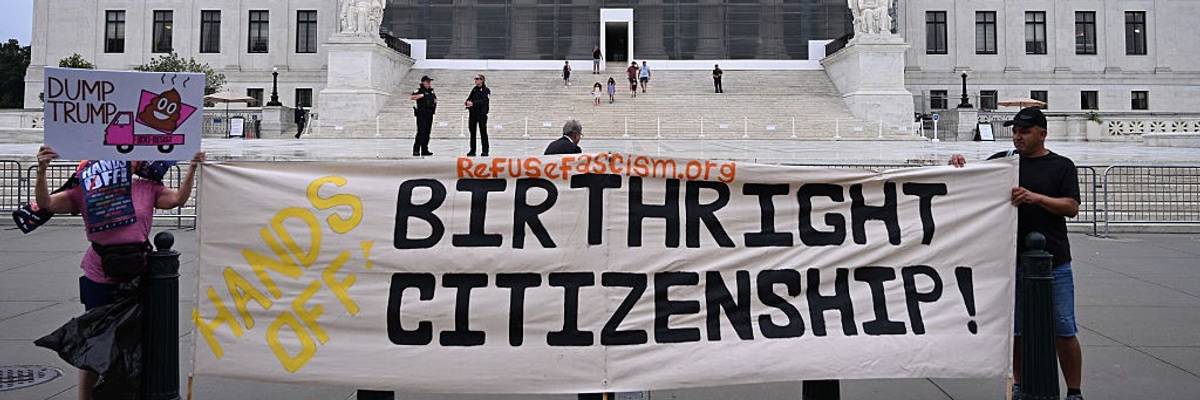
Demonstrators holds up an anti-Trump sign outside the US Supreme Court in Washington, DC, on June 27, 2025.
While birthright citizenship survived today, this ruling exposes how fragile its guarantee has become. This fight is far from over—Republicans will try again, and next time they might succeed.
On June 30, the Supreme Court struck down President Trump’s executive order limiting birthright citizenship.
This is the obviously correct decision. The 14th Amendment is abundantly clear: “All persons born or naturalized in the United States and subject to the jurisdiction thereof, are citizens of the United States.”
The Trump administration’s argument that undocumented immigrants and their children are not “subject to the jurisdiction thereof” was baseless from the start. Not only did it lack any foundation in the Constitution or statutory law, but the meaning of that phrase was never in dispute. Those “subject to the jurisdiction thereof” include everyone born in the US except the children of foreign diplomats, enemy invaders during a hostile occupation, and those born in unincorporated territories of American Samoa (they are considered “noncitizen nationals”).
After several disastrous Supreme Court rulings on Temporary Protected Status (TPS), asylum entries, transgender athletes, campaign finance restrictions, and presidential firing power, it may be tempting to see this decision on birthright as a glimmer of hope. Unfortunately, there are reasons to be concerned.
The Supreme Court is effectively one vote away from fundamentally changing who is entitled to US citizenship and what it means to be an American.
While six justices found Trump’s executive order to be unlawful, only five justices—John Roberts, Sonia Sotomayor, Elena Kagan, Ketanji Brown Jackson, and Amy Coney Barrett—believe that it violates the Constitution.
Justice Brett Kavanaugh argues that it only violates federal law. He writes: “In my view, the Executive Order does not violate the Fourteenth Amendment. But the Order does contravene a federal statute, 8 U.S.C. §1401(a). Congress could—consistent with the Fourteenth Amendment—amend §1401(a) or otherwise enact new legislation establishing exceptions to birthright citizenship for children born to foreign citizens unlawfully or temporarily in the country. But Congress has not yet done so.”
In his dissenting opinion, Justice Neil Gorsuch argues that the 14th Amendment clearly does not extend to children of temporary visitors. Yet, he “harbor doubts” whether the same is true for children of undocumented immigrants “who have long chosen to make this Nation their permanent home.”
The issue of a “permanent home” (or “domicile”) was a core component of Trump’s anti-birthright argument. The Trump administration argued that to be “completely subject” to the “jurisdiction” of the US means one must owe “direct and immediate allegiance” and receive “protection” from it. The children of US citizens, permanent residents, and formerly enslaved persons meet this standard because they “have a permanent domicile.” By contrast, the children of undocumented immigrants “do not owe primary allegiance to the United States by virtue of domicile, for illegal aliens lack the legal capacity to establish domicile here.”
Before the Supreme Court, Solicitor General D. John Sauer argued that the Trump administration’s “point [is] that allegiance is what the word jurisdiction means.” He further contended that, “For aliens, lawful domicile is the status that creates the requisite allegiance and the text of the [Citizenship] Clause presupposes domicile.”
Notably, Gorsuch does not explicitly reject this argument. What’s more, he, along with Justice Clarence Thomas, believes that the Citizenship Clause does not immediately extend to everyone born on US soil. It requires, as the Trump administration argues, possessing a “permanent domicile.”
Justice Samuel Alito likewise concurs with the Trump administration’s argument but emphasizes the allegiance component. In his view, “the Fourteenth Amendment confers citizenship on only those children who, at birth, owe allegiance solely to this country.” Being born in the US is not enough.
Where this leaves us is at a far more precarious crossroads. Only five justices believe that the plain text of the 14th Amendment automatically guarantees citizenship to everyone born in the US.
Kavanaugh believes that Congress could limit birthright citizenship themselves. A constitutional amendment would not be needed.
The same is arguably true for Gorsuch, Thomas, and Alito. If Congress were to pass legislation that codifies Trump’s Executive Order and formally defines “domicile” status in a way that excludes undocumented immigrants and temporary visitors, then those four justices would likely uphold it.
Ultimately, the problem is that this decision does not settle the issue once and for all. What we needed was a clear 7-2 decision (Thomas and Alito were always going to dissent). One that acknowledged what the Constitution plainly says and what it obviously grants—namely, that if you are born here, you are from here. Nothing else matters; not “domicile” or “allegiance.”
As things stand, however, the Supreme Court is effectively one vote away from fundamentally changing who is entitled to US citizenship and what it means to be an American. While birthright citizenship survived today, this ruling exposes how fragile its guarantee has become. This fight is far from over—Republicans will try again, and next time they might succeed.
We cannot let this happen. Now more than ever we need a left-wing wall in Congress to stop Trump’s assault on our rights, protect birthright citizenship, and defend the Constitution.
Dear Common Dreams reader, It’s been nearly 30 years since I co-founded Common Dreams with my late wife, Lina Newhouser. We had the radical notion that journalism should serve the public good, not corporate profits. It was clear to us from the outset what it would take to build such a project. No paid advertisements. No corporate sponsors. No millionaire publisher telling us what to think or do. Many people said we wouldn't last a year, but we proved those doubters wrong. Together with a tremendous team of journalists and dedicated staff, we built an independent media outlet free from the constraints of profits and corporate control. Our mission has always been simple: To inform. To inspire. To ignite change for the common good. Building Common Dreams was not easy. Our survival was never guaranteed. When you take on the most powerful forces—Wall Street greed, fossil fuel industry destruction, Big Tech lobbyists, and uber-rich oligarchs who have spent billions upon billions rigging the economy and democracy in their favor—the only bulwark you have is supporters who believe in your work. But here’s the urgent message from me today. It's never been this bad out there. And it's never been this hard to keep us going. At the very moment Common Dreams is most needed, the threats we face are intensifying. We need your support now more than ever. We don't accept corporate advertising and never will. We don't have a paywall because we don't think people should be blocked from critical news based on their ability to pay. Everything we do is funded by the donations of readers like you. When everyone does the little they can afford, we are strong. But if that support retreats or dries up, so do we. Will you donate now to make sure Common Dreams not only survives but thrives? —Craig Brown, Co-founder |
On June 30, the Supreme Court struck down President Trump’s executive order limiting birthright citizenship.
This is the obviously correct decision. The 14th Amendment is abundantly clear: “All persons born or naturalized in the United States and subject to the jurisdiction thereof, are citizens of the United States.”
The Trump administration’s argument that undocumented immigrants and their children are not “subject to the jurisdiction thereof” was baseless from the start. Not only did it lack any foundation in the Constitution or statutory law, but the meaning of that phrase was never in dispute. Those “subject to the jurisdiction thereof” include everyone born in the US except the children of foreign diplomats, enemy invaders during a hostile occupation, and those born in unincorporated territories of American Samoa (they are considered “noncitizen nationals”).
After several disastrous Supreme Court rulings on Temporary Protected Status (TPS), asylum entries, transgender athletes, campaign finance restrictions, and presidential firing power, it may be tempting to see this decision on birthright as a glimmer of hope. Unfortunately, there are reasons to be concerned.
The Supreme Court is effectively one vote away from fundamentally changing who is entitled to US citizenship and what it means to be an American.
While six justices found Trump’s executive order to be unlawful, only five justices—John Roberts, Sonia Sotomayor, Elena Kagan, Ketanji Brown Jackson, and Amy Coney Barrett—believe that it violates the Constitution.
Justice Brett Kavanaugh argues that it only violates federal law. He writes: “In my view, the Executive Order does not violate the Fourteenth Amendment. But the Order does contravene a federal statute, 8 U.S.C. §1401(a). Congress could—consistent with the Fourteenth Amendment—amend §1401(a) or otherwise enact new legislation establishing exceptions to birthright citizenship for children born to foreign citizens unlawfully or temporarily in the country. But Congress has not yet done so.”
In his dissenting opinion, Justice Neil Gorsuch argues that the 14th Amendment clearly does not extend to children of temporary visitors. Yet, he “harbor doubts” whether the same is true for children of undocumented immigrants “who have long chosen to make this Nation their permanent home.”
The issue of a “permanent home” (or “domicile”) was a core component of Trump’s anti-birthright argument. The Trump administration argued that to be “completely subject” to the “jurisdiction” of the US means one must owe “direct and immediate allegiance” and receive “protection” from it. The children of US citizens, permanent residents, and formerly enslaved persons meet this standard because they “have a permanent domicile.” By contrast, the children of undocumented immigrants “do not owe primary allegiance to the United States by virtue of domicile, for illegal aliens lack the legal capacity to establish domicile here.”
Before the Supreme Court, Solicitor General D. John Sauer argued that the Trump administration’s “point [is] that allegiance is what the word jurisdiction means.” He further contended that, “For aliens, lawful domicile is the status that creates the requisite allegiance and the text of the [Citizenship] Clause presupposes domicile.”
Notably, Gorsuch does not explicitly reject this argument. What’s more, he, along with Justice Clarence Thomas, believes that the Citizenship Clause does not immediately extend to everyone born on US soil. It requires, as the Trump administration argues, possessing a “permanent domicile.”
Justice Samuel Alito likewise concurs with the Trump administration’s argument but emphasizes the allegiance component. In his view, “the Fourteenth Amendment confers citizenship on only those children who, at birth, owe allegiance solely to this country.” Being born in the US is not enough.
Where this leaves us is at a far more precarious crossroads. Only five justices believe that the plain text of the 14th Amendment automatically guarantees citizenship to everyone born in the US.
Kavanaugh believes that Congress could limit birthright citizenship themselves. A constitutional amendment would not be needed.
The same is arguably true for Gorsuch, Thomas, and Alito. If Congress were to pass legislation that codifies Trump’s Executive Order and formally defines “domicile” status in a way that excludes undocumented immigrants and temporary visitors, then those four justices would likely uphold it.
Ultimately, the problem is that this decision does not settle the issue once and for all. What we needed was a clear 7-2 decision (Thomas and Alito were always going to dissent). One that acknowledged what the Constitution plainly says and what it obviously grants—namely, that if you are born here, you are from here. Nothing else matters; not “domicile” or “allegiance.”
As things stand, however, the Supreme Court is effectively one vote away from fundamentally changing who is entitled to US citizenship and what it means to be an American. While birthright citizenship survived today, this ruling exposes how fragile its guarantee has become. This fight is far from over—Republicans will try again, and next time they might succeed.
We cannot let this happen. Now more than ever we need a left-wing wall in Congress to stop Trump’s assault on our rights, protect birthright citizenship, and defend the Constitution.
On June 30, the Supreme Court struck down President Trump’s executive order limiting birthright citizenship.
This is the obviously correct decision. The 14th Amendment is abundantly clear: “All persons born or naturalized in the United States and subject to the jurisdiction thereof, are citizens of the United States.”
The Trump administration’s argument that undocumented immigrants and their children are not “subject to the jurisdiction thereof” was baseless from the start. Not only did it lack any foundation in the Constitution or statutory law, but the meaning of that phrase was never in dispute. Those “subject to the jurisdiction thereof” include everyone born in the US except the children of foreign diplomats, enemy invaders during a hostile occupation, and those born in unincorporated territories of American Samoa (they are considered “noncitizen nationals”).
After several disastrous Supreme Court rulings on Temporary Protected Status (TPS), asylum entries, transgender athletes, campaign finance restrictions, and presidential firing power, it may be tempting to see this decision on birthright as a glimmer of hope. Unfortunately, there are reasons to be concerned.
The Supreme Court is effectively one vote away from fundamentally changing who is entitled to US citizenship and what it means to be an American.
While six justices found Trump’s executive order to be unlawful, only five justices—John Roberts, Sonia Sotomayor, Elena Kagan, Ketanji Brown Jackson, and Amy Coney Barrett—believe that it violates the Constitution.
Justice Brett Kavanaugh argues that it only violates federal law. He writes: “In my view, the Executive Order does not violate the Fourteenth Amendment. But the Order does contravene a federal statute, 8 U.S.C. §1401(a). Congress could—consistent with the Fourteenth Amendment—amend §1401(a) or otherwise enact new legislation establishing exceptions to birthright citizenship for children born to foreign citizens unlawfully or temporarily in the country. But Congress has not yet done so.”
In his dissenting opinion, Justice Neil Gorsuch argues that the 14th Amendment clearly does not extend to children of temporary visitors. Yet, he “harbor doubts” whether the same is true for children of undocumented immigrants “who have long chosen to make this Nation their permanent home.”
The issue of a “permanent home” (or “domicile”) was a core component of Trump’s anti-birthright argument. The Trump administration argued that to be “completely subject” to the “jurisdiction” of the US means one must owe “direct and immediate allegiance” and receive “protection” from it. The children of US citizens, permanent residents, and formerly enslaved persons meet this standard because they “have a permanent domicile.” By contrast, the children of undocumented immigrants “do not owe primary allegiance to the United States by virtue of domicile, for illegal aliens lack the legal capacity to establish domicile here.”
Before the Supreme Court, Solicitor General D. John Sauer argued that the Trump administration’s “point [is] that allegiance is what the word jurisdiction means.” He further contended that, “For aliens, lawful domicile is the status that creates the requisite allegiance and the text of the [Citizenship] Clause presupposes domicile.”
Notably, Gorsuch does not explicitly reject this argument. What’s more, he, along with Justice Clarence Thomas, believes that the Citizenship Clause does not immediately extend to everyone born on US soil. It requires, as the Trump administration argues, possessing a “permanent domicile.”
Justice Samuel Alito likewise concurs with the Trump administration’s argument but emphasizes the allegiance component. In his view, “the Fourteenth Amendment confers citizenship on only those children who, at birth, owe allegiance solely to this country.” Being born in the US is not enough.
Where this leaves us is at a far more precarious crossroads. Only five justices believe that the plain text of the 14th Amendment automatically guarantees citizenship to everyone born in the US.
Kavanaugh believes that Congress could limit birthright citizenship themselves. A constitutional amendment would not be needed.
The same is arguably true for Gorsuch, Thomas, and Alito. If Congress were to pass legislation that codifies Trump’s Executive Order and formally defines “domicile” status in a way that excludes undocumented immigrants and temporary visitors, then those four justices would likely uphold it.
Ultimately, the problem is that this decision does not settle the issue once and for all. What we needed was a clear 7-2 decision (Thomas and Alito were always going to dissent). One that acknowledged what the Constitution plainly says and what it obviously grants—namely, that if you are born here, you are from here. Nothing else matters; not “domicile” or “allegiance.”
As things stand, however, the Supreme Court is effectively one vote away from fundamentally changing who is entitled to US citizenship and what it means to be an American. While birthright citizenship survived today, this ruling exposes how fragile its guarantee has become. This fight is far from over—Republicans will try again, and next time they might succeed.
We cannot let this happen. Now more than ever we need a left-wing wall in Congress to stop Trump’s assault on our rights, protect birthright citizenship, and defend the Constitution.