SUBSCRIBE TO OUR FREE NEWSLETTER
Daily news & progressive opinion—funded by the people, not the corporations—delivered straight to your inbox.
5
#000000
#FFFFFF
To donate by check, phone, or other method, see our More Ways to Give page.
Daily news & progressive opinion—funded by the people, not the corporations—delivered straight to your inbox.
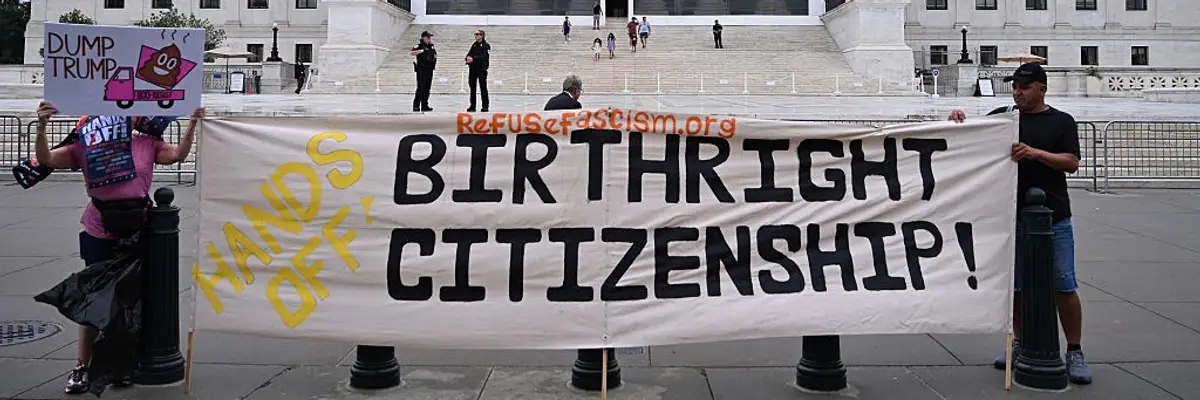
Demonstrators holds up an anti-Trump sign outside the US Supreme Court in Washington, DC, on June 27, 2025.
Defending birthright citizenship is not only about protecting children of immigrants. It is about preserving a constitutional framework that recognizes our shared humanity and limits the government’s ability to decide whose rights matter.
For more than 150 years, the 14th Amendment has been an uncompromising line: If you are born on US soil, you are a citizen. That principle is so foundational, many of us take it for granted.
But that principle is under attack.
On April 1, the Supreme Court will hear oral arguments challenging President Donald Trump’s effort to end birthright citizenship. At the center of the case is an executive order issued on the first day of Trump’s second term to end Birthright Citizenship for children of undocumented parents.
The justices will now decide whether a president can rewrite one of the clearest promises embedded in American law.
If the court strikes down birthright citizenship, it would let the government decide who counts as American based on the circumstances of their birth.
On the surface, threatening the rights of children born in the United States might seem like an immigration debate. But history tells a different story.
Birthright citizenship was never an abstract ideal. It was a response to America’s long history of dehumanization—a past that Trump and his MAGA allies are now openly trying to resurrect. The 14th Amendment was designed to dismantle a system that denied Black people a political voice, treated us as property, and denied our humanity.
Ratified in 1868, the amendment overturned Dred Scott v. Sandford, which declared that Black people “had no rights which the white man was bound to respect.” Birthright citizenship was meant to be simple and permanent so no government could take it away based on race, ancestry, or political whim.
For formerly enslaved people and their descendants, it guaranteed recognition as full citizens in their own country. But the 14th Amendment did more than correct the injustices of slavery: It expanded who counts as American.
The Constitution says plainly that anyone born in the United States and subject to its laws is a citizen. That principle was reaffirmed by the Supreme Court in United States v. Wong Kim Ark, which ruled that a man born in San Francisco to Chinese immigrant parents was a citizen, establishing that US-born children of immigrants are citizens. This was despite the fact that Chinese immigrants at the time were barred from naturalization under the Chinese Exclusion laws.
The case now before the court seeks to undo that understanding.
If the court strikes down birthright citizenship, it would let the government decide who counts as American based on the circumstances of their birth.
The 14th Amendment’s authors understood the danger of that approach. Once citizenship becomes conditional, every other right soon follows.
Ending birthright citizenship would affect everyone—not just children of immigrants—in a system that has long questioned the belonging of people of color, including Black Americans.
Who must prove their citizenship? Who is presumed to have it? Who gets stopped, questioned, or detained? Who lives under suspicion?
History answers clearly: Marginalized communities pay the price first.
I write this as someone who has spent more than 15 years organizing for racial justice and as a Black man whose citizenship was once explicitly denied by law. Today, I see how systemic racism—from policing to voter suppression—continues to shape the livelihoods of Black Americans.
And that danger does not stop with birthright citizenship: These attacks threaten the entire 14th Amendment, including the Equal Protection and Due Process Clauses that underpin victories against segregation, discrimination, voter suppression, and unchecked government power.
If the government can redefine citizenship, unequal treatment under the law becomes easier to justify. Civil rights become conditional. Equal protection becomes negotiable. State power expands while accountability shrinks.
We have seen this playbook before. After Reconstruction came Jim Crow. During industrialization came the Chinese Exclusion Act. Black workers were excluded from key New Deal protections. The gains of the civil rights movement were followed by voter suppression and mass incarceration.
Each time progress threatened entrenched power, the response was restriction rather than inclusion.
The 14th Amendment was written to break that cycle.
Defending birthright citizenship is not only about protecting children of immigrants. It is about preserving a constitutional framework that recognizes our shared humanity and limits the government’s ability to decide whose rights matter.
So the stakes could not be clearer during these Supreme Court arguments.
Birthright citizenship is more than law. It is the promise that America’s diversity, struggle, and resilience matter. It is the legacy of those who fought to be recognized as fully human—and the foundation of a democracy that must belong to all of us.
Dear Common Dreams reader, It’s been nearly 30 years since I co-founded Common Dreams with my late wife, Lina Newhouser. We had the radical notion that journalism should serve the public good, not corporate profits. It was clear to us from the outset what it would take to build such a project. No paid advertisements. No corporate sponsors. No millionaire publisher telling us what to think or do. Many people said we wouldn't last a year, but we proved those doubters wrong. Together with a tremendous team of journalists and dedicated staff, we built an independent media outlet free from the constraints of profits and corporate control. Our mission has always been simple: To inform. To inspire. To ignite change for the common good. Building Common Dreams was not easy. Our survival was never guaranteed. When you take on the most powerful forces—Wall Street greed, fossil fuel industry destruction, Big Tech lobbyists, and uber-rich oligarchs who have spent billions upon billions rigging the economy and democracy in their favor—the only bulwark you have is supporters who believe in your work. But here’s the urgent message from me today. It's never been this bad out there. And it's never been this hard to keep us going. At the very moment Common Dreams is most needed, the threats we face are intensifying. We need your support now more than ever. We don't accept corporate advertising and never will. We don't have a paywall because we don't think people should be blocked from critical news based on their ability to pay. Everything we do is funded by the donations of readers like you. When everyone does the little they can afford, we are strong. But if that support retreats or dries up, so do we. Will you donate now to make sure Common Dreams not only survives but thrives? —Craig Brown, Co-founder |
For more than 150 years, the 14th Amendment has been an uncompromising line: If you are born on US soil, you are a citizen. That principle is so foundational, many of us take it for granted.
But that principle is under attack.
On April 1, the Supreme Court will hear oral arguments challenging President Donald Trump’s effort to end birthright citizenship. At the center of the case is an executive order issued on the first day of Trump’s second term to end Birthright Citizenship for children of undocumented parents.
The justices will now decide whether a president can rewrite one of the clearest promises embedded in American law.
If the court strikes down birthright citizenship, it would let the government decide who counts as American based on the circumstances of their birth.
On the surface, threatening the rights of children born in the United States might seem like an immigration debate. But history tells a different story.
Birthright citizenship was never an abstract ideal. It was a response to America’s long history of dehumanization—a past that Trump and his MAGA allies are now openly trying to resurrect. The 14th Amendment was designed to dismantle a system that denied Black people a political voice, treated us as property, and denied our humanity.
Ratified in 1868, the amendment overturned Dred Scott v. Sandford, which declared that Black people “had no rights which the white man was bound to respect.” Birthright citizenship was meant to be simple and permanent so no government could take it away based on race, ancestry, or political whim.
For formerly enslaved people and their descendants, it guaranteed recognition as full citizens in their own country. But the 14th Amendment did more than correct the injustices of slavery: It expanded who counts as American.
The Constitution says plainly that anyone born in the United States and subject to its laws is a citizen. That principle was reaffirmed by the Supreme Court in United States v. Wong Kim Ark, which ruled that a man born in San Francisco to Chinese immigrant parents was a citizen, establishing that US-born children of immigrants are citizens. This was despite the fact that Chinese immigrants at the time were barred from naturalization under the Chinese Exclusion laws.
The case now before the court seeks to undo that understanding.
If the court strikes down birthright citizenship, it would let the government decide who counts as American based on the circumstances of their birth.
The 14th Amendment’s authors understood the danger of that approach. Once citizenship becomes conditional, every other right soon follows.
Ending birthright citizenship would affect everyone—not just children of immigrants—in a system that has long questioned the belonging of people of color, including Black Americans.
Who must prove their citizenship? Who is presumed to have it? Who gets stopped, questioned, or detained? Who lives under suspicion?
History answers clearly: Marginalized communities pay the price first.
I write this as someone who has spent more than 15 years organizing for racial justice and as a Black man whose citizenship was once explicitly denied by law. Today, I see how systemic racism—from policing to voter suppression—continues to shape the livelihoods of Black Americans.
And that danger does not stop with birthright citizenship: These attacks threaten the entire 14th Amendment, including the Equal Protection and Due Process Clauses that underpin victories against segregation, discrimination, voter suppression, and unchecked government power.
If the government can redefine citizenship, unequal treatment under the law becomes easier to justify. Civil rights become conditional. Equal protection becomes negotiable. State power expands while accountability shrinks.
We have seen this playbook before. After Reconstruction came Jim Crow. During industrialization came the Chinese Exclusion Act. Black workers were excluded from key New Deal protections. The gains of the civil rights movement were followed by voter suppression and mass incarceration.
Each time progress threatened entrenched power, the response was restriction rather than inclusion.
The 14th Amendment was written to break that cycle.
Defending birthright citizenship is not only about protecting children of immigrants. It is about preserving a constitutional framework that recognizes our shared humanity and limits the government’s ability to decide whose rights matter.
So the stakes could not be clearer during these Supreme Court arguments.
Birthright citizenship is more than law. It is the promise that America’s diversity, struggle, and resilience matter. It is the legacy of those who fought to be recognized as fully human—and the foundation of a democracy that must belong to all of us.
For more than 150 years, the 14th Amendment has been an uncompromising line: If you are born on US soil, you are a citizen. That principle is so foundational, many of us take it for granted.
But that principle is under attack.
On April 1, the Supreme Court will hear oral arguments challenging President Donald Trump’s effort to end birthright citizenship. At the center of the case is an executive order issued on the first day of Trump’s second term to end Birthright Citizenship for children of undocumented parents.
The justices will now decide whether a president can rewrite one of the clearest promises embedded in American law.
If the court strikes down birthright citizenship, it would let the government decide who counts as American based on the circumstances of their birth.
On the surface, threatening the rights of children born in the United States might seem like an immigration debate. But history tells a different story.
Birthright citizenship was never an abstract ideal. It was a response to America’s long history of dehumanization—a past that Trump and his MAGA allies are now openly trying to resurrect. The 14th Amendment was designed to dismantle a system that denied Black people a political voice, treated us as property, and denied our humanity.
Ratified in 1868, the amendment overturned Dred Scott v. Sandford, which declared that Black people “had no rights which the white man was bound to respect.” Birthright citizenship was meant to be simple and permanent so no government could take it away based on race, ancestry, or political whim.
For formerly enslaved people and their descendants, it guaranteed recognition as full citizens in their own country. But the 14th Amendment did more than correct the injustices of slavery: It expanded who counts as American.
The Constitution says plainly that anyone born in the United States and subject to its laws is a citizen. That principle was reaffirmed by the Supreme Court in United States v. Wong Kim Ark, which ruled that a man born in San Francisco to Chinese immigrant parents was a citizen, establishing that US-born children of immigrants are citizens. This was despite the fact that Chinese immigrants at the time were barred from naturalization under the Chinese Exclusion laws.
The case now before the court seeks to undo that understanding.
If the court strikes down birthright citizenship, it would let the government decide who counts as American based on the circumstances of their birth.
The 14th Amendment’s authors understood the danger of that approach. Once citizenship becomes conditional, every other right soon follows.
Ending birthright citizenship would affect everyone—not just children of immigrants—in a system that has long questioned the belonging of people of color, including Black Americans.
Who must prove their citizenship? Who is presumed to have it? Who gets stopped, questioned, or detained? Who lives under suspicion?
History answers clearly: Marginalized communities pay the price first.
I write this as someone who has spent more than 15 years organizing for racial justice and as a Black man whose citizenship was once explicitly denied by law. Today, I see how systemic racism—from policing to voter suppression—continues to shape the livelihoods of Black Americans.
And that danger does not stop with birthright citizenship: These attacks threaten the entire 14th Amendment, including the Equal Protection and Due Process Clauses that underpin victories against segregation, discrimination, voter suppression, and unchecked government power.
If the government can redefine citizenship, unequal treatment under the law becomes easier to justify. Civil rights become conditional. Equal protection becomes negotiable. State power expands while accountability shrinks.
We have seen this playbook before. After Reconstruction came Jim Crow. During industrialization came the Chinese Exclusion Act. Black workers were excluded from key New Deal protections. The gains of the civil rights movement were followed by voter suppression and mass incarceration.
Each time progress threatened entrenched power, the response was restriction rather than inclusion.
The 14th Amendment was written to break that cycle.
Defending birthright citizenship is not only about protecting children of immigrants. It is about preserving a constitutional framework that recognizes our shared humanity and limits the government’s ability to decide whose rights matter.
So the stakes could not be clearer during these Supreme Court arguments.
Birthright citizenship is more than law. It is the promise that America’s diversity, struggle, and resilience matter. It is the legacy of those who fought to be recognized as fully human—and the foundation of a democracy that must belong to all of us.