SUBSCRIBE TO OUR FREE NEWSLETTER
Daily news & progressive opinion—funded by the people, not the corporations—delivered straight to your inbox.
5
#000000
#FFFFFF
To donate by check, phone, or other method, see our More Ways to Give page.
Daily news & progressive opinion—funded by the people, not the corporations—delivered straight to your inbox.
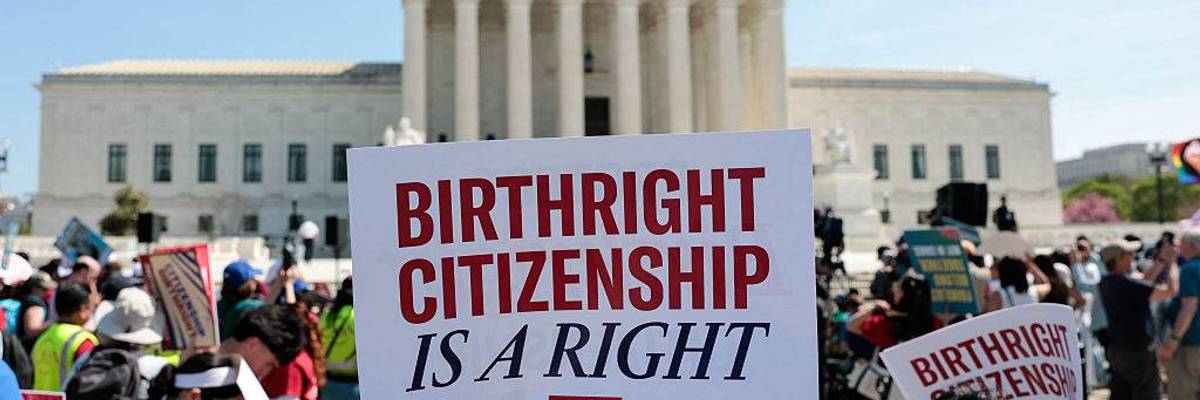
Demonstrators rally in support of birthright citizenship outside the US Supreme Court in Washington, DC on April 1, 2026.
The majority of Supreme Court justices expressed "profound skepticism toward the government’s revisionist history of the 14th Amendment, with most sounding downright hostile," wrote one legal reporter.
Some legal experts who listened to oral arguments at the US Supreme Court on Wednesday came away with the impression that a majority of justices were skeptical of President Donald Trump's executive order that unilaterally reinterprets the 14th Amendment of the US Constitution.
During the hearing, many observers noted that some conservative justices—including John Roberts, Neil Gorsuch, and Amy Coney Barrett—all asked pointed questions of US Solicitor General John Sauer, who was presenting the case in defense of the Trump executive order that declared an end to birthright citizenship in the country, despite more than a century of legal precedent.
After listening to the arguments, Georgetown University Law Center professor Steve Vladeck predicted that the final verdict would be "7-2 to block the executive order," and maybe even an 8-1 vote.
"This wasn't (and won't be) close," said Vladeck.
Cornell Law School professor Michael C. Dorf shared Vladeck's view that a clear majority of the court would likely vote to strike down the Trump order, but he cautioned that it could give the court cover to issue less extreme rulings that would nonetheless erode Americans' rights.
"Don't get me wrong: I'm relieved that this case is shaping up as either 8-1 or 7-2 against the Trump executive order," Dorf explained. "But the case is a gift to the Supreme Court. By rejecting an outlandish position, it will earn credibility as apolitical, even as the Overton window moves far to the right."
Elie Mystal, justice correspondent at The Nation, said after watching the hearings that he simply could not imagine a majority of the court ruling in Trump's favor.
"What I don't think is a possibility is 5-4 Trump wins," he wrote. "We have [Amy Coney Barrett]. We have Roberts. We almost certainly have Gorsuch (possibly as a concurrence). I CANNOT count to five on a Trump win here. So... good. I mean, terrible that it's gotten his far. But good."
Author and former CNN legal analyst Jeffrey Toobin wasn't ready to make a full prediction on the outcome of the case, but he did note that "the birthright citizenship argument is going poorly for the Trump Administration."
Slate senior writer Mark Joseph Stern found that the Supreme Court hearing "quickly shaped up to be a blowout against the administration," with seven justices expressing "profound skepticism toward the government’s revisionist history of the 14th Amendment, with most sounding downright hostile toward the pseudo-originalist theory cooked up to legitimize the policy."
In fact, Stern thought that the administration's arguments before the court were so unconvincing that he found it "alarming" that Justices Clarence Thomas and Samuel Alito appeared convinced by its rationales.
All the same, he predicted that Trump's birthright citizenship order "is about to go down in flames."
Dear Common Dreams reader, It’s been nearly 30 years since I co-founded Common Dreams with my late wife, Lina Newhouser. We had the radical notion that journalism should serve the public good, not corporate profits. It was clear to us from the outset what it would take to build such a project. No paid advertisements. No corporate sponsors. No millionaire publisher telling us what to think or do. Many people said we wouldn't last a year, but we proved those doubters wrong. Together with a tremendous team of journalists and dedicated staff, we built an independent media outlet free from the constraints of profits and corporate control. Our mission has always been simple: To inform. To inspire. To ignite change for the common good. Building Common Dreams was not easy. Our survival was never guaranteed. When you take on the most powerful forces—Wall Street greed, fossil fuel industry destruction, Big Tech lobbyists, and uber-rich oligarchs who have spent billions upon billions rigging the economy and democracy in their favor—the only bulwark you have is supporters who believe in your work. But here’s the urgent message from me today. It's never been this bad out there. And it's never been this hard to keep us going. At the very moment Common Dreams is most needed, the threats we face are intensifying. We need your support now more than ever. We don't accept corporate advertising and never will. We don't have a paywall because we don't think people should be blocked from critical news based on their ability to pay. Everything we do is funded by the donations of readers like you. When everyone does the little they can afford, we are strong. But if that support retreats or dries up, so do we. Will you donate now to make sure Common Dreams not only survives but thrives? —Craig Brown, Co-founder |
Some legal experts who listened to oral arguments at the US Supreme Court on Wednesday came away with the impression that a majority of justices were skeptical of President Donald Trump's executive order that unilaterally reinterprets the 14th Amendment of the US Constitution.
During the hearing, many observers noted that some conservative justices—including John Roberts, Neil Gorsuch, and Amy Coney Barrett—all asked pointed questions of US Solicitor General John Sauer, who was presenting the case in defense of the Trump executive order that declared an end to birthright citizenship in the country, despite more than a century of legal precedent.
After listening to the arguments, Georgetown University Law Center professor Steve Vladeck predicted that the final verdict would be "7-2 to block the executive order," and maybe even an 8-1 vote.
"This wasn't (and won't be) close," said Vladeck.
Cornell Law School professor Michael C. Dorf shared Vladeck's view that a clear majority of the court would likely vote to strike down the Trump order, but he cautioned that it could give the court cover to issue less extreme rulings that would nonetheless erode Americans' rights.
"Don't get me wrong: I'm relieved that this case is shaping up as either 8-1 or 7-2 against the Trump executive order," Dorf explained. "But the case is a gift to the Supreme Court. By rejecting an outlandish position, it will earn credibility as apolitical, even as the Overton window moves far to the right."
Elie Mystal, justice correspondent at The Nation, said after watching the hearings that he simply could not imagine a majority of the court ruling in Trump's favor.
"What I don't think is a possibility is 5-4 Trump wins," he wrote. "We have [Amy Coney Barrett]. We have Roberts. We almost certainly have Gorsuch (possibly as a concurrence). I CANNOT count to five on a Trump win here. So... good. I mean, terrible that it's gotten his far. But good."
Author and former CNN legal analyst Jeffrey Toobin wasn't ready to make a full prediction on the outcome of the case, but he did note that "the birthright citizenship argument is going poorly for the Trump Administration."
Slate senior writer Mark Joseph Stern found that the Supreme Court hearing "quickly shaped up to be a blowout against the administration," with seven justices expressing "profound skepticism toward the government’s revisionist history of the 14th Amendment, with most sounding downright hostile toward the pseudo-originalist theory cooked up to legitimize the policy."
In fact, Stern thought that the administration's arguments before the court were so unconvincing that he found it "alarming" that Justices Clarence Thomas and Samuel Alito appeared convinced by its rationales.
All the same, he predicted that Trump's birthright citizenship order "is about to go down in flames."
Some legal experts who listened to oral arguments at the US Supreme Court on Wednesday came away with the impression that a majority of justices were skeptical of President Donald Trump's executive order that unilaterally reinterprets the 14th Amendment of the US Constitution.
During the hearing, many observers noted that some conservative justices—including John Roberts, Neil Gorsuch, and Amy Coney Barrett—all asked pointed questions of US Solicitor General John Sauer, who was presenting the case in defense of the Trump executive order that declared an end to birthright citizenship in the country, despite more than a century of legal precedent.
After listening to the arguments, Georgetown University Law Center professor Steve Vladeck predicted that the final verdict would be "7-2 to block the executive order," and maybe even an 8-1 vote.
"This wasn't (and won't be) close," said Vladeck.
Cornell Law School professor Michael C. Dorf shared Vladeck's view that a clear majority of the court would likely vote to strike down the Trump order, but he cautioned that it could give the court cover to issue less extreme rulings that would nonetheless erode Americans' rights.
"Don't get me wrong: I'm relieved that this case is shaping up as either 8-1 or 7-2 against the Trump executive order," Dorf explained. "But the case is a gift to the Supreme Court. By rejecting an outlandish position, it will earn credibility as apolitical, even as the Overton window moves far to the right."
Elie Mystal, justice correspondent at The Nation, said after watching the hearings that he simply could not imagine a majority of the court ruling in Trump's favor.
"What I don't think is a possibility is 5-4 Trump wins," he wrote. "We have [Amy Coney Barrett]. We have Roberts. We almost certainly have Gorsuch (possibly as a concurrence). I CANNOT count to five on a Trump win here. So... good. I mean, terrible that it's gotten his far. But good."
Author and former CNN legal analyst Jeffrey Toobin wasn't ready to make a full prediction on the outcome of the case, but he did note that "the birthright citizenship argument is going poorly for the Trump Administration."
Slate senior writer Mark Joseph Stern found that the Supreme Court hearing "quickly shaped up to be a blowout against the administration," with seven justices expressing "profound skepticism toward the government’s revisionist history of the 14th Amendment, with most sounding downright hostile toward the pseudo-originalist theory cooked up to legitimize the policy."
In fact, Stern thought that the administration's arguments before the court were so unconvincing that he found it "alarming" that Justices Clarence Thomas and Samuel Alito appeared convinced by its rationales.
All the same, he predicted that Trump's birthright citizenship order "is about to go down in flames."