SUBSCRIBE TO OUR FREE NEWSLETTER
Daily news & progressive opinion—funded by the people, not the corporations—delivered straight to your inbox.
5
#000000
#FFFFFF
To donate by check, phone, or other method, see our More Ways to Give page.
Daily news & progressive opinion—funded by the people, not the corporations—delivered straight to your inbox.
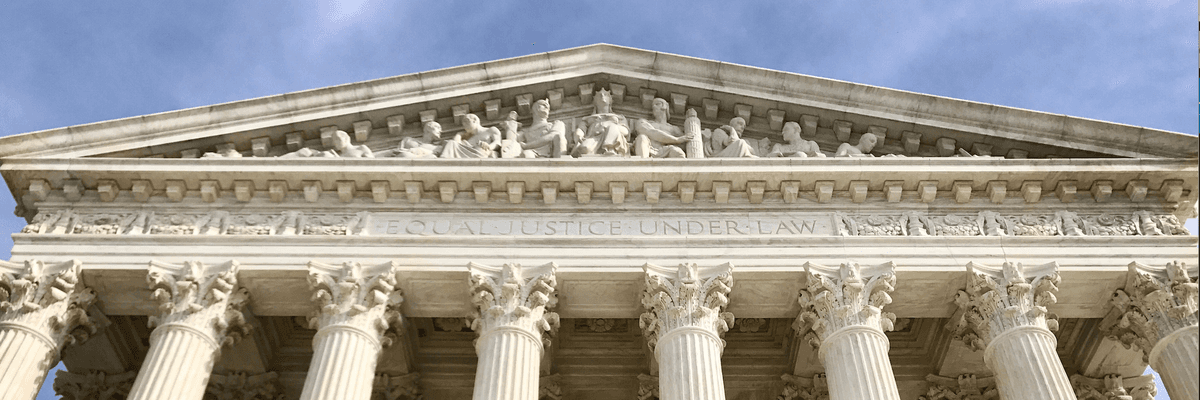
This closeup photo shows details of the U.S. Supreme Court building in Washington, D.C.
"All persons born on U.S. soil are U.S. citizens, that is what our Constitution dictates and is something President Trump cannot undo by waving a pen," one Democratic congresswoman said.
The U.S. Supreme Court said Thursday that it will hear oral arguments related to President Donald Trump's effort to enforce an executive order that would end more than a century of constitutionally enshrined birthright citizenship, while deferring a Trump administration request to allow immediate implementation of the edict, which has been blocked by multiple federal judges.
The justices issued an order scheduling oral arguments on May 15 to consider the Trump administration's request to limit the scope of nationwide preliminary injunctions against Trump's day one executive order aimed at denying citizenship to people born in the U.S. if neither of their parents are citizens.
Breaking: SCOTUS sets May 15 arguments in Trump birthright citizenship order request. Technically over the administration's "partial stay" request, a ruling could allow the admin to start implementing the unconstitutional order. Also: More on DOJ Civil Rights. New, at Law Dork —>
[image or embed]
— Chris Geidner ( @chrisgeidner.bsky.social) April 17, 2025 at 12:37 PM
The citizenship clause of the Constitution's 14th Amendment explicitly states that "all persons born or naturalized in the United States" are citizens.
However, Trump argues in his executive order that the 14th Amendment "has never been interpreted to extend citizenship universally to everyone born within the United States," and "has always excluded from birthright citizenship persons who were born in the United States but not 'subject to the jurisdiction thereof.'"
Trump's order sparked outrage and lawsuits by more than 20 states and numerous advocacy groups. Federal district courts in Washington, Maryland, New Hampshire, and Massachusetts blocked the administration from enforcing the president's order by issuing nationwide preliminary injunctions. Federal appellate courts in San Francisco, Boston, and Richmond, Virginia subsequently rejected Trump administration requests to partially block the injunctions.
Trump has argued that the 14th Amendment is "all about slavery." While the amendment was adopted in 1868 during Reconstruction to grant citizenship to emancipated Black slaves, the Supreme Court ruled in United States v. Wong Kim Ark (1898) that the amendment confers citizenship to children born in the country regardless of their parents' status.
Briefs—including one by the immigrant advocacy groups CASA and the Asylum Seeker Advocacy Project, and danother filed on behalf of Arizona, Illinois, Oregon, and Washington—urged the Supreme Court to reject the government's argument against the nationwide injunctions.
"Being directed to follow the law as it has been universally understood for over 125 years is not an emergency warranting the extraordinary remedy of a stay," asserts the brief filed by the states—which calls the Trump administration's focus on the nature of the injunctions "myopic."
CASA and Asylum Seeker Advocacy Project argued that nationwide consistency is imperative for immigration policy and that "the executive branch has been complying with the settled interpretation of the citizenship clause for 125 years, and the government has demonstrated no urgent need to change now."
"Whether a child is a citizen of our nation should not depend on the state where she is born or the associations her parents have joined," the groups added.
Earlier this month, more than 200 Democratic lawmakers in the U.S. House of Representatives filed an amicus brief opposing Trump's order.
"Birthright citizenship is a core piece of our Constitution. Ending it through executive order is simply unconstitutional and a dangerous overreach of executive power," Rep. Pramila Jayapal (D-Wash.), the ranking member of the House Subcommittee on Immigration Integrity, Security, and Enforcement, said in a statement announcing the brief.
"All persons born on U.S. soil are U.S. citizens, that is what our Constitution dictates and is something President Trump cannot undo by waving a pen," Jayapal added.
Dear Common Dreams reader, It’s been nearly 30 years since I co-founded Common Dreams with my late wife, Lina Newhouser. We had the radical notion that journalism should serve the public good, not corporate profits. It was clear to us from the outset what it would take to build such a project. No paid advertisements. No corporate sponsors. No millionaire publisher telling us what to think or do. Many people said we wouldn't last a year, but we proved those doubters wrong. Together with a tremendous team of journalists and dedicated staff, we built an independent media outlet free from the constraints of profits and corporate control. Our mission has always been simple: To inform. To inspire. To ignite change for the common good. Building Common Dreams was not easy. Our survival was never guaranteed. When you take on the most powerful forces—Wall Street greed, fossil fuel industry destruction, Big Tech lobbyists, and uber-rich oligarchs who have spent billions upon billions rigging the economy and democracy in their favor—the only bulwark you have is supporters who believe in your work. But here’s the urgent message from me today. It's never been this bad out there. And it's never been this hard to keep us going. At the very moment Common Dreams is most needed, the threats we face are intensifying. We need your support now more than ever. We don't accept corporate advertising and never will. We don't have a paywall because we don't think people should be blocked from critical news based on their ability to pay. Everything we do is funded by the donations of readers like you. When everyone does the little they can afford, we are strong. But if that support retreats or dries up, so do we. Will you donate now to make sure Common Dreams not only survives but thrives? —Craig Brown, Co-founder |
The U.S. Supreme Court said Thursday that it will hear oral arguments related to President Donald Trump's effort to enforce an executive order that would end more than a century of constitutionally enshrined birthright citizenship, while deferring a Trump administration request to allow immediate implementation of the edict, which has been blocked by multiple federal judges.
The justices issued an order scheduling oral arguments on May 15 to consider the Trump administration's request to limit the scope of nationwide preliminary injunctions against Trump's day one executive order aimed at denying citizenship to people born in the U.S. if neither of their parents are citizens.
Breaking: SCOTUS sets May 15 arguments in Trump birthright citizenship order request. Technically over the administration's "partial stay" request, a ruling could allow the admin to start implementing the unconstitutional order. Also: More on DOJ Civil Rights. New, at Law Dork —>
[image or embed]
— Chris Geidner ( @chrisgeidner.bsky.social) April 17, 2025 at 12:37 PM
The citizenship clause of the Constitution's 14th Amendment explicitly states that "all persons born or naturalized in the United States" are citizens.
However, Trump argues in his executive order that the 14th Amendment "has never been interpreted to extend citizenship universally to everyone born within the United States," and "has always excluded from birthright citizenship persons who were born in the United States but not 'subject to the jurisdiction thereof.'"
Trump's order sparked outrage and lawsuits by more than 20 states and numerous advocacy groups. Federal district courts in Washington, Maryland, New Hampshire, and Massachusetts blocked the administration from enforcing the president's order by issuing nationwide preliminary injunctions. Federal appellate courts in San Francisco, Boston, and Richmond, Virginia subsequently rejected Trump administration requests to partially block the injunctions.
Trump has argued that the 14th Amendment is "all about slavery." While the amendment was adopted in 1868 during Reconstruction to grant citizenship to emancipated Black slaves, the Supreme Court ruled in United States v. Wong Kim Ark (1898) that the amendment confers citizenship to children born in the country regardless of their parents' status.
Briefs—including one by the immigrant advocacy groups CASA and the Asylum Seeker Advocacy Project, and danother filed on behalf of Arizona, Illinois, Oregon, and Washington—urged the Supreme Court to reject the government's argument against the nationwide injunctions.
"Being directed to follow the law as it has been universally understood for over 125 years is not an emergency warranting the extraordinary remedy of a stay," asserts the brief filed by the states—which calls the Trump administration's focus on the nature of the injunctions "myopic."
CASA and Asylum Seeker Advocacy Project argued that nationwide consistency is imperative for immigration policy and that "the executive branch has been complying with the settled interpretation of the citizenship clause for 125 years, and the government has demonstrated no urgent need to change now."
"Whether a child is a citizen of our nation should not depend on the state where she is born or the associations her parents have joined," the groups added.
Earlier this month, more than 200 Democratic lawmakers in the U.S. House of Representatives filed an amicus brief opposing Trump's order.
"Birthright citizenship is a core piece of our Constitution. Ending it through executive order is simply unconstitutional and a dangerous overreach of executive power," Rep. Pramila Jayapal (D-Wash.), the ranking member of the House Subcommittee on Immigration Integrity, Security, and Enforcement, said in a statement announcing the brief.
"All persons born on U.S. soil are U.S. citizens, that is what our Constitution dictates and is something President Trump cannot undo by waving a pen," Jayapal added.
The U.S. Supreme Court said Thursday that it will hear oral arguments related to President Donald Trump's effort to enforce an executive order that would end more than a century of constitutionally enshrined birthright citizenship, while deferring a Trump administration request to allow immediate implementation of the edict, which has been blocked by multiple federal judges.
The justices issued an order scheduling oral arguments on May 15 to consider the Trump administration's request to limit the scope of nationwide preliminary injunctions against Trump's day one executive order aimed at denying citizenship to people born in the U.S. if neither of their parents are citizens.
Breaking: SCOTUS sets May 15 arguments in Trump birthright citizenship order request. Technically over the administration's "partial stay" request, a ruling could allow the admin to start implementing the unconstitutional order. Also: More on DOJ Civil Rights. New, at Law Dork —>
[image or embed]
— Chris Geidner ( @chrisgeidner.bsky.social) April 17, 2025 at 12:37 PM
The citizenship clause of the Constitution's 14th Amendment explicitly states that "all persons born or naturalized in the United States" are citizens.
However, Trump argues in his executive order that the 14th Amendment "has never been interpreted to extend citizenship universally to everyone born within the United States," and "has always excluded from birthright citizenship persons who were born in the United States but not 'subject to the jurisdiction thereof.'"
Trump's order sparked outrage and lawsuits by more than 20 states and numerous advocacy groups. Federal district courts in Washington, Maryland, New Hampshire, and Massachusetts blocked the administration from enforcing the president's order by issuing nationwide preliminary injunctions. Federal appellate courts in San Francisco, Boston, and Richmond, Virginia subsequently rejected Trump administration requests to partially block the injunctions.
Trump has argued that the 14th Amendment is "all about slavery." While the amendment was adopted in 1868 during Reconstruction to grant citizenship to emancipated Black slaves, the Supreme Court ruled in United States v. Wong Kim Ark (1898) that the amendment confers citizenship to children born in the country regardless of their parents' status.
Briefs—including one by the immigrant advocacy groups CASA and the Asylum Seeker Advocacy Project, and danother filed on behalf of Arizona, Illinois, Oregon, and Washington—urged the Supreme Court to reject the government's argument against the nationwide injunctions.
"Being directed to follow the law as it has been universally understood for over 125 years is not an emergency warranting the extraordinary remedy of a stay," asserts the brief filed by the states—which calls the Trump administration's focus on the nature of the injunctions "myopic."
CASA and Asylum Seeker Advocacy Project argued that nationwide consistency is imperative for immigration policy and that "the executive branch has been complying with the settled interpretation of the citizenship clause for 125 years, and the government has demonstrated no urgent need to change now."
"Whether a child is a citizen of our nation should not depend on the state where she is born or the associations her parents have joined," the groups added.
Earlier this month, more than 200 Democratic lawmakers in the U.S. House of Representatives filed an amicus brief opposing Trump's order.
"Birthright citizenship is a core piece of our Constitution. Ending it through executive order is simply unconstitutional and a dangerous overreach of executive power," Rep. Pramila Jayapal (D-Wash.), the ranking member of the House Subcommittee on Immigration Integrity, Security, and Enforcement, said in a statement announcing the brief.
"All persons born on U.S. soil are U.S. citizens, that is what our Constitution dictates and is something President Trump cannot undo by waving a pen," Jayapal added.