SUBSCRIBE TO OUR FREE NEWSLETTER
Daily news & progressive opinion—funded by the people, not the corporations—delivered straight to your inbox.
5
#000000
#FFFFFF
To donate by check, phone, or other method, see our More Ways to Give page.
Daily news & progressive opinion—funded by the people, not the corporations—delivered straight to your inbox.
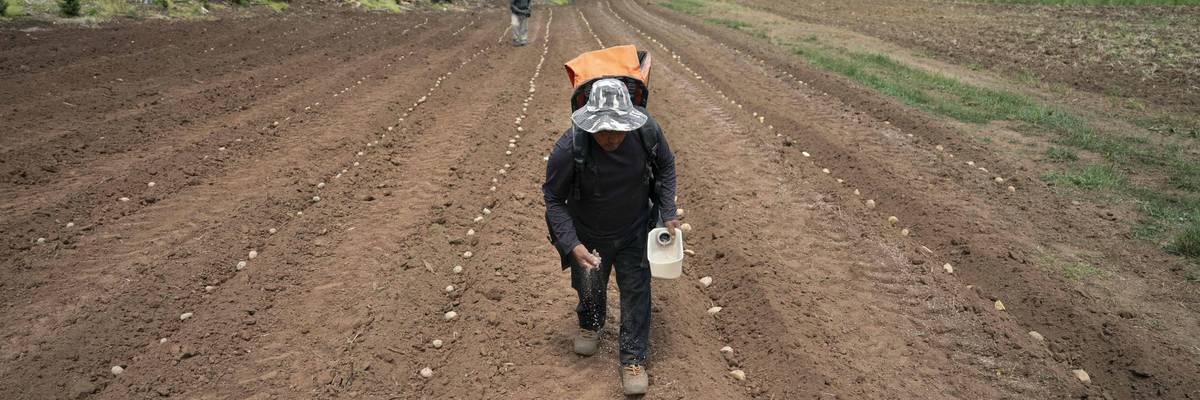
Workers spread fertilizer after planting potatoes at Bluff View Farms on April 24, 2026 in West Jefferson, North Carolina.
If we want to keep farmers on their land and help underrepresented communities break into agriculture, we’ll need a consistent, predictable policy.
America’s farmers understand that some degree of uncertainty comes with the job. They can’t control the weather, after all. But for most of them, the biggest source of uncertainty is not nature, but politics.
As US foreign and domestic policy becomes less predictable, it becomes more difficult for families who work the land to make informed long-term decisions.
The partisan wrangling over the most recent Farm Bill provides the perfect example. This legislation would give farmers more access to government-backed credit, help them sell their crops overseas, and provide much-needed relief to those facing droughts or floods. Unfortunately, the process of passing it devolved into a partisan slap fight due to Republicans’ insistence on cutting the food stamps low-income Americans rely on to feed their families.
Sen. Chuck Grassley (R-Iowa), himself a farmer, could hardly believe how ugly the process got. “I think every other Farm Bill that I’ve worked on in the 46 years I’ve been in the United States Senate has been a bipartisan bill,” he told the press. If future Farm Bill negotiations prove equally contentious, it could lead to disastrous funding lapses for key agricultural programs.
The farming sector can only manufacture so much certainty in the marketplace when Republicans keep changing the marketplace rules, ignoring the very forgotten men and women in rural America that they espouse to protect.
The Trump administration’s ongoing war with Iran has only added fuel to the uncertainty fire for America’s farmers. About one-third of the world’s seaborne fertilizer trade passes through the Strait of Hormuz, which has mostly remained closed since the bombs started falling on February 28. Within weeks, urea prices spiked from a pre-war level of less than $500 a ton to over $700 a ton, and although they’ve fallen since then, prices remain significantly higher than they were just two years ago and have continued to fluctuate amid tense negotiations and broken ceasefires.
Another source of uncertainty is President Donald Trump’s global trade wars. It’s true that some of his trade agreements—like the one he reached with the United Kingdom last May—increased market access for American farmers. But it’s also true that those deals are only worth as much as the word of the president who made them. In February, Trump threatened to blow up his newly inked trade deals with the UK and other European nations unless they agreed to sell him Greenland. The ever-shifting legal justifications for Trump’s tariff regime muddy the waters even further.
Should a farmer invest in increased production to meet demand from new British buyers? Or will a surprise judicial ruling or fit of presidential pique cause the tariffs and trade deals that undergird those contracts to disappear overnight? Guess wrong and you might go bankrupt.
Closer to home, Trump’s refusal to renew the US-Mexico-Canada (USMCA) agreement has scrambled relationships between American farmers and their Canadian and Mexican customers and competitors. These stakeholders were just barely getting used to the new status quo after USMCA replaced NAFTA in 2020, and now they might have to start all over again.
Immigration policy also plays a role in creating uncertainty for farmers. A survey of 2,250 agricultural workers conducted by the United Farm Workers Foundation found that 88% of respondents worried about being detained or deported due to the increase in immigration raids at farms. The administration has mostly stopped these raids but could restart them at any time.
Some companies impacted by the Trump administration’s anti-worker, anti-farmer, nativist policies are trying their best to stabilize the agricultural industry’s conditions so that they can have more certainty. John Deere, for example, recently offered its unionized employees a contract extension that preserves its employees’ cost-of-living wage adjustments, no-deductible health coverage, and pension benefits through 2029. Even though the country is in a crop sector recession, the economic logic behind this proposal is sound because studies show that workplace anxiety severely impacts worker productivity. Giving workers additional certainty over their ability to put food on the table for their families thus improves both efficiency and employee retention. Nevertheless, the farming sector can only manufacture so much certainty in the marketplace when Republicans keep changing the marketplace rules, ignoring the very forgotten men and women in rural America that they espouse to protect.
An administration that thinks only in terms of news cycles is bad news for farm families who think in terms of seasons—or even generations. If we want to keep farmers on their land and help underrepresented communities break into agriculture, we’ll need a consistent, predictable policy. Our government might not be able to control the weather, but it should be able to pass a Farm Bill and play nice with our trading partners.
Dear Common Dreams reader, It’s been nearly 30 years since I co-founded Common Dreams with my late wife, Lina Newhouser. We had the radical notion that journalism should serve the public good, not corporate profits. It was clear to us from the outset what it would take to build such a project. No paid advertisements. No corporate sponsors. No millionaire publisher telling us what to think or do. Many people said we wouldn't last a year, but we proved those doubters wrong. Together with a tremendous team of journalists and dedicated staff, we built an independent media outlet free from the constraints of profits and corporate control. Our mission has always been simple: To inform. To inspire. To ignite change for the common good. Building Common Dreams was not easy. Our survival was never guaranteed. When you take on the most powerful forces—Wall Street greed, fossil fuel industry destruction, Big Tech lobbyists, and uber-rich oligarchs who have spent billions upon billions rigging the economy and democracy in their favor—the only bulwark you have is supporters who believe in your work. But here’s the urgent message from me today. It's never been this bad out there. And it's never been this hard to keep us going. At the very moment Common Dreams is most needed, the threats we face are intensifying. We need your support now more than ever. We don't accept corporate advertising and never will. We don't have a paywall because we don't think people should be blocked from critical news based on their ability to pay. Everything we do is funded by the donations of readers like you. When everyone does the little they can afford, we are strong. But if that support retreats or dries up, so do we. Will you donate now to make sure Common Dreams not only survives but thrives? —Craig Brown, Co-founder |
America’s farmers understand that some degree of uncertainty comes with the job. They can’t control the weather, after all. But for most of them, the biggest source of uncertainty is not nature, but politics.
As US foreign and domestic policy becomes less predictable, it becomes more difficult for families who work the land to make informed long-term decisions.
The partisan wrangling over the most recent Farm Bill provides the perfect example. This legislation would give farmers more access to government-backed credit, help them sell their crops overseas, and provide much-needed relief to those facing droughts or floods. Unfortunately, the process of passing it devolved into a partisan slap fight due to Republicans’ insistence on cutting the food stamps low-income Americans rely on to feed their families.
Sen. Chuck Grassley (R-Iowa), himself a farmer, could hardly believe how ugly the process got. “I think every other Farm Bill that I’ve worked on in the 46 years I’ve been in the United States Senate has been a bipartisan bill,” he told the press. If future Farm Bill negotiations prove equally contentious, it could lead to disastrous funding lapses for key agricultural programs.
The farming sector can only manufacture so much certainty in the marketplace when Republicans keep changing the marketplace rules, ignoring the very forgotten men and women in rural America that they espouse to protect.
The Trump administration’s ongoing war with Iran has only added fuel to the uncertainty fire for America’s farmers. About one-third of the world’s seaborne fertilizer trade passes through the Strait of Hormuz, which has mostly remained closed since the bombs started falling on February 28. Within weeks, urea prices spiked from a pre-war level of less than $500 a ton to over $700 a ton, and although they’ve fallen since then, prices remain significantly higher than they were just two years ago and have continued to fluctuate amid tense negotiations and broken ceasefires.
Another source of uncertainty is President Donald Trump’s global trade wars. It’s true that some of his trade agreements—like the one he reached with the United Kingdom last May—increased market access for American farmers. But it’s also true that those deals are only worth as much as the word of the president who made them. In February, Trump threatened to blow up his newly inked trade deals with the UK and other European nations unless they agreed to sell him Greenland. The ever-shifting legal justifications for Trump’s tariff regime muddy the waters even further.
Should a farmer invest in increased production to meet demand from new British buyers? Or will a surprise judicial ruling or fit of presidential pique cause the tariffs and trade deals that undergird those contracts to disappear overnight? Guess wrong and you might go bankrupt.
Closer to home, Trump’s refusal to renew the US-Mexico-Canada (USMCA) agreement has scrambled relationships between American farmers and their Canadian and Mexican customers and competitors. These stakeholders were just barely getting used to the new status quo after USMCA replaced NAFTA in 2020, and now they might have to start all over again.
Immigration policy also plays a role in creating uncertainty for farmers. A survey of 2,250 agricultural workers conducted by the United Farm Workers Foundation found that 88% of respondents worried about being detained or deported due to the increase in immigration raids at farms. The administration has mostly stopped these raids but could restart them at any time.
Some companies impacted by the Trump administration’s anti-worker, anti-farmer, nativist policies are trying their best to stabilize the agricultural industry’s conditions so that they can have more certainty. John Deere, for example, recently offered its unionized employees a contract extension that preserves its employees’ cost-of-living wage adjustments, no-deductible health coverage, and pension benefits through 2029. Even though the country is in a crop sector recession, the economic logic behind this proposal is sound because studies show that workplace anxiety severely impacts worker productivity. Giving workers additional certainty over their ability to put food on the table for their families thus improves both efficiency and employee retention. Nevertheless, the farming sector can only manufacture so much certainty in the marketplace when Republicans keep changing the marketplace rules, ignoring the very forgotten men and women in rural America that they espouse to protect.
An administration that thinks only in terms of news cycles is bad news for farm families who think in terms of seasons—or even generations. If we want to keep farmers on their land and help underrepresented communities break into agriculture, we’ll need a consistent, predictable policy. Our government might not be able to control the weather, but it should be able to pass a Farm Bill and play nice with our trading partners.
America’s farmers understand that some degree of uncertainty comes with the job. They can’t control the weather, after all. But for most of them, the biggest source of uncertainty is not nature, but politics.
As US foreign and domestic policy becomes less predictable, it becomes more difficult for families who work the land to make informed long-term decisions.
The partisan wrangling over the most recent Farm Bill provides the perfect example. This legislation would give farmers more access to government-backed credit, help them sell their crops overseas, and provide much-needed relief to those facing droughts or floods. Unfortunately, the process of passing it devolved into a partisan slap fight due to Republicans’ insistence on cutting the food stamps low-income Americans rely on to feed their families.
Sen. Chuck Grassley (R-Iowa), himself a farmer, could hardly believe how ugly the process got. “I think every other Farm Bill that I’ve worked on in the 46 years I’ve been in the United States Senate has been a bipartisan bill,” he told the press. If future Farm Bill negotiations prove equally contentious, it could lead to disastrous funding lapses for key agricultural programs.
The farming sector can only manufacture so much certainty in the marketplace when Republicans keep changing the marketplace rules, ignoring the very forgotten men and women in rural America that they espouse to protect.
The Trump administration’s ongoing war with Iran has only added fuel to the uncertainty fire for America’s farmers. About one-third of the world’s seaborne fertilizer trade passes through the Strait of Hormuz, which has mostly remained closed since the bombs started falling on February 28. Within weeks, urea prices spiked from a pre-war level of less than $500 a ton to over $700 a ton, and although they’ve fallen since then, prices remain significantly higher than they were just two years ago and have continued to fluctuate amid tense negotiations and broken ceasefires.
Another source of uncertainty is President Donald Trump’s global trade wars. It’s true that some of his trade agreements—like the one he reached with the United Kingdom last May—increased market access for American farmers. But it’s also true that those deals are only worth as much as the word of the president who made them. In February, Trump threatened to blow up his newly inked trade deals with the UK and other European nations unless they agreed to sell him Greenland. The ever-shifting legal justifications for Trump’s tariff regime muddy the waters even further.
Should a farmer invest in increased production to meet demand from new British buyers? Or will a surprise judicial ruling or fit of presidential pique cause the tariffs and trade deals that undergird those contracts to disappear overnight? Guess wrong and you might go bankrupt.
Closer to home, Trump’s refusal to renew the US-Mexico-Canada (USMCA) agreement has scrambled relationships between American farmers and their Canadian and Mexican customers and competitors. These stakeholders were just barely getting used to the new status quo after USMCA replaced NAFTA in 2020, and now they might have to start all over again.
Immigration policy also plays a role in creating uncertainty for farmers. A survey of 2,250 agricultural workers conducted by the United Farm Workers Foundation found that 88% of respondents worried about being detained or deported due to the increase in immigration raids at farms. The administration has mostly stopped these raids but could restart them at any time.
Some companies impacted by the Trump administration’s anti-worker, anti-farmer, nativist policies are trying their best to stabilize the agricultural industry’s conditions so that they can have more certainty. John Deere, for example, recently offered its unionized employees a contract extension that preserves its employees’ cost-of-living wage adjustments, no-deductible health coverage, and pension benefits through 2029. Even though the country is in a crop sector recession, the economic logic behind this proposal is sound because studies show that workplace anxiety severely impacts worker productivity. Giving workers additional certainty over their ability to put food on the table for their families thus improves both efficiency and employee retention. Nevertheless, the farming sector can only manufacture so much certainty in the marketplace when Republicans keep changing the marketplace rules, ignoring the very forgotten men and women in rural America that they espouse to protect.
An administration that thinks only in terms of news cycles is bad news for farm families who think in terms of seasons—or even generations. If we want to keep farmers on their land and help underrepresented communities break into agriculture, we’ll need a consistent, predictable policy. Our government might not be able to control the weather, but it should be able to pass a Farm Bill and play nice with our trading partners.