SUBSCRIBE TO OUR FREE NEWSLETTER
Daily news & progressive opinion—funded by the people, not the corporations—delivered straight to your inbox.
5
#000000
#FFFFFF
To donate by check, phone, or other method, see our More Ways to Give page.
Daily news & progressive opinion—funded by the people, not the corporations—delivered straight to your inbox.
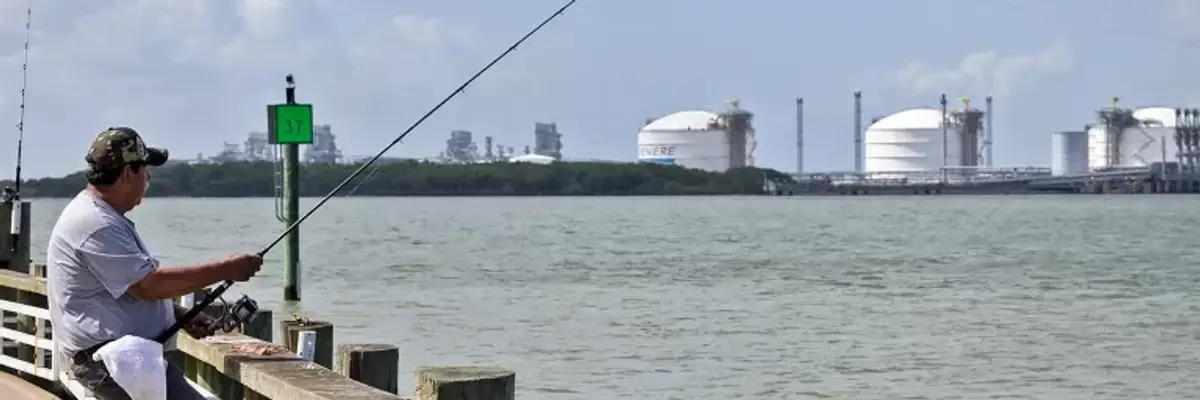
A man fishes near an LNG facility in Sabine Pass, Louisiana.
People and our planet should not bear the brunt of the socioeconomic, human rights, and environmental harms of expanding global LNG trade.
Liquefied natural gas, or LNG, derived from cooling fossil gas to store and transport over long distances, is part of the array of fossil fuels standing in the way of climate progress. Its expansion is derailing efforts to keep global warming below 1.5°C.
Industry likes to call it “transitional” or a “bridge” fuel, but endorsing it that way is detrimental, especially when LNG is neither clean nor low in greenhouse gas (GHG) emissions. Both people and our planet should not bear the brunt of the socioeconomic, human rights, and environmental harms of expanding global LNG trade.
Russia’s invasion of Ukraine contributed significantly to the global LNG industry’s resurgent growth and social license to operate. Under the guise of “energy security,” the United States worked closely with European allies to supply LNG amid sanctions on Russian gas. Yet continued fossil fuel dependency makes us energy insecure, especially when soaring prices of fossil gas are passed on to households.
LNG is neither a secure nor reliable fuel source, particularly for less wealthy countries.
As millions of Europeans are struggling to afford their energy bills, anti-gas campaigners are exposing the fossil gas industry’s culpability in Europe’s cost of living crisis. This is a critical juncture for European leaders to achieve true energy security by focusing on scaling up renewable energy deployment and energy efficiency gains. Decoupling from Russian gas should ultimately signal an end to extractive fossil gas industries in Europe.
When LNG prices surge, energy access in many developing countries is compromised. Last year, the breakdown in the long-term LNG supply from Eni forced Pakistan to purchase LNG at high spot market prices, further jeopardizing its economy. Similarly, Bangladesh had to suspend purchases of LNG, leading to frequent power outages and a decrease in national industrial output. In such volatile market conditions, LNG is neither a secure nor reliable fuel source, particularly for less wealthy countries.
Continued extraction of fossil gas perpetuates energy inequity for large segments of the population, especially for the millions without reliable access to energy. In Africa, extracting fossil LNG and gas is touted as the panacea for energy poverty and development in the region. But 92% of the $103 billion channeled into gas-rich countries—such as Mozambique, Nigeria, and Tanzania—is earmarked for LNG export terminals. Gas extracted from the African continent benefits Europe’s short-lived dash for gas, and not the 600 million people in sub-Saharan Africa who live without access to electricity.
As youth climate activist Vanessa Nakate has said, African countries that are persuaded to pursue fossil gas projects could face economic instability when demand for gas dries up. The message from the Don’t Gas Africa movement is clear: Reversing the systemic energy inequality faced by Africa’s poor and rural communities must be achieved through sustainable development of renewable energy and not through ill-gained LNG profits.
Violence afflicts the global value chain of fossil gas extraction, transport, liquefaction, and shipment of LNG. North American LNG exporters liquefy the region’s abundant fracked methane gas, which has devastating implications for air pollution and water contamination. The LNG Canada project, the country’s first export terminal, has faced significant resistance in its development. Indigenous land defenders from Wet’suwet’en territory have opposed TC Energy’s Coastal GasLink project, the pipeline intended to supply LNG Canada with fossil gas. Hereditary chiefs faced intimidation and militant action against them as they strove to protect their unceded, Indigenous homelands from the devastating impacts of gas expansion.
Many new areas of sacrifice arise in LNG importing and exporting countries, compromising the health of marginalized and disadvantaged communities. LNG terminals release harmful air pollutants—such as volatile organic compounds, nitrogen oxides, sulfur dioxide, carbon monoxide, and particulate matter—that can contribute to increased incidences of respiratory disease, heart disease, and cancer.
Along the U.S. Gulf Coast, many communities are living at the epicenter of U.S. LNG export infrastructure development. Roishetta Ozane, an environmental justice champion, has called for the end to Louisiana’s LNG expansion that is disproportionately compromising the health and livelihoods of communities of color. Meanwhile, in neighboring Mexico, developers are planning to re-export natural gas from the Permian Basin that is imported into the country via pipeline. More than 6 billion cubic feet per day (bcf/d) of LNG projects in development in Mexico would enable U.S. Permian gas to reach demand in Asia faster by bypassing the Panama Canal. Such build-out could result in similar social and community health risks In Mexico. In addition, three of the projects proposed—Saguaro Energía, AMIGO (American Mexican Integrated Gas Operations), and Vista Pacifico—would impact the rich marine biodiversity of the Gulf of California, a UNESCO World Heritage Site.
Alongside the human impacts, we cannot forget the staggering climate and biodiversity threats from LNG expansion. Leaks and intentional releases of methane, the main ingredient in LNG and an extremely potent greenhouse gas, during the extraction and export of LNG can eliminate any climate benefits, even if LNG is used to replace coal in electricity generation. Massive LNG expansions will seriously compromise meeting the 1.5°C Paris agreement goals.
LNG terminals are situated around many biodiversity hot spots and continuous LNG cargo traffic causes significant disturbance to marine life. In Batangas, Philippines, the Verde Island Passage is commonly referred to as the “Amazon of the oceans” because its waters have the highest known concentration of marine life on earth. Eight of the 12 proposed LNG terminals in the Philippines are in Batangas. In the construction of two gas projects, the water quality degraded due to the presence of key pollutants and heavy metals. Simultaneously, the marine ecology in adjacent waters exhibited a reduction in fish biodiversity and abundance.
Developing LNG comes at too high a cost on multiple fronts. LNG should be phased out in tandem with other fossil fuels, paving the way for renewable energy to meet international climate and sustainable development goals. Join NRDC to stand in solidarity with its global partners campaigning to put an end to LNG expansion.
Dear Common Dreams reader, It’s been nearly 30 years since I co-founded Common Dreams with my late wife, Lina Newhouser. We had the radical notion that journalism should serve the public good, not corporate profits. It was clear to us from the outset what it would take to build such a project. No paid advertisements. No corporate sponsors. No millionaire publisher telling us what to think or do. Many people said we wouldn't last a year, but we proved those doubters wrong. Together with a tremendous team of journalists and dedicated staff, we built an independent media outlet free from the constraints of profits and corporate control. Our mission has always been simple: To inform. To inspire. To ignite change for the common good. Building Common Dreams was not easy. Our survival was never guaranteed. When you take on the most powerful forces—Wall Street greed, fossil fuel industry destruction, Big Tech lobbyists, and uber-rich oligarchs who have spent billions upon billions rigging the economy and democracy in their favor—the only bulwark you have is supporters who believe in your work. But here’s the urgent message from me today. It's never been this bad out there. And it's never been this hard to keep us going. At the very moment Common Dreams is most needed, the threats we face are intensifying. We need your support now more than ever. We don't accept corporate advertising and never will. We don't have a paywall because we don't think people should be blocked from critical news based on their ability to pay. Everything we do is funded by the donations of readers like you. When everyone does the little they can afford, we are strong. But if that support retreats or dries up, so do we. Will you donate now to make sure Common Dreams not only survives but thrives? —Craig Brown, Co-founder |
Liquefied natural gas, or LNG, derived from cooling fossil gas to store and transport over long distances, is part of the array of fossil fuels standing in the way of climate progress. Its expansion is derailing efforts to keep global warming below 1.5°C.
Industry likes to call it “transitional” or a “bridge” fuel, but endorsing it that way is detrimental, especially when LNG is neither clean nor low in greenhouse gas (GHG) emissions. Both people and our planet should not bear the brunt of the socioeconomic, human rights, and environmental harms of expanding global LNG trade.
Russia’s invasion of Ukraine contributed significantly to the global LNG industry’s resurgent growth and social license to operate. Under the guise of “energy security,” the United States worked closely with European allies to supply LNG amid sanctions on Russian gas. Yet continued fossil fuel dependency makes us energy insecure, especially when soaring prices of fossil gas are passed on to households.
LNG is neither a secure nor reliable fuel source, particularly for less wealthy countries.
As millions of Europeans are struggling to afford their energy bills, anti-gas campaigners are exposing the fossil gas industry’s culpability in Europe’s cost of living crisis. This is a critical juncture for European leaders to achieve true energy security by focusing on scaling up renewable energy deployment and energy efficiency gains. Decoupling from Russian gas should ultimately signal an end to extractive fossil gas industries in Europe.
When LNG prices surge, energy access in many developing countries is compromised. Last year, the breakdown in the long-term LNG supply from Eni forced Pakistan to purchase LNG at high spot market prices, further jeopardizing its economy. Similarly, Bangladesh had to suspend purchases of LNG, leading to frequent power outages and a decrease in national industrial output. In such volatile market conditions, LNG is neither a secure nor reliable fuel source, particularly for less wealthy countries.
Continued extraction of fossil gas perpetuates energy inequity for large segments of the population, especially for the millions without reliable access to energy. In Africa, extracting fossil LNG and gas is touted as the panacea for energy poverty and development in the region. But 92% of the $103 billion channeled into gas-rich countries—such as Mozambique, Nigeria, and Tanzania—is earmarked for LNG export terminals. Gas extracted from the African continent benefits Europe’s short-lived dash for gas, and not the 600 million people in sub-Saharan Africa who live without access to electricity.
As youth climate activist Vanessa Nakate has said, African countries that are persuaded to pursue fossil gas projects could face economic instability when demand for gas dries up. The message from the Don’t Gas Africa movement is clear: Reversing the systemic energy inequality faced by Africa’s poor and rural communities must be achieved through sustainable development of renewable energy and not through ill-gained LNG profits.
Violence afflicts the global value chain of fossil gas extraction, transport, liquefaction, and shipment of LNG. North American LNG exporters liquefy the region’s abundant fracked methane gas, which has devastating implications for air pollution and water contamination. The LNG Canada project, the country’s first export terminal, has faced significant resistance in its development. Indigenous land defenders from Wet’suwet’en territory have opposed TC Energy’s Coastal GasLink project, the pipeline intended to supply LNG Canada with fossil gas. Hereditary chiefs faced intimidation and militant action against them as they strove to protect their unceded, Indigenous homelands from the devastating impacts of gas expansion.
Many new areas of sacrifice arise in LNG importing and exporting countries, compromising the health of marginalized and disadvantaged communities. LNG terminals release harmful air pollutants—such as volatile organic compounds, nitrogen oxides, sulfur dioxide, carbon monoxide, and particulate matter—that can contribute to increased incidences of respiratory disease, heart disease, and cancer.
Along the U.S. Gulf Coast, many communities are living at the epicenter of U.S. LNG export infrastructure development. Roishetta Ozane, an environmental justice champion, has called for the end to Louisiana’s LNG expansion that is disproportionately compromising the health and livelihoods of communities of color. Meanwhile, in neighboring Mexico, developers are planning to re-export natural gas from the Permian Basin that is imported into the country via pipeline. More than 6 billion cubic feet per day (bcf/d) of LNG projects in development in Mexico would enable U.S. Permian gas to reach demand in Asia faster by bypassing the Panama Canal. Such build-out could result in similar social and community health risks In Mexico. In addition, three of the projects proposed—Saguaro Energía, AMIGO (American Mexican Integrated Gas Operations), and Vista Pacifico—would impact the rich marine biodiversity of the Gulf of California, a UNESCO World Heritage Site.
Alongside the human impacts, we cannot forget the staggering climate and biodiversity threats from LNG expansion. Leaks and intentional releases of methane, the main ingredient in LNG and an extremely potent greenhouse gas, during the extraction and export of LNG can eliminate any climate benefits, even if LNG is used to replace coal in electricity generation. Massive LNG expansions will seriously compromise meeting the 1.5°C Paris agreement goals.
LNG terminals are situated around many biodiversity hot spots and continuous LNG cargo traffic causes significant disturbance to marine life. In Batangas, Philippines, the Verde Island Passage is commonly referred to as the “Amazon of the oceans” because its waters have the highest known concentration of marine life on earth. Eight of the 12 proposed LNG terminals in the Philippines are in Batangas. In the construction of two gas projects, the water quality degraded due to the presence of key pollutants and heavy metals. Simultaneously, the marine ecology in adjacent waters exhibited a reduction in fish biodiversity and abundance.
Developing LNG comes at too high a cost on multiple fronts. LNG should be phased out in tandem with other fossil fuels, paving the way for renewable energy to meet international climate and sustainable development goals. Join NRDC to stand in solidarity with its global partners campaigning to put an end to LNG expansion.
Liquefied natural gas, or LNG, derived from cooling fossil gas to store and transport over long distances, is part of the array of fossil fuels standing in the way of climate progress. Its expansion is derailing efforts to keep global warming below 1.5°C.
Industry likes to call it “transitional” or a “bridge” fuel, but endorsing it that way is detrimental, especially when LNG is neither clean nor low in greenhouse gas (GHG) emissions. Both people and our planet should not bear the brunt of the socioeconomic, human rights, and environmental harms of expanding global LNG trade.
Russia’s invasion of Ukraine contributed significantly to the global LNG industry’s resurgent growth and social license to operate. Under the guise of “energy security,” the United States worked closely with European allies to supply LNG amid sanctions on Russian gas. Yet continued fossil fuel dependency makes us energy insecure, especially when soaring prices of fossil gas are passed on to households.
LNG is neither a secure nor reliable fuel source, particularly for less wealthy countries.
As millions of Europeans are struggling to afford their energy bills, anti-gas campaigners are exposing the fossil gas industry’s culpability in Europe’s cost of living crisis. This is a critical juncture for European leaders to achieve true energy security by focusing on scaling up renewable energy deployment and energy efficiency gains. Decoupling from Russian gas should ultimately signal an end to extractive fossil gas industries in Europe.
When LNG prices surge, energy access in many developing countries is compromised. Last year, the breakdown in the long-term LNG supply from Eni forced Pakistan to purchase LNG at high spot market prices, further jeopardizing its economy. Similarly, Bangladesh had to suspend purchases of LNG, leading to frequent power outages and a decrease in national industrial output. In such volatile market conditions, LNG is neither a secure nor reliable fuel source, particularly for less wealthy countries.
Continued extraction of fossil gas perpetuates energy inequity for large segments of the population, especially for the millions without reliable access to energy. In Africa, extracting fossil LNG and gas is touted as the panacea for energy poverty and development in the region. But 92% of the $103 billion channeled into gas-rich countries—such as Mozambique, Nigeria, and Tanzania—is earmarked for LNG export terminals. Gas extracted from the African continent benefits Europe’s short-lived dash for gas, and not the 600 million people in sub-Saharan Africa who live without access to electricity.
As youth climate activist Vanessa Nakate has said, African countries that are persuaded to pursue fossil gas projects could face economic instability when demand for gas dries up. The message from the Don’t Gas Africa movement is clear: Reversing the systemic energy inequality faced by Africa’s poor and rural communities must be achieved through sustainable development of renewable energy and not through ill-gained LNG profits.
Violence afflicts the global value chain of fossil gas extraction, transport, liquefaction, and shipment of LNG. North American LNG exporters liquefy the region’s abundant fracked methane gas, which has devastating implications for air pollution and water contamination. The LNG Canada project, the country’s first export terminal, has faced significant resistance in its development. Indigenous land defenders from Wet’suwet’en territory have opposed TC Energy’s Coastal GasLink project, the pipeline intended to supply LNG Canada with fossil gas. Hereditary chiefs faced intimidation and militant action against them as they strove to protect their unceded, Indigenous homelands from the devastating impacts of gas expansion.
Many new areas of sacrifice arise in LNG importing and exporting countries, compromising the health of marginalized and disadvantaged communities. LNG terminals release harmful air pollutants—such as volatile organic compounds, nitrogen oxides, sulfur dioxide, carbon monoxide, and particulate matter—that can contribute to increased incidences of respiratory disease, heart disease, and cancer.
Along the U.S. Gulf Coast, many communities are living at the epicenter of U.S. LNG export infrastructure development. Roishetta Ozane, an environmental justice champion, has called for the end to Louisiana’s LNG expansion that is disproportionately compromising the health and livelihoods of communities of color. Meanwhile, in neighboring Mexico, developers are planning to re-export natural gas from the Permian Basin that is imported into the country via pipeline. More than 6 billion cubic feet per day (bcf/d) of LNG projects in development in Mexico would enable U.S. Permian gas to reach demand in Asia faster by bypassing the Panama Canal. Such build-out could result in similar social and community health risks In Mexico. In addition, three of the projects proposed—Saguaro Energía, AMIGO (American Mexican Integrated Gas Operations), and Vista Pacifico—would impact the rich marine biodiversity of the Gulf of California, a UNESCO World Heritage Site.
Alongside the human impacts, we cannot forget the staggering climate and biodiversity threats from LNG expansion. Leaks and intentional releases of methane, the main ingredient in LNG and an extremely potent greenhouse gas, during the extraction and export of LNG can eliminate any climate benefits, even if LNG is used to replace coal in electricity generation. Massive LNG expansions will seriously compromise meeting the 1.5°C Paris agreement goals.
LNG terminals are situated around many biodiversity hot spots and continuous LNG cargo traffic causes significant disturbance to marine life. In Batangas, Philippines, the Verde Island Passage is commonly referred to as the “Amazon of the oceans” because its waters have the highest known concentration of marine life on earth. Eight of the 12 proposed LNG terminals in the Philippines are in Batangas. In the construction of two gas projects, the water quality degraded due to the presence of key pollutants and heavy metals. Simultaneously, the marine ecology in adjacent waters exhibited a reduction in fish biodiversity and abundance.
Developing LNG comes at too high a cost on multiple fronts. LNG should be phased out in tandem with other fossil fuels, paving the way for renewable energy to meet international climate and sustainable development goals. Join NRDC to stand in solidarity with its global partners campaigning to put an end to LNG expansion.