SUBSCRIBE TO OUR FREE NEWSLETTER
Daily news & progressive opinion—funded by the people, not the corporations—delivered straight to your inbox.
5
#000000
#FFFFFF
To donate by check, phone, or other method, see our More Ways to Give page.
Daily news & progressive opinion—funded by the people, not the corporations—delivered straight to your inbox.
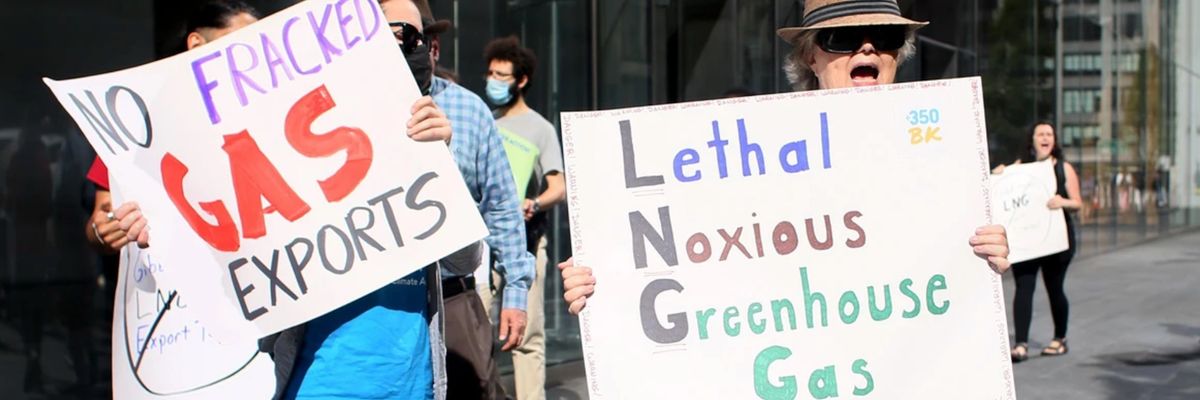
Activists protest against fracked gas exports on June 15, 2022 in New York City.
"Exports of LNG have created higher prices for U.S. consumers, leaving them vulnerable to massive price spikes like what happened this weekend," said one expert.
With millions of Americans suffering sub-zero temperatures under a deadly Arctic blast, a leading consumer advocate on Tuesday attributed the fivefold increase in the U.S. benchmark price of natural gas to the recent "explosion in LNG exports."
As the National Weather Service warns of continued near-record temperatures and wind chills affecting over 100 million people—mainly in the Midwest and Rocky Mountain regions and as far south as Texas—plunging mercury means soaring demand for fuel across much of the continental U.S.
This, in turn, sent liquefied natural gas prices skyward, with the spot price of gas from Henry Hub in Louisiana—the official delivery location for futures contracts on the New York Mercantile Exchange—soaring 400%, according to Bloomberg.
"The explosion in LNG exports since 2016 has resulted in a far more fragile and volatile balance between supply and demand."
But the consumer advocacy group Public Citizen says there's another explanation for sky-high LNG prices besides the deep freeze.
"The explosion in LNG exports since 2016 has resulted in a far more fragile and volatile balance between supply and demand," said Tyson Slocum, head of the group's energy program. "Exports of LNG have created higher prices for U.S. consumers, leaving them vulnerable to massive price spikes like what happened this weekend. U.S. gas demand hit a record high over the weekend, led by record exports."
Slocum added that the U.S. Energy Department "has failed to implement procedures restricting gas exports during extreme weather events, or proactively establish seasonal standards to curtail exports in advance of pending extreme weather events."
The Biden administration has presided over what climate campaigners have called a "staggering" LNG expansion, including Venture Global's Calcasieu Pass 2 export terminal in Cameron Parish, Louisiana and more than a dozen other projects that, if all completed, would make U.S. exported LNG emissions higher than all of Europe's combined greenhouse gas footprint, according to climate campaigner Bill McKibben.
McKibben and others have called on President Joe Biden to halt LNG exports.
"Nearly 90 years ago, Congress mandated that most natural gas could only be exported if the government first determined that doing so was 'consistent with the public interest,'" noted Slocum. "The Biden administration's Energy Department is in charge of enforcing this law, and has presided over unprecedented volumes of natural gas exports, exacerbating higher prices during winter storms."
"The Biden administration must follow the directive mandated by Congress and reassess its methodology for authorizing LNG exports, and establish proactive standards to curtail exports in the event of emergencies and seasonal demand surges," Slocum added.
Under mounting pressure to keep the president's promise to transition away from fossil fuels, the Biden administration is
reportedly considering a review of its LNG export approval process, with an eye toward whether it is properly accounting for their climate impacts.
While supporters of LNG claim it's one of the safest fossil fuels to produce and transport, critics point to the numerous explosions and fires at gas facilities in recent years, as well as the worsening climate emergency caused and exacerbated by fossil fuel extraction and use.
Dear Common Dreams reader, It’s been nearly 30 years since I co-founded Common Dreams with my late wife, Lina Newhouser. We had the radical notion that journalism should serve the public good, not corporate profits. It was clear to us from the outset what it would take to build such a project. No paid advertisements. No corporate sponsors. No millionaire publisher telling us what to think or do. Many people said we wouldn't last a year, but we proved those doubters wrong. Together with a tremendous team of journalists and dedicated staff, we built an independent media outlet free from the constraints of profits and corporate control. Our mission has always been simple: To inform. To inspire. To ignite change for the common good. Building Common Dreams was not easy. Our survival was never guaranteed. When you take on the most powerful forces—Wall Street greed, fossil fuel industry destruction, Big Tech lobbyists, and uber-rich oligarchs who have spent billions upon billions rigging the economy and democracy in their favor—the only bulwark you have is supporters who believe in your work. But here’s the urgent message from me today. It's never been this bad out there. And it's never been this hard to keep us going. At the very moment Common Dreams is most needed, the threats we face are intensifying. We need your support now more than ever. We don't accept corporate advertising and never will. We don't have a paywall because we don't think people should be blocked from critical news based on their ability to pay. Everything we do is funded by the donations of readers like you. When everyone does the little they can afford, we are strong. But if that support retreats or dries up, so do we. Will you donate now to make sure Common Dreams not only survives but thrives? —Craig Brown, Co-founder |
With millions of Americans suffering sub-zero temperatures under a deadly Arctic blast, a leading consumer advocate on Tuesday attributed the fivefold increase in the U.S. benchmark price of natural gas to the recent "explosion in LNG exports."
As the National Weather Service warns of continued near-record temperatures and wind chills affecting over 100 million people—mainly in the Midwest and Rocky Mountain regions and as far south as Texas—plunging mercury means soaring demand for fuel across much of the continental U.S.
This, in turn, sent liquefied natural gas prices skyward, with the spot price of gas from Henry Hub in Louisiana—the official delivery location for futures contracts on the New York Mercantile Exchange—soaring 400%, according to Bloomberg.
"The explosion in LNG exports since 2016 has resulted in a far more fragile and volatile balance between supply and demand."
But the consumer advocacy group Public Citizen says there's another explanation for sky-high LNG prices besides the deep freeze.
"The explosion in LNG exports since 2016 has resulted in a far more fragile and volatile balance between supply and demand," said Tyson Slocum, head of the group's energy program. "Exports of LNG have created higher prices for U.S. consumers, leaving them vulnerable to massive price spikes like what happened this weekend. U.S. gas demand hit a record high over the weekend, led by record exports."
Slocum added that the U.S. Energy Department "has failed to implement procedures restricting gas exports during extreme weather events, or proactively establish seasonal standards to curtail exports in advance of pending extreme weather events."
The Biden administration has presided over what climate campaigners have called a "staggering" LNG expansion, including Venture Global's Calcasieu Pass 2 export terminal in Cameron Parish, Louisiana and more than a dozen other projects that, if all completed, would make U.S. exported LNG emissions higher than all of Europe's combined greenhouse gas footprint, according to climate campaigner Bill McKibben.
McKibben and others have called on President Joe Biden to halt LNG exports.
"Nearly 90 years ago, Congress mandated that most natural gas could only be exported if the government first determined that doing so was 'consistent with the public interest,'" noted Slocum. "The Biden administration's Energy Department is in charge of enforcing this law, and has presided over unprecedented volumes of natural gas exports, exacerbating higher prices during winter storms."
"The Biden administration must follow the directive mandated by Congress and reassess its methodology for authorizing LNG exports, and establish proactive standards to curtail exports in the event of emergencies and seasonal demand surges," Slocum added.
Under mounting pressure to keep the president's promise to transition away from fossil fuels, the Biden administration is
reportedly considering a review of its LNG export approval process, with an eye toward whether it is properly accounting for their climate impacts.
While supporters of LNG claim it's one of the safest fossil fuels to produce and transport, critics point to the numerous explosions and fires at gas facilities in recent years, as well as the worsening climate emergency caused and exacerbated by fossil fuel extraction and use.
With millions of Americans suffering sub-zero temperatures under a deadly Arctic blast, a leading consumer advocate on Tuesday attributed the fivefold increase in the U.S. benchmark price of natural gas to the recent "explosion in LNG exports."
As the National Weather Service warns of continued near-record temperatures and wind chills affecting over 100 million people—mainly in the Midwest and Rocky Mountain regions and as far south as Texas—plunging mercury means soaring demand for fuel across much of the continental U.S.
This, in turn, sent liquefied natural gas prices skyward, with the spot price of gas from Henry Hub in Louisiana—the official delivery location for futures contracts on the New York Mercantile Exchange—soaring 400%, according to Bloomberg.
"The explosion in LNG exports since 2016 has resulted in a far more fragile and volatile balance between supply and demand."
But the consumer advocacy group Public Citizen says there's another explanation for sky-high LNG prices besides the deep freeze.
"The explosion in LNG exports since 2016 has resulted in a far more fragile and volatile balance between supply and demand," said Tyson Slocum, head of the group's energy program. "Exports of LNG have created higher prices for U.S. consumers, leaving them vulnerable to massive price spikes like what happened this weekend. U.S. gas demand hit a record high over the weekend, led by record exports."
Slocum added that the U.S. Energy Department "has failed to implement procedures restricting gas exports during extreme weather events, or proactively establish seasonal standards to curtail exports in advance of pending extreme weather events."
The Biden administration has presided over what climate campaigners have called a "staggering" LNG expansion, including Venture Global's Calcasieu Pass 2 export terminal in Cameron Parish, Louisiana and more than a dozen other projects that, if all completed, would make U.S. exported LNG emissions higher than all of Europe's combined greenhouse gas footprint, according to climate campaigner Bill McKibben.
McKibben and others have called on President Joe Biden to halt LNG exports.
"Nearly 90 years ago, Congress mandated that most natural gas could only be exported if the government first determined that doing so was 'consistent with the public interest,'" noted Slocum. "The Biden administration's Energy Department is in charge of enforcing this law, and has presided over unprecedented volumes of natural gas exports, exacerbating higher prices during winter storms."
"The Biden administration must follow the directive mandated by Congress and reassess its methodology for authorizing LNG exports, and establish proactive standards to curtail exports in the event of emergencies and seasonal demand surges," Slocum added.
Under mounting pressure to keep the president's promise to transition away from fossil fuels, the Biden administration is
reportedly considering a review of its LNG export approval process, with an eye toward whether it is properly accounting for their climate impacts.
While supporters of LNG claim it's one of the safest fossil fuels to produce and transport, critics point to the numerous explosions and fires at gas facilities in recent years, as well as the worsening climate emergency caused and exacerbated by fossil fuel extraction and use.