

SUBSCRIBE TO OUR FREE NEWSLETTER
Daily news & progressive opinion—funded by the people, not the corporations—delivered straight to your inbox.
5
#000000
#FFFFFF
To donate by check, phone, or other method, see our More Ways to Give page.
Daily news & progressive opinion—funded by the people, not the corporations—delivered straight to your inbox.
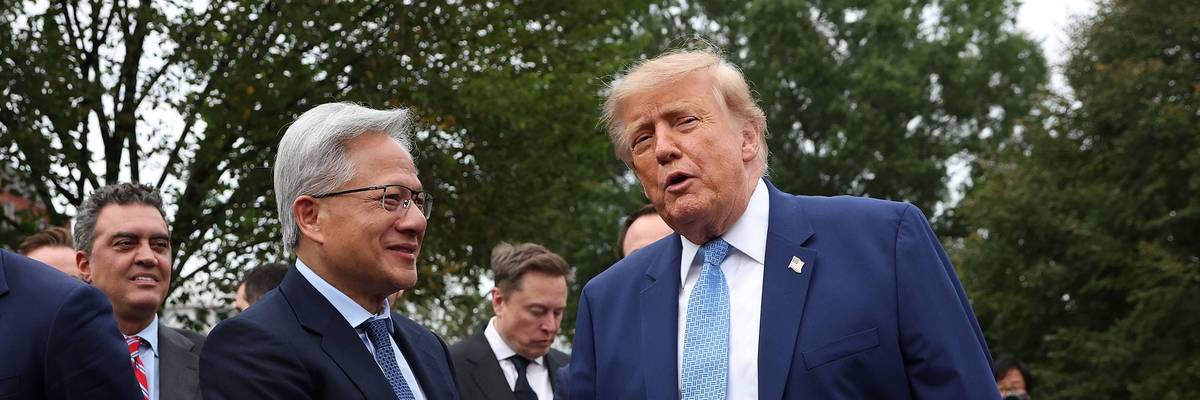
US President Donald Trump greeted then-Nvidia CEO Jensen Huang outside the West Wing of the White House on September 29, 2026 in Washington, DC.
"Individual stock ownership by federal officials across Congress, the executive branch, and the judiciary is fundamentally incompatible with the public interest," said the Revolving Door Project.
A government watchdog group on Tuesday called for a sweeping ban on stock ownership by federal officials—including members of Congress and the executive branch—amid revelations that President Donald Trump's investment accounts traded as much as $97.5 million worth of Nvidia shares before the AI chip giant's CEO became engulfed in scandal.
“The breadth of the fallout from the Nvidia scandal illustrates why individual stock ownership by federal officials across Congress, the executive branch, and the judiciary is fundamentally incompatible with the public interest," said Jeff Hauser, executive director of the Revolving Door Project. "A company at one point only of interest to gamers has suddenly become the centerpiece of the dominant sector of the world economy—and Nvidia’s scandal demands all of the government ‘take stock’ of what comes next."
A CNBC analysis of Trump's financial disclosures shows that, during his second White House term, the president's accounts "have bought or sold Nvidia shares at least 103 times—transactions worth a combined $27 million to $97.5 million." Trump, who has refused to divest his stock holdings, has insisted that he doesn't control his asset portfolio, which he says is managed by his children and third-party organizations.
Scrutiny of Trump's Nvidia holdings intensified after Jensen Huang, a close ally of the White House and donor to Trump vanity projects, resigned as the company's chief executive after admitting to cheating on his wife, sending Nvidia's stock price tumbling. One of Huang's extramarital affairs was with a woman flagged by US intelligence agencies for potential ties to the Chinese government, though allegations that she was an agent of espionage have not been proven.
Trump has defended Huang and said he "would not mind" if the former CEO returned to his role, raising further questions about the president's relationship with the executive and the AI chip giant.
Hauser said Tuesday that "all individual stock ownership creates inherent conflicts of interest," adding that "public officials’ stock holdings should be limited to broadly diversified index funds instead.”
"In addition to the president’s millions invested in the company, Nvidia stock appears in the financial disclosures of at least 379 other Trump administration officials," said Hauser. "Whatever trust Americans have in government officials to act in the public interest goes out the window when so many public servants hold financial stakes in the very companies they oversee.”
Congressional Democrats are expected to pursue a stock trading ban once they take control of the House and Senate in January. Bloomberg reported last week that it wasn’t immediately clear whether Democrats "would include the president in the stock trading ban, which could provoke opposition from Republican lawmakers or a presidential veto since Donald Trump has actively traded stocks and chafed at restrictions on his financial dealings while in office."
Earlier this year, the Republican-controlled US House passed the Stop Insider Trading Act, a Republican bill packed with loopholes that would allow lawmakers to continue holding and selling stocks. The Senate rejected the measure in September.
Many Democrats have backed the Halting Ownership and Non-Ethical Stock Transactions (HONEST) Act, bipartisan legislation that would bar "members of Congress, the president, the vice president, and their spouses and dependent children from holding, buying, or selling stocks."
In July, Sen. Bernie Moreno (R-Ohio) blocked a Democratic attempt to pass the HONEST Act via unanimous consent.
This country and this world are at a monumental crossroads. US voters have an opportunity to beat back the forces of fascism and confront the billionaires who are rigging the economy, our media system, and our democracy, making it increasingly impossible for ordinary people to get by. We’re not just talking about the election. We’re talking about what must be done once these fascist elements are vanquished from power. We need a bolder set of solutions than what either major party has so far been willing to offer and a working-class movement ready to fight like hell for it. Trump didn't emerge from nowhere. The conditions that fueled MAGA authoritarianism were created by decades of radical neoliberal economic policies and a corrupt political system dominated by corporate interests. They slashed taxes on the super-rich, promising that the benefits would trickle down. They said giveaways to the corporate titans would make life more affordable for the rest of us. It was all bullshit. And when a bitter, betrayed populace searches for someone to blame, right-wing demagogues have little trouble finding scapegoats. People know when they're being lied to, but you won't hear any of this from the corporate media. Only independent journalism—powered and funded by people who believe in building a better world—can deliver truly trustworthy daily news. If you share our vision, please contribute whatever you can to sustain our work. |
A government watchdog group on Tuesday called for a sweeping ban on stock ownership by federal officials—including members of Congress and the executive branch—amid revelations that President Donald Trump's investment accounts traded as much as $97.5 million worth of Nvidia shares before the AI chip giant's CEO became engulfed in scandal.
“The breadth of the fallout from the Nvidia scandal illustrates why individual stock ownership by federal officials across Congress, the executive branch, and the judiciary is fundamentally incompatible with the public interest," said Jeff Hauser, executive director of the Revolving Door Project. "A company at one point only of interest to gamers has suddenly become the centerpiece of the dominant sector of the world economy—and Nvidia’s scandal demands all of the government ‘take stock’ of what comes next."
A CNBC analysis of Trump's financial disclosures shows that, during his second White House term, the president's accounts "have bought or sold Nvidia shares at least 103 times—transactions worth a combined $27 million to $97.5 million." Trump, who has refused to divest his stock holdings, has insisted that he doesn't control his asset portfolio, which he says is managed by his children and third-party organizations.
Scrutiny of Trump's Nvidia holdings intensified after Jensen Huang, a close ally of the White House and donor to Trump vanity projects, resigned as the company's chief executive after admitting to cheating on his wife, sending Nvidia's stock price tumbling. One of Huang's extramarital affairs was with a woman flagged by US intelligence agencies for potential ties to the Chinese government, though allegations that she was an agent of espionage have not been proven.
Trump has defended Huang and said he "would not mind" if the former CEO returned to his role, raising further questions about the president's relationship with the executive and the AI chip giant.
Hauser said Tuesday that "all individual stock ownership creates inherent conflicts of interest," adding that "public officials’ stock holdings should be limited to broadly diversified index funds instead.”
"In addition to the president’s millions invested in the company, Nvidia stock appears in the financial disclosures of at least 379 other Trump administration officials," said Hauser. "Whatever trust Americans have in government officials to act in the public interest goes out the window when so many public servants hold financial stakes in the very companies they oversee.”
Congressional Democrats are expected to pursue a stock trading ban once they take control of the House and Senate in January. Bloomberg reported last week that it wasn’t immediately clear whether Democrats "would include the president in the stock trading ban, which could provoke opposition from Republican lawmakers or a presidential veto since Donald Trump has actively traded stocks and chafed at restrictions on his financial dealings while in office."
Earlier this year, the Republican-controlled US House passed the Stop Insider Trading Act, a Republican bill packed with loopholes that would allow lawmakers to continue holding and selling stocks. The Senate rejected the measure in September.
Many Democrats have backed the Halting Ownership and Non-Ethical Stock Transactions (HONEST) Act, bipartisan legislation that would bar "members of Congress, the president, the vice president, and their spouses and dependent children from holding, buying, or selling stocks."
In July, Sen. Bernie Moreno (R-Ohio) blocked a Democratic attempt to pass the HONEST Act via unanimous consent.

