SUBSCRIBE TO OUR FREE NEWSLETTER
Daily news & progressive opinion—funded by the people, not the corporations—delivered straight to your inbox.
5
#000000
#FFFFFF
To donate by check, phone, or other method, see our More Ways to Give page.
In his recent social media diatribes, Donald Trump has complained that our allies are ungrateful for the war he has initiated against Iran. He is angered that they aren’t anxious to send in their military forces to win a war that he claims is already won. Trump also doesn’t seem to think it matters that he never consulted, or even warned, any US allies, with the notable exception of Israel.
To anyone not in the Trump cult, these complaints qualify as batshit crazy. Trump’s war is a massive whack to economies across the world. These countries are not grateful for an economic hit that is equivalent to a massive weather disaster or serious pandemic.
How bad the economic hit ends up being depends on both how long the war continues and the lasting damage it does to physical facilities. But a cheap and easy calculation is to look at how much the rise in oil prices costs countries relative to the size of their economies.
This is the picture based on the assumption that oil prices have risen $40 a barrel from the pre-war level and remain there for a full year. I don’t have a crystal ball that tells me whether prices will stay at this level. There are many analysts arguing that they could go considerably higher. And if the Hormuz Straits are opened soon, whether by military action or a peace agreement, they will presumably move most of the way back to their pre-war level. But a $40 rise should be a reasonable starting point.
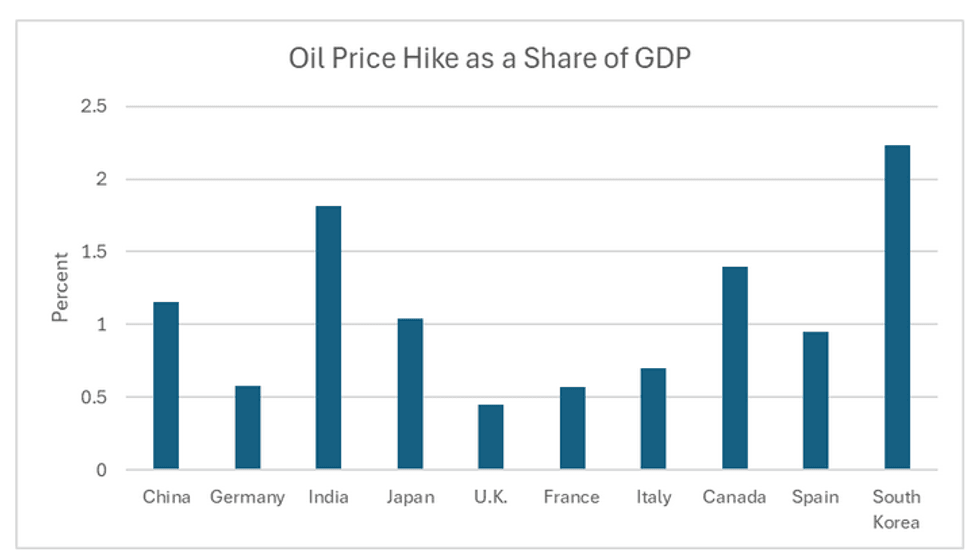
As I noted previously, the countries of Asia look to be the hardest hit from these price increases. South Korea would be spending an additional amount equal to 2.2 percent of GDP for its oil, followed by India at 1.8 percent, and Canada at 1.4 percent. For a benchmark, 1.5 percent of GDP in the United States would be around $3,700 per household.
This measure of the economic hit is far from complete. In addition to higher oil prices, the price of natural gas has doubled in Europe and Asia. Prices of other exports from the Gulf region, notably fertilizers, have also soared. In addition, the rest of the world has at least temporarily lost a major market for its exports.
There are also some positive entries. For countries outside the Gulf region that are major oil exporters, notably Canada, Brazil, and Mexico, the jump in oil prices is a windfall. But the hit in terms of higher oil prices can give a good first approximation of the costs our allies are bearing as a result of the war for which Trump says they should be grateful.
The Trumpian argument is the Iranian regime was dangerous, and everyone should be glad to see it weakened, if not actually overthrown. There are few who would look to Iran as any sort of model country. It has killed and imprisoned tens of thousands of its own people. And it did build up a considerable military force, making itself at least potentially a threat to the rest of the world.
But the Iranian regime hardly has a monopoly in these categories. If we’re looking around for repressive militaristic regimes, North Korea would almost certainly top everyone’s list. And we don’t have to worry that North Korea will develop nuclear weapons and ballistic missiles. It already has them. There hasn’t been any talk of attacking North Korea. In fact, Trump still boasts about his “love letter” from its leader, Kim Jung Un.
Similarly, Saudi Arabia sits on the other side of the Persian Gulf. It is still ruled by a feudal monarchy that has no pretense of being democratic. It routinely arrests, tortures, and kills dissidents, and explicitly discriminates against women. Saudi Arabia also has developed substantial military capabilities. And it hasn’t been shy about taking its war against dissidents overseas, notably killing Jamal Khashoggi, a journalist who was a US resident, in its embassy in Turkey. Trump doesn’t seem to be planning any wars against Saudi Arabia. In fact, its de facto ruler, Mohammed bin Salman, is a friend of Trump’s and family business partner.
There is no shortage of countries with undemocratic governments that Trump has not felt the need to attack. It is also worth mentioning that there is some relevant recent history here. Few would argue that Saddam Hussein was a good guy. But it would be hard to argue that the Iraqi people or the world was better off by having him deposed.
The same would be true for the Taliban in Afghanistan. In that case, after 20 years of war and occupation, the country is back to where it was before the invasion in 2001. Similarly, Moammar Quadafy was a brutal dictator, but his overthrow in 2011 led to a civil war in Libya that continues to the present. It would be hard to contend that either the world or the Libyan people are better off from this military intervention.
The bottom line here is that Donald Trump somehow thinks that US allies in Europe and Asia should be thankful to him for starting a war that is tremendously costly to them and provides them little obvious benefit. It’s like someone burning down your house and then expecting you to be thankful because they thought it was ugly. That may make sense to Donald Trump, but not to anyone else in the world.
In his recent social media diatribes, Donald Trump has complained that our allies are ungrateful for the war he has initiated against Iran. He is angered that they aren’t anxious to send in their military forces to win a war that he claims is already won. Trump also doesn’t seem to think it matters that he never consulted, or even warned, any US allies, with the notable exception of Israel.
To anyone not in the Trump cult, these complaints qualify as batshit crazy. Trump’s war is a massive whack to economies across the world. These countries are not grateful for an economic hit that is equivalent to a massive weather disaster or serious pandemic.
How bad the economic hit ends up being depends on both how long the war continues and the lasting damage it does to physical facilities. But a cheap and easy calculation is to look at how much the rise in oil prices costs countries relative to the size of their economies.
This is the picture based on the assumption that oil prices have risen $40 a barrel from the pre-war level and remain there for a full year. I don’t have a crystal ball that tells me whether prices will stay at this level. There are many analysts arguing that they could go considerably higher. And if the Hormuz Straits are opened soon, whether by military action or a peace agreement, they will presumably move most of the way back to their pre-war level. But a $40 rise should be a reasonable starting point.
As I noted previously, the countries of Asia look to be the hardest hit from these price increases. South Korea would be spending an additional amount equal to 2.2 percent of GDP for its oil, followed by India at 1.8 percent, and Canada at 1.4 percent. For a benchmark, 1.5 percent of GDP in the United States would be around $3,700 per household.
This measure of the economic hit is far from complete. In addition to higher oil prices, the price of natural gas has doubled in Europe and Asia. Prices of other exports from the Gulf region, notably fertilizers, have also soared. In addition, the rest of the world has at least temporarily lost a major market for its exports.
There are also some positive entries. For countries outside the Gulf region that are major oil exporters, notably Canada, Brazil, and Mexico, the jump in oil prices is a windfall. But the hit in terms of higher oil prices can give a good first approximation of the costs our allies are bearing as a result of the war for which Trump says they should be grateful.
The Trumpian argument is the Iranian regime was dangerous, and everyone should be glad to see it weakened, if not actually overthrown. There are few who would look to Iran as any sort of model country. It has killed and imprisoned tens of thousands of its own people. And it did build up a considerable military force, making itself at least potentially a threat to the rest of the world.
But the Iranian regime hardly has a monopoly in these categories. If we’re looking around for repressive militaristic regimes, North Korea would almost certainly top everyone’s list. And we don’t have to worry that North Korea will develop nuclear weapons and ballistic missiles. It already has them. There hasn’t been any talk of attacking North Korea. In fact, Trump still boasts about his “love letter” from its leader, Kim Jung Un.
Similarly, Saudi Arabia sits on the other side of the Persian Gulf. It is still ruled by a feudal monarchy that has no pretense of being democratic. It routinely arrests, tortures, and kills dissidents, and explicitly discriminates against women. Saudi Arabia also has developed substantial military capabilities. And it hasn’t been shy about taking its war against dissidents overseas, notably killing Jamal Khashoggi, a journalist who was a US resident, in its embassy in Turkey. Trump doesn’t seem to be planning any wars against Saudi Arabia. In fact, its de facto ruler, Mohammed bin Salman, is a friend of Trump’s and family business partner.
There is no shortage of countries with undemocratic governments that Trump has not felt the need to attack. It is also worth mentioning that there is some relevant recent history here. Few would argue that Saddam Hussein was a good guy. But it would be hard to argue that the Iraqi people or the world was better off by having him deposed.
The same would be true for the Taliban in Afghanistan. In that case, after 20 years of war and occupation, the country is back to where it was before the invasion in 2001. Similarly, Moammar Quadafy was a brutal dictator, but his overthrow in 2011 led to a civil war in Libya that continues to the present. It would be hard to contend that either the world or the Libyan people are better off from this military intervention.
The bottom line here is that Donald Trump somehow thinks that US allies in Europe and Asia should be thankful to him for starting a war that is tremendously costly to them and provides them little obvious benefit. It’s like someone burning down your house and then expecting you to be thankful because they thought it was ugly. That may make sense to Donald Trump, but not to anyone else in the world.
In his recent social media diatribes, Donald Trump has complained that our allies are ungrateful for the war he has initiated against Iran. He is angered that they aren’t anxious to send in their military forces to win a war that he claims is already won. Trump also doesn’t seem to think it matters that he never consulted, or even warned, any US allies, with the notable exception of Israel.
To anyone not in the Trump cult, these complaints qualify as batshit crazy. Trump’s war is a massive whack to economies across the world. These countries are not grateful for an economic hit that is equivalent to a massive weather disaster or serious pandemic.
How bad the economic hit ends up being depends on both how long the war continues and the lasting damage it does to physical facilities. But a cheap and easy calculation is to look at how much the rise in oil prices costs countries relative to the size of their economies.
This is the picture based on the assumption that oil prices have risen $40 a barrel from the pre-war level and remain there for a full year. I don’t have a crystal ball that tells me whether prices will stay at this level. There are many analysts arguing that they could go considerably higher. And if the Hormuz Straits are opened soon, whether by military action or a peace agreement, they will presumably move most of the way back to their pre-war level. But a $40 rise should be a reasonable starting point.
As I noted previously, the countries of Asia look to be the hardest hit from these price increases. South Korea would be spending an additional amount equal to 2.2 percent of GDP for its oil, followed by India at 1.8 percent, and Canada at 1.4 percent. For a benchmark, 1.5 percent of GDP in the United States would be around $3,700 per household.
This measure of the economic hit is far from complete. In addition to higher oil prices, the price of natural gas has doubled in Europe and Asia. Prices of other exports from the Gulf region, notably fertilizers, have also soared. In addition, the rest of the world has at least temporarily lost a major market for its exports.
There are also some positive entries. For countries outside the Gulf region that are major oil exporters, notably Canada, Brazil, and Mexico, the jump in oil prices is a windfall. But the hit in terms of higher oil prices can give a good first approximation of the costs our allies are bearing as a result of the war for which Trump says they should be grateful.
The Trumpian argument is the Iranian regime was dangerous, and everyone should be glad to see it weakened, if not actually overthrown. There are few who would look to Iran as any sort of model country. It has killed and imprisoned tens of thousands of its own people. And it did build up a considerable military force, making itself at least potentially a threat to the rest of the world.
But the Iranian regime hardly has a monopoly in these categories. If we’re looking around for repressive militaristic regimes, North Korea would almost certainly top everyone’s list. And we don’t have to worry that North Korea will develop nuclear weapons and ballistic missiles. It already has them. There hasn’t been any talk of attacking North Korea. In fact, Trump still boasts about his “love letter” from its leader, Kim Jung Un.
Similarly, Saudi Arabia sits on the other side of the Persian Gulf. It is still ruled by a feudal monarchy that has no pretense of being democratic. It routinely arrests, tortures, and kills dissidents, and explicitly discriminates against women. Saudi Arabia also has developed substantial military capabilities. And it hasn’t been shy about taking its war against dissidents overseas, notably killing Jamal Khashoggi, a journalist who was a US resident, in its embassy in Turkey. Trump doesn’t seem to be planning any wars against Saudi Arabia. In fact, its de facto ruler, Mohammed bin Salman, is a friend of Trump’s and family business partner.
There is no shortage of countries with undemocratic governments that Trump has not felt the need to attack. It is also worth mentioning that there is some relevant recent history here. Few would argue that Saddam Hussein was a good guy. But it would be hard to argue that the Iraqi people or the world was better off by having him deposed.
The same would be true for the Taliban in Afghanistan. In that case, after 20 years of war and occupation, the country is back to where it was before the invasion in 2001. Similarly, Moammar Quadafy was a brutal dictator, but his overthrow in 2011 led to a civil war in Libya that continues to the present. It would be hard to contend that either the world or the Libyan people are better off from this military intervention.
The bottom line here is that Donald Trump somehow thinks that US allies in Europe and Asia should be thankful to him for starting a war that is tremendously costly to them and provides them little obvious benefit. It’s like someone burning down your house and then expecting you to be thankful because they thought it was ugly. That may make sense to Donald Trump, but not to anyone else in the world.